As Ethereum, Solana, Cosmos, Avalanche, and a growing number of Layer 2 networks rapidly evolve, Web3 is entering an era where multiple chains coexist. Each blockchain has its own technical architecture, asset standards, and execution environment, making secure, efficient, and cost-effective interoperability a foundational challenge for the industry’s expansion.
From an industry perspective, cross-chain technology is shifting from basic asset bridging toward advanced interoperability networks. Protocols like Squid, LayerZero, and Wormhole each pursue solutions in cross-chain routing, message passing, and ecosystem connectivity, collectively driving Web3’s transition from isolated chains to open, multi-chain networks.
What Is a Cross-Chain Protocol
A cross-chain protocol is a foundational technology that connects independent blockchain networks, enabling them to transmit information, transfer assets, and support more sophisticated cross-chain application interactions.
Early blockchain ecosystems focused on single-chain development. For instance, Ethereum’s smart contracts fostered DeFi and NFT ecosystems; Bitcoin served primarily as a store of value; Solana’s high-performance design powered large-scale applications; and Cosmos built a multi-chain network through its application chain model. However, as the number of blockchains grows, no single chain can meet all applications’ needs for performance, cost, security, and functionality—making multi-chain ecosystems the natural evolution.
The multi-chain landscape introduces new challenges: blockchains cannot communicate natively. Each chain has its own consensus mechanism, data structure, virtual machine, and asset standards. For example, ERC-20 tokens on Ethereum aren’t natively recognized by Solana or Cosmos. Users who want to access applications in other ecosystems typically need to use cross-chain bridges, swap assets, and switch networks—often in multiple steps.
Cross-chain protocols aim to break down these barriers.
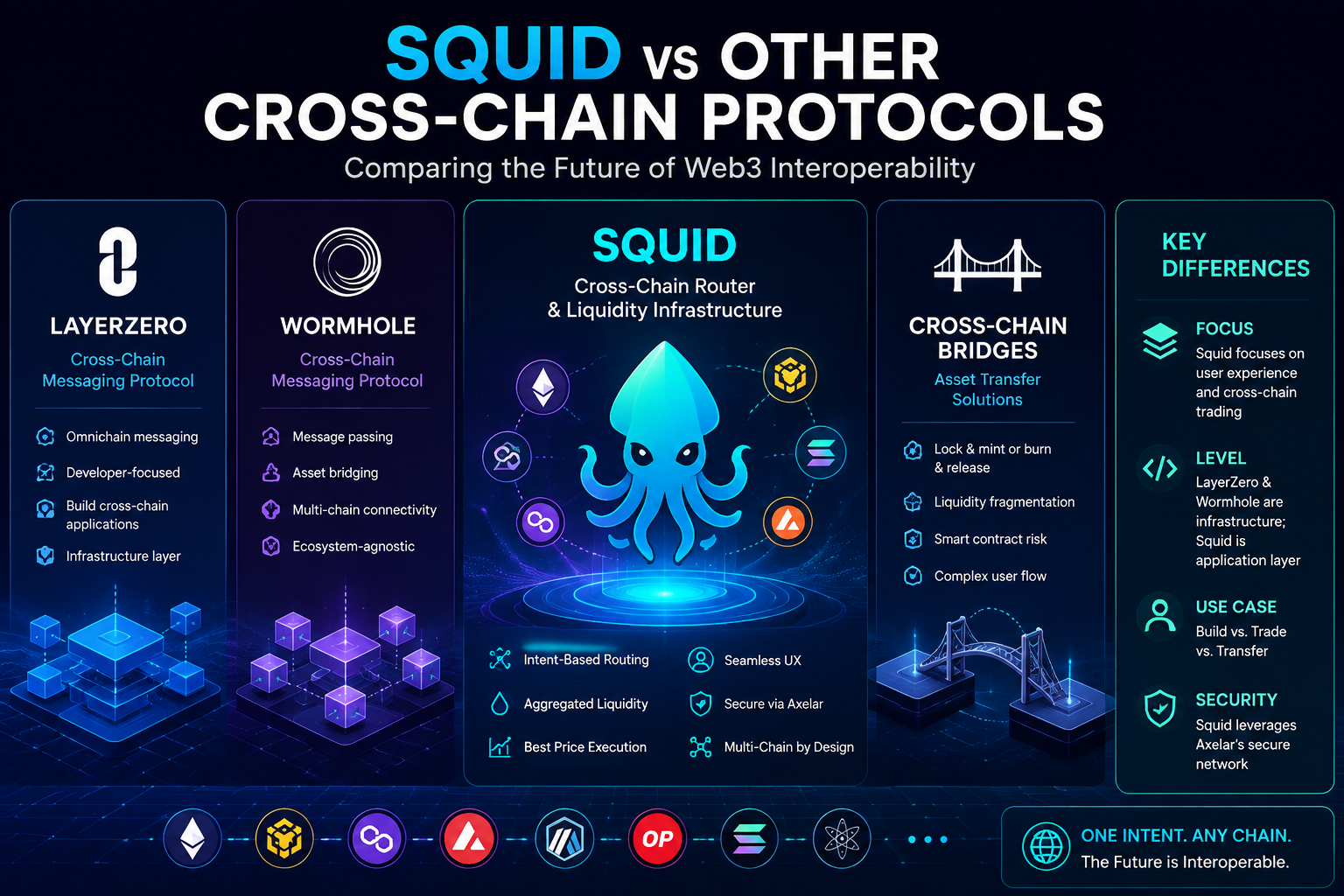
Technically, today’s cross-chain solutions fall into three main categories. The first is cross-chain messaging protocols—like LayerZero and Wormhole—which focus on information transfer between blockchains and enable cross-chain smart contract calls. The second is traditional cross-chain bridges, whose core function is moving assets from one chain to another. The third is cross-chain routing infrastructure—such as Squid—which integrates cross-chain messaging, liquidity sources, and trade execution to deliver a seamless multi-chain trading experience.
While all three are part of Web3’s interoperability stack, they address different problems. Messaging protocols focus on “how chains communicate,” bridges focus on “how assets move,” and routers solve “how users can easily complete cross-chain operations.”
How Squid and LayerZero Differ
Squid and LayerZero are both essential to Web3 interoperability, but they serve different technical layers and have distinct roles.
LayerZero Labs is a universal cross-chain messaging protocol designed to enable communication between blockchains. Developers use LayerZero to build cross-chain DeFi protocols, NFT applications, games, and multi-chain smart contracts.
LayerZero’s core function is facilitating communication between blockchains. It provides the underlying message transport that lets smart contracts on one chain send instructions to another chain and trigger actions. LayerZero is thus closer to the foundational infrastructure layer.
Squid, by contrast, is positioned at the application layer.
Built on the Axelar network, Squid combines cross-chain messaging, liquidity routing, and trade execution to give users a direct entry point for cross-chain trading. Rather than just passing messages, Squid’s focus is making asset swaps and application interactions simple for users—without requiring them to understand the underlying cross-chain process.
For example, if a user wants to convert USDC on Ethereum into an asset on another chain, the traditional method might involve selecting a bridge, transferring assets to the target network, and then swapping via a DEX—using multiple tools and confirmations.
Squid’s design consolidates these steps. The user selects the input asset, target chain, and desired asset; the system automatically finds the best route based on available liquidity and completes the cross-chain swap.
In summary:
| Comparison |
Squid |
LayerZero |
| Core Role |
Cross-chain trade routing and liquidity infrastructure |
Cross-chain messaging protocol |
| Technical Layer |
Application/service layer |
Infrastructure layer |
| Core Capabilities |
Cross-chain swaps, liquidity aggregation, trade execution |
Cross-chain message passing, smart contract communication |
| Target Audience |
Users, application developers |
Primarily developers and protocol teams |
| Problem Solved |
Simple cross-chain operations |
Secure inter-chain communication |
From an ecosystem standpoint, Squid and LayerZero are complementary, not purely competitive. LayerZero provides the communication layer; Squid builds a user-facing entry point on top.
The future of multi-chain ecosystems will require both foundational messaging protocols and application-layer services—together forming a complete interoperability stack.
How Squid and Wormhole Differ
Wormhole is another leading cross-chain infrastructure protocol, focused on message passing, asset bridging, NFT transfers, and multi-chain application development.
Like LayerZero, Wormhole’s main concern is cross-chain communication. By linking disparate blockchains, Wormhole enables developers to build applications that interact with data and assets across ecosystems.
Squid, on the other hand, emphasizes the cross-chain trading experience and liquidity connectivity.
In simple terms, Wormhole addresses:
“How can blockchains securely transfer information?”
Squid focuses on:
“How can users quickly complete cross-chain trades?”
For example, a development team might use Wormhole’s messaging to sync NFT states across networks. But a typical user wanting to swap Ethereum assets for Cosmos tokens is a prime use case for Squid.
Both are interoperability infrastructure, but with different emphases:
| Comparison |
Squid |
Wormhole |
| Positioning |
Cross-chain routing and trade infrastructure |
Cross-chain messaging protocol |
| Core Objective |
Enhancing user cross-chain experience |
Enabling multi-chain communication |
| Main Functions |
Cross-chain swaps, liquidity routing |
Message passing, asset bridging |
| Primary Users |
General users, application developers |
Developers, ecosystem projects |
| Focus |
Trade execution and user experience |
Network connectivity and security |
As Web3 applications grow more complex, future cross-chain infrastructure will likely feature layered collaboration: foundational protocols for messaging, middleware for asset and liquidity management, and upper layers for user experience.
Squid’s approach is to build a user-friendly multi-chain interaction layer atop cross-chain messaging capabilities.
Cross-Chain Bridge vs Cross-Chain Router: What’s the Difference?
While both cross-chain bridges and routers connect blockchains, they solve different problems.
Traditional bridges are designed for asset transfers. Users typically lock assets in a smart contract on the source chain, and the bridge protocol issues or releases corresponding assets on the target chain. This model solved the initial problem of moving assets across chains and became a cornerstone of the multi-chain ecosystem.
For example, moving ETH from Ethereum to another network via a bridge involves:
Deposit assets into the source chain bridge contract → cross-chain verification → release or mint assets on the target chain.
While straightforward, this model has limitations as cross-chain demand grows:
- User experience is complex. Users must understand different wallet addresses, gas fees, asset types, and the bridging process—posing a high learning curve.
- Asset liquidity can become fragmented. Different bridges may create multiple versions of the same token (e.g., USDC), which may not be fully interoperable.
- Bridge contracts often hold large sums, making them high-value attack targets. Past security incidents often stemmed from smart contract bugs, verification flaws, or private key management issues.
Routers, by contrast, focus on optimizing the cross-chain trading process—not just asset transfer.
Squid, for example, acts as a cross-chain trade aggregator. When a user initiates a trade, the system finds the best path—selecting liquidity sources, executing swaps, and completing actions on the target chain.
In summary:
| Comparison |
Cross-Chain Bridge |
Cross-Chain Router |
| Core Objective |
Asset transfer |
Complete cross-chain trades |
| User Interaction |
Manual path selection |
Automated path optimization |
| Main Functions |
Lock, verify, release assets |
Routing, swapping, cross-chain execution |
| Liquidity Model |
Typically relies on bridge pools |
Aggregates multiple liquidity sources |
| User Experience |
Multi-step process |
Near one-stop trading experience |
Industry trends show that bridges are foundational tools for moving assets, while routers aim to optimize the multi-chain application experience.
As Web3 enters the multi-chain era, users will care less about which chain their assets are on and more about what assets and applications they can access. Cross-chain infrastructure is evolving from simple bridging to intelligent routing.
Why Cross-Chain Security Is an Industry Priority
Cross-chain security is a top concern in Web3 infrastructure because these systems connect multiple blockchains—any weak link can jeopardize the entire transaction flow. Unlike single-chain applications, cross-chain protocols must manage trust across several networks, adding complexity.
In recent years, cross-chain hacks have resulted in losses of hundreds of millions of dollars. Such events have shown that cross-chain security is not just about smart contracts, but also about trust models.
Different solutions use different security mechanisms. Traditional bridges rely on asset locking; if attackers control validators or exploit contract bugs, they can forge cross-chain messages and release assets illicitly. Messaging protocols like LayerZero and Wormhole focus on robust verification to ensure messages from the source chain are securely delivered to the target chain. Squid, built on Axelar, leverages Axelar’s cross-chain communication infrastructure.
Key aspects of cross-chain security include:
- Verification mechanisms: Ensuring source chain transactions are authentic and blocking malicious messages.
- Decentralization: The number and distribution of validators and governance mechanisms impact overall security.
- Smart contract security: Even if the messaging layer is secure, application-layer bugs can still put assets at risk.
- Liquidity risk: Routing across multiple pools may increase slippage or cause failed trades if liquidity is insufficient.
Going forward, cross-chain competition will focus not just on connecting more blockchains, but on delivering higher levels of secure interoperability.
Choosing the Right Cross-Chain Solution
There’s no one-size-fits-all cross-chain solution—each fits different needs.
For building cross-chain applications (NFTs, DeFi, or multi-chain smart contracts), messaging protocols like LayerZero and Wormhole are ideal.
They offer foundational messaging, letting developers design custom cross-chain logic.
For simple asset transfers, traditional bridges are the straightforward choice.
If users want a seamless cross-chain trading experience, routers like Squid are the future.
Squid’s strength is that users don’t need to understand the underlying complexity—automated routing handles asset swaps.
Reference guide:
| Use Case |
Best Solution |
| Building cross-chain apps |
Messaging protocols (LayerZero, Wormhole) |
| Simple asset migration |
Cross-chain bridges |
| Optimizing multi-chain trading |
Cross-chain routers like Squid |
| Accessing DeFi liquidity across chains |
Routing + liquidity aggregation solutions |
| Gaming and NFT cross-chain |
Messaging or comprehensive cross-chain solutions |
In the future, cross-chain infrastructure will likely be composable, not winner-takes-all.
Foundational layers will handle messaging, middleware will manage routing and liquidity, and the application layer will focus on user experience—this stack may define the next phase of the multi-chain ecosystem.
What’s Next for Cross-Chain Infrastructure Technology
As the blockchain ecosystem expands, cross-chain technology is moving beyond asset bridging to advanced interoperability.
Key directions to watch:
From Asset to Application Cross-Chain
Early cross-chain solutions focused on asset transfers. Now, Web3 applications need more: identity on Ethereum, high-performance apps on Solana, low-cost transactions on Layer 2.
Protocols must support not just asset movement, but also state synchronization, contract calls, and complex task execution.
Simplifying the Cross-Chain Experience
Today, most Web3 users must understand wallet networks, gas fees, bridging, and asset formats.
The future is about abstracting these details. Users simply request, “convert my USDC to another chain’s asset,” and the system handles the rest.
Squid’s routing model is pioneering this direction.
AI Agent Integration
AI agents could become the gateway to Web3. Users might manage assets, seek yields, or execute trades via AI, which will require access to multiple blockchain ecosystems. Cross-chain capabilities will be essential infrastructure.
Protocols offering secure, automated cross-chain services could become foundational for AI-Web3 integration.
Zero-Knowledge Proofs and Enhanced Security
Advances in cryptography—like zero-knowledge proofs—could further boost cross-chain security, reducing reliance on centralized validators and increasing trust.
Squid’s Role in the Multi-Chain Ecosystem
Squid isn’t competing with every cross-chain protocol—it acts as middleware connecting users, applications, and blockchains. Compared to bridges, Squid prioritizes trading experience; compared to messaging protocols like LayerZero and Wormhole, Squid focuses on application-layer use cases. The logic: Axelar provides cross-chain messaging; Squid turns this into usable trading services; developers and users access the multi-chain ecosystem through Squid.
As the number of blockchains grows, so does the complexity of the multi-chain environment.
In the future, users may not choose chains directly—they’ll interact with different networks automatically, based on the application.
For example: payments on low-cost Layer 2s, trading on high-liquidity chains, gaming on high-performance networks. Cross-chain infrastructure will only become more critical.
Squid faces challenges, too: ecosystem competition, user adoption, security requirements, and the fast-changing cross-chain market.
With ongoing innovation in LayerZero, Wormhole, and new interoperability solutions, the cross-chain space remains highly dynamic.
Ultimately, the winners won’t be those who connect the most blockchains, but those who deliver the most secure, efficient, and user-friendly multi-chain experience.
Conclusion
Cross-chain protocols are the backbone of the Web3 multi-chain ecosystem, breaking down silos between blockchains.
LayerZero and Wormhole focus on foundational messaging, connecting networks via message passing; bridges address asset migration; Squid advances to the application layer, optimizing user experience with cross-chain routing and liquidity aggregation.
As the ecosystem grows, the future of cross-chain competition will shift from “connecting more chains” to “delivering a superior multi-chain experience.” Security, liquidity efficiency, developer support, and user experience will be key value drivers.
Squid’s cross-chain routing model represents Web3’s evolution from chain-to-chain connectivity to seamless integration between applications and users. Ultimately, a combination of cross-chain technologies will underpin a more open blockchain internet.