Bitcoin has long been viewed primarily as a store of value and a transactional asset. Unlike blockchains such as Ethereum that use proof-of-stake mechanisms, the Bitcoin mainnet uses proof-of-work (PoW) consensus. BTC holders cannot earn network staking rewards simply by locking their native BTC, as validators on PoS networks can. As a result, Bitcoin holders generally need to rely on other protocols, custodial arrangements, or cross-chain asset formats to participate in on-chain yield activities.
As the Bitcoin ecosystem has developed, BTC’s use cases have expanded beyond simple value transfer and holding to include lending, liquidity provision, staking, and restaking. Protocols such as Babylon are exploring the use of Bitcoin’s economic security properties to support other PoS systems. Around this mechanism, liquid staking products have also emerged, attempting to allow users to stake BTC while receiving tokenized certificates that can continue to be used.
PumpBTC is one project pursuing this direction. By connecting the BTC staking process with the Babylon ecosystem, it provides users with pumpBTC as a liquid staking certificate, allowing participants to retain some composability for their on-chain assets. However, liquid staking does not mean that BTC is no longer subject to lockups, redemption waiting periods, or custodial arrangements. Understanding the sources of yield and how assets move through the system is essential when evaluating these products.
Key Takeaways
-
The Bitcoin mainnet uses PoW consensus, so BTC holders cannot directly apply the native staking model used by PoS networks.
-
Babylon is exploring ways for BTC to participate in the economic security mechanisms of other PoS systems, providing Bitcoin holders with a new participation pathway.
-
PumpBTC provides users with pumpBTC liquid staking certificates through the staking process, giving staked BTC the opportunity to continue participating in supported DeFi use cases.
-
A liquid staking certificate is not the same as native BTC. It does not mean that users can redeem it instantly at a fixed ratio at any time and without conditions.
-
When evaluating PumpBTC, users should consider the underlying BTC, custodians, smart contracts, cross-chain mechanisms, yield sources, and exit liquidity.
Why Does Bitcoin Need Liquid Staking?
Bitcoin’s consensus mechanism determines how BTC can be used natively. Miners participate in block production by contributing computing resources and receive block rewards and transaction fees according to the protocol rules. Ordinary BTC holders can participate in Bitcoin’s economy through trading, transfers, or long-term holding, but they cannot earn native staking rewards by delegating to validators as token holders on PoS networks can.
This does not mean that BTC cannot participate in the security mechanisms of other networks. Bitcoin has a large asset base and significant market influence, and some protocols are attempting to introduce BTC’s economic value into other blockchain systems. Babylon’s Bitcoin staking mechanism is one example of this approach. Users lock BTC according to the protocol’s requirements, allowing it to support the security services of PoS networks and earn corresponding rewards under the applicable mechanism.
However, staking BTC generally means that the asset is subject to certain restrictions. During the lockup period, users may not be able to transfer or use their assets as freely as they could hold ordinary BTC. If users want to participate in staking and other DeFi activities at the same time, they need a certificate that represents their staking rights and can continue to be used in supported on-chain environments. This is how liquid staking products emerged.
The basic concept behind liquid staking is that users deposit eligible assets into a relevant protocol, which issues tokens representing the corresponding rights according to the product rules. Users can hold these tokens and continue using the asset’s value in supported trading, lending, or liquidity use cases, while the underlying assets participate in staking under the protocol’s arrangements. Liquid staking does not eliminate the lockup of the underlying assets. Instead, it separates the right to use the assets from the underlying staking process to a certain extent.
How Does PumpBTC Connect BTC Staking With Liquidity?
PumpBTC positions itself as a liquid staking solution for Babylon. Its goal is to reduce the operational complexity of participating in Babylon staking for BTC holders and to issue a liquidity token that gives users an on-chain certificate they can continue to use while staking. According to the project documentation, PumpBTC allows users to stake BTC-related assets through the applicable process and receive pumpBTC after completing the staking operation.
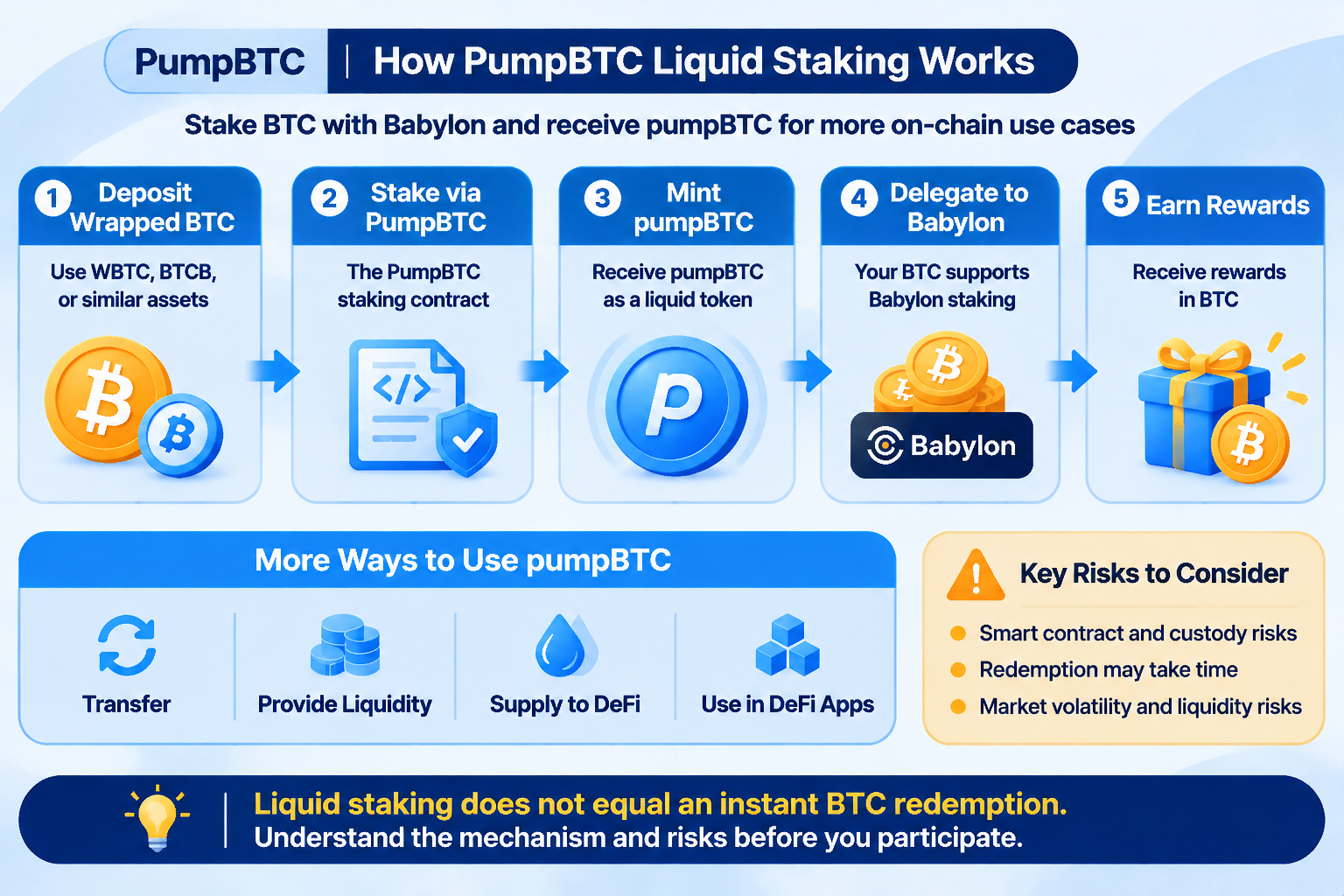
Under the specific mechanism, users may deposit wrapped Bitcoin assets such as WBTC and BTCB. Through the relevant smart contracts and operational processes, the project converts these assets into native BTC and then delegates the BTC to a Babylon Finality Provider as arranged. The pumpBTC received by users represents the relevant staking rights and can continue to be transferred or used in DeFi applications within supported EVM ecosystems.
This structure involves multiple steps: users deposit wrapped BTC, the contract mints pumpBTC, the operator processes the asset conversion, native BTC enters the Babylon staking process, and rewards are distributed according to the protocol rules. The liquidity of pumpBTC comes from its transferability as a tokenized certificate, not from the ability to freely withdraw the underlying BTC during staking.
Therefore, pumpBTC should not simply be understood as another BTC stablecoin. Although it has a value relationship with BTC, its market price, liquidity, and redemption conditions are also affected by the staking status, underlying assets, contract mechanisms, and market depth. Even if the project is designed to maintain a corresponding relationship with BTC, users should distinguish between the protocol’s reserve design and the actual execution price in the secondary market.
What Role Does Babylon Play in the PumpBTC Mechanism?
Babylon is one of the underlying staking protocols in the PumpBTC mechanism. It explores the use of Bitcoin’s economic security properties to support other PoS systems. Unlike the PoW consensus used by the Bitcoin mainnet, this type of mechanism does not make BTC holders direct Bitcoin miners. Instead, it uses protocol design to allow BTC to participate in the security service arrangements of other networks.
Under Babylon-related mechanisms, BTC holders lock their assets according to the protocol requirements and participate in security services through the relevant validators or Finality Providers. The specific yield and participation conditions depend on Babylon’s protocol design, supported networks, and reward rules. PumpBTC provides a product-level connection between users and this underlying staking process, reducing the need for users to handle complex staking operations directly.
This layered design allows BTC’s economic value to be introduced into more blockchain applications, but it also adds risk layers that users need to understand. In addition to BTC itself, users need to understand Babylon’s staking rules, the operating conditions of validators or Finality Providers, and how PumpBTC handles asset conversion, certificate issuance, and redemption.
In addition, the security mechanism provided by an underlying protocol does not mean that all products built on top of it receive the same level of security protection. Even if Babylon’s staking mechanism operates normally, PumpBTC still involves its own contracts, custodial arrangements, operations, and cross-chain components. When evaluating the product, users should assess the risks of the underlying protocol and the product separately rather than treating the security of one protocol as a guarantee of the security of the entire product system.
Where Does pumpBTC’s Yield Come From?
PumpBTC’s yield design is related to the Babylon staking mechanism. After users participate in the relevant process through PumpBTC, the underlying BTC participates in staking according to the protocol’s arrangements, and rewards are distributed based on the underlying protocol and product rules. Unlike simply relying on a token price increase, these products are designed to allow the underlying BTC to generate BTC-denominated rewards while participating in staking.
The specific form of the yield must be understood in conjunction with the product’s token model and redemption rules. According to PumpBTC’s relevant design, yield may be reflected in the exchange relationship between pumpBTC and the underlying BTC or in the corresponding reward arrangements. During the period users hold the certificate, the accumulation of yield depends on the underlying staking rewards, protocol fees, and product distribution mechanism. The annualized rate displayed at a particular point in time cannot be used to infer that future yield will remain unchanged.
In addition, BTC staking yield and BTC’s fiat price are two different dimensions. Suppose a user receives rewards denominated in BTC, but BTC’s price against the U.S. dollar declines during the same period. Even if the user’s BTC balance increases, the asset’s value when converted into U.S. dollars may still decline. Conversely, an increase in the BTC price may increase the yield measured in fiat currency, but that does not mean the staking product’s yield rate has changed by the same amount.
Users should also consider whether yield comes from underlying staking rewards, additional incentives, or other DeFi activities. Different yield sources carry different risks. If the yield during a certain period includes points, token incentives, or liquidity mining rewards, it should not all be treated as sustainable native BTC staking yield. Understanding the sources of yield is essential to evaluating a product’s long-term sustainability.
Can Liquid Staking Certificates Continue to Be Used in DeFi?
An important feature of liquid staking certificates is that they preserve a certain degree of on-chain composability while the underlying assets participate in staking. pumpBTC can be transferred on supported networks and used in supported applications. It may also be used for trading, collateralization, or liquidity provision. This allows users to participate in underlying BTC staking without giving up all on-chain use cases for their assets.
However, composability also introduces additional risks. If users deposit pumpBTC into a lending protocol as collateral, they face not only the original staking and custodial risks but also the lending platform’s smart contract risk, liquidation risk, and risk arising from changes in collateral ratios. If users contribute pumpBTC to a liquidity pool, they may also face price divergence between the pool’s assets, insufficient liquidity, and impermanent loss.
More importantly, the secondary-market liquidity of pumpBTC is not exactly the same as the ability to redeem the underlying BTC. Even if a DeFi pool supports pumpBTC trading, this does not mean that the pool will always have enough depth to allow all holders to exit at a price close to their expectations. Under significant market pressure, the liquidity certificate may trade at a discount, and users need to consider slippage and redemption restrictions.
Therefore, the "liquidity" of liquid staking should be understood as increased transferability and usability of the tokenized certificate, not as a guarantee of lossless exit at any time. Before participating in lending, trading, or liquidity provision, users should first confirm the token version supported by the relevant application, market depth, and exit conditions.
What Are the Main Risks of PumpBTC?
The first is custodial risk. PumpBTC’s technical documentation describes arrangements involving professional custodians, including Cobo and Coincover, and states that the underlying native BTC will be held and staked according to the relevant mechanisms. Custodians can provide professional key management and asset operation services, but custody does not eliminate risk. Users still need to consider the custodian’s operations, key management, access controls, and asset transfer procedures.
The second is smart contract risk. After users deposit wrapped BTC, they rely on PumpBTC’s contracts to mint, burn, stake, and redeem certificates. Contract vulnerabilities, incorrectly configured permissions, oracle failures, or risks in upgrade mechanisms could affect asset security. Open-source code and on-chain data can facilitate external review, but they cannot guarantee that contracts will never encounter problems.
The third is redemption and liquidity risk. PumpBTC’s contract documentation lists standard redemption and instant redemption methods. Standard redemption involves withdrawing BTC from Babylon and then converting it into wrapped BTC. The documentation gives an approximate processing time of T+10. Instant redemption depends on other users’ assets that have not yet completed the conversion process and incurs an additional fee. Instant redemption capacity is limited by available liquidity and should not be treated as an unconditional guarantee.
Finally, there are underlying protocol and cross-chain risks. PumpBTC’s asset flows involve multiple networks, wrapped assets, custodians, and cross-chain components. A failure at any stage could affect certificate transfers, asset redemption, or reward distribution. Users should review the project’s proof of reserves, contract addresses, asset distribution, and risk disclosures rather than focusing only on yield rates or token prices.
PUMPBTC on Gate: Trading the Token Is Different From Participating in Staking
Gate provides spot trading for PUMPBTC/USDT. Users can view market quotes and trading information on Gate’s PUMPBTC spot trading page. This gives users a channel to trade PUMPBTC on the platform, but spot trading is not the same operation as directly participating in PumpBTC protocol staking.
Buying PUMPBTC in the spot market means that users acquire the token and assume the risks related to its market price fluctuations, liquidity, and the project. Directly participating in protocol staking requires users to deposit eligible BTC-related assets according to the networks, asset types, and contract processes supported by the project and receive the corresponding liquid staking certificate. The two methods differ in terms of asset sources, operating procedures, and risk structures.
Therefore, PUMPBTC spot trading on Gate should not be described as automatically enrolling users in Babylon staking, and buying the token in the spot market should not be equated with receiving underlying BTC staking rewards. Before trading, users should verify the token contract, project name, trading pair, and product rules to avoid confusing PUMPBTC with other tokens or assets that share a similar name.
From the broader perspective of the Bitcoin ecosystem, Gate’s PUMPBTC spot market represents a trading use case for liquid staking certificates after they enter a centralized trading platform, while the PumpBTC protocol manages the underlying staking and asset management mechanisms. The trading platform provides a market trading channel, but it cannot replace users’ independent assessment of the underlying protocol, custodial structure, and redemption rules.
Conclusion
PumpBTC demonstrates a new way to use assets in the Bitcoin ecosystem: participating in BTC staking through protocols such as Babylon and then using a liquid staking certificate to bring the related rights into more on-chain applications. It connects Bitcoin holding, staking participation, and DeFi composability, giving BTC holders an option beyond simply holding the asset.
However, liquid staking does not eliminate the underlying asset’s restrictions. Custody, smart contracts, cross-chain mechanisms, redemption waiting periods, and market liquidity can all affect the assets and yield that users ultimately receive. Understanding these mechanisms is more important than focusing on the yield rate or token price at a particular stage.
Users who want to participate in this ecosystem should distinguish among three different paths: holding BTC directly, obtaining pumpBTC through protocol staking, and buying PUMPBTC on Gate’s spot market. These paths involve different rights, procedures, and risks. Before choosing one, users should assess it based on their own risk tolerance and intended use period for the funds.
FAQ
What Is PumpBTC?
PumpBTC is a Bitcoin liquid staking solution for the Babylon ecosystem. Through relevant staking and asset management processes, it allows users to deposit eligible BTC-related assets and receive pumpBTC liquid staking certificates.
Can Bitcoin Be Natively Staked Like Ethereum?
The Bitcoin mainnet uses a proof-of-work mechanism and does not have the same native validator staking mechanism as PoS networks. BTC holders can participate in the security services of other networks through protocols such as Babylon, but this involves additional protocol arrangements and does not represent a change to Bitcoin’s mainnet consensus mechanism.
What Is the Difference Between pumpBTC and BTC?
BTC is the native asset of the Bitcoin network. pumpBTC is a liquid staking certificate issued through the PumpBTC staking process and represents the relevant staking rights. Their market liquidity, redemption conditions, and sources of risk are not exactly the same.
Where Does PumpBTC’s Yield Come From?
Its yield design is related to the underlying Babylon staking mechanism and depends on staking rewards, product fees, and distribution rules. Users should distinguish among native BTC staking rewards, additional incentives, and DeFi activity yield. The yield displayed during a particular period should not be treated as a long-term guarantee.
Can pumpBTC Be Redeemed for BTC at Any Time?
It cannot simply be assumed that pumpBTC can be redeemed instantly and unconditionally at any time. PumpBTC’s documentation lists standard and instant redemption methods. The standard process involves withdrawing and converting the underlying assets and may require a waiting period. Instant redemption depends on available liquidity and may incur an additional fee.