Trading activity in the crypto market increasingly relies on automated tools. Market makers, quantitative teams, and professional traders connect their trading systems to trading accounts through APIs to execute orders, manage positions, obtain market data, and adjust risk exposure. APIs improve trading efficiency while extending account access from manual operations to programmatic environments.
This type of connection introduces an easily overlooked issue: API keys are themselves part of an account’s access permissions. If a key is stored improperly, exposed, or obtained by an unauthorized person, an attacker may be able to use the functions permitted by the key without knowing the user’s login password or wallet private key. The scope of the risk depends on the key’s configuration. It may range from reading market and account information to placing and canceling orders or even performing other sensitive operations.
The Lighter API key security incident in November 2026 once again drew market attention to the protection of trading account credentials. According to Lighter’s explanation of the incident, the event involved the exposure of an API key belonging to a trader’s account, while the protocol and smart contracts themselves were not affected. On-chain research traced approximately 10.39 million USDC transferred out of related contracts. The incident shows that the protocol contracts not being directly compromised does not mean that user accounts and trading permissions are free from security risks.
Key Takeaways
- API keys are account authorization credentials: If exposed, they may allow attackers to perform operations within the scope of the key’s permissions.
- The scope of permissions determines potential losses: The risks associated with read-only permissions differ significantly from those associated with trading or withdrawal permissions.
- Account-level security differs from protocol-level security: The fact that a smart contract was not exploited does not mean that user accounts did not suffer losses.
- Abnormal trading can amplify risk: Automated trading, liquidity operations, and large-scale fund transfers may cause losses to grow rapidly.
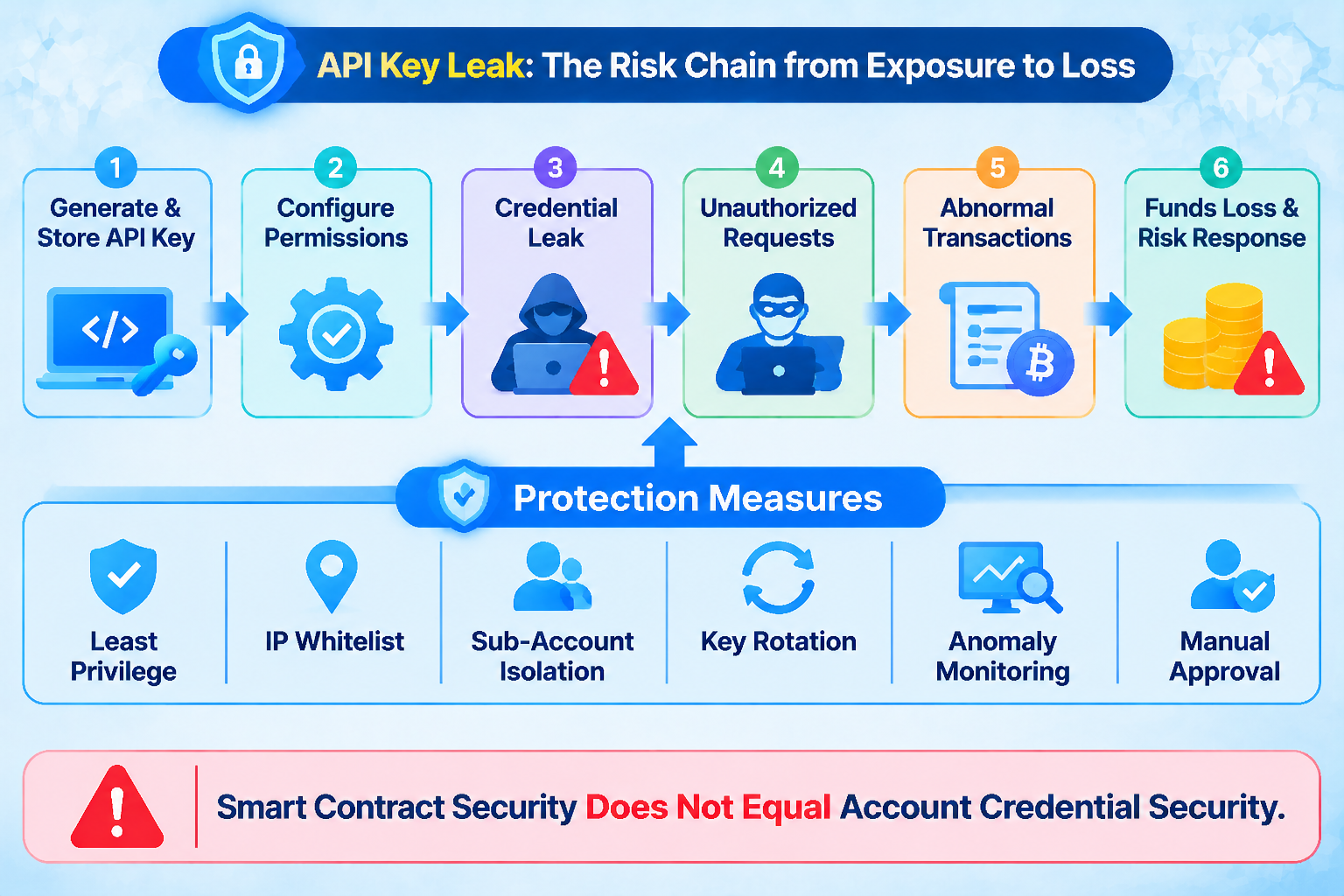
- Security measures should be deployed in layers: Least-privilege access, IP allowlists, key rotation, subaccount isolation, and real-time monitoring need to work together.
Why Do API Keys Have Such High Security Value?
An API is an interface that enables data exchange and function calls between applications. In crypto trading, API keys are typically used to identify accounts and authorize programs to perform specific operations. Trading bots can use APIs to obtain market data, read account balances, submit orders, and manage positions without requiring the user to perform each action manually.
The security risk of an API key comes from its authorization capabilities. If a key only has permission to read market data, the actions available to an attacker are usually relatively limited even if the key is exposed. If the key allows order placement, order cancellation, or other account operations, an attacker may be able to affect the account’s assets through abnormal trading. Different platforms divide and support API permissions differently, so users must confirm the specific meaning of each permission when creating a key.
API keys may also be stored in server configuration files, code repositories, automation scripts, log systems, or third-party trading tools. If these environments lack access controls, the keys may be exposed without the user’s knowledge. Security management cannot focus solely on the trading platform. It must also cover the user’s own development environment, cloud servers, and third-party services.
How Can an Exposed API Key Turn Into Actual Losses?
An exposed key does not necessarily lead to a direct transfer of funds. An attacker may first use trading permissions to place abnormal orders, change the account’s positions, or create unfavorable executions. If the account uses high leverage, price impacts and changes in margin may further amplify losses. The specific risks depend on the account permissions, trading rules, and fund management practices.
In an automated trading environment, the trading system may continue running and executing predefined strategies. If an attacker can use exposed permissions to change trading parameters, submit abnormal orders, or manipulate account activity, the system may execute multiple operations in succession within a short period. For market-making accounts, abnormal trading may also affect quotes, inventory management, and liquidity allocation, causing losses that extend beyond a single order.
The Lighter incident in November 2026 provides a specific example. Lighter said that the incident was caused by the exposure of an API key belonging to a trader’s account and stated that the protocol and smart contracts were not affected. An on-chain investigation by Bitquery recorded approximately 10,393,057 USDC transferred out of contracts related to Lighter. The funds were subsequently exchanged for ETH and transferred through multiple addresses. Estimates of the potentially affected accounts and total losses differed across reports. The amount of transfers observed on-chain should therefore be distinguished from account losses that have not yet been fully confirmed.
Why Can Users Still Lose Funds If the Protocol Was Not Compromised?
Blockchain protocol security and account authorization security operate at different levels. Smart contract vulnerabilities typically involve the contract code, access controls, or asset transfer logic itself. An exposed API key, by contrast, may result from credential management issues involving a user account, trading program, or third-party service. Even when a protocol executes transactions as designed, losses may still occur if account authorization is abused.
This distinction is particularly important in DeFi and on-chain trading. On-chain protocols can verify whether a transaction complies with the rules of a contract, but they generally cannot determine whether the person initiating the operation has actually received the account owner’s authorization. If an attacker holds valid API credentials and performs operations through processes permitted by the protocol, the on-chain record may show a series of technically valid transactions.
Security assessments therefore cannot focus solely on whether a smart contract has been audited. They must also consider how account keys are generated, stored, and used, whether authorization is restricted, and whether abnormal behavior can be identified promptly. Account security, endpoint security, API management, and smart contract security must work together as a complete protection system.
How Can Least-Privilege Access Reduce API Risks?
Least-privilege access is an important principle of API security management. Users should enable only the permissions required for an API key to perform a specific task. For example, a market-monitoring program typically needs only permission to read market data. A trading bot may need permission to place and cancel orders but not necessarily withdrawal permission. If an application does not need access to transfer funds out of an account, it should not be granted the corresponding permission.
For programs that need to execute trades, users can limit the assets they can access by placing them in an independent subaccount. Separating strategy accounts from primary funding accounts can help reduce the impact of a single credential exposure. Market-making and quantitative teams can also establish different account and permission boundaries based on strategy type, fund size, and trading frequency.
IP allowlists are another common security measure. Restricting API requests to specified server addresses can reduce the likelihood that a key will be misused in other environments. However, an IP allowlist cannot replace proper key protection. If an attacker has already compromised an approved server or the trading program itself contains a vulnerability, the attacker may still perform abnormal operations through a legitimate network path.
Why Are Key Rotation and Abnormal Activity Monitoring Important?
API keys should not be treated as static credentials that remain valid indefinitely. Users and institutions can set rotation schedules based on business risk and promptly revoke old keys and create new ones when personnel changes occur, servers are migrated, third-party services are replaced, or abnormal access is detected. Key rotation can shorten the period during which an exposed credential remains effective, but the update process must not cause unplanned interruptions to production systems.
Abnormal activity monitoring helps identify signs that credentials may have been misused. Requests from unknown IP addresses, unusual trading frequency, abnormal order sizes, account permission changes, and large numbers of cancellations or fund operations within a short period can all trigger alerts. Institutional accounts can also establish trading limits and manual approval mechanisms so that high-risk operations cannot be completed through a single API request.
Log management is also important. Systems should record key usage times, request sources, operation types, and execution results, but they must not write complete keys to ordinary logs. Logs themselves also require access controls and tamper protection. Otherwise, attackers may delete or modify critical evidence after causing losses.
How Do API Risks Interact With DeFi Fund Management?
In the DeFi ecosystem, trading accounts, on-chain wallets, and protocol contracts may be connected through automated programs. Trading bots can monitor on-chain prices and execute trades, market-making systems can adjust fund allocations based on market conditions, and fund management tools may execute on-chain operations through APIs or signing services. The more connections there are, the more important permission boundaries and credential management become.
If a trading account holds substantial funds or can manage multiple strategy accounts, an exposed API key may create broader risk exposure. Positions held by an institution in other markets may also be reassessed following a security incident. In November 2026, market monitoring information indicated that Abraxas Capital adjusted its on-chain positions following the related API key incident. It was reported to have closed approximately $200 million in related positions, transferred approximately 109 million USDC in collateral, and requested the redemption of approximately 219,000 HYPE. The position reduction and redemption request were subsequent risk response actions and should not be conflated with the losses from the initial API key exposure.
These events show that security incidents can affect multiple markets through fund management and risk control decisions. However, the fact that events occurred in a particular sequence alone is not sufficient to conclude that all subsequent position adjustments were direct losses. Nor should the risk response actions of a single institution be treated as evidence of a systemic failure across the DeFi market.
How Should Gate Users Understand API and Account Security?
For users of trading platforms such as Gate, API security should also be part of account management. If you use an API to connect a trading bot, market data tool, or quantitative program, first verify the application’s source and permission requirements. Then restrict the key’s permissions based on the security settings actually provided by the platform. Do not send API keys to strangers or write them to public code repositories or unprotected configuration files.
Users should also regularly review their API key lists, revoke keys that are no longer in use, and create separate credentials for different applications. If the platform supports IP allowlists, subaccounts, permission separation, or other security features, configure them appropriately for the specific business scenario. For high-frequency or automated trading, consider setting order size limits, abnormal activity alerts, and manual pause mechanisms.
Gate provides trading services including spot and futures trading. When using automated trading tools, users should also distinguish between the risks of spot accounts and futures accounts. Futures trading involves margin, leverage, and liquidation mechanisms. If API permissions are misused, it may create more complex position-related risks. The specific API permissions and account security settings available should be based on the latest information in the official Gate API documentation and on the platform’s security pages.
Conclusion
API keys are important tools for automated trading and account management, but they also form a security boundary between trading accounts and external programs. Once credentials are exposed, attackers may use the account’s existing permissions to perform abnormal operations. Users may suffer actual losses even when the underlying protocol and smart contracts have not been compromised.
API security therefore cannot rely on a single measure. Least-privilege access, account isolation, key rotation, IP restrictions, and abnormal activity monitoring must form a complete system. For institutional and individual users, effective security management means ensuring that each credential can perform only the necessary tasks and that the potential impact of an incident is limited as much as possible.
FAQ
Does an Exposed API Key Always Result in Stolen Funds?
Not necessarily. The actual risk depends on the key’s permissions, account settings, and platform restrictions. A read-only key has a different potential impact from a key with trading or withdrawal permissions.
What Is the Difference Between an API Key and a Wallet Private Key?
An API key is generally used to authorize a program to access a trading account or perform specific operations. A wallet private key is used to control an on-chain address and sign transactions. Both require strict protection, but their permissions and use cases differ.
Why Can an Account Still Suffer Losses When a Smart Contract Has No Vulnerability?
An attacker may use valid account credentials to perform operations permitted by the protocol. A contract verifies whether a transaction complies with its rules, but it may not be able to determine whether the operator has actually received authorization from the account owner.
How Can the Risk of API Key Exposure Be Reduced?
You can use measures such as least-privilege access, IP allowlists, independent subaccounts, key rotation, secure storage, and abnormal trading monitoring. You should also revoke keys that are no longer in use.
Should API Keys Have Withdrawal Permissions Enabled?
This permission should be considered only when it is genuinely required for the business and additional security controls are in place. Most trading bots do not need withdrawal permissions. Avoiding unnecessary authorization can reduce the potential scope of losses.