Cryptocurrency payment use cases are expanding from person-to-person asset transfers to service settlement between programs. In the past, users typically had to open a wallet, select an asset, confirm the recipient address, and sign a transaction to use digital assets. AI Agents work differently. During a single task, they may call multiple external services in sequence, with each call requiring them to determine the service price, check the budget, complete authorization, and receive the result. If every step requires manual action, an Agent's automation capabilities will be limited.
This issue is not merely a technical detail for the AI industry. It also concerns the evolution of cryptocurrency payment infrastructure. Traditional online services typically rely on accounts, subscriptions, and API keys, while blockchain wallets can enable programs to manage digital assets within authorized limits. How to connect service requests with payment actions while controlling fund permissions and spending risks has become an important question for the sustainable operation of the machine economy.
Texel is one example for observing this direction. Its platform provides GPU rentals and outputs from multiple AI models, and it describes a per-request payment method through x402. To understand this model, the focus is not the short-term market performance of a particular token, but how services are priced, how Agents are authorized, how payments are settled, and what on-chain records can prove.
Key Takeaways
-
Autonomous machine payments require a clear payment process: Agents must be able to obtain service prices, check authorization limits, and complete payments when the budget permits
-
x402 embeds payment requirements into the HTTP request flow: the server can return payment requirements, and the client can resubmit the request after signing to complete payment for the service
-
On-chain settlement provides searchable records: payment transactions can be recorded on the blockchain, but on-chain records do not guarantee service quality
-
Wallet authorization and budget controls are essential: an Agent's payment permissions should be constrained by spending limits, validity periods, and revocation mechanisms
-
TEXEL has a specific connection to platform services: official documentation lists TEXEL as one of the supported payment assets and describes related usage and burn rules, but token prices are still affected by market factors
From HTTP 402 to x402: Why Do Web Requests Need Payment Mechanisms?
HTTP is the foundational protocol for exchanging requests and responses between internet services. In traditional web interactions, a client sends a request to a server, and the server returns content or status information. If a user needs to access a paid service, identity and payment verification are usually completed through account login, subscription status, or an API key. This model is suitable for service relationships managed by people, but when the caller becomes a continuously operating AI Agent, account registration, funding, and key management may introduce additional integration costs.
The HTTP 402 status code is called "Payment Required." It has existed in the HTTP standard for a long time, but the traditional internet has not developed a unified, widely adopted general payment flow. x402 attempts to use this status code to incorporate payment requirements into the web request and response process: when a client requests a paid resource, the server can return payment requirements; the client completes payment authorization based on those requirements and resubmits the request; the server verifies the payment and provides the corresponding service.
The key to this model is connecting service access with payment actions. Agents do not need to rely entirely on traditional subscription accounts. They can also decide whether to pay each time they call a service based on the price and budget. This approach is suitable to some extent for pay-per-use digital services, such as model inference, data queries, content generation, and computing resource usage.
However, x402 is not an independent blockchain, nor is it a complete financial system that can automatically guarantee transaction security. It describes a mechanism for organizing payment requirements and payment proof around HTTP requests. Which assets are used, which blockchain settles the payment, who pays network fees, and how the server verifies payment all depend on the specific implementation.
How Is an x402 Payment Completed?
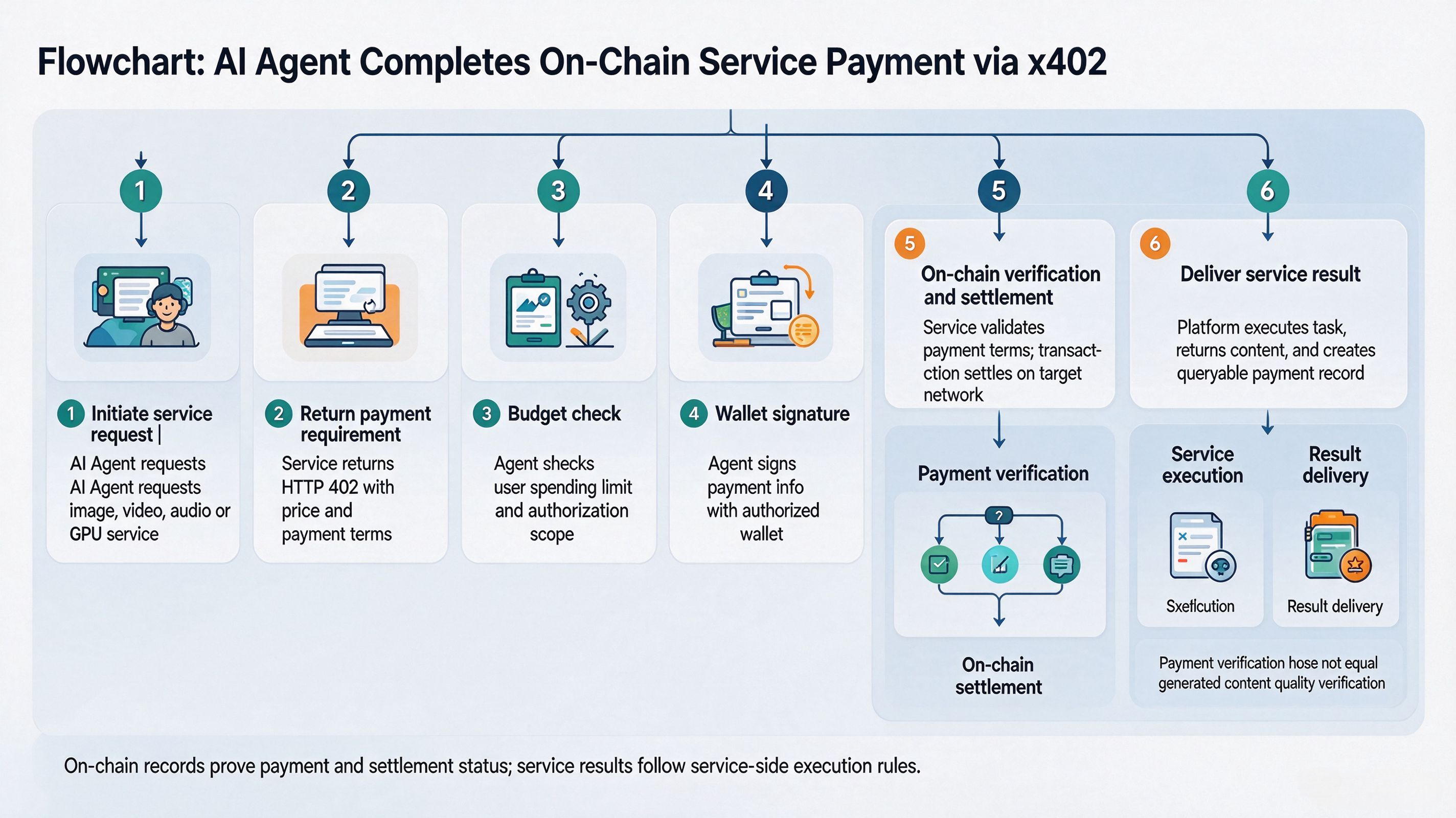
A typical x402 interaction begins when a client initiates a service request. An AI Agent requests a resource from a server, such as generating an image. If the resource requires payment, the server returns payment requirements that include the price and payment information needed to complete the request. The Agent determines whether the request fits within the task budget and uses a pre-authorized wallet to sign the payment.
After signing, the client resubmits the request with the corresponding payment authorization information. After verifying that the payment conditions are met, the server continues processing the task and returns the result. If payment verification fails or the authorized amount exceeds the permitted limit, the service request should not continue. In this way, payment becomes part of the service call flow rather than a manual step that is completely separate from task execution.
Using Texel's implementation as an example, its official documentation explains that Agents can pay for model outputs per request through x402. The platform returns payment requirements, the Agent uses a wallet to complete the corresponding signature, and then resubmits the request with payment authorization. Texel's official website also shows an interaction example in which payment is made with USDG and the platform handles the related Gas. Specific assets, fee arrangements, and request flows should be based on the platform's current documentation. The implementation of one platform should not be regarded as a uniform rule for all x402 services.
Why Do Autonomous Machine Payments Need Permission and Budget Controls?
When an AI Agent gains payment capabilities, fund management becomes more important as automation efficiency improves. An Agent may call multiple external services based on task requirements. If every call can use wallet assets without restriction, flawed task planning, repeated requests, or malicious tool calls may result in ongoing spending. Therefore, a payment system cannot focus only on whether payment can be made. It must also clearly define how much can be paid, who can be paid, and when payments should stop.
The first consideration is spending limits. Users can set daily or per-transaction spending limits for an Agent, allowing it to call paid services only within a defined range. The second is authorization scope. Wallets or payment systems should limit the conditions under which funds can be used as much as possible, preventing an Agent from receiving permissions beyond what the task requires. Finally, there must be revocation capabilities. When users discover abnormal Agent behavior, they should be able to stop subsequent calls or revoke unused authorizations.
Texel's documentation describes how to create API keys for Agents and set daily spending limits. It also shows a stop switch controlled by the user. These features demonstrate that autonomous machine payments do not mean handing fund management over entirely to Agents. A more reasonable model is for users to set boundaries in advance and allow Agents to complete service calls within their authorized scope.
In addition, the validity period of payment authorizations, signature contents, repeated request handling, and refund mechanisms are also worth considering. If the server cannot accurately identify duplicate payments, or if clear refund rules are unavailable after a request fails, users may still incur additional costs. For developers, a secure Agent payment system needs to treat wallet management, request verification, spending limits, and exception handling as an integrated design rather than relying solely on a single signature.
What Can On-Chain Settlement Provide, and What Can It Not Prove?
One feature of on-chain payments is that transactions can be publicly queried and verified. For digital services, on-chain records can help users verify whether a payment occurred, which address the funds were sent from, which contract or receiving address ultimately received them, and when the transaction was confirmed by the network. This provides auditable fund records for programmatic service payments.
When payments are associated with specific service requests, platforms can also generate corresponding records for usage. The Texel official website describes GPU usage records and on-chain receipts as a way for users to view resource consumption and fees. For Agents that need to call services over a long period, these records can help reconcile spending, analyze costs, and track resource usage across different tasks.
However, the scope of what on-chain records prove must be understood accurately. A blockchain can prove that a transaction was recorded according to network rules, but it cannot independently prove that a user received an image, video, or model output that met requirements. It also cannot prove that GPU performance, availability, or service quality met expectations. Computing tasks still occur off-chain, and service providers remain responsible for hardware operations, model deployment, result delivery, and customer support.
Therefore, on-chain payments are better viewed as a settlement and record layer within the service economy rather than a comprehensive guarantee of the entire service process. If machine payments become more widespread in the future, the industry will also need more robust mechanisms for service evaluation, task verification, dispute resolution, and data protection to create a more reliable connection between on-chain settlement and actual service delivery.
What Role Does TEXEL Play in the Platform's Payment System?
Texel's platform services have a functional connection with the TEXEL token. According to official documentation, users can use assets such as USDG, ETH, or TEXEL to purchase Texel credits, then use those credits to pay for model outputs and GPU rental fees. The platform uses credits as a unified unit for service pricing, allowing different payment assets to enter a relatively consistent service consumption flow.
TEXEL is not merely a market token displayed on the platform. Official documentation explains that users can choose to use TEXEL to purchase platform credits. Credits purchased this way are consumed first, and the related TEXEL is periodically sent to a burn address according to the platform's published rules. This creates a clear mechanism-based connection between TEXEL and platform service consumption. However, the number of tokens burned and the actual economic impact still need to be evaluated based on real usage, token circulation, and platform rules. The existence of a burn mechanism alone does not mean the token will necessarily appreciate.
The platform has also published an Earn feature related to TEXEL holdings, stating that wallets holding TEXEL can receive NVDA tokens in proportion to their holdings. When understanding this feature, it is important to distinguish between platform rules, tokenized assets, and traditional stocks themselves. Tokenized assets may involve separate issuance, custody, and rights arrangements. They should not be considered direct ownership of traditional market stocks based on their name alone, and related legal, redemption, and trading restrictions should not be overlooked.
From a cryptocurrency perspective, TEXEL can be analyzed across three areas: first, whether platform services create ongoing actual demand; second, whether TEXEL payments, credit consumption, and burn mechanisms operate according to the rules; and third, whether token-related features have clear, verifiable disclosures of rights and risks. These dimensions can help distinguish the relationship between product usage, token mechanisms, and market prices.
Users who want to learn more about TEXEL-related token information can visit the TEXEL page on Gate Alpha for relevant market information. Note that the token information portal on Gate Alpha and Texel platform services are different use cases. Following or trading TEXEL through Gate Alpha does not automatically grant Texel platform credits, Earn benefits, or other platform features.
The Long-Term Challenges of the Machine Economy: Payment Is Only One Part
The long-term development of autonomous AI Agent payments depends on whether multiple types of infrastructure can work together. First, services need to be discoverable and understandable by Agents, including clear tool descriptions, pricing, parameter requirements, and error-handling methods. Second, payment mechanisms need to support programmatic authorization and controlled spending, avoiding the need for manual operations for every call while preserving the user's ultimate control over funds.
Another consideration is service quality and accountability boundaries. Agents can initiate requests automatically, but if a service does not deliver results as agreed, users need to know who is responsible, how refunds are handled, and how disputes are resolved. On-chain payment records can provide some evidence, but they cannot replace service agreements and dispute resolution mechanisms. For GPU, model, and data services, service availability and output quality remain important factors when users choose a platform.
Finally, there are differences related to assets and regulation. Different blockchains, stablecoins, and tokenized assets have different issuance and settlement rules. Cross-network payments may also involve bridging, conversion, and additional fees. To achieve large-scale adoption, autonomous machine payments need to keep payment costs, asset risks, and compliance requirements understandable and manageable rather than merely pursuing fewer manual steps.
From this perspective, x402 is meaningful because it explores a closer connection between internet service requests and digital asset payments. It provides a composable payment approach for AI Agents calling paid services, but a truly mature machine economy still requires support from tool standards, wallet security, service verification, cost management, and user protection.
Conclusion
The autonomous execution capabilities of AI Agents are driving payment systems to expand from human-facing interactions toward program-facing service settlement. x402 embeds payment requirements into the web request flow, allowing Agents to independently pay for digital services after obtaining prices, checking budgets, and completing authorization. On-chain settlement provides searchable fund records for these transactions.
Texel applies x402 to GPU and AI model services, demonstrating how machines can use wallets to call external computing and content-generation capabilities. TEXEL has a certain connection to service usage through platform payments and credit consumption mechanisms. However, payment protocols, platform businesses, token features, and market prices should always be distinguished: they are related, but they cannot replace one another.
Whether the machine economy can scale in the future depends not only on whether payments are convenient enough, but also on whether permissions can be managed securely, services can be delivered reliably, and users can clearly understand the costs and risks generated by every call.
FAQ
What is x402?
x402 is a payment interaction mechanism designed around the HTTP 402 Payment Required status code. When a request requires payment, the server can return payment requirements. The client resubmits the request after completing the corresponding authorization, thereby completing payment for the service. The specific assets and settlement network depend on the actual application.
Is x402 a blockchain?
No. x402 is not itself a blockchain. It is a mechanism for integrating payment requirements into the web request flow. Specific transactions can be completed on supported blockchain networks, while the assets used, fees, and verification methods depend on the service implementation.
Can AI Agents manage cryptocurrency themselves?
AI Agents can call wallets or payment tools under user authorization, but this does not mean they should receive unrestricted control over funds. A more reasonable approach is to set spending limits, authorization scopes, and stop mechanisms while retaining the user's ability to revoke permissions.
How does Texel use x402?
According to Texel's official introduction, an Agent can request paid output from Texel, after which the server returns payment requirements. The Agent uses a wallet to complete the corresponding signature and resubmits the request. After payment is verified, the platform executes the task and returns the result. The specific process should be based on Texel's official documentation.
Can TEXEL be used to pay for Texel services?
Yes. Texel's official documentation lists TEXEL as one of the payment options for purchasing platform credits. These credits can be used to pay for model outputs and GPU rental services. Credits purchased with TEXEL also involve the platform's published token burn rules. Specific mechanisms may change, so refer to the latest official documentation.
Can on-chain payment records prove the quality of AI outputs?
No. On-chain records can help verify payment transactions and fund flows, but they cannot independently prove that GPU performance, model output quality, or service delivery meets expectations. These still require support from the platform's service mechanisms and off-chain verification processes.
Where can I find information about TEXEL?
You can learn about platform products and token rules through Texel's official website, and you can also view related token market information on the TEXEL page on Gate Alpha. Token market information and platform service benefits should be understood separately.