Over nearly a decade of scaling evolution for Layer-1 blockchains, the "Blockchain Trilemma"—how to strike a precise balance among decentralization, security, and high scalability—has remained the central challenge driving every technological iteration. Before Ethereum Layer-2 solutions (Rollups) became mainstream, blockchains centered on State Sharding and parallel transaction processing were widely anticipated to lead the next phase of development. Harmony (ONE) was one of the most representative early pioneers of this "sharded blockchain wave." With its distinctive Effective Proof-of-Stake (EPoS) consensus mechanism and low-latency Fast Finality, it once built an active decentralized finance and cross-chain ecosystem.
However, blockchain development has been shaped by a harsh form of Darwinism. As cross-chain bridge security incidents continued to undermine trust across the industry, and the liquidity-siphoning effects of modular architectures and the Ethereum Rollup ecosystem intensified, the operating costs and security margins involved in independently maintaining a high-throughput sharded mainnet came under severe pressure. In 2026, the Harmony team made a strategically significant decision with historical implications: to shut down its long-running independent Layer-1 mainnet, migrate the native ONE token to the Ethereum network as an ERC-20 standard token, and explore a transition into emerging fields such as multimodal AI infrastructure. This article provides an in-depth analysis of Harmony (ONE)'s architectural evolution and broader industry significance, covering the principles of sharded architecture, lessons from cross-chain bridge security, the technical path for mainnet migration, and the coordination between Gate's spot market and deposit and withdrawal ecosystem.
Key Takeaways
- Analyze in depth the technical principles and scaling efforts behind Harmony's early innovations in State Sharding and Effective Proof-of-Stake (EPoS) consensus
- Systematically examine the cryptographic risks and security bottlenecks facing blockchain cross-chain infrastructure, and reflect on the historical lessons of early multisignature cross-chain bridges
- Break down the engineering logic behind a blockchain's strategic contraction and asset migration (Mainnet Sunset & ERC-20 Migration), and analyze the deeper reasons for moving the ONE token closer to the Ethereum ecosystem
- Explore how established Layer-1 blockchains can seek a path forward through unified asset standards and business repositioning when facing liquidity fragmentation and Rollup competition
- Analyze how seamless token mapping support, spot market liquidity, and risk management tools on major trading platforms such as Gate can help investors respond to blockchain migrations and market volatility
State Sharding and EPoS: Harmony's Early Blockchain Technology Exploration
To objectively assess the evolution of Harmony (ONE), it is first necessary to revisit its technological origins in the history of blockchain scaling. When its mainnet launched in 2019, the Ethereum mainnet was still constrained by throughput of only a few dozen transactions per second (TPS) and high Gas fees. Harmony proposed a "Deep State Sharding" architecture that divided the network, transaction, and state layers, attempting to overcome the performance ceiling of a single chain through horizontal scaling.
At the core of its underlying technical design, Harmony introduced two major innovations:
-
Effective Proof-of-Stake (EPoS): Traditional Proof-of-Stake (PoS) networks are often susceptible to a Matthew effect in which leading validators monopolize staking weight, increasing centralization. By setting staking caps and using a dynamic reward and penalty algorithm, EPoS limits the concentration of computing power and stake in a single super node. It encourages validators to distribute tokens across multiple small and medium-sized nodes while maintaining high block production efficiency and preserving network decentralization.
-
VRF-Based Shard Assignment to Prevent Malicious Activity: To prevent malicious nodes from concentrating their efforts on taking over a specific shard—known as a "single-shard takeover attack"—Harmony combined a VRF (Verifiable Random Function) with a VDF (Verifiable Delay Function) to periodically and unpredictably reassign validators to different shards during each Epoch. It then used a Fast Byzantine Fault Tolerance (FBFT) algorithm to achieve block finality in approximately 2 seconds.
Although this sharding and consensus architecture was theoretically elegant, the latency of Cross-Shard Communication and the complexity of synchronizing the state across full nodes continued to create significant maintenance barriers for developers and ecosystem expansion.
Cross-Chain Security and Ecosystem Shifts: The Underlying Drivers of the Mainnet Migration
The rise and fall of any blockchain depends not only on its own code architecture but also on broader changes in external cross-chain security and industry liquidity. Throughout Harmony's ecosystem development, cross-chain bridge security incidents and the subsequent reshaping of the global blockchain landscape became direct catalysts for its 2026 decision to shut down its independent mainnet and transition to Ethereum ERC-20.
| Evolution Stage and Dimension |
Early Independent Layer-1 Era (2019–2025) |
Architecture Restructuring and ERC-20 Migration Era (From 2026) |
| Underlying Network and Ledger |
An independently operated four-shard blockchain that relied on its own validator network |
Independent Layer-1 mainnet shut down, with assets migrated entirely to the Ethereum mainnet |
| Token Technical Standard |
Native mainnet token (Native ONE) used to pay local Gas fees and for validator staking |
Standard Ethereum ERC-20 token (ERC-20 ONE) compatible with the full EVM infrastructure stack |
| Security Model |
Independently responsible for network-wide consensus security and the multisignature verification risks of cross-chain bridges |
Shares Ethereum's extensive decentralized security budget and auditing standards |
| Ecosystem Liquidity Integration |
Pronounced liquidity-island effect, with heavy reliance on cross-chain bridges to import external assets |
Direct access to Ethereum's extensive DeFi, DEX, and institutional custody liquidity pools |
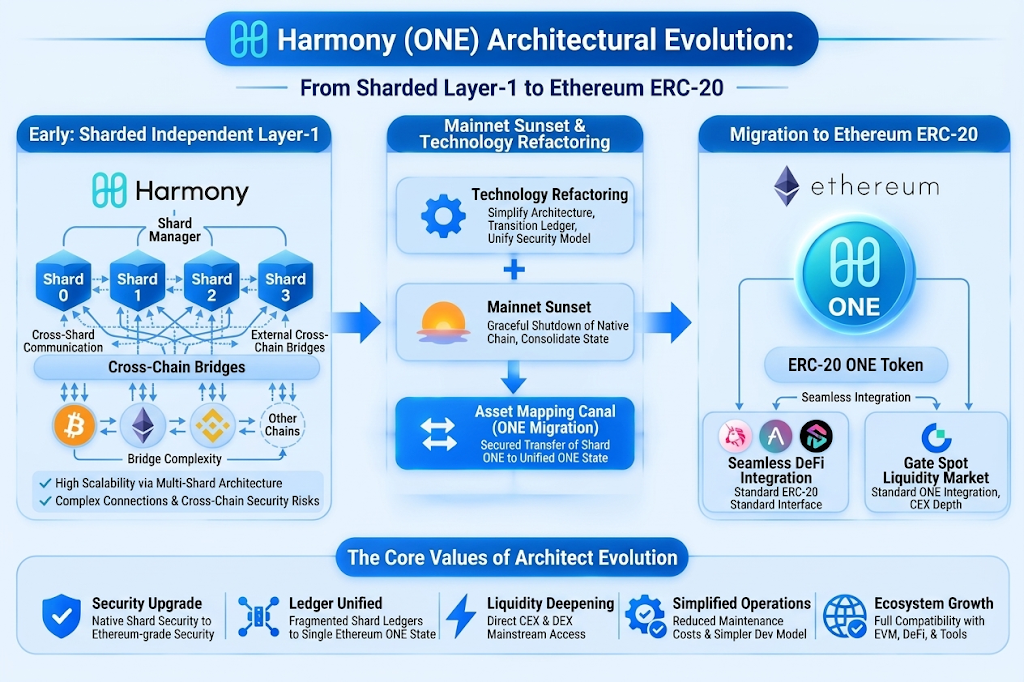
This strategic transition reflects three core principles of today's blockchain infrastructure sector:
-
The Far-Reaching Impact of Cross-Chain Security Lessons: In the early blockchain industry, cross-chain bridges commonly relied on multisignature mechanisms. This design, which locked hundreds of millions of dollars in assets under the control of a small number of private keys, became a major target for hackers. Once underlying trust is damaged, an independent blockchain faces extremely high costs when attempting to rebuild its native liquidity pools in the short term.
-
The Liquidity-Siphoning Effect of Ethereum and Modular Ecosystems: As consensus around the security of the Ethereum mainnet continued to strengthen and Layer-2 scaling solutions matured, most stablecoins, RWA assets, and institutional funds became highly concentrated in the EVM ecosystem. Rather than spending heavily to maintain an independent chain with low activity, established Layer-1 projects can convert their assets to the ERC-20 standard and integrate directly into the world's deepest liquidity pool.
-
Transition to a Lighter Asset Model and Business Repositioning: By shedding the burden of maintaining a complex underlying blockchain, project teams can refocus limited engineering resources on application-layer protocols, data infrastructure, artificial intelligence, and other emerging fields with greater commercial growth potential.
Asset Mapping and Market Volatility: The Market Dynamics of Blockchain Repositioning
In the cryptocurrency market, events such as "mainnet upgrades," "token standard conversions (Swap/Migration)," and "major strategic changes" can cause the tokens involved to appear on gainers or volatility rankings across major platforms as liquidity is repriced, positions are adjusted, and speculative sentiment builds.
For ordinary traders, understanding the underlying dynamics of this market volatility is essential:
-
Short-Term Supply and Demand Imbalances Caused by Deposit and Withdrawal Suspensions: During a blockchain's mainnet shutdown and ERC-20 token mapping, major centralized exchanges typically temporarily suspend deposits and withdrawals on the old mainnet to complete underlying snapshots and technical integration. During this window, the circulating supply in the exchange's internal spot market is relatively constrained, and concentrated buying can easily trigger a sharp short-term price increase.
-
Redistribution of Existing Token Liquidity: Migrating from the mainnet to Ethereum means that the rules governing the token's future storage, transfers, and DeFi interactions will change fundamentally. Some early on-chain wallet holders may fail to monitor the mapping deadline or may be unable to complete the process due to operational barriers. As a result, some tokens remaining on-chain may not enter secondary-market circulation immediately, temporarily changing the structure of the market's actual circulating supply.
-
The Clash Between Sentiment and Fundamental Revaluation: When faced with an established blockchain's "last-resort" architectural restructuring, market participants often become sharply divided. Bullish participants may view it as a positive catalyst that removes historical burdens and embraces a new narrative, while bearish participants may focus on the long-term support for value amid ecosystem contraction. This conflict between buyers and sellers can directly amplify market fluctuations.
The Synergistic Value of Blockchain Architecture Evolution and the Gate Ecosystem
Whenever an underlying blockchain undergoes a mainnet sunset, cross-chain migration, or token standard conversion, ordinary on-chain users often face substantial risks, including exporting private keys, making mistakes when using cross-chain bridges, or encountering phishing websites that impersonate official migration services. During this critical technological transition, leading centralized trading platforms can serve as a "security buffer" and "liquidity hub" that protects users' assets and facilitates a smooth upgrade.
Gate, for example, is one of the digital asset trading platforms with the longest operating histories and broadest asset support globally. It has established automated response and risk management systems for handling blockchain upgrades, token mapping, and sharp market volatility.
During the architectural transition of Harmony (ONE) and the evolution of emerging blockchain ecosystems, Gate provides three key forms of synergy:
-
One-Stop, Seamless Token Mapping and Technical Custody: For technical changes such as migrating Harmony's mainnet to Ethereum ERC-20, Gate's underlying wallet technology team can typically assist users in completing on-chain snapshots, contract mapping, and seamless conversion to tokens under the new standard. Users do not need to research complex cross-chain migration contracts themselves. They can simply keep their assets in their Gate accounts to complete the transition securely and avoid the risk of asset loss caused by on-chain operational errors.
-
Deep Spot Liquidity and a High-Concurrency Matching Engine: When technical upgrades or sector rotations trigger sudden market volatility, Gate's order book depth and millisecond-level matching engine help traders execute their intended transactions quickly with low slippage when buying or selling spot trading pairs such as ONE/USDT, reducing the risk of liquidity shortages during sharp market movements.
-
A Multi-Dimensional Risk Management Toolkit: In response to the high volatility associated with market hotspots, investors can use Gate's Spot Grid automated range-trading tool and perpetual contract hedging mechanisms to establish disciplined risk controls while seeking to capture market swings and implement more rational asset allocation.
FAQ
What Is Harmony (ONE)'s Mainnet Migration? What Should Holders Know?
In 2026, Harmony began an architectural transition to shut down its independent Layer-1 mainnet and migrate the native ONE token to an Ethereum ERC-20 standard token. Token holders should closely monitor the migration deadline announced by the official team and should not transfer assets to addresses on the discontinued old mainnet. If assets are held on a major trading platform that supports automatic mapping, such as Gate, the platform can assist with completing the standard conversion.
Why Would an Established Blockchain Abandon Its Independent Mainnet and Transition to Ethereum ERC-20?
As Ethereum and modular ecosystems have attracted most of the market's liquidity, maintaining an independent early-generation sharded blockchain requires substantial node maintenance costs and cross-chain security risks. Transitioning to the ERC-20 standard allows the token to share Ethereum's underlying security and DeFi composability directly, enabling a lighter-asset transition.