The key distinction between Grvt, traditional centralized exchanges (CEXs), and typical perpetual DEXs is Grvt’s integration of non-custodial accounts, unified margin, and yield investment modules within a single account architecture. Traditional CEXs rely primarily on platform custody, while perpetual DEXs are generally focused on single-chain, on-chain derivatives trading. To fully grasp these differences, it’s essential to view Grvt’s core positioning in the context of the evolution of on-chain trading solutions.
All three offer trading interfaces and position management, but they define “account” differently. Centralized exchanges combine trading, custody, and financial products within one institutional framework. Perpetual DEXs prioritize self-custody and on-chain settlement. Grvt, however, is centered on enabling a single fund pool to simultaneously support trading, collateral, and yield allocation.
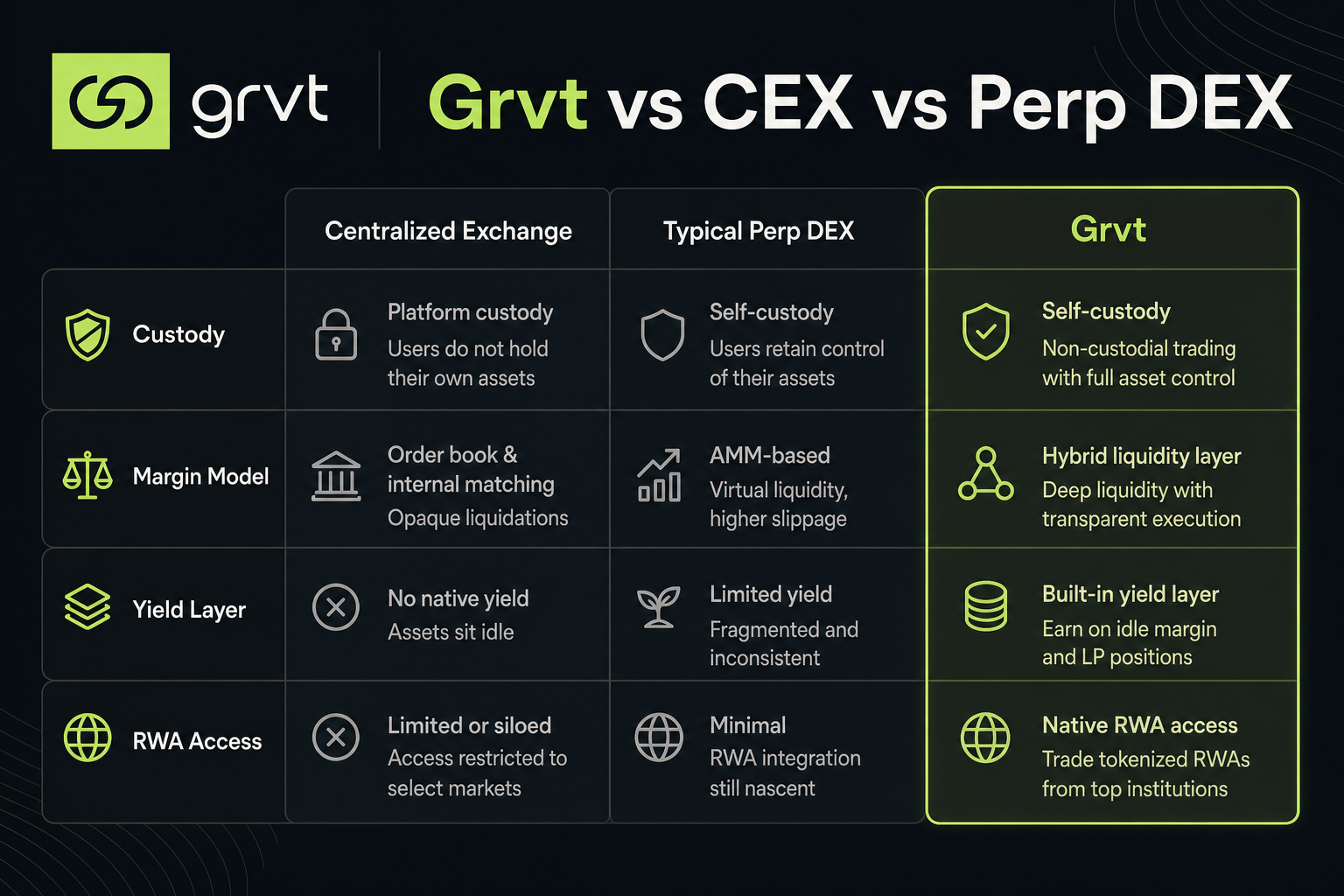 Figure 1. Comparison of Grvt, centralized exchanges, and typical perpetual DEXs in custody, margin, yield, and RWA integration.
What Is Grvt? Why Is It Frequently Compared to CEXs and Typical Perpetual DEXs?
Grvt is an on-chain trading and investment platform that goes beyond a single contract market by offering a unified account structure for trading, earning, and investing. The platform addresses not only whether users can open positions, but also whether trading capital must remain idle and if the yield module is siloed from the trading account.

This comprehensive approach is why Grvt is often compared with both CEXs and perpetual DEXs. CEXs represent the established, integrated custody experience, while perpetual DEXs embody on-chain, self-custodied derivatives trading. The Grvt trading process aims to merge on-chain account control with a nearly unified interface for capital orchestration.
What Are Traditional Centralized Exchanges and Typical Perpetual DEXs?
Traditional centralized exchanges usually hold user assets on the platform and use internal accounts for order placement, matching, settlement, and financial product segmentation. This unified access point offers convenience, but asset control, risk management, and product listing are mostly centralized under the platform operator.
Typical perpetual DEXs execute trading logic via on-chain smart contracts, with users connecting through self-custody wallets. The focus is typically on the perpetual contract itself. Protocols may use order books, vAMMs, or hybrid models, but most products are rooted in a single derivatives market—long-term integration of yield, investment, and accounts is rare.
Thus, when comparing Grvt to these alternatives, the critical evaluation is not interface similarity, but how accounts, margin, and product boundaries are defined.
How Do Custody Models Differ? Who Controls Assets and Bears Account-Level Trust?
Custody is the clearest differentiator among these models. Traditional CEXs use platform custody; perpetual DEXs rely on user self-custody; Grvt’s public framework emphasizes non-custodial or self-custodial account structures.
| Dimension |
Traditional Centralized Exchange |
Typical Perpetual DEX |
Grvt |
| Asset Custody |
Centralized platform custody |
User wallet self-custody |
Non-custodial account emphasis |
| Account Trust |
Platform ledger and operator |
On-chain contracts and wallet permissions |
On-chain accounts and platform risk controls |
| Key Risk Focus |
Custody and counterparty risk |
Contract, oracle, and liquidity risk |
Account structure, strategy, and contract risks |
Grvt is not a simple on-chain replica of a CEX. It preserves self-custody logic while delivering more integrated account management than most perpetual DEXs, introducing a new allocation of rights and responsibilities at the account level, rather than a binary choice.
What’s the Difference Between Unified Margin and Single-Product Margin? How Does Capital Efficiency Vary?
Unified margin and single-product margin differ in whether risk is assessed at the account level or on a per-market/module basis. While some CEXs offer unified accounts, these rely on platform custody. Perpetual DEXs typically manage collateral for a single protocol. Grvt’s unified margin mechanism is a core differentiator.
With unified margin, a single balance isn’t fragmented across multiple positions. The account acts as a net asset pool, not isolated sub-accounts, directly impacting how stablecoins, major assets, and yield balances are utilized.
| Margin Model |
Capital Utilization |
Typical Outcome |
| Single-product margin |
Collateral locked per module |
Funds are fragmented, more idle capital |
| Platform unified account |
Cross-market capital allocation, usually platform-custodial |
Centralized experience, control remains with platform |
| Grvt unified margin |
Unified capital assessment in a non-custodial context |
Same balance supports trading and yield |
Capital efficiency isn’t just about higher leverage; it’s about minimizing fund transfers, fragmentation, and idle time. Grvt’s advantage lies in account orchestration, not merely matching speed or trading pair variety.
Do Yield and RWA Modules Create Differentiation? Why Is This Critical?
Yield and RWA modules are major differentiators for Grvt compared to perpetual DEXs. Most perpetual DEXs focus on making trading more on-chain, transparent, or efficient, while yield generation and RWA access often require connecting to other protocols. Grvt builds yield and investment as extensions within the account system.
This integration means users don’t need to treat trading and investment as separate systems. On CEXs, yield and trading products may coexist, but always within the platform’s custodial framework. Unlike perpetual DEXs, Grvt’s yield layer is not a side page, but an extension of the main capital flow.
One Table to Understand Grvt, CEX, and Perpetual DEX Core Differences
| Comparison Dimension |
Traditional Centralized Exchange |
Typical Perpetual DEX |
Grvt |
| Core Positioning |
Custodial integrated trading platform |
Self-custody on-chain perpetuals |
Integrated trading, margin, and yield account |
| Asset Control |
Platform holds assets |
User wallet direct control |
Non-custodial account control |
| Margin Structure |
Centralized, platform-based |
Single-protocol trading module |
Unified margin for the same account |
| Product Boundaries |
Trading, finance, custody parallel |
Focused on perpetuals |
Trade, earn, invest in one path |
| RWA/Yield Integration |
Platform-dependent |
Often requires external protocols |
Clearly integrated into the application layer |
| Main User Considerations |
Platform credibility, product completeness |
Contract security, trading mechanism |
Account orchestration, capital efficiency, module integration |
Placed on an evolutionary spectrum, CEXs lean toward integrated, centralized accounts; perpetual DEXs toward on-chain, single-function protocols; Grvt seeks to blend integrated account experience with on-chain self-custody. These differences reflect distinct problem spaces rather than superiority.
Summary
The main distinctions between Grvt, traditional CEXs, and perpetual DEXs lie in custody model, account structure, margin design, yield integration, and RWA investment access. CEXs focus on unified platform management; perpetual DEXs on on-chain execution; Grvt unifies margin and yield modules within a non-custodial account framework.
Grvt’s uniqueness isn’t just being “another on-chain perpetuals platform,” but in extending capital efficiency from single trades to long-term account management. This is ultimately reflected in unified margin, trading flow, and yield integration within the account.
FAQ
How Is Grvt Different from Standard Perpetual DEXs?
Grvt’s primary distinction is its integration of non-custodial accounts, unified margin, and yield investment modules within a single account pathway, rather than organizing capital solely around a single derivatives market. Standard perpetual DEXs focus on trade execution, with yield and RWA typically requiring external protocols.
Is Grvt a Non-Custodial Platform?
Grvt is publicly positioned as a non-custodial or self-custodial account system, where user asset control differs from CEXs. Non-custodial does not mean risk-free—it means the custody relationship, permissions, and trust model are fundamentally different.
Is Grvt an Exchange or a DeFi Platform?
Grvt combines features of both a trading platform and a DeFi account system. It delivers an integrated trading experience, but with account control, yield integration, and capital orchestration that align more with on-chain composable accounts than traditional custodial platforms.
What Are the Risks of Using Grvt?
Users must understand trading risk, unified margin’s account-level risk, and contract, liquidity, and structural risks from yield and RWA modules. The more multifunctional the account system, the more critical it is to distinguish whether risks stem from matching, collateral management, or underlying asset mapping.
Is Grvt’s Unified Margin the Same as a CEX Unified Account?
Both aim to let a single fund pool support multiple positions and uses, but their trust structures differ. CEX unified accounts are based on platform custody and internal ledgers; Grvt’s unified margin is built on on-chain accounts and a non-custodial model. The comparison is not just about shared balances, but about underlying trust and architecture.