This article separates three layers readers often collapse: Gitcoin’s historical grants stack, Gitcoin 3.0’s multi-mechanism funding practice, and Techne’s local pilots. For a baseline definition of GTC and public-goods funding, start with Gate Learn’s existing Gitcoin (GTC) explainer; the goal here is boundary clarity for holders and researchers, not a price thesis.
Key Takeaways
- Techne is branded and legally framed as a separate initiative; Gitcoin DAO and GTC continue to govern Gitcoin itself.
- Forum guidance in October 2026 states GTC holders would not have economic interest in Techne and that no new Techne token is planned.
- Gitcoin 3.0 (illustrated by GG24) is about multi-mechanism, domain-led grants after Grants Stack sunset—not a rebrand of Techne.
- Quadratic funding is repositioned as a feature inside Buoy (local money), not a standalone Techne platform bet for 2026.
- Read governance proposals (governor upgrade, quorum changes) as Gitcoin DAO housekeeping, not as Techne equity events.
What Is Gitcoin Techne?
Techne (from the Greek idea of craft / knowing how to make) is the name Kevin Owocki and collaborators assigned in October 2026 to work previously described as a Gitcoin reboot, expanding the idea of craft to include practical knowledge and making. The stated job is helping people renegotiate their relationship with technology, with localism—neighbors, local events, local funding—as a practical chapter rather than only open-source grants, and to help people build local community ties while shaping a different future for technology use.
According to the October 2026 Techne update, Techne gets its own accounts, email, and brand, built fresh alongside Gitcoin’s. The DAO and GTC “keep doing what they do.” Owocki also said he would stop explaining Techne mostly through Gitcoin because new audiences may never have heard of quadratic funding.
A later clarification in the same thread frames Techne as a separate initiative planned as a 501(c)(3), developing local domestic use cases, with any Gitcoin funding contribution expected to be at arm’s length and subject to Gitcoin ratification. That legal structure helps determine the place Techne occupies relative to Gitcoin. That structure is educational context for readers parsing headlines—not investment advice.
Gitcoin 3.0 vs Techne: Two Different Layers
Gitcoin 3.0 is best read as Gitcoin’s own grants operating model after the May 2025 wind-down of Gitcoin Labs and Grants Stack, with its mechanisms set within a broader order for the post-sunset era. Gitcoin Grants 24 (GG24) is described as the inaugural round of that model: domain allocators, multiple mechanisms working as a series rather than a single model in parallel (quadratic funding, deep funding, MACI voting, conviction voting, retroactive funding, hypercerts, and others), and Gitcoin acting more as ecosystem coordinator than as the sole infrastructure operator.
Techne is not a synonym for GG24. Techne’s early product bets center on offline-local software loops and the tools being developed for local use cases: Beacon for local events and discovery, Buoy for local money (where quadratic funding is expected to live as a feature), plus storytelling and membership experiments. Launch was targeted for mid-December 2026 in the October update, with legal work called out as the most likely delay factor.
Readers who already studied Gitcoin 2.0 / Allo modularization should treat Allo’s later maintenance-mode status and Grants Stack sunset as infrastructure history. They explain why GG24 moved QF operations onto other platforms and why Techne’s local pilots are a different product surface, helping readers choose the right layer to analyze.
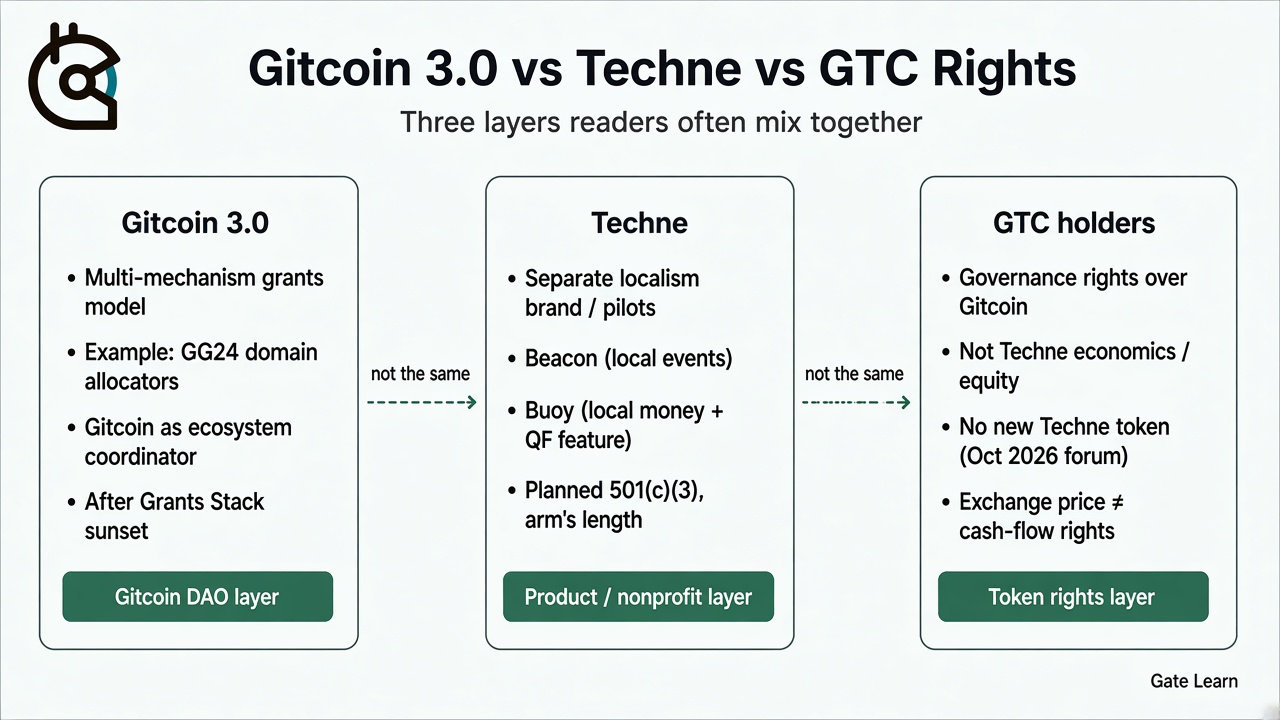
Figure 1. Gitcoin 3.0, Techne, and GTC rights as three separate layers (educational schematic; based on October 2026 forum clarifications).
What GTC Holders Still Control—and What They Do Not
GTC remains Gitcoin’s governance token for the Gitcoin DAO: the power to act on treasury, disputes, and protocol-level decisions that belong to Gitcoin. Holding GTC is therefore still about Gitcoin governance participation, not automatic equity in a new localism nonprofit brand.
Forum answers in October 2026 are explicit on two holder questions: there are no plans for a new token for Techne, and GTC holders would not have economic interest in Techne while keeping governance rights over Gitcoin—so Techne headlines should not be read as automatic GTC cash-flow rights. Any contribution from Gitcoin toward launching Techne’s foundation was described as something that may be proposed, announced with approximate amounts, and brought forward for support and ratification by Gitcoin—again at arm’s length.
This boundary matters when social feeds treat “Techne launch” as if it were a GTC cash-flow unlock. Educational reading separates: (1) Gitcoin governance process, (2) Techne product pilots, (3) secondary-market trading of GTC on exchanges. Only (1) is a direct GTC rights story, and only Gitcoin governance rights are true rights in this context; (2) is mission/product news; (3) is market behavior—this article does not cover trading advice.
Beacon, Buoy, and Where Quadratic Funding Goes
Beacon is described as a local events and discovery app. The October update reported an App Store release after sprint 4, a first in-person Beacon party with a very small sample, roughly eight engaged beta testers, and early connection anecdotes. The early result was directional only and did not justify a firm conclusion, so the authors treated the sample as too small for strong conclusions and planned city tests plus before/after baselines (time with other people, dollars spent at local shops) as a test designed to determine whether behaviors change.
Buoy is pilot 2, targeting November in that update. Quadratic funding is folded into Buoy instead of standing alone as a 2026 platform bet. The rationale given is that QF works best when communities are small enough that people actually know the projects, since local public goods dynamics are easier to observe there—hence “local money.” An SDK / local-AGI tooling track was deferred toward 2027 because staffing and resources shaped what was pushed back.
For readers who want the mechanism itself, Gate Learn already covers quadratic funding in the Gitcoin overview and related analysis pages. This section only maps QF’s roadmap role: from Gitcoin Grants flagship → multi-mechanism GG24 toolkit → Buoy feature inside Techne’s localism stack.
Gitcoin DAO Housekeeping Is Not Techne Equity
The same October window also brought a list of Gitcoin DAO operational items that are easy to misread as Techne tokenomics: a Governor upgrade path (Proposal Guardian, late-quorum protection, adjustable quorum), Snapshot quorum discussion (for example proposals to lower quorum from 2.5M to 1.5M GTC), with some items added to improve governance process rather than create Techne economics, Trust Graph v1 in shadow mode, and Allo.capital wind-down wiring. These belong to Gitcoin DAO security and participation design.
Separately, Allo Protocol is documented as having entered maintenance mode after Grants Stack wind-down: contracts remain deployed and forkable, while active development has ceased. That status update belongs in any 2026 Gitcoin product map so readers do not assume Allo is still the live product layer for every new round.
Treat DAO housekeeping as governance hygiene for GTC-weighted decisions. Treat Techne pilots as a neighbouring brand experiment. Conflating the two mixes governance cleanup with product speculation and recreates the FOMO narrative this article is meant to defuse.
How to Read Headlines Without Mixing Rights
Use a three-question checklist when a headline mentions Gitcoin, Techne, GTC, or a grants round:
- Entity: Is the subject Gitcoin DAO, a grants round (for example GG24), or Techne the separate initiative?
- Right type: Does the claim change GTC governance parameters, describe a product pilot, or imply cash-flow / ownership of Techne?
- Primary source: Can you point to gov.gitcoin.co, gitcoin.co campaign pages, or a ratified proposal—not only a derivative trading thread?
If the answer to (2) is “implied Techne economics for GTC,” compare it against the October forum clarification before treating the claim as fact. If the answer is “Gitcoin governance parameter,” read the proposal text and voting venue. If the answer is “local pilot progress,” expect small-sample language and legal-timeline caveats.
Summary
Gitcoin Techne is a separately branded 2026 localism initiative planned around a 501(c)(3) structure, with Beacon and Buoy as early pilots aimed at helping local communities build practical alternatives around technology, and with quadratic funding repositioned inside local money rather than as the sole platform story. Gitcoin 3.0 describes Gitcoin’s multi-mechanism grants practice after Grants Stack sunset. GTC continues to govern Gitcoin; official October 2026 statements say holders would not have economic interest in Techne and that no new Techne token is planned. Keep product news, DAO housekeeping, and secondary-market narratives in separate buckets so readers can tell which claims change GTC rights and which do not.
FAQ
What is Gitcoin Techne?
Techne is the name given in October 2026 to Gitcoin-adjacent reboot work focused on localism software and helping communities renegotiate their relationship with technology. It is framed as a separate brand and planned 501(c)(3) initiative centered on practical knowledge and community use, not as a rename of GTC.
Does Techne issue a new token?
Forum responses from Kevin Owocki in October 2026 state there are no plans for a new token. Always re-check the governance forum for later updates before relying on secondary summaries or social mentions.
Do GTC holders own Techne economics?
Official clarification in the Techne update thread states GTC holders would not have economic interest in Techne while continuing to hold governance rights over Gitcoin. Any Gitcoin funding application or contribution toward Techne’s foundation was described as arm’s-length and subject to ratification.
Is Gitcoin 3.0 the same as Techne?
No. Gitcoin 3.0 refers to Gitcoin’s multi-mechanism grants model, with examples such as GG24 domain allocators. Techne refers to the localism product and nonprofit initiative running pilots such as Beacon and Buoy. They occupy different places in the model, and readers should not cut that distinction when summarizing the roadmap.
Where do projects and quadratic funding fit after Grants Stack sunset?
In the October 2026 Techne roadmap, quadratic funding is described as one feature inside Buoy (local money), not the whole product, which helps determine its role after Grants Stack sunset rather than framing it as a standalone Techne platform bet. Gitcoin grants rounds may still use QF among other mechanisms under the Gitcoin 3.0 model.
Why did GTC react to Techne news on exchanges?
Secondary markets often reprice narratives quickly when a named product and launch window appear. That price behavior is not the same as a change in GTC cash-flow rights over Techne. This article explains the rights boundary; it does not give trading advice.