For teams running multiple strategies at once, capital split across separate accounts usually means underused margin and constant manual transfers. Unified Account structures exist precisely to solve that problem.
This article explains what a Unified Account is, how shared margin can improve capital efficiency, and the risk boundaries institutions should understand before adopting it.
Key Takeaways
- Unified Account is mainly about centralizing capital and risk views.
- Shared margin structures can reduce capital fragmentation across products.
- For multi-strategy teams, Unified Account can improve both capital efficiency and operating efficiency.
- Unified Account does not remove risk, but it can make risk management more centralized.
What Is Unified Account?
Unified Account usually refers to an account framework that consolidates capital, margin, and risk controls across products that would otherwise sit in separate balance pools. Instead of funding each product line in isolation, professional users can manage capital through a more integrated structure.
In practical terms, this helps a team use one broader account view instead of treating each product line as a separate operational silo. That matters for institutions because fragmented capital can slow execution, increase transfer friction, and make it harder to understand how much usable margin is available at a given time.
For a professional desk, that broader view is often the real definition that matters. A unified account is not simply a cosmetic dashboard change. It changes how users think about available collateral, margin efficiency, transfer timing, and the relationship between execution decisions and account-level risk.
Why Do Institutions Care About Unified Account?
Institutions often run several trading strategies at once. If each product requires a separate capital buffer, a large amount of idle capital can remain trapped in isolated accounts. Unified Account is valuable because it reduces that fragmentation and makes capital easier to allocate.
It also helps teams spend less time moving funds between internal buckets. When traders, treasury operators, and risk teams all need to use the same capital base, a unified structure can make day-to-day workflows easier to manage and easier to review.
This matters even more when a firm is active across several markets during the same trading session. Capital that stays trapped in separate sub-accounts may create delays exactly when a desk wants to react quickly. Unified Account is appealing because it helps institutions use the same operating pool more effectively instead of treating each product as a separate funding problem.
For many teams, the attraction is not only convenience but capital efficiency itself. When one account view supports multiple strategies, firms can assess how capital is performing across different positions, whether current usage is creating enough return, and where missed opportunities may be hidden by fragmented balances. That broader source of insights can improve decision quality without changing the underlying market risk, especially when one pool of capital can offset another desk's temporary funding pressure.
How Does Gate's Unified Account Improve Capital Efficiency?
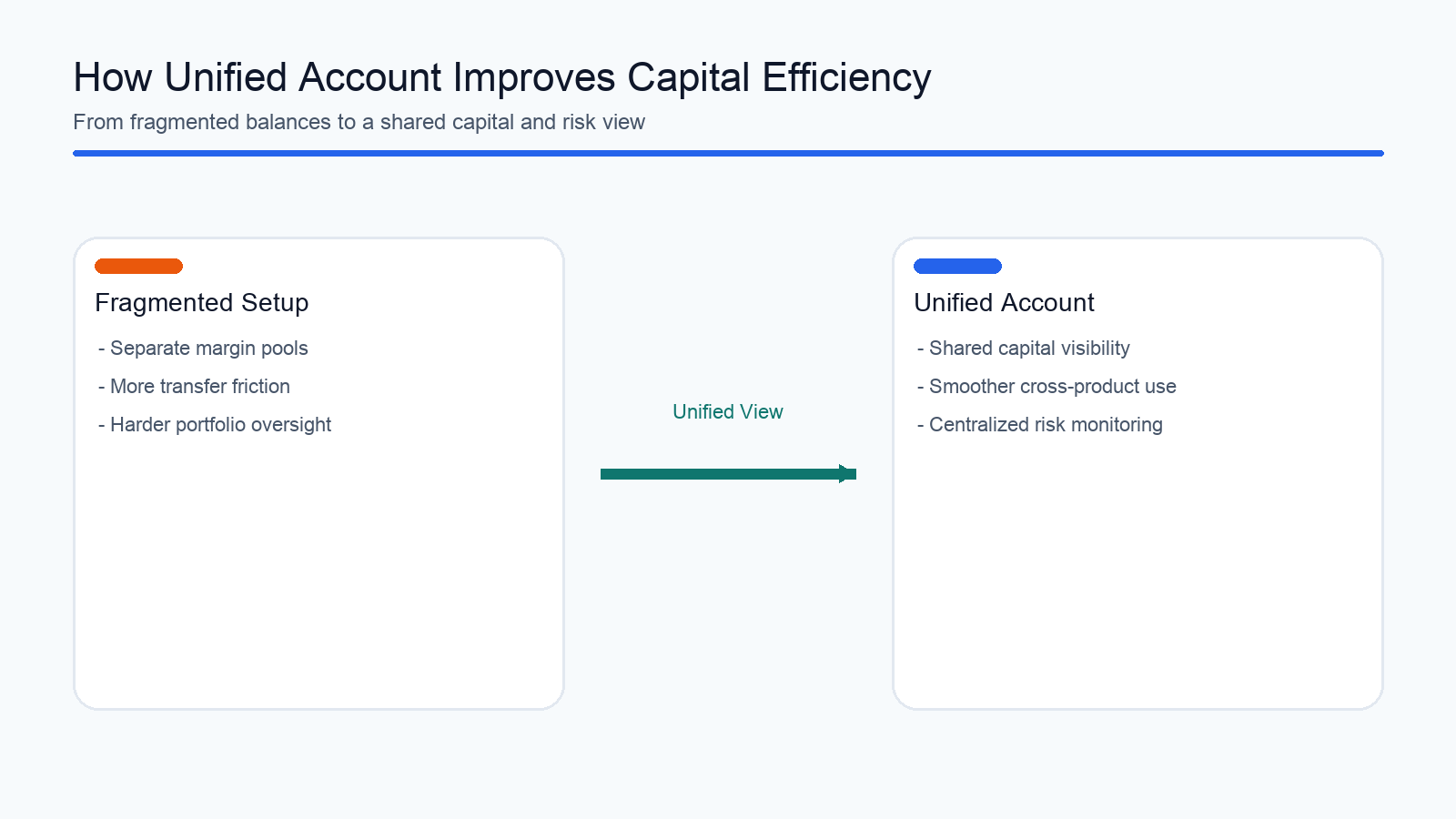
Figure 1. Unified Account improves capital efficiency by reducing fragmented balances and creating a more centralized view of capital and risk.
It Reduces Segmented Margin Usage
When margin can be managed more efficiently inside one framework, teams often do not need to reserve as much excess capital for each separate strategy bucket.
That does not mean firms should use more leverage by default. It means the same capital pool can be used more deliberately, with less duplication across products and less operational drag caused by idle buffers that are kept only because the account structure is fragmented.
Over time, this can improve planning quality. A team that does not need to overfund each product line separately may be able to review capital usage in a more disciplined way, reserve liquidity for higher-priority strategies, and reduce the amount of balance that sits unused simply because it was allocated to the wrong internal bucket.
This is also where capital efficiency becomes easier to measure in practice. Teams can calculate how much usable capital is available across current positions, compare that figure with expected return, and review whether excess buffers are offsetting flexibility rather than reducing risk. In that sense, Unified Account supports better performance review, not just simpler account management.
It Makes Cross-Product Operations Smoother
For teams that use spot, futures, or multiple execution products together, Unified Account can reduce the friction created by constant transfers and account switching.
This smoother experience becomes more important over time as a desk adds more products, more users, and more operational checks. A unified framework helps the team use capital with fewer interruptions and gives operators a clearer picture of how funds move through the trading workflow.
That smoother operation is not only useful for traders. It can also help finance, treasury, and support teams spend less time verifying where capital sits and more time reviewing whether the overall workflow is functioning as intended. In institutional environments, operational simplicity often matters almost as much as headline trading functionality.
It Creates a More Centralized Risk View
The point is not to erase risk. The point is to bring exposures, margin usage, and potential losses into a more unified monitoring view so teams can react more quickly.
That central view also helps with internal coordination. Risk managers need to know when exposure is growing, traders need to know how much room they have to act, and operations teams need enough visibility to support reconciliations and oversight without switching between disconnected account views.
From a governance perspective, this also makes review processes easier to standardize. When risk and capital information are easier to read in one place, it is usually easier to compare planned usage with actual usage and easier to spot when a strategy begins to consume more margin or create more concentration risk than expected.
This can be especially helpful during fast-moving markets. When volatility increases, teams often need to make decisions quickly while still keeping risk controls visible. A unified view does not remove uncertainty, but it can reduce the time needed to understand where the account stands and what capacity remains.
A more centralized risk view also improves the quality of management insights. Instead of reviewing each product in isolation, teams can evaluate how one set of positions may offset another, whether aggregate exposure still supports the intended strategy mix, and how capital usage today may affect tomorrow's flexibility. That is a practical source of value for firms that want better oversight without slowing down execution.
Which Use Cases Fit Unified Account Best?
Multi-Strategy Quant Trading
Quant teams running arbitrage, trend, market-making, or hedging strategies often benefit from a structure that allows smoother capital movement between strategies.
These teams often care about time as much as they care about headline efficiency. If capital has to be moved manually or checked across too many disconnected balances, execution speed can suffer. Unified Account helps reduce that operational lag.
It can also make strategy review more useful. When teams can see balances, margin use, and open positions in one place, they are better positioned to compare expected return with actual performance, identify which opportunities are worth funding, and understand whether capital is being consumed by the strategies that matter most.
Professional Trading Desks
Teams that move between markets frequently may use Unified Account to reduce account-level operational complexity.
For desks that use multiple products during fast market conditions, this can help preserve decision quality. Traders spend less time checking whether capital is parked in the right place and more time focusing on execution, risk, and timing.
Institutions That Need Centralized Risk Oversight
Asset managers and institutional desks often want a single risk view across multiple products, and Unified Account can support that goal.
This is especially useful when several people or teams need to use the same structure over time. A unified setup helps them stay aligned on capital usage, monitor limits more consistently, and use common operating rules when market conditions change quickly.
It also helps when institutions need to explain internal workflows clearly. A simpler structure makes it easier for stakeholders to understand who can use capital, when that capital can be deployed, and how risks are monitored across the broader account.
For firms with layered approval processes, that clarity can save time. A more consistent structure makes it easier to document operating assumptions, review changes in exposure, and compare current conditions with internal limits without moving between several disconnected balances.
It can also support better source-of-truth reporting. Instead of stitching together account notes from multiple systems, reviewers can discuss capital usage, open positions, offsetting exposures, and potential losses from a shared framework. That usually improves both oversight quality and meeting efficiency.
What Should Teams Evaluate Before Adopting Unified Account?
Before adopting a unified structure, teams should confirm whether shared margin logic fits their risk tolerance, whether their internal controls can support a centralized account model, and how cross-product risk transmission should be monitored.
They should also evaluate how the account will be used in practice. Questions such as who can use the structure, how often capital needs to move, what happens during volatile periods, and how quickly teams can review balances all matter when deciding whether a unified model is the right fit.
Another useful question is whether the team will actually use the extra flexibility well. Unified Account helps only when firms have clear rules for allocation, risk review, and escalation. Without that discipline, a more integrated structure may still create confusion even if it reduces technical friction.
Teams should also think about implementation time. Even when the account model itself is straightforward, institutions still need to decide how users will interact with it, what monitoring reports are required, and which internal reviews should happen before capital is shifted between strategies. Those process questions often determine whether a unified setup truly helps in daily use.
A final question is measurement. Teams should know how they will calculate capital efficiency, which metrics they will use to judge performance, and what threshold would trigger a review of current positions or capital allocation. Without that framework, it is harder to tell whether the unified structure is producing useful return or simply making the account feel simpler.
Summary
Unified Account is valuable not just because it reduces transfer steps, but because it creates a more integrated structure for capital and risk management. For professional teams that use multiple products and strategies, that structure can improve capital efficiency compared with fully segmented account models.
Used well, it helps institutions save time, use capital more deliberately, and maintain a clearer operating view across products. That combination is often why Unified Account becomes an important part of a broader institutional trading workflow.
For institutions evaluating Gate's broader ecosystem, Unified Account is one of the clearest examples of how platform structure can influence day-to-day efficiency. It shows how account design, not just market access, can shape execution quality, coordination, and capital use.
In that sense, Unified Account is best understood as an operating model improvement as much as an account feature. It helps institutions connect execution, monitoring, review, and capital allocation inside one clearer workflow.
The practical benefit is that teams can evaluate opportunities with better context. A unified account can reveal how capital supports current positions, how return compares with planned usage, and where the firm may be able to offset fragmentation without increasing unnecessary risk. That combination of structure and insight is the main reason institutions consider it a meaningful efficiency upgrade.
FAQ
How is Unified Account different from a regular account setup?
The main difference is that it integrates capital and risk management across multiple product lines instead of separating them completely.
Does Unified Account eliminate risk?
No. It mainly improves capital usage and risk visibility, but market risk still remains.
Who benefits most from Unified Account?
Professional users and institutions that trade across multiple products, move capital frequently, or want more centralized risk control often benefit the most.
The more often a team needs to use the same capital base across products, the more meaningful the benefit tends to become. Firms with multiple strategies, shared treasury functions, or frequent account-level monitoring needs usually see the strongest practical value.
That is why Unified Account is often discussed as a structural advantage rather than a minor convenience feature. For the teams that rely on it most, the real value comes from making capital easier to use, easier to review, and easier to coordinate over time.
It can also help teams use time more effectively by reducing repeated account checks and routine transfer decisions.
That operational clarity is one reason institutions continue to use unified structures as workflows become more complex.