Gate Staking and Gate Soft Staking both allow users to earn additional rewards from eligible crypto holdings, but they work differently. Gate Staking requires users to actively select and participate in a specific staking product, while Soft Staking focuses on a “hold and earn” model: once enabled, eligible holdings are automatically included in reward calculations based on the applicable rules.
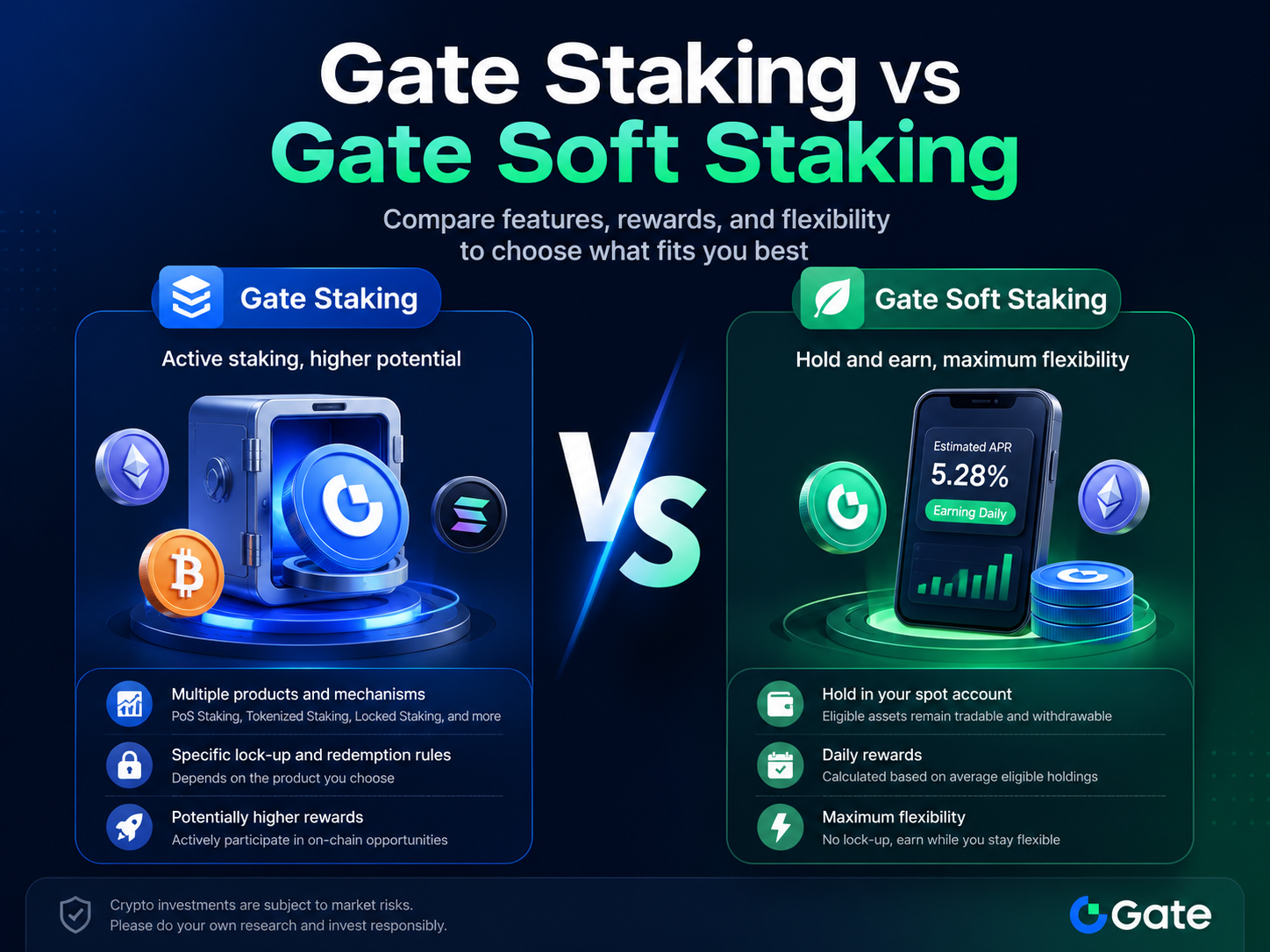
The most noticeable difference is how assets are used. Gate Staking products may involve Tokenized Staking, Locked Staking, or product-specific redemption mechanisms. Soft Staking does not require traditional lock-up, allowing eligible assets to remain available in supported accounts while rewards are calculated from qualifying balances.
As a result, there is no universal answer to whether Gate Staking or Soft Staking is better. Users who want to participate in a specific staking or on-chain yield mechanism may prefer Gate Staking, while those who prioritize liquidity and want eligible holdings to generate rewards with fewer manual steps may find Soft Staking more suitable.
Key Takeaways
-
Gate Staking requires users to actively select and participate in a specific staking product, while Gate Soft Staking automatically calculates rewards on eligible holdings after the feature is enabled.
-
Gate Staking covers multiple product mechanisms, including PoS staking, Tokenized Staking, and other asset-specific structures.
-
Soft Staking does not require traditional lock-up, giving eligible assets greater flexibility for trading, withdrawal, or other supported uses.
-
Gate Staking liquidity depends on the specific product, and some products may involve representative tokens, lock-up periods, or redemption waiting times.
-
Soft Staking rewards are calculated based on eligible average holdings and are generally distributed daily.
-
Estimated APRs for both products can change dynamically and should not be treated as guaranteed returns.
-
Soft Staking is generally more relevant for users who prioritize liquidity, while Gate Staking is designed for users who want to actively participate in specific staking products.
-
Both approaches involve crypto price, blockchain, protocol, liquidity, and product-rule risks.
What Are Gate Staking and Gate Soft Staking?
Gate Staking is a suite of products that gives users access to crypto staking and on-chain yield opportunities. Users select a supported asset and product, commit the corresponding crypto, and earn rewards according to the underlying mechanism and product rules.
Traditional staking is usually associated with Proof of Stake (PoS) networks, where assets are staked to support network consensus and validation in exchange for protocol rewards. However, Gate Staking covers a broader range of mechanisms, so users need to review the reward and redemption rules of each product individually.
Gate Soft Staking, by contrast, places greater emphasis on liquidity. After users enable Soft Staking, the system calculates rewards based on eligible holdings in designated accounts, with rewards distributed according to the applicable product rules.
One of the defining features of Soft Staking is that users do not need to move every eligible asset into a traditional locked staking position. Eligible holdings can remain available for supported account activities, providing a more flexible way to earn staking-related rewards.
Gate Staking vs Soft Staking: What Are the Main Differences?
The fundamental difference can be summarized as actively joining a specific staking product versus earning rewards from eligible holdings with greater flexibility.
Gate Staking requires users to select an asset and participate in a specific product. Depending on the product, this may involve Tokenized Staking, Locked Staking, or another on-chain staking structure. The status of the deposited asset and the exit mechanism therefore depend on the specific product.
Soft Staking works differently. Once the feature is enabled, eligible holdings in supported accounts can automatically participate in reward calculations without requiring users to subscribe to each eligible asset separately.
| Category |
Gate Staking |
Gate Soft Staking |
| Participation |
Actively select and join a specific product |
Enable the feature and earn on eligible holdings |
| Asset location |
Depends on the specific staking product |
Remains in eligible designated accounts |
| Lock-up |
Depends on product rules |
No traditional lock-up |
| Asset flexibility |
Depends on product and asset structure |
Eligible assets remain more flexible |
| Reward calculation |
Depends on the specific product |
Based on eligible average holdings and APR |
| Reward distribution |
Varies by product |
Generally distributed daily |
| Exit mechanism |
Redemption follows product rules |
Changes in holdings affect future rewards |
| Typical use case |
Participating in a specific staking product |
Earning while maintaining greater asset flexibility |
Although both products provide staking-related rewards, the user experience is therefore quite different. Gate Staking is more product-oriented, while Soft Staking is more closely integrated with users’ existing eligible holdings.
How Does Gate Staking Generate Rewards?
The source of Gate Staking rewards depends on the asset and product selected.
For PoS assets such as ETH and SOL, underlying staking rewards are generally connected to blockchain consensus. Staked assets contribute to network operation or validation, while the protocol distributes rewards according to its rules.
Some Gate Staking products use Tokenized Staking. These products represent a staking position through another token or asset. Rewards may accumulate through token distributions, changes in conversion value, or another mechanism rather than simply appearing as a fixed daily payment of the original asset.
Not every asset available through Gate Staking uses native PoS staking. BTC, for example, uses Proof of Work (PoW), so BTC-related staking products rely on different underlying mechanisms rather than native Bitcoin validator staking.
Estimated APRs can also change as network rewards, staking participation, product incentives, and other conditions evolve. The displayed APR should therefore be treated as a reference rather than a guaranteed future rate.
How Are Gate Soft Staking Rewards Calculated?
Soft Staking uses a more standardized reward calculation based primarily on the user’s eligible average holdings and the applicable APR.
Once Soft Staking is enabled, the system takes snapshots of eligible balances according to the current product rules and uses them to determine the user’s average qualifying holdings.
A simplified daily reward formula is:
Daily Reward = Average Eligible Soft Staking Holdings × APR ÷ 365
For example, if a user has an average eligible balance of 10 ETH and the applicable APR is 3%, the theoretical daily reward would be approximately:
10 × 3% ÷ 365 ≈ 0.000822 ETH
The actual reward depends on the applicable APR, eligible balance snapshots, and current product rules. Soft Staking APRs can also change over time, so a rate displayed today should not be used as a guaranteed projection for an entire year.
Why Is Gate Soft Staking More Flexible?
One of the main features of Soft Staking is that it does not require users to place eligible assets into a traditional locked staking position.
Eligible assets remain in designated accounts and can continue to be used for supported activities such as trading or withdrawal. Users therefore do not generally need to complete a conventional unstaking process before accessing the assets.
However, this does not mean that every asset displayed in an account will continuously earn Soft Staking rewards. Rewards depend on eligible average holdings. If users sell, transfer, or otherwise reduce their qualifying balance, subsequent reward calculations will change accordingly.
Assets that are frozen or otherwise excluded under the applicable rules may also not count toward rewards. “Flexible” therefore means that the assets are not subject to a traditional staking lock-up, rather than that the same assets can always be used elsewhere while simultaneously generating rewards.
This structure can be particularly useful for users who want to maintain access to their holdings while still earning rewards when those assets are eligible.
How Liquid Is Gate Staking?
Gate Staking does not have one universal liquidity rule because different products use different asset structures and redemption mechanisms.
For conventional PoS staking, the underlying blockchain may impose an unstaking or withdrawal period. This means users may need to wait for the network or product redemption process before the original asset becomes fully available again.
Tokenized Staking can approach liquidity differently. Users may receive a token representing the staking position, potentially giving the position additional utility while the underlying assets continue participating in the staking mechanism.
Locked Staking products may have specific holding periods or redemption conditions, making their liquidity different from both Tokenized Staking and Soft Staking.
Gate Staking should therefore not automatically be described as “locked,” but neither should every Gate Staking product be assumed to provide the same level of asset availability as Soft Staking. Users need to check the redemption mechanism of the specific product they plan to use.
Which Has a Higher APR: Gate Staking or Soft Staking?
There is no fixed rule stating that Gate Staking or Soft Staking always provides the higher APR.
Gate Staking APR depends on the specific asset, underlying blockchain, product structure, staking participation, and applicable incentives. Different PoS networks can have significantly different native staking yields, while Tokenized Staking products may use additional reward mechanisms.
Soft Staking APR also varies by asset and can change with network staking yields, market conditions, and product parameters.
For this reason, users should not compare the two products only by looking at which one currently displays a higher APR. A more useful comparison includes APR, liquidity, reward calculation, redemption conditions, and the expected holding period.
A higher APR also does not necessarily mean a higher overall investment return. Crypto price declines, liquidity changes, and other market risks can outweigh the value of staking rewards.
Which Is Better for Users Who Trade Frequently?
For users who frequently need access to their crypto holdings, Soft Staking generally offers greater flexibility by design.
Because eligible assets do not need to be placed into a traditional locked staking position, users can continue using qualifying holdings for supported activities. If the user sells or transfers part of the position, the eligible average balance and subsequent rewards adjust accordingly.
For example, a user may hold ETH in an eligible account but still expect to adjust the position when market conditions change. Soft Staking allows qualifying holdings to participate in reward calculations without requiring the user to complete a separate traditional unstaking process before making every adjustment.
Gate Staking may be more suitable when a user has already decided to allocate part of a portfolio to a particular staking product. In this case, the user can compare the product’s APR, underlying mechanism, and redemption conditions before committing the assets.
The key difference is therefore liquidity preference rather than simply the level of rewards.
Which Is Better for Long-Term Crypto Holders?
Both products can be relevant for long-term holders. The main question is whether the user wants to actively allocate assets to a specific staking product or keep them more readily available.
If a user expects to hold ETH, SOL, or another supported asset for an extended period without actively trading it, a Gate Staking product may provide more direct exposure to the corresponding staking or on-chain yield mechanism. The user can evaluate the product based on its APR, underlying structure, and redemption terms.
If the user plans to hold the asset long term but still wants it readily available for trading or withdrawal, Soft Staking may provide a more flexible structure.
Rewards distributed through Soft Staking can also become part of subsequent eligible balances when the applicable rules allow, creating a compounding effect over time.
Long-term holding alone therefore does not determine which product is more suitable. Liquidity requirements, supported assets, reward mechanisms, APR, and exit plans all need to be considered.
How to Use Gate Staking and Gate Soft Staking
To use Gate Staking, users can visit the Gate Staking page and review currently supported assets, estimated APRs, reward assets, and product types. After selecting an asset, users can check the participation requirements and redemption mechanism before staking.
For Soft Staking, users can visit the Gate Soft Staking page and enable the feature. Eligible assets can then participate in reward calculations according to the current rules.
Soft Staking generally reduces the need to subscribe to each eligible asset individually. Once the feature is activated, supported holdings in designated accounts can be included automatically, although individual assets may still have minimum balance requirements, maximum eligible amounts, or other conditions.
For both products, users should check the latest supported assets, APRs, minimum participation amounts, reward rules, and redemption conditions before participating, as these parameters can change over time.
What Are the Risks of Gate Staking and Soft Staking?
Both approaches involve the price risk of the underlying crypto asset. Even when staking rewards increase the number of tokens held, a significant decline in the asset’s market price can reduce the total position value when measured in USDT or fiat currency.
Gate Staking may also involve product-specific liquidity and underlying mechanism risks. PoS staking can involve network unstaking periods, while Tokenized Staking can introduce representative-token, conversion-rate, liquidity, and protocol considerations.
Soft Staking offers greater liquidity but does not provide fixed or guaranteed returns. APRs can change, supported assets and eligible balance limits can be adjusted, and trading or transferring assets can reduce the qualifying balance used for reward calculations.
Both products should therefore be viewed as ways to manage existing crypto holdings rather than as reasons to acquire more of an asset solely for yield. Potential rewards should be evaluated together with asset-price risk, liquidity requirements, and the user’s broader risk tolerance.
Gate Staking vs Soft Staking: Which Should You Choose?
Gate Staking may be more relevant for users who want to actively participate in a specific staking or on-chain yield product. Users can select an asset and product and participate according to its PoS, Tokenized Staking, Locked Staking, or other supported mechanism.
Soft Staking may be more relevant for users who prioritize liquidity. Once enabled, eligible holdings can participate in reward calculations while remaining more readily available for supported account activities.
A simple way to compare the two is:
| User Need |
Product to Consider |
| Want to actively select a specific staking product |
Gate Staking |
| Want eligible assets to remain more flexible |
Soft Staking |
| Frequently trade or adjust positions |
Soft Staking |
| Comfortable with product-specific redemption rules |
Gate Staking |
| Want fewer manual subscription steps |
Soft Staking |
| Interested in a specific Tokenized Staking product |
Gate Staking |
This comparison describes the product mechanisms rather than recommending one based on potential returns. The appropriate choice depends on the assets held, current APRs, product rules, and individual liquidity requirements.
Summary
Gate Staking and Gate Soft Staking both allow eligible crypto holdings to generate staking-related rewards, but they use different asset-management models.
Gate Staking focuses on actively selecting specific products. Users allocate assets to the corresponding staking mechanism, while rewards, representative assets, and redemption rules depend on the individual product.
Soft Staking emphasizes flexibility. Once enabled, the system calculates rewards based on eligible holdings without requiring a traditional lock-up, allowing qualifying assets to remain more accessible for supported uses.
The key question is therefore not simply which product offers a higher APR. Users should compare liquidity, supported assets, reward calculations, underlying mechanisms, and redemption conditions before deciding which approach better fits how they plan to use their crypto.
FAQ
What is the main difference between Gate Staking and Soft Staking?
Gate Staking requires users to actively select and participate in a specific staking product, while Soft Staking calculates rewards on eligible holdings after the feature is enabled without requiring traditional lock-up.
Does Gate Soft Staking require a lock-up?
Gate Soft Staking does not require a traditional lock-up. Eligible assets can remain available in supported accounts, although changes in qualifying holdings will affect subsequent reward calculations.
Does Gate Staking always require locking assets?
No. Whether Gate Staking involves a lock-up depends on the specific product. Tokenized Staking and other products may use different liquidity and redemption mechanisms, so not every Gate Staking product should be treated as fixed-term staking.
How are Soft Staking rewards calculated?
Soft Staking daily rewards are generally calculated using the user’s average eligible holdings and the applicable APR, commonly expressed as: average eligible holdings × APR ÷ 365.
Which has a higher APR, Gate Staking or Soft Staking?
There is no fixed answer. APRs vary by asset, network conditions, and product rules, so users should compare the specific products available at the same time rather than assuming one category always offers higher yields.
Which is more suitable for frequent traders, Gate Staking or Soft Staking?
From a product-mechanism perspective, Soft Staking generally provides greater flexibility because eligible holdings do not require traditional lock-up and can remain more readily available for supported trading or withdrawal activities.