Gate Pre-Market Trading and spot trading differ in what is actually traded: pre-market trades PreTokens—platform-bound credentials minted by staking USDT that represent a claim on an upcoming token—while spot trading buys and sells the real, already-listed token with full on-chain withdrawal rights.
Both mechanisms live inside the same exchange account, but they serve different stages of a token's lifecycle. Pre-market trading happens before the official listing and centers on early price discovery, delivery obligations, and session-based trading; spot trading begins after listing and centers on continuous exchange of the actual asset. Readers who want the full mechanics of PreToken minting, delivery, and settlement can refer to the Gate Pre-Market Trading pillar; this comparison focuses on how the two trading modes differ in structure, settlement, order flow, and risk. It also helps investors verify whether they want early exposure before the market open of a listed token or direct ownership after listing.
Traditional finance uses pre-market and after-hours sessions for listed securities such as stocks, but Gate's crypto pre-market works at an earlier stage. The name is similar, yet the open time, settlement logic, and what traders actually hold are different. That difference matters when investors compare hours, sessions, and risks across asset classes.
Key Takeaways
- Gate Pre-Market Trading deals in PreToken credentials minted against staked USDT; spot trading deals in the real, listed token itself.
- PreTokens cannot be withdrawn or transferred and are cleared after settlement; spot tokens can be withdrawn on-chain and traded continuously.
- Pre-market settlement follows a snapshot and delivery deadline backed by collateral; spot settlement is effectively instant at trade execution.
- Pre-market suits users seeking early exposure before listing; spot suits users who want immediate ownership and deeper liquidity.
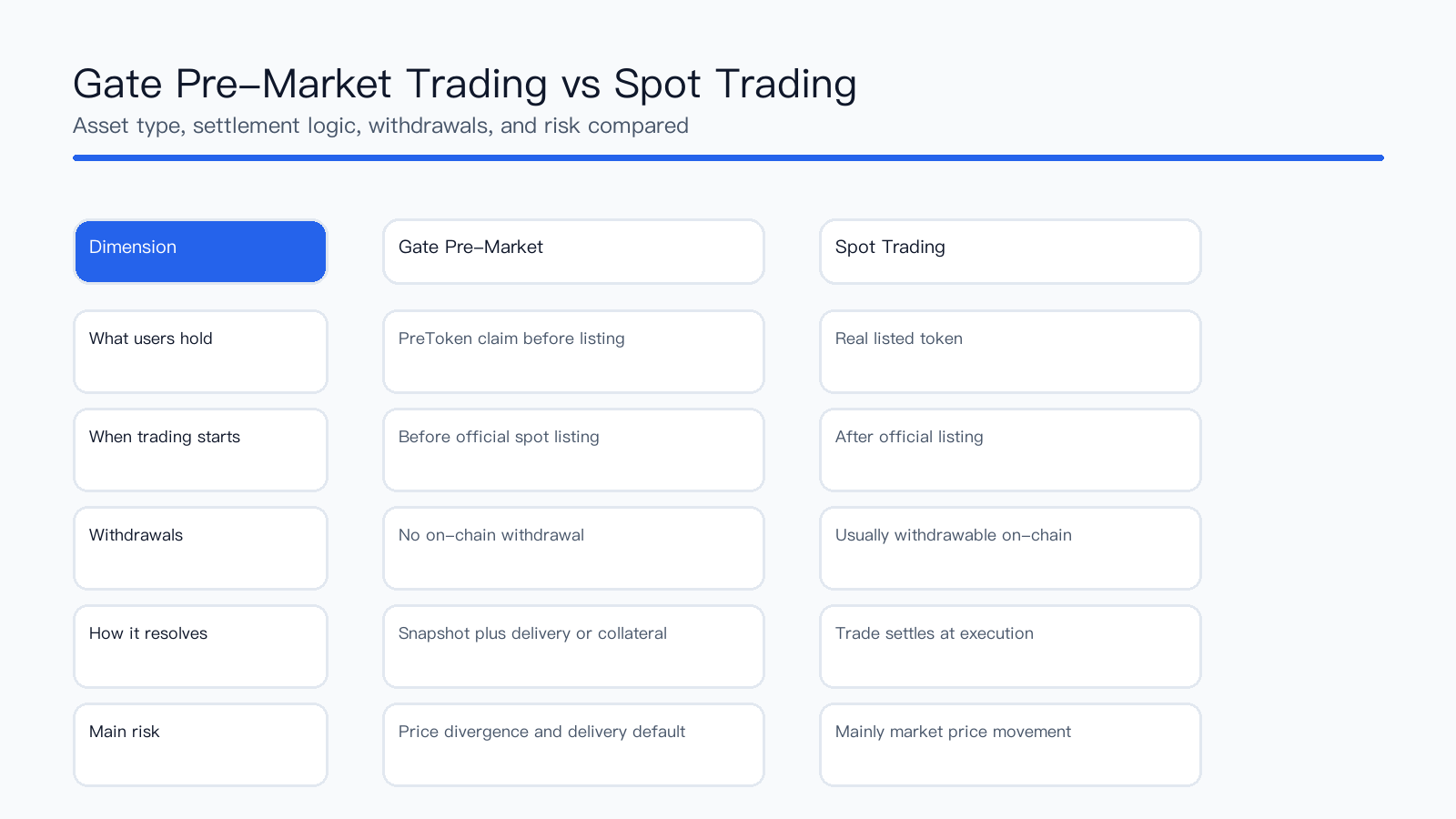
| Feature |
Pre-Market Trading |
Spot Trading |
| What you trade |
PreToken credential minted by staking USDT |
Real, already-listed token |
| Timing |
Before official listing |
After official listing |
| Withdrawals |
Not allowed; PreTokens stay on Gate |
On-chain withdrawals supported |
| Settlement |
Snapshot plus delivery deadline |
Instant at execution |
| Counterparty structure |
Minter collateral backs delivery |
Direct buyer-seller matching |
| Liquidity |
Thinner, early market |
Deeper, continuous market |
| Main risk |
Delivery default and price divergence |
Market price risk |
The table shows that the two modes are not simply "early" and "late" versions of the same trade. They differ in the asset being exchanged, the settlement guarantees behind it, and the risks each side takes on. The sections below break down each dimension.
What Is Gate Pre-Market Trading?
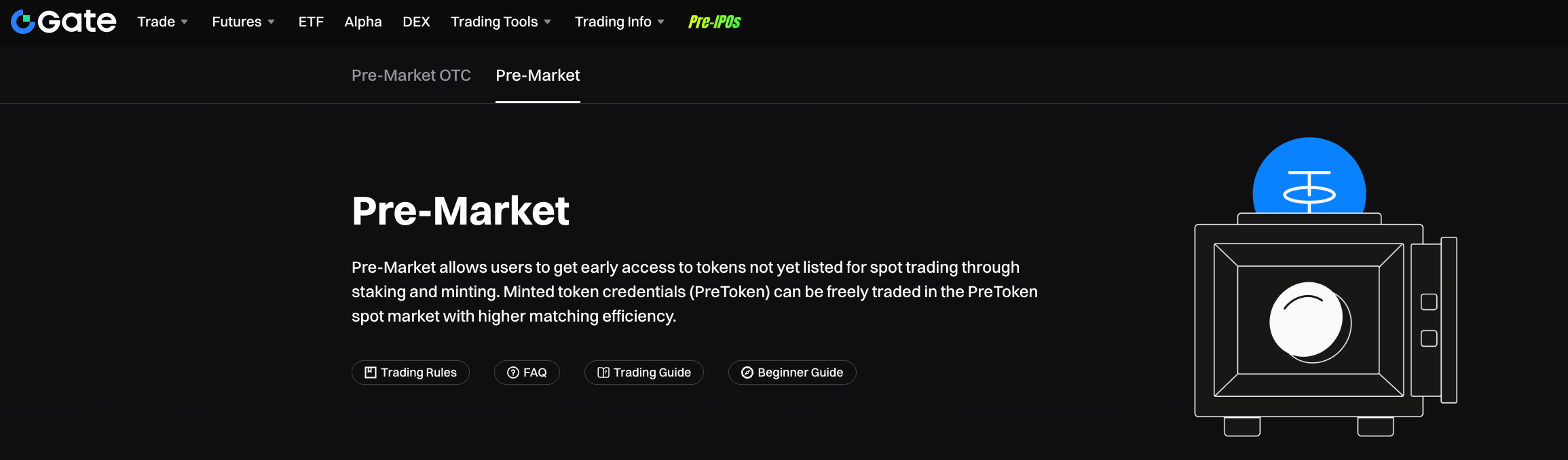
Gate Pre-Market Trading is a pre-listing mechanism in which users stake USDT to mint PreTokens, then trade those PreTokens in a dedicated pre-market spot market with limit and market orders. A PreToken is a credential representing a claim on a token that has not yet officially listed; it is not the token itself.
PreTokens are platform-bound. They cannot be withdrawn to an external wallet and cannot be transferred outside Gate. Minters carry a delivery obligation: they must deliver the real project tokens before the settlement deadline in order to redeem their staked USDT. If delivery fails, the staked collateral is forfeited and distributed to PreToken holders according to a holdings snapshot, after which the PreTokens are cleared.
What Is Spot Trading?
Spot trading crypto means buying and selling the real, already-listed token on the regular spot market. Ownership transfers at execution, and the purchased tokens belong to the buyer immediately.
Spot tokens can be withdrawn on-chain to an external wallet, traded continuously around the clock, and typically benefit from deeper liquidity and tighter spreads because the full market participates after listing. The dominant risk is market price movement rather than delivery or counterparty structure.
Pre-Market vs Spot: What You Actually Trade
The core difference between pre-market and spot trading is the object of the trade. In pre-market, the buyer acquires a credential that settles into the real token only after a successful delivery; in spot, the buyer acquires the token itself at the moment of execution.
This is also where the contrast with adjacent products matters. Launchpool, for example, is a subscription-style mechanism in which users stake assets to earn new-token rewards; it does not create a tradable credential market at all. In launchpool vs pre-market terms, launchpool is fundraising-style distribution, while pre-market is credential trading with a delivery obligation attached. Neither should be confused with buying the real token on spot.
Pre-Market vs Spot: Price Discovery and Liquidity
Pre-market price discovery happens in a thin, early market formed before the token's full supply and full participant base are available. PreToken prices reflect early expectations about the listing and can diverge meaningfully from the eventual spot price once the token lists and deeper liquidity arrives. Because these sessions open before the real token begins continuous trading, traders often face wider spreads, less depth, and more sensitivity to news or abrupt order imbalances.
Spot price discovery happens with full market participation. More buyers, sellers, and market makers produce deeper order books, narrower spreads, and prices that incorporate broader information. A pre-market price is best read as an early signal, not as a guarantee of where spot will trade. In traditional stock sessions, investors often watch pre-market and after-hours data to verify sentiment before the opening bell; in crypto pre-market trading on Gate, the equivalent question is whether the early session reflects likely listing demand or only a brief pocket of thin liquidity.
Pre-Market vs Spot: Settlement, Withdrawals, and Risk
Pre-market settlement is event-based. A snapshot records PreToken holdings, minters must deliver the real tokens before the settlement deadline, and successful delivery lets minters redeem their staked USDT. Failed delivery triggers forfeiture, and the collateral is distributed to PreToken holders per the snapshot; the PreTokens are then cleared.
Spot settlement is continuous and effectively instant. The trade executes, the token changes hands, and the buyer can withdraw on-chain without waiting for a settlement event.
The risk profiles diverge accordingly. Pre-market adds delivery-default risk and price-divergence risk on top of ordinary market risk; if a minter fails to deliver, PreToken holders receive collateral rather than the token they expected. Spot trading carries mainly market risk, because the asset is real, delivered at execution, and freely withdrawable. Investors should also verify session timing, available order types, and whether thin pre-market hours create additional execution risks that would not appear once the token is fully open on the spot market.
Which Should You Choose?
Choose pre-market trading if the goal is to gain early exposure to a token before its official listing, to participate in early price discovery, or to position ahead of listing volatility—and if the delivery-default and price-divergence risks are understood and acceptable. Users who want to understand the participation flow can review How to participate in Gate pre-market trading.
Choose spot trading if the goal is to own the actual token immediately, withdraw it on-chain, trade continuously in a deeper market, and avoid settlement and counterparty-structure complexity. Some investors prefer the clarity of an already open market with more active traders, more visible order depth, and fewer session-specific constraints. Neither mode is universally better; the right choice depends on timing, objectives, risk tolerance, and whether the trader wants a pre-listing opportunity or a fully open market.
Summary
Gate Pre-Market Trading and spot trading serve different stages of a token's lifecycle. Pre-market trades PreToken credentials minted against staked USDT in a thin pre-listing market, with settlement enforced by collateral, a snapshot, and a delivery deadline; PreTokens cannot be withdrawn and are cleared after settlement. Spot trading exchanges the real listed token instantly, with on-chain withdrawals and deeper liquidity.
The practical dividing line is what the trader wants to hold: an early, collateral-backed claim on a future token, or the token itself. Understanding that distinction—along with the settlement mechanics and risk profile of each mode—is the foundation for choosing between them.
FAQ
What is the difference between pre-market and spot trading?
Pre-market trading deals in PreToken credentials that represent a claim on a token before it lists, while spot trading deals in the real, already-listed token. Pre-market uses collateral-backed delivery and snapshot settlement; spot settles instantly and supports on-chain withdrawals.
Is pre-market trading safe or risky?
Pre-market trading carries additional risks beyond normal market risk, including delivery-default risk—where a minter fails to deliver the real token and holders receive forfeited collateral instead—and price-divergence risk between the thin pre-market and the eventual spot price. These risks are structural and should be understood before participating.
Can PreTokens be withdrawn to an external wallet?
No. PreTokens are platform-bound credentials that cannot be withdrawn or transferred outside Gate. After settlement completes, PreTokens are cleared and replaced by the delivered tokens or distributed collateral.
What happens if a PreToken minter fails to deliver the real tokens?
If a minter does not deliver the real project tokens before the settlement deadline, the minter's staked USDT collateral is forfeited and distributed to PreToken holders according to the holdings snapshot.
How is launchpool different from pre-market trading?
Launchpool is a subscription-style mechanism in which users stake assets to earn new-token rewards, while pre-market trading is a credential market in which PreTokens are minted against staked USDT and actively traded. Launchpool does not create a tradable credential; pre-market does.
When does spot trading become available for a pre-market token?
Spot trading becomes available once the token officially lists on the Gate spot market. At that point the real token trades continuously with full withdrawal support, and the earlier pre-market PreToken market has already been settled and cleared.