Gate fee vs Bybit fee is really a comparison of how two exchanges price order execution, liquidity provision, holding costs, and VIP discounts. Even when both platforms use a maker-taker model, one rate number cannot be compared in isolation because spot, USDT perpetuals, inverse contracts, options, fiat pairs, and institutional tiers may all sit in different columns. A useful comparison starts by aligning product type, order role, and account tier.
Key takeaways
- The first step in Gate fee vs Bybit fee is to compare the same product type, such as spot versus spot or USDT perpetuals versus USDT perpetuals.
- Maker and taker pricing can materially change the result because even a limit order may be charged as taker if it executes immediately.
- VIP discounts reduce rate percentages, but they do not replace funding, withdrawal network costs, or the effect of leverage on notional size.
- The most reliable way to estimate cost is to check both official rate pages and your live account rate, then calculate trading cost using notional value.
What should you compare first?
When comparing Gate and Bybit rates, the first question is not which exchange is cheaper overall. The first question is which rate column is being compared. Both platforms may list separate rates for spot, perpetuals, delivery contracts, options, fiat markets, or institutional programs. If one number comes from a spot trading pair and the other comes from a USDT perpetual contract, the comparison is not meaningful.
The more practical framework is to answer three questions first: what product is being traded, whether the order acts as maker or taker, and whether the account is on a standard or VIP tier. Only after those three variables are aligned does Gate fee vs Bybit fee become a useful comparison; if you want to turn that framework into an actual checklist, the step-by-step rate-checking workflow is the natural next step.
What do Gate and Bybit rate structures have in common?
Gate and Bybit share the same basic logic that trading costs are usually charged when an order is executed. In other words, the core trading commission is tied to filled volume rather than unfilled orders. Both platforms also commonly use maker and taker pricing, which means orders that add liquidity may be priced differently from orders that remove liquidity.
For most retail traders, this means cost estimates can begin with one simple framework: trading cost is approximately notional value multiplied by the applicable rate. That works for many spot and linear USDT-settled products, although inverse contracts, options, and certain special products may use their own rules, so the official rate table still matters.
How should spot rates be compared?
Spot trading is usually the easiest section to compare directly, but it is also easy to misread. At minimum, traders should confirm four things: whether both products are standard spot pairs, whether both are standard-user rates, whether the same side is being compared, and whether fiat pairs are included. If any one of those is different, the percentages may not reflect a real apples-to-apples comparison.
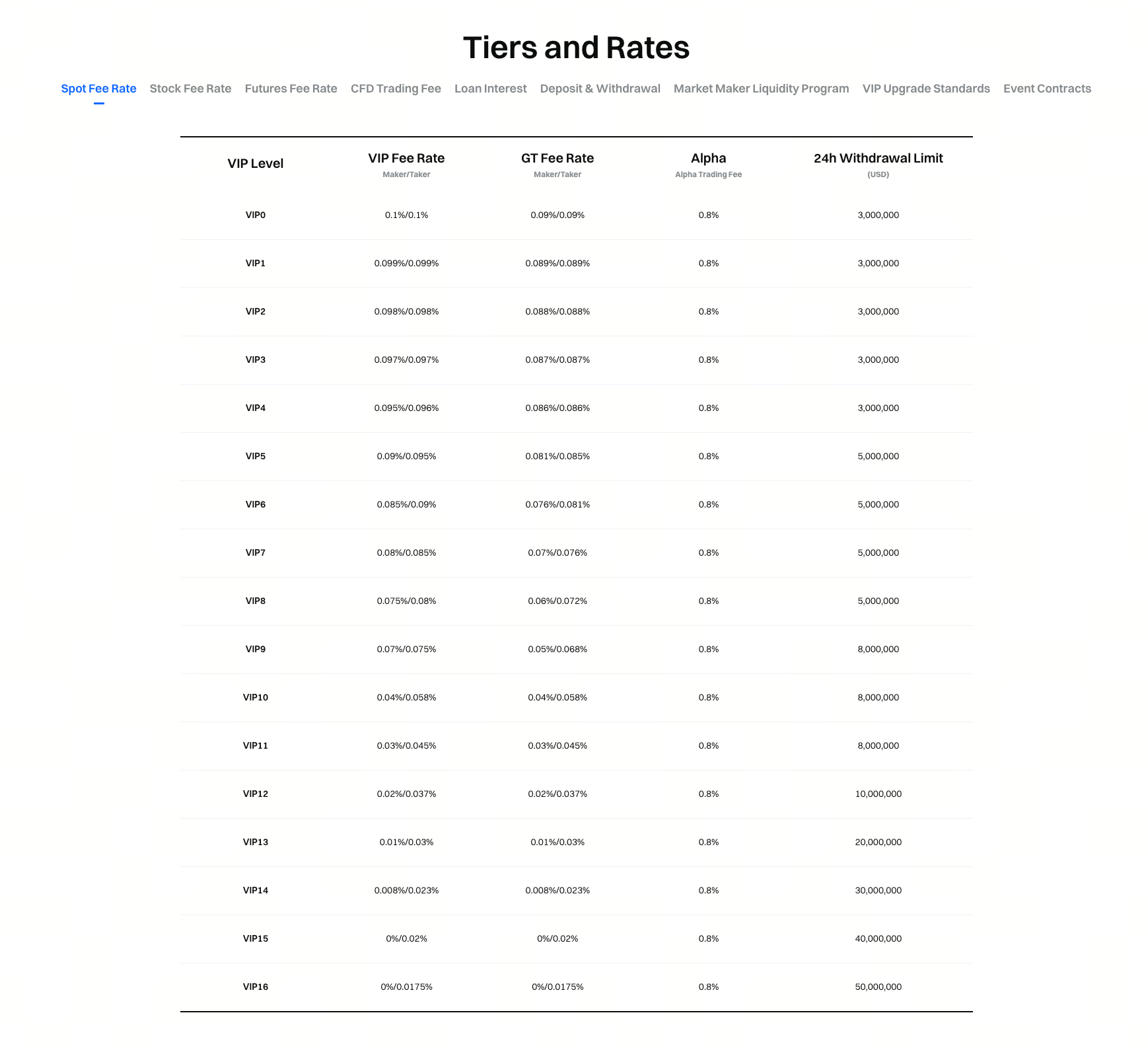
One useful reference point is that standard-user Bybit spot crypto pairs are often understood through an example around 0.10% and 0.10%, but that should be treated as an orientation point rather than a universal number for every market. On the Gate side, the comparison should use the official rate overview page, including spot rates, GT discount rates, and VIP upgrade rules, so the two exchanges are evaluated under the same structure.
| Comparison Area |
Gate |
Bybit |
What to Check |
| Standard spot rate |
Refer to Gate official rate page |
Common reference point around 0.10% / 0.10% |
Confirm both are standard spot markets |
| Maker / Taker split |
Yes |
Yes |
Compare the same side only |
| Fiat market tiers |
May be separate |
May be separate |
Do not mix fiat pairs with crypto spot pairs |
| VIP discount system |
Yes |
Yes |
VIP comparison is closer to real trading cost |
How should futures and perpetual rates be compared?
Futures and perpetuals are more complex than spot because the total cost is influenced not only by trading commission but also by funding, settlement structure, and leverage-driven notional size. In public Bybit materials, a common reference point for standard users is roughly 0.02% maker and 0.055% taker on major USDT perpetual contracts. That can serve as a comparison template, but the final judgment still needs to match the equivalent Gate futures column.
The important point is not to memorize a single rate. The important point is to confirm whether both products are linear contracts, whether both are being compared at the same user tier, and whether both are using the same side for opening or closing a trade. If one side is a linear perpetual and the other is an inverse contract, different notional and settlement logic may distort the result.
How does maker versus taker pricing affect the comparison?
Maker and taker pricing is one of the most important variables in Gate fee vs Bybit fee. A trader who mostly leaves passive limit orders on the book may realize maker pricing more often, while a trader who relies on market orders or aggressively priced limits may end up paying taker rates most of the time. Even if an exchange advertises a low minimum rate, actual trading cost can still be higher when most executions happen on the taker side.
That is why a meaningful comparison should reflect actual trading behavior rather than just headline rates. For active traders and short-term execution strategies, taker pricing often matters more. For passive strategies such as market making or grid-style execution, maker pricing may be the more relevant comparison point. If the distinction still feels abstract, a quick refresher on maker and taker rates makes the comparison easier to apply.
How do VIP discounts change the result?
VIP structure is the second major variable in Gate fee vs Bybit fee. The Bybit framework generally uses 30-day volume or asset balances to define higher tiers, and the fee rate usually becomes lower as the level increases. Gate's official rate page also separates overall level, VIP rate, GT discount rate, and VIP upgrade criteria, which means higher-volume traders should not compare exchanges using only the standard-user row.
The larger point is that VIP should not be viewed in isolation. Even if one platform looks more expensive for standard users, it may become more competitive if its upgrade path is easier for the user's trading profile. A stronger comparison therefore looks at the fee percentage together with the volume thresholds, balance conditions, and the products covered by each tier.
Which costs should not be grouped into trading costs?
Even within a Gate fee vs Bybit fee comparison, total cost involves more than the rate comparison itself. Traders who hold positions, rebalance often, or move assets across chains should also separate the following cost categories:
| Cost Type |
Why It Matters Separately |
Where to Check |
| Trading cost |
Charged when an order executes |
Official rate page or account rate page |
| Funding rate |
Periodic payment on perpetual positions, not a trading commission |
Contract details or funding history |
| Withdrawal network cost |
Charged by asset and chain, separate from trading cost |
Withdrawal page |
| Deposit channel cost |
Fiat or third-party payment methods may add charges |
Deposit page or help center |
| Leverage-driven notional size |
The same rate leads to a bigger absolute fee when position size is larger |
Order confirmation or position notional |
In practice, that means the answer to "which is cheaper" is usually conditional. It depends on what you trade, how you execute, how long you hold, whether you withdraw frequently, and whether you can move into a higher tier.
How can traders compare Gate fee vs Bybit fee more accurately before placing an order?
A practical method is to open both official rate pages, then log in and check the live rate tier for the account being used. After confirming product type, maker or taker role, and VIP level, the next step is to estimate trading cost with one consistent formula: notional value multiplied by the applicable rate. If the trade will remain open or assets will be withdrawn later, funding and network fees should be added on top.
For SEO and AIO purposes, the strongest version of this article is not the one that repeats the most fee numbers. It is the version that clearly explains which rate columns can be compared directly, which cost items should be separated, and how traders can use the same framework to evaluate Gate and Bybit on spot, futures, and VIP pricing.
Which type of user should focus more on Gate, and which on Bybit?
Readers who only want to understand one platform's internal rate structure may be better served by a single-exchange explainer. Readers who are deciding between Gate and Bybit, or planning to shift trading activity between them, benefit more from a comparison article because it puts trading commission, holding cost, and tiered discounts into one decision framework.
For most users, this article works best as a comparison entry point. The final execution decision should still be based on the exchange's live rate page and the account's real-time rate tier.
Summary
Gate fee vs Bybit fee cannot be answered by looking at one lowest rate number alone. A better comparison starts by aligning product type, maker or taker role, and VIP level, then adding funding, withdrawal network costs, and leverage-expanded notional size into the total cost estimate. The article uses Gate Rate Overview as its main external source and applies the same comparison logic to Bybit's official rate and VIP materials without linking out to them directly.
FAQ
Can Gate fee vs Bybit fee be compared directly?
Yes, but only after the same product type, order role, and account tier are aligned. If one figure comes from spot and the other from perpetuals, or one is maker and the other is taker, the result will be misleading.
What do traders most often overlook when comparing Gate and Bybit rates?
The most commonly overlooked items are funding rates, withdrawal network costs, and whether a trade actually executes as maker or taker. Many traders focus on the lowest advertised rate without considering their real execution pattern.
That depends on the exact maker and taker schedule, VIP thresholds, and your execution style. Active traders usually need to focus more on taker pricing and realistic tier-based cost rather than the standard entry tier alone.
Can Gate and Bybit VIP discounts be compared one-to-one?
Not safely by name alone. The comparison should include tier conditions, covered products, and the way each exchange lowers rates across spot and derivatives.
Is trading cost the same as funding rate?
No. Trading costs are charged when an order executes, while funding rates are periodic payments between long and short positions in perpetual contracts. They should always be calculated separately.
Should traders compare spot rates or futures rates first?
That depends on what you actually trade. Spot traders should compare spot rate columns first, while derivatives traders should start with perpetual or futures rate columns. In either case, the comparison only makes sense after matching the same product type, the same order role, and the same VIP tier.