Event trading typically begins with an assessment of a particular outcome. Market participants may focus on Bitcoin price movements within a specific time window, whether a macroeconomic indicator meets expectations, or how a real-world event will ultimately develop, and select the corresponding contract according to market rules. Unlike traditional spot trading, event contracts create trading markets around clearly defined questions and outcome conditions. Users need to assess not only the possible outcome of an event, but also how the contract defines the event, how it is priced, and the criteria used for final settlement.
For a trading platform, a user's assessment of an event does not mean the participation experience ends there. Events in the market continue to evolve, and new contracts may emerge around different topics and time windows. Users may enter the market because of a specific event, then continue exploring other contracts after completing a trade. How to connect a single trade with ongoing market exploration has gradually become part of the event trading product experience.
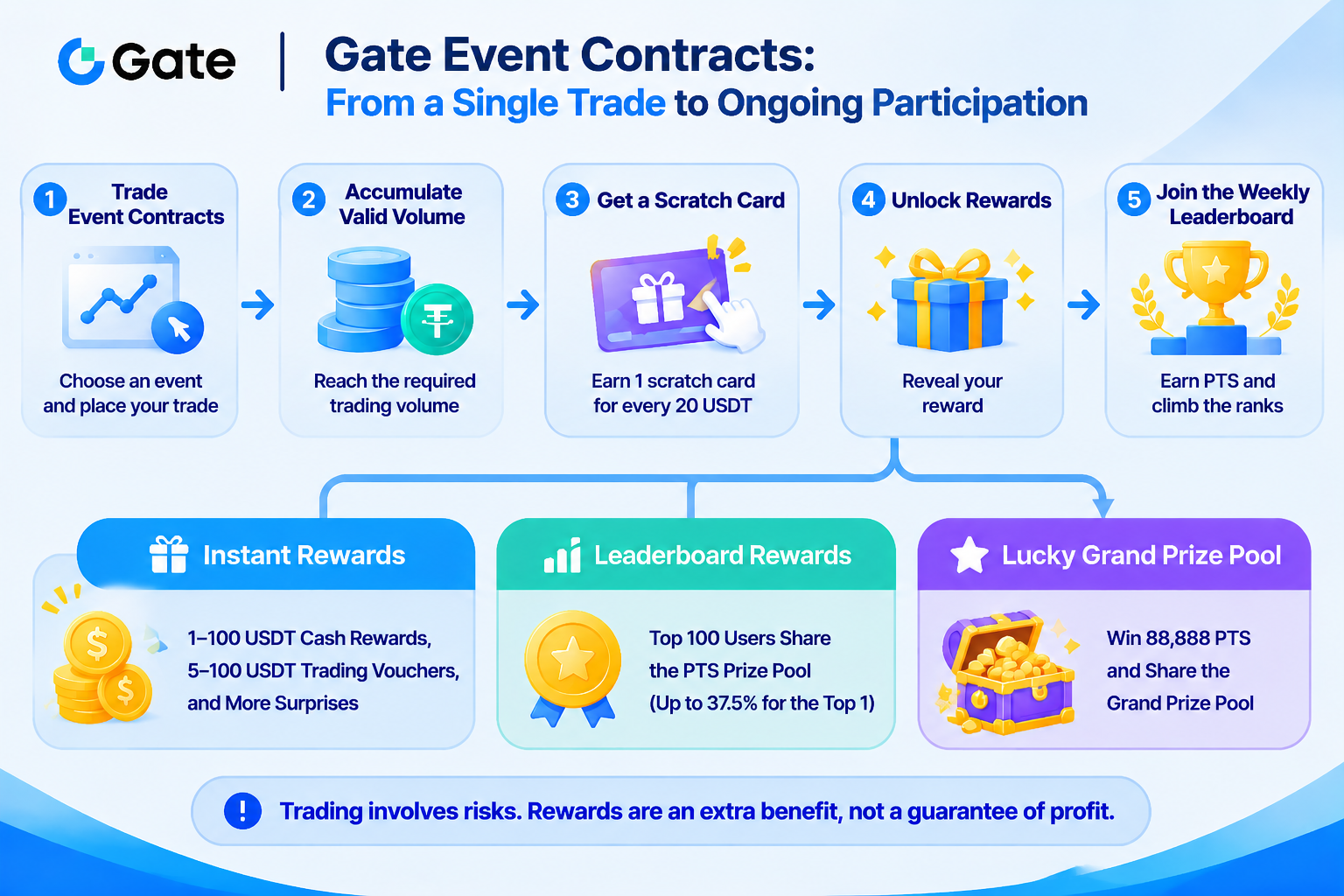
Gate has incorporated Event Contract Trading into its Event Points system, further expanding this participation path. Eligible event contract trades can accumulate valid trading volume. Each time users reach the specified volume threshold, they can receive a Scratch Card and may unlock USDT, PTS Event Points, trading trial vouchers, and other rewards. PTS obtained through Scratch Cards are also included in the weekly points leaderboard, allowing users to participate in periodic points rankings beyond a single trade.
This mechanism connects trading, immediate rewards, and weekly rankings, but these three elements do not follow the same return logic. Profit or loss from event contracts is determined by contract prices, trading direction, and settlement rules. Scratch Card rewards depend on the event mechanism and the actual Scratch Card result. Leaderboard rewards depend on points accumulated during the ranking period and final ranking. Understanding these differences is the starting point for understanding Gate's Event Contract Points system. This article analyzes the trading characteristics of event contracts, how the points system works, reward structures, and ranking-period rules, while discussing how users can establish a more reasonable participation rhythm.
Key Takeaways
-
Event contracts trade specific event conditions: Users need to understand the contract question, outcome options, observation period, and settlement criteria, rather than simply assessing the long-term trend of an asset
-
Eligible trades can earn Scratch Cards: Under the current event rules, every 20 USDT in valid event contract trading volume earns 1 Scratch Card
-
Rewards come in different forms: Scratch Cards may unlock USDT, PTS Event Points, trading trial vouchers, and other rewards. Each reward type has different purposes and restrictions
-
PTS is connected to the weekly leaderboard: Event Points obtained through Scratch Cards are included in the current ranking period, and users can participate in the points prize pool distribution based on their final ranking
-
Event rewards are not the same as trading returns: Scratch Cards and points are additional incentives and do not change an event contract's profit or loss, settlement conditions, or trading risks
Event Contracts Are Not Only About Predicting Outcomes, but Also Assessing Event Conditions
The core of an event contract is the conversion of a future event into a tradable instrument with clearly defined rules. Unlike directly holding a digital asset, event contracts generally establish trading directions and settlement conditions around a specific question. Users need to assess whether a particular outcome will occur or whether an indicator will reach a specified range. Market prices reflect participants' expectations for different outcomes, as well as supply and demand formed by buyers and sellers under current market conditions. Therefore, the trading logic of event contracts involves not only directional assessments, but also an understanding of the event definition, observation period, and settlement basis.
For example, with a short-term BTC price movement event contract, users are not focused solely on Bitcoin's long-term value, but on price changes within a specific time window. Information updates more quickly in short-term markets, and price movements, market liquidity, and trading timing can all affect contract prices. Even if a user correctly assesses BTC's overall trend, that does not necessarily mean they can accurately assess the outcome within a particular short-term period. In contrast, contracts based on macroeconomic data, policy developments, or other real-world events may rely more heavily on the timing of the event, official data sources, and market rules. Different contracts have different assessment criteria, so the same trading approach cannot be applied indiscriminately.
Therefore, before participating in event contracts, users should first understand what they are trading. Users should review the contract question, available outcomes, trading deadline, settlement time, outcome determination criteria, and price data source. It is especially important to note events with similar wording but different conditions. For example, "whether a price reaches a certain level during a period" and "whether the price closes above that level at a specific time" may lead to entirely different settlement outcomes. Only by clearly understanding the contract conditions can users assess whether the current market price aligns with their expectations and reduce trading errors caused by misreading the rules.
Another characteristic of event contracts is that participation rhythms may differ significantly across markets. Some events have clearly defined short cycles, with outcomes potentially determined within a relatively short period. Other events may require waiting for macroeconomic data releases, policy developments, or real-world events to unfold. Short-term contracts place greater emphasis on understanding time windows and price changes, while longer-term contracts require attention to event developments and uncertainty. For new users, starting with event types they understand and learning how markets are priced, how trades are executed, and how outcomes are settled can help build a stable understanding more effectively than participating in many different types of markets at once.
From Trading to Rewards: How the Event Points System Connects Participation
The most direct change in this feature upgrade is that event contract trading has officially entered the reward scope of Gate's Event Points system. The existing mechanism of "trade to earn cards, scratch cards to claim rewards, and earn points for the leaderboard" now further covers event contract scenarios. Under the current event rules, users can receive 1 Scratch Card for every cumulative 20 USDT in eligible event contract trading volume. Users do not need to complete a separate registration process for this reward entry. Eligible trades accumulate qualification according to the event mechanism.
This design separates trading participation and reward collection into two related but distinct stages. Users must first complete eligible trades and accumulate valid trading volume. Once the corresponding threshold is reached, the system issues a Scratch Card. Users then unlock specific rewards by using the Scratch Card. A Scratch Card does not mean that every trade directly receives a fixed amount, nor does it mean that trading principal or contract returns are protected. It is more like a reward credential linked to valid trading activity, and the actual reward received depends on the Scratch Card result.
The automatic eligibility mechanism reduces additional registration steps and makes the participation path easier to understand. After confirming the event rules, entering an eligible event contract market, and completing valid trades, users can qualify for Scratch Cards according to system rules. However, "no additional registration required" does not mean users do not need to review the event conditions. Users should still confirm the event scope, how valid trading volume is calculated, participation eligibility, and reward claim methods to avoid assuming that ineligible trades can accumulate event progress.
From a product experience perspective, the points system does more than add another reward layer. Event markets are highly thematic and time-sensitive. Users may enter the market because of a trending event and stop following other contracts after completing a single trade. After event contracts are included in the points mechanism, users can gradually learn about other contract types on the platform while following different events, and can also review their participation through the points leaderboard. Trading rewards therefore serve as a supporting mechanism that connects different market scenarios, but they should not replace a user's assessment of the event itself or become a reason to trade frequently just to reach a threshold.
What Rewards Are Available Through Scratch Cards? Different Roles of Immediate Rewards and Points Accumulation
According to the event rules, each eligible and successfully obtained valid Scratch Card may unlock one reward. Reward types include 1–100 USDT cash rewards, 1–88,888 PTS Event Points, 5–100 USDT trading trial vouchers, and other surprise rewards such as iPhone Duo. Different rewards have different purposes and eligibility conditions: USDT cash rewards are asset rewards; PTS Event Points are used to participate in points leaderboard rankings; trading trial vouchers must be used according to the rules of the applicable product; and physical or other surprise rewards may involve additional claim and distribution conditions.
Event Points are a key part of this upgrade. PTS obtained through Scratch Cards are automatically included in the current ranking period's points and used to participate in the weekly points leaderboard. This is a separate calculation system from profit or loss on contract trades: contract trading results depend on market prices, the user's trading direction, and settlement rules, while points are generated through the event mechanism and included in the ranking period based on Scratch Card results. Even if a user receives points, this does not indicate that an event contract trade has been profitable. Conversely, generating returns from a contract trade does not mean the user will necessarily receive a specific amount of event points.
The event also includes a Super Lucky Prize mechanism, through which users may receive 88,888 PTS from a single Scratch Card and participate in sharing the current Lucky Prize Pool. These rewards add variety to the event and introduce an element of randomness to Scratch Card results. However, users should view them as additional reward opportunities rather than expected fixed returns. Different rewards may have different distribution conditions, usage periods, or applicable scopes. After receiving a reward, users should review their account records and the corresponding rules to confirm whether the reward has been credited, how it can be used, and whether any validity restrictions apply.
For trading trial vouchers, users should pay particular attention to the difference between the voucher's face value and actual realizable returns. Trial vouchers are generally subject to specified trading products, usage periods, scopes of use, and settlement rules, and should not simply be treated as freely withdrawable USDT. For PTS, users should also pay attention to their purpose in the event and their validity during the ranking period, rather than treating the number of points as a fixed cash value. The more diverse the reward types, the more important it is for users to review the specific details after claiming a reward to avoid misunderstanding their actual benefits because of similar reward names.
How Does the Weekly Leaderboard Work? Understanding Ranking Periods, Resets, and Prize Pool Distribution
Gate's Event Points event uses a weekly ranking period mechanism. Under the current event rules, the previous points leaderboard is settled every Monday at 18:00 (UTC+8), and a new event period begins at the same time. Event Points obtained through Scratch Cards during the current ranking period are included in that period's leaderboard. After the ranking period ends, the system determines reward distribution based on final rankings. The top 100 users on each points leaderboard can share the points prize pool according to their rankings, with the top-ranked user eligible to receive up to 37.5% of the points prize pool. This means the event provides not only individual Scratch Card rewards, but also a recurring competitive objective for users who continue participating.
The ranking period mechanism requires particular attention to two time points: the settlement time and the start time of the new period. Every Monday at 18:00 (UTC+8) marks both the end and settlement of the previous period and the start of a new period. If users receive points near settlement, they should confirm which ranking period the points are actually credited to. After a new period begins, new points enter the new ranking cycle. Because points for the current period are automatically reset after each settlement, users cannot treat points from the previous period as a long-term balance that can be accumulated indefinitely for future periods. Ranking competition is based on points earned during the current period, so participation across periods requires users to accumulate points again.
Scratch Cards are also subject to ranking period restrictions. According to the event rules, unused Scratch Cards expire when each period is settled. Therefore, users should not hold Scratch Cards for an extended time, but should monitor the event cycle and card status and use them within the time permitted by the rules. If a user receives a Scratch Card near the end of a ranking period but does not use it within the specified time, they may not be able to retain it for the next period. Points resets and unused card expiration are two rules that can be easily overlooked when understanding the event rhythm.
Leaderboard rewards and the Lucky Prize Pool use different distribution logic. Under the current event rules, Gate contributes a fixed 10,000 USDT to each period. Each successfully scratched Scratch Card also adds an additional 0.1 USDT to the prize pool. Of the current prize pool, 80% is used for points leaderboard rewards, while the remaining 20% enters the Lucky Prize Pool. The former is distributed based on ranking-period rankings, while the latter is related to the Super Lucky Prize mechanism. If no user receives the Super Lucky Prize during a period, the Lucky Prize Pool automatically rolls over to the next period and continues accumulating. In other words, the points leaderboard and Lucky Prize Pool are not the same reward account, and users should understand their reward sources and eligibility conditions according to their respective rules.
For new users who want to participate in the leaderboard, a more reasonable approach is to first understand ranking period schedules and points rules, then decide how frequently to participate based on their own trading plan. Leaderboard rewards are competitive by nature, and final distribution depends on participation during the current period and points results. Users should not infer final returns solely from a ranking at a particular moment. Users should also not increase their trading volume to pursue a ranking, as event points cannot offset potential losses from contract trading. Treating the points leaderboard as an additional participation objective rather than the sole basis for trading decisions can help manage risk.
How Can New Users Get Started? Understand Contracts First, Then Learn the Points Mechanism
For users trying Gate event contracts for the first time, it may be helpful to start with a market theme they already understand. If they regularly follow BTC market movements, they can first view BTC Price Movement Event Contracts to understand the questions posed by contracts, trading directions, price changes, and settlement times. For example, Gate provides access to short-term BTC price movement event contracts, where users can view specific contracts and their trading rules on the market page. When using the feature for the first time, there is no need to rush into multiple markets. Users should first understand the complete process for one contract, from selection and order placement to holding and settlement.
After becoming familiar with contracts, users should review the Event Points event page to understand which event contract trades qualify as valid trades, how valid trading volume is calculated, and the Scratch Card standard for every 20 USDT in volume. Users should also confirm the start and end times of the current ranking period, Scratch Card usage period, how PTS is credited, and reward claim conditions. This allows users to understand trading rules and event rules separately: the former determines how contract trading itself works, while the latter determines how eligible trades receive additional rewards. Both sets of rules need to be understood. Users should not review only the reward details while overlooking the contract terms.
If users want to participate in weekly points rankings, they can monitor changes in their points and leaderboard position during the event, but do not need to treat ranking changes as a target that must be pursued. Leaderboard positions can be affected by changes in other participants' points, and a short-term ranking does not represent the final result. Users can arrange trades according to their own understanding of the market and risk tolerance, rather than continually increasing the number of trades to receive more Scratch Cards or points. Especially for short-term contracts, frequent trading may amplify assessment errors, trading costs, and the effects of short-term volatility.
New users should also pay attention to account and reward records. After completing eligible trades, users can check whether Scratch Cards have been credited. After using a Scratch Card, they should confirm the reward type, quantity, and applicable rules. If they receive PTS, they should verify that it has been correctly included in the current ranking period. For trading trial vouchers or other rewards, users should further review the validity period and applicable products. If there are issues such as delayed points display, rewards not being credited, or uncertainty about whether trades count toward valid trading volume, users should refer to the Gate event page and Help Center instructions and verify through official support channels rather than relying solely on community discussions.
Make Rewards a Supporting Experience, Not the Starting Point for Trading Decisions
The Event Points system upgrade provides richer participation feedback for Gate event contracts. Users can receive Scratch Cards through eligible trades, access different types of rewards through Scratch Cards, and participate in weekly leaderboards through PTS. Immediate rewards, periodic rankings, and the Lucky Prize Pool create event experiences at different levels and allow users to continue participating in Gate's event contract ecosystem while following different events.
However, no reward event should change a user's fundamental assessment of trading risks. Event contract trading results are determined by market rules and event settlement. Short-term markets in particular may be affected by price volatility, liquidity changes, and unexpected information. Valid trading volume is the basis for calculating reward eligibility, not a trading target that users should pursue. Entering trades that users do not understand in order to receive Scratch Cards, or increasing positions to improve leaderboard rankings, may turn the reward mechanism from an added experience into an additional source of risk.
A more reasonable way to participate is to first choose events that users can understand, carefully read the contract rules, and then decide whether to trade according to their individual plans. After completing a trade, users can treat Scratch Cards and points as an additional event experience. If they want to participate in the leaderboard, they should understand ranking-period changes, points resets, and card expiration rules in advance, then arrange their participation accordingly. Users should always use their own risk tolerance as a boundary and should not view event rewards as principal protection, fixed returns, or compensation for trading losses.
From a product development perspective, integrating event contracts into the Event Points system means that Gate has incorporated more trading scenarios into a unified user incentive mechanism. For users, this provides a new entry point to learn about event contracts, explore different markets, and participate in platform events. For the event market ecosystem, it also creates a closer connection between trading, rewards, and continued participation. As product features and event mechanisms continue to improve, users can gradually explore more event trading scenarios based on a full understanding of the rules, rather than making decisions solely around a single trending event or individual trade.
FAQ
Can Gate event contract trading now earn Event Points Scratch Cards?
Yes. Under the current event rules, eligible event contract trades have been included in the Event Points system. Users can receive 1 Scratch Card for every 20 USDT in valid trading volume. Specific calculation methods and applicable scope are subject to the event page.
Is separate registration required to participate in the Event Contract Points event?
According to the current event details, after event contract trading is connected to the points system, eligible trades can accumulate Scratch Card eligibility without additional registration. However, users should still review the event page to confirm participation eligibility, applicable markets, and other specific rules.
What rewards can be obtained through Scratch Cards?
Rewards include 1–100 USDT cash rewards, 1–88,888 PTS Event Points, 5–100 USDT trading trial vouchers, and other surprise rewards such as iPhone Duo. The actual reward associated with each valid Scratch Card is determined by the Scratch Card result.
When is the Gate Event Points leaderboard settled?
The event uses a weekly ranking period mechanism. The previous period is settled and a new period begins every Monday at 18:00 (UTC+8). The top 100 users on each points leaderboard can share the points prize pool according to their final rankings, with the top-ranked user eligible to receive up to 37.5% of that period's points prize pool.
Can unused Scratch Cards from the previous period be kept for the next period?
No. Under the current event rules, unused Scratch Cards expire when each period is settled, and points for the current period are automatically reset. Users should note the ranking period deadline and use Scratch Cards within their validity period.
Can Event Points be withdrawn directly as USDT?
PTS Event Points should not be treated as a USDT cash balance. Points are primarily used to participate in event leaderboards and related reward mechanisms. Specific uses and eligibility conditions are subject to the latest details on the Gate event page.
Should users increase their event contract trading volume to receive more Scratch Cards?
It is not recommended to increase trading volume solely to receive Scratch Cards. Event contracts involve market volatility, liquidity, and settlement risks, and trades may result in losses. Users should first understand the contract rules and decide whether to participate based on their own risk tolerance.