For quant teams and institutional desks, an exchange's API largely determines how efficiently internal systems can connect to the market. Evaluating an API goes far beyond whether it can place orders; it also covers data, monitoring, permissions, and long-term operational stability.
This article looks at Gate API from the perspective of institutional workflows, outlining what quant teams typically focus on and the questions worth answering before integration.
Key Takeaways
- API access is infrastructure for institutions, not an optional add-on.
- Quant teams usually evaluate data, execution, monitoring, and reporting together.
- Permission controls and operational stability matter as much as order placement.
- API integration should be assessed as an end-to-end workflow rather than a single endpoint.
What Role Does Gate API Play in Institutional Trading?
For quant teams and institutional desks, Gate API is the connection layer between Gate's trading environment and internal systems. It helps professional users move from manual platform operation to programmatic workflows for data retrieval, execution, monitoring, and reporting.
In institutional settings, API access is not only a technical feature. It is often part of the operating model itself. Teams may use it to collect market data, submit and review orders, observe account conditions, and feed information into internal trading tools or control systems.
That is why institutions usually evaluate API quality by workflow value rather than by endpoint count alone. A usable API needs to support day-to-day coordination between research, execution, operations, and oversight.
For many teams, this also changes how responsibility is divided inside the organization. Traders may focus on execution decisions, while engineers, operations staff, and risk reviewers rely on the same API-connected data flow to understand what the trading system is doing and whether it is behaving as expected.
How Do Quant Teams Typically Use Gate API?
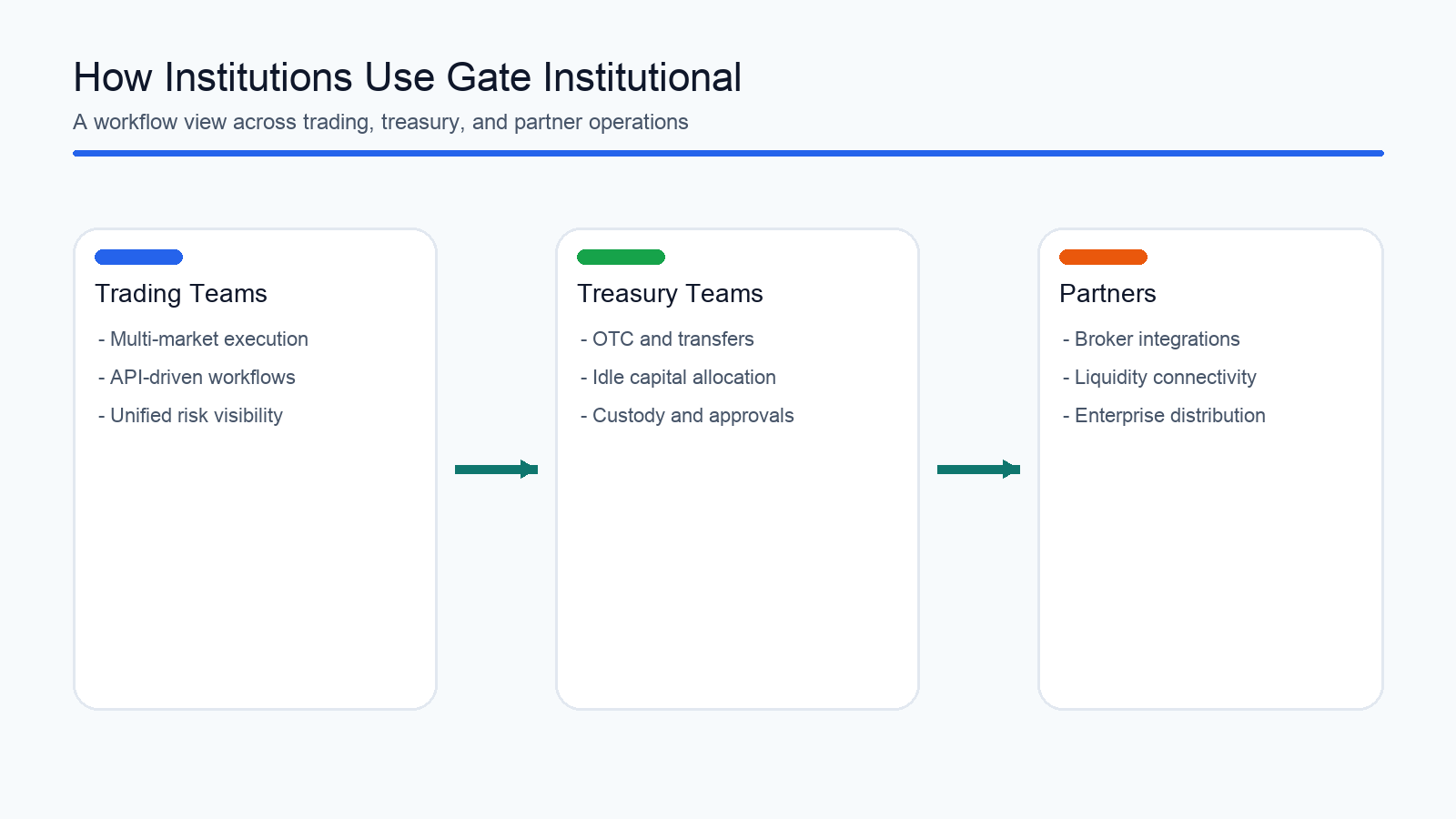
Figure 1. Gate API supports institutional workflows across market data, execution, monitoring, and permission controls.
Market Data Access
Quant teams often rely on stable access to market information. This may include price changes, order book conditions, trade activity, and other product-level data that help a strategy decide how to respond.
Reliable data matters because execution and monitoring depend on it. If a team cannot trust the data layer, it becomes harder to trust everything built on top of it.
This is one reason institutions usually evaluate data access as part of the full workflow rather than as a separate technical module. A market-data stream is only useful if the surrounding systems can consume it consistently, compare it with internal expectations, and use it to support later execution or review.
Order Execution and Status Feedback
API access also helps institutions manage trading actions programmatically. In practice, that means the workflow does not stop at sending an order. Teams also need clear updates on order status, fills, cancellations, and execution outcomes.
This is especially important when a desk operates across more than one product type. A consistent way to manage order submission and feedback can reduce friction between strategy systems and operational review.
It also makes post-trade review easier. If execution data and order status are easier to inspect through the same integration layer, teams can compare intended behavior with actual results more quickly and reduce the time spent reconciling questions between trading and operations.
Risk and Account Monitoring
Institutions also use API access to observe balances, account conditions, and exposure-related information. Even when the main objective is execution, teams still need enough visibility to understand how account state changes over time.
For example, a team may need to compare active trading with account balances, review how capital is being used, or monitor whether live activity remains aligned with internal controls. That is why monitoring functions matter alongside pure execution functions.
In practice, this means institutions often judge the usefulness of an API by how well it supports routine observation. A good trading integration should help users notice changes early, not only react after a problem has already affected live activity.
What Should Teams Evaluate When Assessing Institutional API Access?
API Coverage
The first question is whether the API covers the workflows the team actually needs. It is not enough to support narrow execution if the institution also depends on market data, account visibility, or monitoring-related access.
Coverage also matters at the level of returned details. An endpoint may exist, but it still needs to provide enough information for a team to reconcile activity and compare platform output with internal systems.
This is why institutions often evaluate APIs from the perspective of business continuity. If one missing capability forces a team back into manual work for a critical control step, the practical value of the broader integration falls quickly.
Stability and Error Handling
In institutional environments, an API must remain dependable under routine and abnormal conditions. Teams usually review how the integration behaves when requests fail, when data are delayed, or when returned results do not match internal expectations.
This is important because institutions often build alerting, escalation, and recovery processes around those responses. A technically available API is not enough if failures are hard to diagnose or hard to manage.
The same principle applies to monitoring and reporting. Internal systems need enough consistency to distinguish between a true trading issue and a temporary data problem, otherwise teams may lose time investigating the wrong source of risk.
Permissions and Security Controls
API access also needs to fit the institution's security model. Teams usually care about how permissions are separated, how keys are managed, and whether access can be aligned with operational roles.
This matters when several users, teams, or services interact with the same environment. Research systems, execution systems, and oversight functions often should not all have the same authority.
When access boundaries are clearer, the integration becomes easier to govern. That lowers the chance that one workflow accidentally receives broader authority than intended and helps institutions scale usage more safely across multiple teams.
Integration Costs With Internal Systems
Institutions often already have a strategy engine, OMS, reporting process, or risk framework in place. Because of that, the practical cost of integration matters almost as much as the API feature set itself.
That cost includes testing, data mapping, operational support, and future maintenance as workflows evolve. An API is more useful when it lowers long-term operational burden, not only when it exposes more functions.
For many institutions, this is the difference between a technically possible integration and a sustainable one. A workflow that is expensive to maintain may still work in the short term, but it becomes harder to support once the number of strategies, users, or review steps begins to grow.
How Does Gate API Fit Into the Institutional Entry Point?
From an institutional perspective, Gate API is one part of a broader setup that also includes execution products, account structures, and enterprise-facing services. Institutions usually do not evaluate API access in isolation. They want to know whether the API fits the same operating environment their traders, operators, and risk teams will actually use.
That is why API evaluation often overlaps with workflow design, account controls, and internal coordination. A technically capable API becomes much more valuable when it works smoothly with the rest of the institutional setup.
Practical Preparation Steps for Quant Teams
Define Required Interfaces First
Before integration begins, teams should identify which workflows truly need automation. That usually includes deciding which market-data, execution, account, and monitoring actions must be supported from the start.
This helps prevent teams from spending time on low-priority integration work while missing the interfaces that matter most in production.
Build Test and Monitoring Processes
Even when documentation looks complete, teams still need their own testing process. That process should check normal usage, failure handling, and whether returned data remain consistent with internal expectations.
The goal is not only to prove that an API call works once. It is to confirm that the surrounding workflow remains dependable when the integration is used repeatedly under real operating conditions.
This often requires repeatable checks rather than one-time validation. Institutions usually benefit from testing the same workflow across multiple scenarios so that both engineering and operations teams can agree on how the system should behave before larger activity is pushed through it.
Design Permission and Key-Management Policies
In collaborative environments, key rotation, permission boundaries, and internal ownership rules matter as much as technical integration. Institutions usually need to decide which systems can observe, which can execute, and which are responsible for review and oversight.
That clarity helps reduce operational risk and makes the API easier to maintain over time as the number of users, services, or trading workflows grows.
It also makes responsibilities easier to audit internally. When teams define ownership clearly at the beginning, they are better positioned to review access, update workflows, and keep the integration aligned with operational policy as institutional usage expands.
Summary
Gate API is important because it helps institutions connect platform activity with internal trading, monitoring, and reporting systems. For quant teams, the real question is not whether one feature exists, but whether the API can support a dependable workflow across data, execution, account visibility, and operational control.
In a standard evaluation model, the most useful API is one that combines functional coverage with clear permissions, maintainable integration effort, and stable day-to-day behavior. That is the lens through which institutions are most likely to judge whether Gate API fits their operating needs.
When reviewed this way, API access becomes part of the broader institutional operating framework rather than a stand-alone feature. That is usually the most practical way to decide whether it can support long-term production use.
That broader perspective is often what separates a workable integration from a merely available one.
FAQ
Why is Gate API important for quant teams?
Because quant teams often rely on system-to-system access for data retrieval, order management, monitoring, and internal reporting.
What should teams evaluate first in a trading API?
They usually begin with workflow coverage, stability, permissions, and how difficult the API is to integrate into existing systems.
Is API access only about placing orders?
No. In institutional settings, it also affects market-data usage, account monitoring, operational review, and the way internal systems interact with the trading environment.