As RWA moves from early pilots toward large-scale commercial adoption, the key bottleneck is no longer how to map assets on-chain. Instead, it is whether financial infrastructure on the settlement side can keep pace with the efficiency of on-chain delivery. Over the past few years of RWA development, underlying assets such as bonds, funds, real estate, and even carbon credits have been transferable within seconds through smart contracts. However, fund settlement has often still relied on traditional bank wire transfers or batch reconciliation systems, creating a serious disconnect in which assets move on-chain while funds lag off-chain.
This financial mismatch—fast asset settlement but slow fund settlement—is approaching a historic breakthrough as the Hong Kong Monetary Authority's Ensemble project advances toward 24/7 wholesale central bank digital currency (wCBDC) and commercial bank tokenized deposit settlement through Ensemble TX. The participation of major settlement banks such as Standard Chartered signals that a new generation of financial market infrastructure (FMI) based on DLT (distributed ledger technology) has formally established a two-way closed loop between "on-chain assets" and "on-chain cash." This article provides an in-depth analysis of how the new settlement framework is reshaping the RWA on-chain clearing model through the evolution of DLT financial infrastructure, the closed-loop RWA clearing and transfer process, ledger programmability, and coordination with Gate Spot and its innovative asset ecosystem.
Key Takeaways
-
An in-depth analysis of the challenges and cost structure of traditional financial market infrastructure (FMI) in RWA clearing, and the efficiency gains enabled by DLT ledgers
-
A systematic breakdown of how the Ensemble TX architecture connects commercial bank tokenized deposits with wCBDC to create an atomic DvP (delivery versus payment) clearing engine without counterparty risk
-
A detailed overview of automated full-lifecycle management for RWA assets supported by tokenized deposits, including automated yield distribution, instant settlement at maturity, and fractional ownership transfers
-
An exploration of value exchange and liquidity transmission between compliant permissioned-ledger DLT infrastructure and decentralized public blockchain crypto asset markets
-
An analysis of pathways for investors to participate in high-growth RWA sectors and allocate to on-chain financial infrastructure assets through coordination between Gate's Spot ecosystem and asset management tools
Traditional FMI Clearing Challenges and the Architectural Innovation of Ensemble TX
To understand the breakthrough that the Ensemble TX architecture brings to RWA clearing, it is necessary to first examine how traditional financial market infrastructure (FMI) operates. Traditional securities and commodities settlement relies on multiple layers of intermediaries, including central securities depositories (CSDs), central counterparties (CCPs), and interbank clearing networks. When a transaction occurs, information must pass through trading platforms, clearing participants, depositories, and bank accounts, undergoing complex matching, netting, and reconciliation processes.
This multilayer intermediary architecture not only generates high clearing costs, but also results in settlement cycles as long as T+1 or T+2. In earlier RWA tokenization initiatives, if asset ownership was issued on-chain while payment continued to depend on periodic manual settlement through traditional banks, investors would still face counterparty default risk during settlement waiting periods and the cost of frozen funds.
The Ensemble TX architecture introduced by the Hong Kong Monetary Authority has successfully overcome technological barriers in underlying financial infrastructure. By creating an interoperability layer across platforms and institutions, it natively connects tokenized deposit ledgers at different commercial banks with the central bank's wholesale CBDC (wCBDC) base layer.
This new generation of DLT financial infrastructure delivers significant efficiency improvements throughout the clearing process:
| Clearing Process Dimension |
Traditional FMI Clearing System (T+1/T+2) |
Ensemble TX-Enabled DLT Clearing System (24/7 Instant) |
| Payment Settlement Asset |
Correspondent banking gateways / fiat wire transfer settlement |
Commercial bank tokenized deposits |
| Settlement Finality |
Relies on batch reconciliation and overnight netting by clearinghouses |
Millisecond-level atomic finality based on smart contracts and wCBDC |
| Delivery Control Mechanism |
Manual reconciliation and asynchronous handling of information and fund flows |
Automated two-way release through delivery versus payment (DvP) conditions |
| Operations and Manual Reconciliation |
High intermediary service fees, manual verification, and reconciliation friction |
Consistent global on-chain state and automated code-based clearing with no manual friction |
Through the Ensemble TX architecture, buyers and sellers in RWA transactions can achieve genuine "delivery versus payment (DvP)"—funds are deducted from tokenized deposits while RWA asset tokens are immediately transferred to the buyer's account, eliminating the structural barrier caused by asynchronous fund and asset settlement.
On-Chain RWA Lifecycle Management: From Trade Settlement to Smart Contract Automation
With commercial bank tokenized deposits and 24/7 settlement infrastructure in place, the value unlocked by RWA assets extends beyond simple secondary-market trade settlement to automated full-lifecycle asset management. Real-world assets, such as government bonds, green receivables, supply chain finance instruments, real estate, and infrastructure income rights, typically involve highly complex follow-up processes, including interest calculations, principal repayment at maturity, dividend distributions, covenant performance audits, and more.
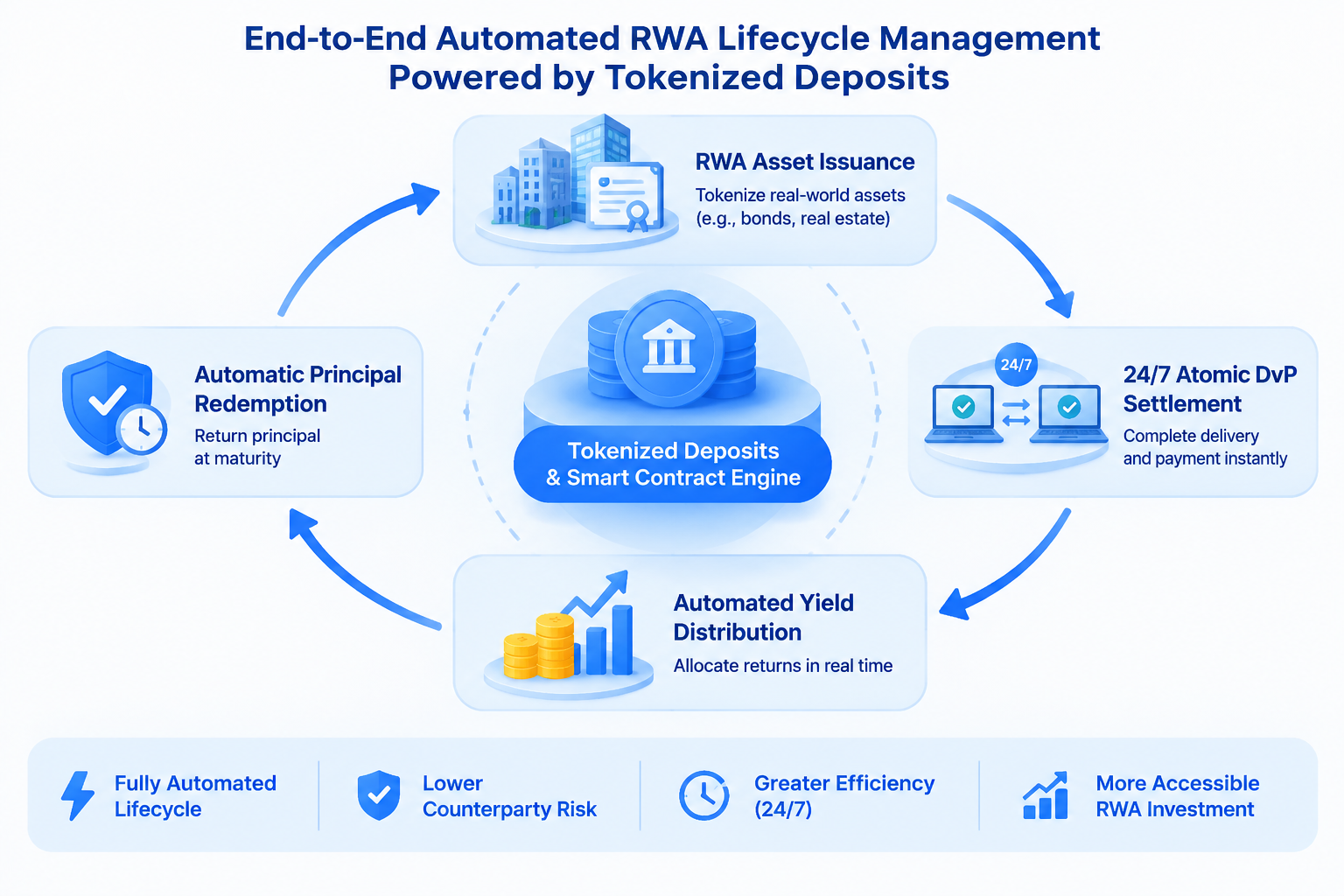
Within the underlying clearing environment provided by Ensemble TX, RWA lifecycle automation introduces three major changes:
-
Automated Instant Yield and Dividend Distribution (Automated Yield Distribution): In traditional tokenized bonds or RWA funds, yield distribution requires asset custodians to consolidate proceeds, convert exchange rates, and distribute funds in batches to investor accounts through banking systems. In a tokenized deposit environment, smart contracts can read returns generated by on-chain assets in real time and transfer tokenized deposits directly to investor wallets with millisecond-level precision, enabling seamless automatic compounding.
-
Automated Settlement and Redemption at Maturity (Atomic Redemption): When tokenized government bonds or commercial paper mature, smart contracts automatically burn the expired asset tokens while returning the equivalent tokenized deposit principal and accrued interest to investors' accounts, without requiring manual applications, approvals, or transfers.
-
Fractional Ownership and Supply Chain Finance Transfers (Fractional Real Economy Financing): As clearing costs approach zero, small and micro enterprises can tokenize fragmented receivables or green carbon reduction proceeds as RWA issuances and settle small amounts instantly through tokenized deposits, substantially lowering funding barriers for the real economy and supply chain finance.
Connecting Permissioned-Ledger DLT Infrastructure With the Decentralized Web3 Era
DLT financial infrastructure represented by the Hong Kong Monetary Authority's Ensemble project uses permissioned ledgers and inter-institutional nodes with strict compliance access controls at its core settlement layer. However, this does not mean it is isolated from the permissionless decentralized public blockchain ecosystem. On the contrary, the establishment of this institutional-grade compliant infrastructure is becoming an entry point for vast amounts of real-world capital into the Web3 era.
Over the long-term evolution of decentralized finance, these two ecosystems are demonstrating significant mutual reinforcement:
-
Unified Underlying Standards and Interoperability: Smart contract protocols used by permissioned-ledger settlement architectures that comply with standards such as ERC-20 and ERC-3643, a standard for compliant assets, make it technically possible for institutional-grade RWA assets to serve as compliant underlying collateral in public blockchain DeFi ecosystems after passing compliant cross-chain verification.
-
Global Transmission of Capital Efficiency: Traditional compliant capital entering DLT settlement networks through tokenized deposits can significantly increase the velocity of capital across the network. This high capital turnover efficiency may indirectly improve overall liquidity in the digital asset market.
This trend indicates that institutional-grade DLT infrastructure is not a replacement for public blockchain ecosystems. Rather, it provides a solid compliance foundation for programmable finance on public blockchains to reach mainstream adoption.
Asset Allocation During the Institutional RWA Wave and the Coordinated Advantages of the Gate Ecosystem
As settlement institutions such as Standard Chartered in Hong Kong implement tokenized deposit projects, the 24/7 DLT settlement vision outlined by the Ensemble project is rapidly evolving from a technical experiment into real-market liquidity benefits. Further development in the RWA tokenization sector is not only reshaping traditional financial infrastructure, but also providing global crypto asset investors with stronger asset-quality support and more diverse yield opportunities.
At this pivotal stage of deeper integration between compliant financial settlement upgrades and decentralized asset markets, mainstream crypto trading platforms play important roles in price discovery, liquidity aggregation, and risk management. Gate, for example, is one of the earliest-established and most comprehensive global digital asset trading platforms. Through its technology-focused approach, Gate has built extensive capabilities in RWA infrastructure, high-performance Layer 1/Layer 2 networks, and decentralized financial tools.
As RWA infrastructure enters a new phase of expansion, the Gate ecosystem provides users with valuable coordinated support:
-
Extensive Coverage of RWA and Clearing Infrastructure Sectors: Gate identifies and lists compliant asset tokens, blockchain interoperability protocols, and DeFi infrastructure assets directly supported by DLT clearing upgrades for global investors.
-
Strong Spot Market Depth and Capital Efficiency: Gate offers deep stablecoin Spot markets and a low-fee structure, enabling users to adjust their portfolios with minimal friction and participate in valuation shifts during institutional tokenization adoption.
-
Automated Risk Management and a Diverse Asset Management Toolkit: When allocating to emerging RWA-related tokens, investors can flexibly use Gate's Spot Grid, automated strategies, Earn products, and options/futures hedging tools to mitigate short-term market volatility and pursue stable long-term returns.
The combination of innovation asset access, efficient Spot trading, and comprehensive asset protection positions Gate as a preferred hub for global investors seeking to participate in the transformation of DLT infrastructure and the evolution of RWA on-chain clearing.
FAQ
What is the Ensemble TX architecture, and what role does it play in RWA clearing?
Ensemble TX is a core infrastructure architecture under the Hong Kong Monetary Authority's Ensemble project. By connecting commercial bank tokenized deposits with wholesale central bank digital currency (wCBDC), it provides RWA with a 24/7 on-chain settlement engine for delivery versus payment (DvP), featuring second-level confirmation and no counterparty risk.
How does tokenized deposit infrastructure improve full-lifecycle management of RWA assets?
It enables yield distribution, principal repayment and redemption at maturity, and fractional yield distribution for RWA assets to be automatically compiled and executed entirely through smart contracts. Funds are transferred in the form of tokenized deposits with millisecond-level speed, eliminating the costs and risks associated with traditional manual reconciliation, bank wire transfer delays, and manual fulfillment.
How can retail investors participate steadily in the growth of RWA infrastructure on Gate?
Investors can use Gate's Spot market and innovation sectors to reasonably allocate to RWA infrastructure assets, interoperability protocol tokens, and core stablecoins. Combined with Gate's Grid Trading and Earn tools, this can support stable asset growth while maintaining manageable risk.