Dgrid AI is a better fit when the priority is routed, verifiable AI inference; Render and Akash are better fits when the priority is sourcing decentralized GPU compute for rendering or general workloads. All three sit in crypto × AI / DePIN narratives, but they sell different layers: inference gateway and quality proofs versus raw or workload-specific compute markets. Educational readers should also compare fee surfaces, custody assumptions, and whether the product returns model outputs or only leased machines. That checklist keeps Dgrid AI vs Render and Akash comparisons grounded in workflow design rather than ticker marketing.
This comparison is educational. It does not rank tokens as investments. For a product primer on Dgrid AI, start from What Is Dgrid AI (DGAI)?. Gate spot mechanics for DGAI are covered in How to trade DGAI spot on Gate.
Key takeaways
-
Dgrid AI emphasizes model aggregation, intelligent routing, and Proof of Quality for inference serving.
-
Render Network emphasizes decentralized GPU capacity often associated with rendering and related compute jobs.
-
Akash Network emphasizes an open marketplace for cloud compute, including GPU instances, matched through bids and providers.
-
Pick by job-to-be-done: inference API-like access with verification versus renting distributed GPUs—not by ticker narrative alone.
What is Dgrid AI?
Dgrid AI vs Render comes down to the product layer under review: Dgrid AI is a decentralized AI inference network built around model aggregation, intelligent routing, and Proof of Quality-style verification, while Render is a decentralized GPU network focused on matching distributed GPU capacity for rendering and other compute jobs. For developers and infrastructure readers comparing decentralized AI inference with decentralized GPU marketplaces, that difference usually changes pricing logic, trust assumptions, security, and the workflow around the stack. In short: prefer a Dgrid AI-style path when the job is API-like model access with verification and routing; prefer a Render-style path when the job is raw GPU compute more than verified inference.
Dgrid AI aggregates models and routes requests for AI services through a unified intelligent market and scheduling layer. Project materials describe access to a large multi-model catalog through a gateway-style entry point. Public materials also describe connections among model providers, node operators, and developers, with on-chain verification goals. The native token ticker is DGAI, with a published BSC contract referenced in Gate’s listing announcement.
The product story centers on making inference cheaper to access and easier to audit than blind trust in a single centralized API, including clearer ways to pay for inference access or settlement. DGAI can appear in settlement, incentive, and staking or service-deposit roles under network rules. Proof of Quality (PoQ) is the signature mechanism name for scoring and challenging outputs so that poor work can be economically discouraged. In a Dgrid AI vs Render comparison, that inference-and-verification layer is the key differentiator from GPU rental markets when the priority is verifiable inference rather than raw compute capacity. Adjacent decentralized compute choices such as Akash belong in the same comparison set for developer workflows, trust models, and token-role differences—not as interchangeable substitutes.
What is Render Network?
Render Network is commonly described as a decentralized GPU network that connects artists, studios, and other compute buyers with distributed GPU operators for rendering tasks and on-demand computing power. Workloads historically emphasize rendering and related graphics pipelines, though broader AI compute discussions often appear alongside DePIN narratives. Teams that need many GPUs for frames, GPUs for scene baking, or GPUs for batch graphics jobs often evaluate Render as an affordable capacity offering rather than an inference gateway.
Render’s default user journey looks like sourcing GPU power for a job, not selecting among routed LLM endpoints with a network-level quality proof brand. Token and settlement details belong in Render’s own docs; here Render is used only as a compute-marketplace reference point for contrast. A good Render fit is making images, animations, or other GPU-heavy assets when the buyer already knows which software stack to launch on those GPUs.
What is Akash Network?
Akash Network is commonly described as a decentralized platform and global marketplace for cloud compute. It is a Layer One Protocol built on the Cosmos SDK and uses a Delegated Proof-of-Stake consensus mechanism, a design that supports security and scalability as network demand grows. Providers advertise capacity and tenants bid for workloads in a peer-to-peer marketplace that can include CPU and GPU instances. The design goal is permissionless cloud infrastructure, with Akash having developed an open cloud marketplace rather than a single branded inference gateway. Akash providers may list GPUs, additional GPUs for burst jobs, and node capacity that tenants use to launch containers or images.
Akash’s default journey is closer to “lease compute, run your own stack” than “call an aggregated model market with PoQ checks.” That makes Akash a useful peer for Render in GPU DePIN discussions and a clear foil for Dgrid AI’s inference-routing pitch, with the underlying technology built around cloud-infrastructure deployment rather than a managed AI endpoint layer, while also emphasizing encryption and auditable smart contracts for security, with AKT supporting the network’s security incentives. Open source tooling and community manifests often appear in how tenants deploy on Akash, and the platform also allows anonymous deployment of applications, making Akash attractive when the team wants an affordable node-level approach instead of a hosted inference API. Akash also supports high-end GPU classes such as H100, H200, and A100 in marketplace listings, with available inventory and hourly rates changing over time—readers should verify current provider catalogs rather than treat any single snapshot as fixed. Open source containers, open source model weights, and open source orchestration examples are a good fit for Akash-style leases when buyers already know how to launch workloads on rented GPUs, including AI model deployment with AkashML and Ray clusters.
Dgrid AI vs Render vs Akash: comparison table
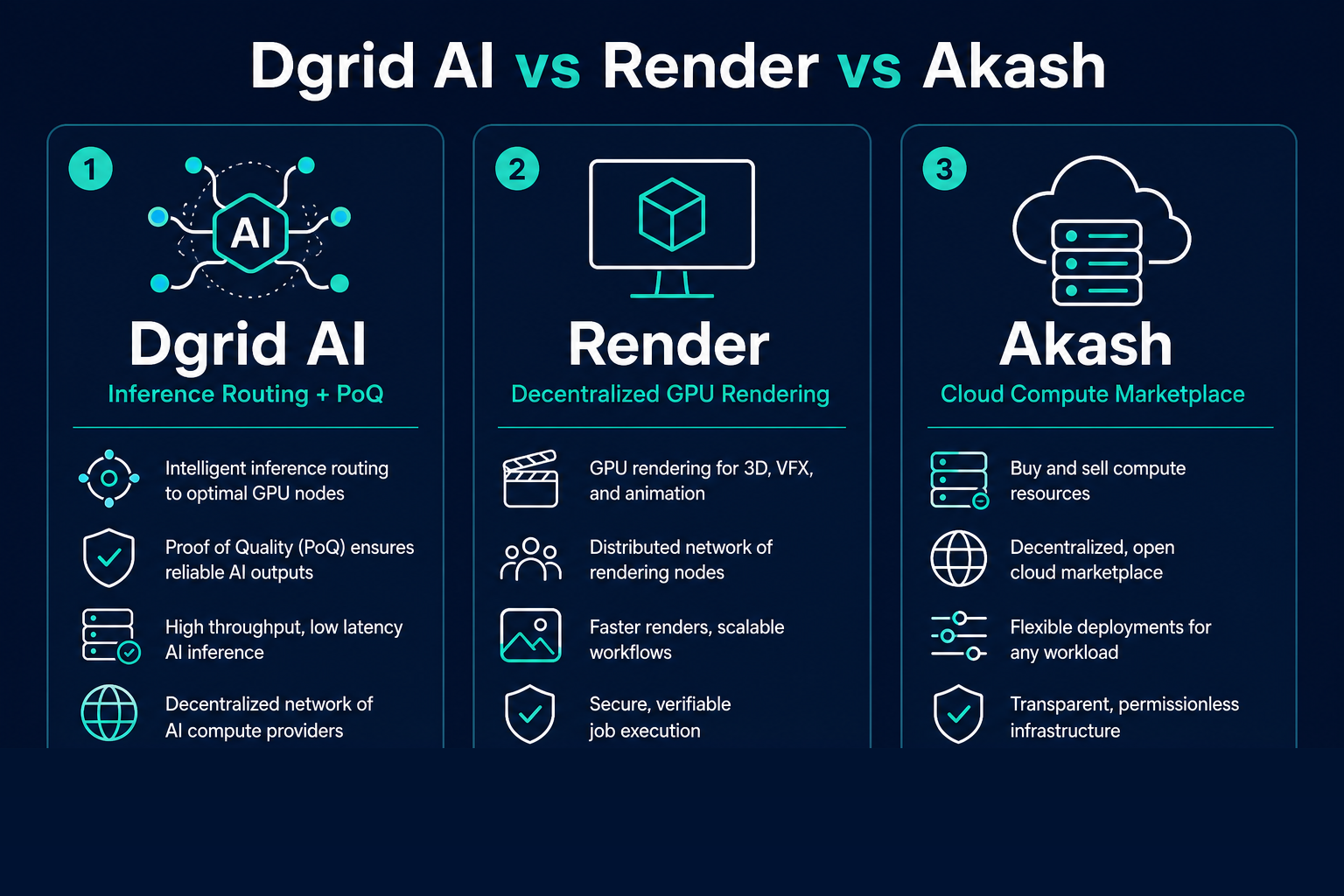
Figure 1. Dgrid AI vs Render vs Akash: inference routing and PoQ versus GPU rendering and cloud compute marketplaces.
| Dimension |
Dgrid AI |
Render Network |
Akash Network |
| Core pitch |
Decentralized inference aggregation + routing for model deployment and reasoning |
Decentralized GPU / rendering compute built to scale larger workloads |
Open cloud compute marketplace |
| Trust / quality angle |
Proof of Quality (PoQ) for outputs |
Job completion and provider performance in compute market |
Provider SLA via marketplace incentives and leases |
| Typical builder entry |
Request inference via aggregated market / gateway |
Submit rendering or GPU jobs to the network |
Bid for instances, handle management, and deploy your stack |
| Closest centralized analogue |
Multi-model AI API gateway |
Render farm / GPU cloud for graphics |
Permissionless AWS-style cloud marketplace |
| Native asset (widely cited) |
DGAI |
RNDR / Render ecosystem token narratives |
AKT |
Tables compress marketing language; always verify live docs before building.
Dgrid AI’s stated path looks closer to “submit a prompt or inference request, receive a routed model response, rely on PoQ signals.” That resembles how developers already think about AI APIs, allowing developers to plug Dgrid AI into an API-style workflow with crypto settlement and verification steps added.
Render’s stated path looks closer to “package a rendering or GPU job, match with providers, retrieve completed output.” Akash’s stated path looks closer to “select resources via marketplace bids, deploy containers or images, implement the workload yourself.”
Neither compute marketplace automatically provides Dgrid AI’s PoQ framing. Conversely, Dgrid AI does not replace the need for raw GPUs when a team wants to fine-tune models or run private training clusters for machine learning. Teams often combine layers: rent GPUs on Akash or Render-style networks for custom workloads, then consume routed inference elsewhere. Comparisons such as io.net vs Akash vs Render Network ask which decentralized platform actually delivers GPUs reliably; Dgrid AI vs Render instead asks whether you need callable, verifiable, settled inference services or an offering of GPUs and node hours. A good approach is making the job explicit before comparing GPUs counts across Akash and Render.
Verification, smart contracts, incentives, and failure modes
Dgrid AI highlights Proof of Quality: sampling, quality scoring, and a verification process with staking penalties when verification fails. The goal is auditable inference under multi-node serving. Public deep dives sometimes describe decentralized AI infrastructure as making services callable, verifiable, and settled—language that fits Dgrid AI’s stated approach more than a pure GPUs marketplace.
Render and Akash lean on marketplace incentives, performance, and security: providers that fail jobs, go offline, or deliver poor performance risk reputation and future demand. Those mechanisms police compute delivery more than semantic quality of an LLM answer. If GPUs return a completed render frame or GPUs finish a batch of images, the “quality” question is different from whether a chatbot hallucination passed a PoQ judge. ISO Proof of Quality style language is sometimes used loosely for process assurance; Dgrid AI’s PoQ brand is specifically about inference output checks, not about how many GPUs a node is offering.
Shared risks remain: smart contracts, token-market volatility, uneven documentation, and the gap between roadmap language and live modules, along with verification trust around data. Spoof tokens and phishing sites are operational hazards across all three narratives.
Token roles and market context
DGAI is tied to Dgrid AI network roles such as incentives, settlement, and verification collateral, forming part of its stated economic model as described in project communications. Render- and Akash-related tokens are tied to their respective compute marketplaces. Listing venues and liquidity are market-structure and business facts when dated and sourced; they are not proof of product superiority.
Gate lists DGAI on spot DGAI/USDT, but a listing or tradable liquidity should not be confused with product adoption or a paying user base. Users comparing assets for educational reasons should still verify contracts and product pages separately.
Which should you choose?
Choose a Dgrid AI-style design if the primary need is serving or consuming AI inference through an aggregated, routable market with explicit output-quality checks. For decision makers, choose Render-style capacity if the primary need is decentralized GPU work often associated with rendering pipelines. Choose Akash-style leases if the primary need is bidding for general cloud or GPU instances to run your own stack. A good rule of thumb is that an affordable GPUs offering is still not a substitute for a good inference routing approach when the product must launch answers for end users rather than merely provision machines. Networks built for compute and networks built for model access should be scored on different scorecards.
Many research notes bundle these under “AI crypto” or “DePIN.” Mechanism fit matters more than narrative buckets. Builders can also keep centralized APIs or clouds for latency-critical production while using decentralized networks where they add flexibility or operational support. Those choices are operational, not investment ratings.
Summary
Dgrid AI, Render, and Akash overlap in crypto infrastructure conversations but diverge in product layers: verifiable inference routing versus decentralized GPU and cloud compute markets. Access paths, verification logic, and token roles follow from that split. Compare them based on whether the job is routed inference with PoQ or renting distributed compute, and treat token markets as separate risk. Lists of “best decentralized computing tools” often mix GPU marketplaces with inference gateways; keeping Dgrid AI vs Render vs Akash on separate scorecards avoids that confusion.
FAQ
What is the main difference between Dgrid AI and Render?
Dgrid AI focuses on aggregating and routing verifiable AI inference. Render is commonly framed as a decentralized GPU network for rendering and related compute jobs, so the user-facing difference is inference access versus raw GPU capacity. One is an inference gateway story with clearer visibility into which model path is called; the other is a GPU capacity marketplace story.
How does Akash differ from Dgrid AI?
Akash is an open compute marketplace where tenants bid for cloud resources, including GPUs, and run their own workloads, often using pre-configured environments for models such as stable diffusion. Many operators treat Akash as infrastructure they configure themselves. Dgrid AI emphasizes model aggregation, routing, and Proof of Quality for inference outputs rather than leasing raw instances.
Is Dgrid AI a decentralized GPU cloud?
Not in the same sense as Akash or Render. Dgrid AI’s public positioning centers on inference access and output verification rather than brokering global GPU power. GPU DePIN networks center on supplying and matching compute capacity.
Can Render or Akash replace a ChatGPT-style API?
They can supply GPUs so a team hosts its own models, including self-managed deployments such as Ray-style distributed clusters, but they do not automatically provide a multi-model routed inference market with PoQ. API-like inference UX is closer to Dgrid AI’s stated design—or to centralized AI APIs.
What risks apply across Dgrid AI, Render, and Akash?
Smart-contract risk, changing token utilities, uneven documentation, marketplace or node reliability, community governance variables, and market volatility apply across crypto compute and AI networks. Always verify official contracts and docs before transferring funds. The comparison is educational and is not investment advice.