In the evolution of artificial general intelligence (AGI) and blockchain cryptography, traditional Classical Computing architectures are facing increasingly evident physical and computational bottlenecks. As large language model (LLM) parameter counts approach the trillion scale, classical silicon chips have demonstrated extremely high energy consumption and computational limits when processing high-dimensional parallel computing, molecular structure simulations, and complex optimization problems. At the same time, breakthroughs in quantum computing based on Shor's algorithm and Grover's algorithm pose a potentially disruptive threat to existing asymmetric encryption systems, such as RSA and ECC elliptic curve cryptography—which form the security foundation of the entire Web3 and blockchain ledger ecosystem.
As a global leader in integrated quantum computing, Quantinuum (formed through the merger of Honeywell Quantum Solutions and Cambridge Quantum) is at the forefront of this shift in computing paradigms. By combining advanced Trapped-Ion hardware with a quantum software stack, Quantinuum is not only opening new channels for exponential acceleration in AI and complex scientific computing, but also providing critical infrastructure support for blockchain's transition to Post-Quantum Cryptography (PQC). This article provides an in-depth analysis of the technological foundation and long-term value of Quantinuum (QNT) from the perspectives of AI computing breakthroughs, on-chain security restructuring, and ecosystem collaboration.
Key Takeaways
-
Analyze Quantinuum's Trapped-Ion quantum computing architecture in depth and examine its exponential computing advantages over traditional silicon chips
-
Systematically examine how quantum computing can advance AI foundation model training, high-dimensional data sampling, and quantum machine learning (QML)
-
Explain the potential impact of quantum computing on classical cryptographic systems and the technical path for blockchain networks to evolve toward Post-Quantum Cryptography (PQC)
-
Explore the application scenarios of Quantinuum (QNT) in decentralized computing verification, data privacy protection, and underlying cryptographic infrastructure
-
Analyze the synergies between participating in cutting-edge quantum technology and crypto infrastructure asset allocation through the spot ecosystem of leading trading platforms such as Gate
Trapped-Ion Architecture and Quantum Machine Learning: Breaking Through the Physical Limits of AI Computing
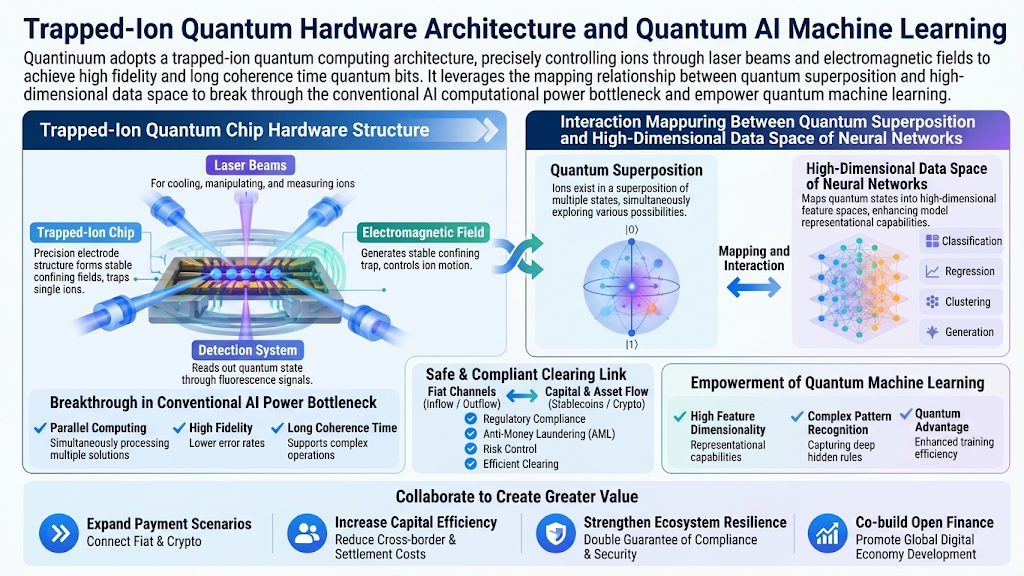
To understand the transformative significance of Quantinuum in AI, it is first necessary to clarify the fundamental differences between classical and quantum computing in terms of underlying data processing. Traditional classical chips perform sequential or limited parallel operations based on binary bits (Bit, 0 or 1). Quantinuum's Trapped-Ion technology, by contrast, uses electromagnetic fields to suspend individual atoms (quantum bits, or Qubits) in a vacuum and uses lasers to precisely control quantum Superposition and Entanglement states.
These physical properties give Quantinuum parallel computing capabilities that are difficult for traditional supercomputers to match when processing high-dimensional probability distributions and complex combinatorial optimization problems. In the training and inference of artificial intelligence foundation models (LLMs), the introduction of quantum computing can fundamentally restructure computing efficiency:
| Computing Dimension |
Traditional Silicon Chips (GPU/TPU) |
Quantinuum Quantum Computing Architecture |
| Underlying State Representation |
Binary deterministic states (0 or 1) |
Quantum superposition and entanglement states ($\vert{}\psi\rangle = \alpha\vert{}0\rangle + \beta\vert{}1\rangle$) |
| High-Dimensional Data Sampling |
Relies on approximation algorithms such as Monte Carlo, which are highly time-consuming |
Enables natural high-dimensional probability sampling and reduces computational complexity exponentially |
| AI Algorithm Compatibility |
Suitable for large-scale matrix multiplication |
Natively compatible with quantum machine learning (QML) and complex optimization models |
By combining quantum algorithms with neural networks, Quantinuum's technology can significantly shorten the convergence time of large language models in high-dimensional vector spaces and reduce the overall energy consumption of computational training. This deep integration of quantum computing and AI is moving artificial intelligence beyond simple scaling through Scaling Laws toward breakthroughs in underlying algorithmic capabilities.
On-Chain Security Restructuring: Post-Quantum Cryptography (PQC) and Enhanced Web3 Ledger Protection
The rise of quantum computing is not only accelerating AI computing; it is also creating new security challenges for existing crypto-financial systems. Major blockchain networks, including Bitcoin and Ethereum, widely use the Elliptic Curve Digital Signature Algorithm (ECDSA) to generate public-private key pairs and verify transactions. In the face of sufficiently powerful general-purpose quantum computers, traditional asymmetric encryption algorithms could potentially be cracked rapidly, putting users' on-chain assets at risk.
As a pioneer in quantum software and cryptography, Quantinuum and its open-source quantum software development kits, such as TKET, provide valuable solutions for the blockchain ecosystem's transition to Post-Quantum Cryptography (PQC):
-
Quantum Random Number Generation (QRNG): True randomness is the cornerstone of secure cryptography. Quantinuum can use physical quantum processes to generate verifiable, truly random numbers, providing unbiased sources of secure entropy for on-chain smart contracts, DeFi oracles, and game-theoretic models.
-
Evolution of Post-Quantum Encryption Algorithms: By collaborating with the cryptography community, Quantinuum supports the deployment of new algorithms such as Lattice-based Cryptography, helping blockchain nodes complete seamless upgrades to post-quantum signatures without compromising scalability performance.
-
Decentralized Quantum Computing Verification: Through blockchain token economics and Proof-of-Computation, the execution process and verification results of remote quantum computing tasks can be recorded on-chain, ensuring transparent and trustless allocation of quantum cloud computing resources.
This underlying security restructuring—using quantum technology to defend against quantum threats—is building a robust line of defense for decentralized Web3 ledgers in the future quantum era.
Hybrid Quantum-Classical Infrastructure and Distributed Computing Resource Scheduling
As quantum computing moves toward commercial deployment, one important technical reality cannot be overlooked: quantum processing units (QPUs) will not completely replace traditional silicon graphics processing units (GPUs/TPUs). Instead, they will form a collaborative Hybrid Computing ecosystem. Most modern AI foundation models still rely on the efficient throughput of GPU clusters for basic matrix operations and data cleaning. When they encounter computing bottlenecks involving high-dimensional combinatorial optimization, complex parameter sampling, and nonlinear probability distribution modeling, tasks can be seamlessly divided and offloaded to Trapped-Ion quantum computing nodes such as those operated by Quantinuum.
This hybrid computing network, in which GPUs handle scaling and QPUs handle algorithmic breakthroughs, presents new challenges for distributed scheduling protocols and smart contracts. By deploying decentralized computing resource scheduling and verification protocols on-chain, developers can not only enable real-time bidding and allocation for hybrid computing tasks, but also use zero-knowledge proofs (ZKPs) to perform lightweight verification of the determinacy of remote quantum computing results. Building this decentralized hybrid computing network can help prevent single points of failure and monopolization in computing resource supply, while opening broad technical pathways for deeper integration between computing infrastructure in the crypto ecosystem (DePIN) and cutting-edge hardware technology.
Asset Perspectives Under the Cutting-Edge Technology Narrative and Synergies with Gate's Spot Ecosystem
As the three cutting-edge narratives of quantum computing, AI, and decentralized cryptography become increasingly interconnected, Quantinuum (QNT) has developed a distinctive technology-asset positioning in the mainstream crypto market. It represents not only the combination of advanced physical-world hardware manufacturing and distributed computing networks, but also an important window for investors observing the global shift in computing paradigms.
For investors focused on the intersection of advanced hardware technology and Web3 innovation, mainstream crypto asset trading platforms provide an efficient and secure bridge for navigating innovation-driven sectors with significant technical barriers. For example, as a leading global crypto asset trading platform, Gate supports spot trading for cutting-edge technology and RWA concept assets such as QNT. Through a wide range of trading pairs, deep liquidity pools, and secure custodial services, Gate also provides users worldwide with access to advanced technology assets.
Through Gate's spot ecosystem, users can conveniently participate in the allocation of blockchain token assets related to Quantinuum. They can also flexibly use the derivatives, lending, and asset hedging tools provided by the platform to help mitigate market volatility risks during the research and development cycles of cutting-edge technologies. This synergy between the convenience of centralized trading and advanced quantum technology innovation provides global investors with a secure and stable way to participate in the development of next-generation computing.
FAQ
What Is Quantinuum (QNT), and What Are Its Core Technological Advantages?
Quantinuum is a quantum computing company formed through the merger of Honeywell Quantum Solutions and Cambridge Quantum. Its core advantages include a high-fidelity Trapped-Ion hardware architecture and a mature quantum software stack, such as TKET, which can provide strong computing support for AI acceleration and Post-Quantum Cryptography.
How Does Quantum Computing Threaten the Security of Blockchain and Cryptocurrencies?
Traditional blockchains rely on ECDSA elliptic curve cryptography to protect public and private keys. In theory, a sufficiently powerful quantum computer running Shor's algorithm could break these asymmetric encryption systems. Blockchain networks therefore need to upgrade to Post-Quantum Cryptography (PQC) to help ensure asset security.
How Can Individual Investors Participate in Quantinuum and the Cutting-Edge Quantum Technology Sector on Gate?
Investors can use Gate's spot market to conveniently allocate QNT and related RWA/AI infrastructure tokens. By combining the platform's deep liquidity with secure custodial tools, they can help manage the risk of individual market fluctuations while participating in the long-term development of cutting-edge technology.