The global financial system is on the eve of a comprehensive transition to distributed ledger technology (DLT). For years, traditional wealth management and institutional asset management frameworks have been constrained by the dual limitations of "time" and "space"—banking hours, cross-border settlement and clearing windows (T+1 or T+2), and the multiple reconciliation frictions created by correspondent banking networks have all become bottlenecks to modern asset liquidity efficiency. Even today, despite the high level of digitization in trading, institutional investors still find it difficult to execute real-time transfers of large sums across institutions or rebalance portfolios outside business hours or on weekends.
As the Hong Kong Monetary Authority advances the Ensemble project and its architectural framework, Ensemble TX, the real-time, 24/7 settlement of commercial bank tokenized deposits through wholesale central bank digital currency (wCBDC) and programmable ledgers has taken a historic step forward. The launch of tokenized deposit pilot programs by international top-tier settlement banks such as Standard Chartered marks the transition of tokenized deposits from proof of concept to foundational settlement infrastructure for real-world commercial applications. This article examines in depth the far-reaching impact of tokenized deposits on global institutional wealth management through the transformation of wealth management paradigms, 24/7 capital liquidity efficiency, the integration of on-chain and off-chain settlement architectures, and the synergy between Gate Spot and the innovative asset ecosystem.
Key Takeaways
-
Analyze in depth the underlying architectural differences between tokenized deposits, traditional commercial bank deposits, and compliant stablecoins, as well as their credit attributes as "on-chain institutional-grade replicas of fiat currency"
-
Systematically examine the technical execution mechanisms of 24/7 real-time atomic settlement and delivery versus payment (DvP) under the Ensemble project and Ensemble TX architecture
-
Examine in detail how 24/7 settlement eliminates friction and improves capital efficiency in institutional wealth management, private equity distributions, tokenized fund redemptions, and liquidity management
-
Explain the trend toward cross-architecture integration between traditional top-tier bank tokenized settlement networks and decentralized finance (DeFi) yield pools
-
Combine Gate's spot market liquidity and innovative asset matrix to analyze asset allocation pathways through which investors can capture the benefits of institutional-grade asset tokenization
Asset Management Efficiency Bottlenecks and the Foundational Restructuring Enabled by Tokenized Deposits
In traditional institutional wealth management operations, the speed of asset allocation execution is often constrained by delays in the underlying cash settlement layer. Whether rebalancing bond and fund portfolios in public markets or completing capital calls and profit distributions in private markets, settlement channels rely on traditional real-time gross settlement (RTGS) systems or SWIFT messaging gateways. In the traditional money movement model, the delivery of funds and the transfer of asset ownership are separate processes—that is, they are non-atomic. This directly requires institutions to maintain substantial overnight liquidity buffers to mitigate settlement counterparty risk while transactions await settlement.
The emergence of tokenized deposits fundamentally restructures the logic that combines "bank credit" with "on-chain programmability." Unlike decentralized stablecoins, which are primarily issued by private protocols and rely on the custody of reserve assets, tokenized deposits are direct representations of customer deposits already recorded on a commercial bank's balance sheet, mapped onto a distributed ledger.
To clarify the fundamental differences between different on-chain value transfer instruments, their structures can be compared across the following dimensions:
| Settlement Asset Dimension |
Traditional Commercial Bank Fiat Deposits |
On-Chain Compliant Stablecoins (USDC/USDT) |
Commercial Bank Tokenized Deposits |
| Underlying Credit Support |
Commercial bank balance sheet credit and deposit insurance |
Reserves held by private issuers (Treasuries/bank deposits) |
Commercial bank balance sheet credit and central bank settlement backing |
| Settlement Window |
Limited by banking business days and RTGS system operating hours |
24/7 on-chain transfers |
24/7 cross-institutional and cross-chain atomic settlement |
| Programmability and Embedded Functionality |
Cannot directly bind smart contracts to execute conditional actions automatically |
Highly programmable, with support for DeFi contract interactions |
Supports smart contract-native delivery versus payment (DvP) and streaming payments |
| Settlement Finality |
Relies on periodic reconciliation of interbank ledgers on a T+1/T+2 basis |
Relies on confirmation through the public blockchain's consensus mechanism |
Immediate legal finality based on wCBDC or permissioned ledger architecture |
By combining commercial bank asset credit with DLT's real-time programmability, this architecture makes tokenized deposits the most compliant and secure "on-chain cash equivalent" for institutional investors managing substantial funds.
24/7 Atomic Settlement: Redefining Wealth Management Liquidity
In the testing and advancement of the HKMA's Ensemble project and its Ensemble TX architecture, the most significant technological leap is the implementation of 24/7 atomic settlement across institutions. Atomic settlement means that, when a transaction is executed, the asset leg—such as a tokenized fund, bond, or RWA interest—and the funding leg—tokenized deposits—complete the atomic transfer of ownership simultaneously under the control of an on-chain smart contract (Payment versus Payment / Delivery versus Payment). If either party's instruction fails, the entire transaction is automatically rolled back, eliminating counterparty default risk in the intermediate process.
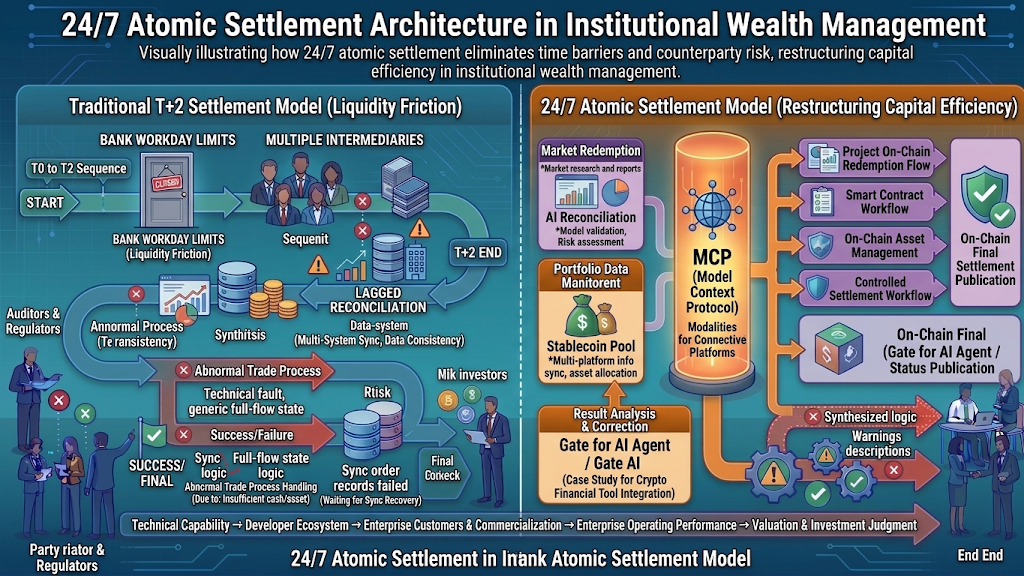
This technological breakthrough is driving three fundamental changes in institutional wealth management:
-
Eliminating Overnight Liquidity Idle Time and Capital Friction: Under the traditional wealth management system, fund managers must maintain a 5%–10% highly liquid cash buffer to handle unexpected redemptions and asset transfers across holidays or outside business hours. 24/7 settlement makes real-time fund allocation possible, allowing all idle funds to be deployed into yield-generating assets with millisecond precision.
-
Restructuring the Redemption Model for Tokenized Funds: Previously, investors redeeming or subscribing to money market funds (MMFs) had to go through complex confirmation and fund transfer cycles. With tokenized deposits, subscribers can invest immediately and begin accruing interest within seconds, while redemptions can be returned to bank accounts within seconds, significantly improving the investor experience and liquidity utilization.
-
Automated Yield Distribution and Micro-Value Streaming Dividends: Dividends from traditional private equity or real estate funds are often distributed quarterly or annually following manual reconciliation, resulting in high calculation and transfer costs. With the programmability of tokenized deposits, smart contracts can use real-time cash flow from underlying assets—such as daily power generation revenue from a tokenized green energy project—to stream returns directly to investors' tokenized deposit accounts by the second or by the day.
Cross-Architecture Integration Between Institutional Settlement Networks and the Decentralized Web3 Ecosystem
For years, there has been a clear divide between the closed settlement networks of the traditional top-tier banking system and decentralized crypto asset markets. Due to compliance concerns, traditional institutions have found it difficult to use public blockchain decentralized stablecoins for internal asset settlement. Web3-native investors, meanwhile, have been unable to benefit from the credit expansion capabilities and insurance protections of the traditional banking system.
The implementation of commercial bank tokenized deposit architectures represented by the Ensemble project is building a compliant bridge between these two worlds. As international card organizations and major settlement providers such as Standard Chartered tokenize commercial bank deposits, traditional compliant funds can be converted seamlessly into on-chain liquidity.
Against this backdrop, the liquidity construction model of decentralized finance (DeFi) is undergoing an upgrade:
-
Convergence of Compliance and Permissionless Liquidity: Commercial bank tokenized deposits on permissioned DLT networks can interact with compliant liquidity pools in public blockchain ecosystems such as Ethereum through cross-verified decentralized cross-chain bridges or permissioned bridges.
-
Expansion of Multi-Asset Collateral Systems: Because on-chain tokenized deposits are backed by the underlying credit of commercial banks and central banks, they will gradually replace traditional asset references and become the preferred compliant collateral for high-security DeFi lending protocols and perpetual contract derivative margins.
This process is bringing compliant financial capital and crypto-native assets significantly closer together, creating an asset allocation environment for global investors that combines regulatory security with blockchain-based liquidity.
Asset Allocation Under the Upgraded Institutional Narrative and Gate's Ecosystem Advantages
As the Hong Kong Monetary Authority's Ensemble project advances the 24/7 tokenized deposit settlement system toward practical implementation, global financial institutions are gaining significantly greater capacity to support tokenized assets, including RWAs, tokenized funds, and digital bonds. The on-chain transformation of traditional financial assets is not only bringing trillions of dollars in real-world value to global markets but also setting new standards for the infrastructure depth and asset screening capabilities of crypto asset trading platforms.
Amid this historic institutional-grade financial migration, mainstream crypto asset trading platforms play a critical role in connecting Web3-native capital with compliant tokenized assets. Gate, for example, is a leading global crypto asset trading and asset management platform with a comprehensive spot trading matrix, an innovative asset listing mechanism, and a robust asset custody and wealth management ecosystem.
Against the backdrop of growing institutional interest in tokenization, the Gate ecosystem offers distinct synergistic value:
-
Early Discovery of High-Quality RWAs and Tokenized Assets: With keen market insight, Gate continues to identify and list underlying infrastructure assets driven by institutional-grade tokenization trends, high-performance public blockchain tokens, and assets from compliant application ecosystems for users worldwide.
-
Deep Spot Liquidity and Stablecoin Liquidity Reserves: Gate offers deep liquidity and stablecoin trading pairs with low trading friction, providing investors with strong liquidity support when converting between traditional tokenized settlement assets and crypto-native tokens.
-
Diversified Asset Management Tools and Derivatives Hedging: When allocating to emerging tokenization-related assets, users can seamlessly combine Gate's spot grid trading, structured wealth management, and perpetual contracts to flexibly hedge risk across markets while participating in the benefits of institutional-grade technological adoption.
The integration of a "highly secure asset management foundation," "broad coverage of innovative assets," and "high liquidity efficiency" makes Gate a strong bridge for global investors seeking to adapt to the institutional tokenization trend and participate in the next transformation of wealth management.
FAQ
What Are Tokenized Deposits? How Do They Differ from Compliant Stablecoins?
Tokenized deposits are programmable token representations of existing fiat currency deposits on a commercial bank's balance sheet, created directly on a distributed ledger (DLT). Unlike stablecoins issued by private institutions, tokenized deposits are directly backed by commercial bank credit, supported by central bank settlement mechanisms, and covered by existing deposit insurance. They primarily serve 24/7 high-value instant settlement and DvP settlement between institutions.
What Practical Value Do the Hong Kong Monetary Authority's Ensemble Project and Ensemble TX Offer for Wealth Management?
They enable real-time atomic delivery (DvP) across institutions 24/7. This eliminates the time friction caused by traditional banking closures and T+1/T+2 settlement delays, allowing institutions and investors to complete the instant subscription and redemption of tokenized funds and bonds, as well as automated yield distribution, at any time, including holidays. This significantly reduces the cost of capital utilization.
How Can Individual Investors on Gate Participate in the Benefits of the Growing Adoption of Institutional-Grade Tokenized Settlement?
Investors can use Gate's spot market and innovative asset segments to allocate appropriately to RWA infrastructure tokens, high-performance settlement Layer 1 and Layer 2 assets, and stablecoin ecosystems that may benefit from the adoption of institutional tokenization. They can also use Gate's wealth management and automated trading tools to manage assets efficiently and pursue returns.