In the crypto market, users often encounter different types of tokens: some are used to pay blockchain network fees, some represent digital art or in-game items, some provide access to platform services, and others are pegged to the U.S. dollar or traditional financial assets. They may all appear as token balances in wallets and may use similar transfer and trading mechanisms, but the economic relationships underlying them are not the same.
This surface-level similarity, combined with differences in actual attributes, can easily lead market participants to confuse a token's technical form with its legal and economic characteristics. For example, the fact that a token can be freely transferred on a blockchain does not necessarily mean that it is a digital commodity. A token's price target being stable does not mean that its legal characteristics are identical to those of all other stablecoins. Similarly, a token that tracks a traditional asset does not mean that its holders automatically enjoy all the rights associated with the underlying asset.
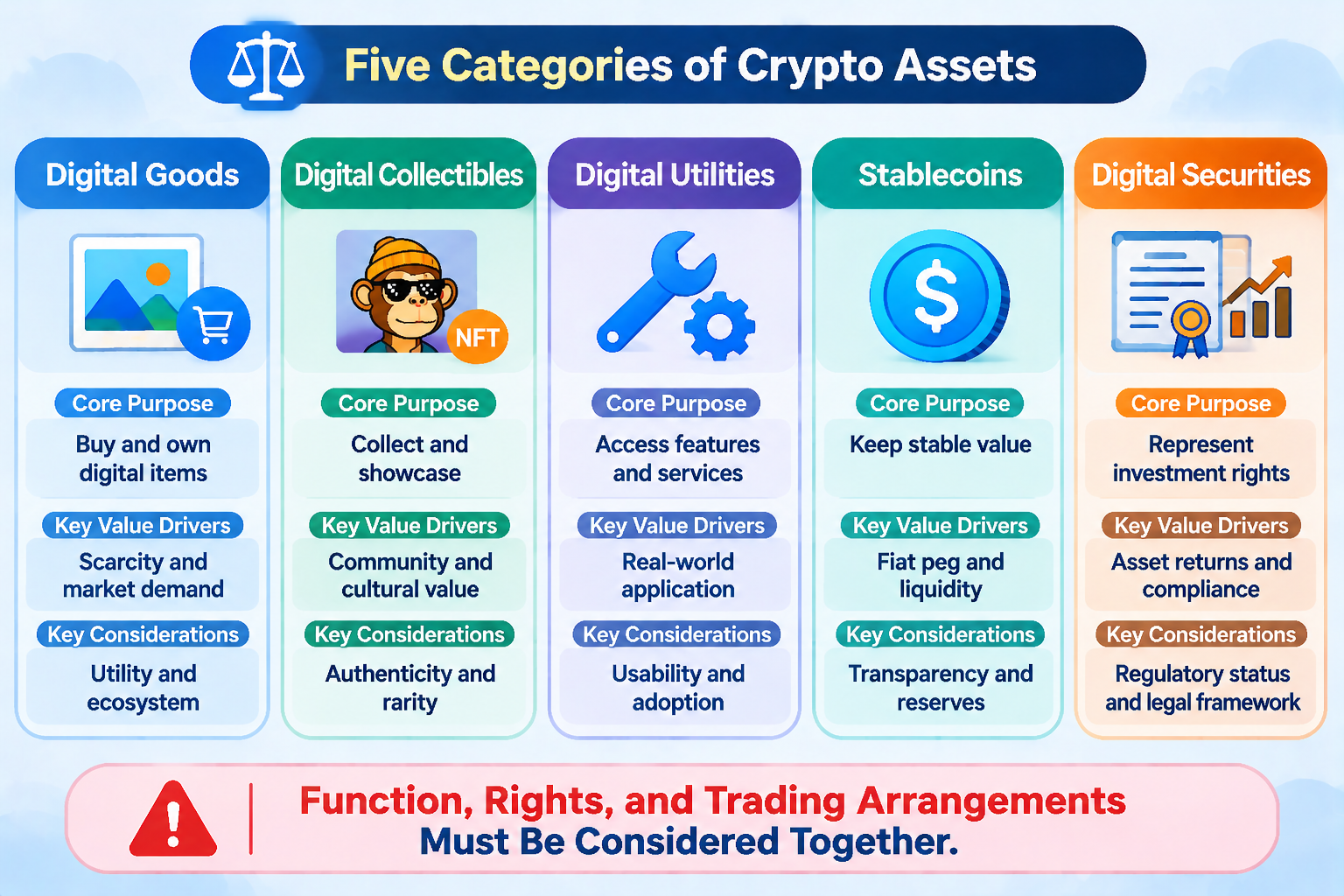
The SEC's 2026 interpretive release on crypto assets provides a useful classification reference, dividing assets into digital commodities, digital collectibles, digital tools, stablecoins, and digital securities. For ordinary market participants, these five categories can help establish a clearer framework for analysis: What is the token primarily used for? Where does its value come from? What rights do holders actually receive? These questions are more helpful for understanding the asset itself than simply tracking the token's name and market popularity.
Key Takeaways
-
Digital commodities depend on network operations: Their value is generally related to the operation of a functional crypto system and supply and demand
-
Digital collectibles emphasize content and collectibility: Their value may come from scarcity, cultural identification, artistic expression, or community demand
-
Digital tools focus on practical use: They primarily provide membership, access, identity, or other service functions
-
Stablecoins focus on value anchoring and redemption mechanisms: Reserves, issuers, and yield arrangements affect risk and regulatory analysis
-
Digital securities represent financial interests: The underlying assets, legal structure, and actual holder rights must be examined further
Digital Commodities: How Do Tokens Become Part of a Blockchain Network?
The core characteristic of a digital commodity is its close connection to a functional crypto system. A token may be used to pay network transaction fees, participate in network operations, or access specific functions within the system. Its value primarily comes from the network's programmed operations and market supply and demand, rather than from expectations of profits generated by the ongoing managerial efforts of a particular issuer. Assets such as BTC, ETH, and SOL are often used to illustrate the typical characteristics of this category.
When analyzing a digital commodity, it is important to consider whether the network has actual functionality and whether the token serves an indispensable or clearly meaningful role within it. Network users may demand the token for transaction fees, network participation, application interactions, or other system activities. If network usage increases, demand for the token may also change. However, changes in demand do not mean that the price will necessarily rise, because token supply, market liquidity, competing networks, and overall risk appetite also affect market performance.
Digital commodities are not risk-free assets. Networks may face technical vulnerabilities, governance disputes, validator concentration, declining ecosystem activity, and shrinking market liquidity. Even when a token has a clear network utility, it is still necessary to assess whether that utility will continue to exist, whether the network can operate reliably, and whether token supply and demand can support its market value.
Digital Collectibles: How Do Content, Scarcity, and Community Identification Create Value?
Digital collectibles primarily relate to collecting, displaying, cultural expression, or rights to digital content. They may represent artwork, music, videos, in-game items, trading cards, or symbols of internet culture. NFTs are a common implementation of digital collectibles, but the two concepts are not identical: NFTs emphasize the non-fungible technical characteristics of a token, while digital collectibles emphasize the asset's primary use and economic characteristics.
The value of these assets is often highly subjective. Creator reputation, the scarcity of the work, community identification, cultural reach, and secondary-market demand may all affect the price of a collectible. Compared with tokens used as network infrastructure, digital collectibles do not necessarily perform functions required for blockchain operations. Their market value may depend more on the content itself and the cultural and social relationships formed around it.
However, collectible characteristics do not automatically exclude financial regulatory analysis. If a digital collectible is designed as a divisible investment interest, or if its issuance and sale arrangements give purchasers a form of investment interest, it may be necessary to further determine whether securities laws apply. Investors should also consider the boundaries of copyright and intellectual property rights, whether the content is authentic, whether the issuance quantity is transparent, and whether the collectible can be transferred between different platforms. Simply owning an on-chain token does not necessarily mean owning the full copyright or commercial usage rights to the work.
Digital Tools: Does the Token Actually Provide a Usable Function?
Digital tools are primarily characterized by their practical functions. They may represent membership, event tickets, identity credentials, access rights, proof of eligibility, or other digital services. Unlike assets that primarily depend on expectations of price appreciation, the core value of a digital tool lies in whether holders can use it to obtain a service or enter a system.
When evaluating a digital tool, the most important considerations are whether its functionality is clear, whether it has already been delivered, and whether holders can actually exercise the relevant rights. For example, if a token is used to enter a particular community, receive a service, or verify an identity, it is necessary to understand who provides the service, what the scope of the service is, how its validity period is determined, and whether the issuer has the right to modify or terminate the relevant functionality. The mere inclusion of "Utility" or "Access" in a token's name is not enough to prove that it has genuine, sustainable utility.
Digital tools may also involve functional dependencies and centralization risks. If a service depends entirely on a single operator, the token's practical utility may decline significantly if that operator stops maintaining the service or changes the rules. If the token can be freely traded, its market price may also diverge from its actual use value. Therefore, evaluating a digital tool requires looking beyond whether it can be transferred technically. It is also necessary to consider whether the service commitments are clear, whether the delivery mechanism is reliable, and whether holders actually possess enforceable usage rights.
Stablecoins: A Price Peg Does Not Mean the Risks Are the Same
Stablecoins generally aim to maintain a stable value relative to a reference asset, commonly by being pegged to a fiat currency such as the U.S. dollar. They can be used for transaction settlement, cross-border transfers, on-chain payments, or as a unit of account in the crypto market. However, stablecoins may differ significantly in their reserve assets, issuance mechanisms, redemption channels, and risk management practices. Their safety or legal characteristics cannot be determined solely by whether their price is close to $1.
When evaluating a stablecoin, it is first necessary to understand its value-anchoring mechanism. For fiat-reserve-backed stablecoins, key considerations generally include the types of reserve assets, custody arrangements, audit or attestation information, and whether holders can redeem the tokens under clearly defined conditions. For crypto asset-collateralized stablecoins, it is necessary to consider collateral price volatility, liquidation mechanisms, overcollateralization ratios, and smart contract risks. Algorithmic or other mechanism-based stablecoins may depend on market incentives, arbitrage mechanisms, or protocol adjustments. Their stability may therefore be affected by market stress and the design of the mechanism.
A stablecoin's legal characteristics likewise cannot be determined based solely on the word "stable." The SEC document states that stablecoins are a broad category whose specific characteristics may depend on their features. When they meet applicable legal requirements, payment stablecoins are generally distinct from other stablecoins that involve different yield or financial arrangements. Users should consider whether the token provides interest or yield, whether it represents a claim against the issuer, who is responsible for the redemption commitment, and whether the relevant arrangements comply with applicable regulatory requirements.
Digital Securities: Financial Rights Behind a Tokenized Form
Digital securities are securities represented or recorded in the form of crypto assets. They may represent stocks, bonds, or other financial instruments that meet the definition of a security. They may also use a blockchain to record issuance, ownership, and transfers. Unlike ordinary tokens designed for network functionality, the key issue for digital securities is not whether the token is used to pay network fees, but what type of financial interest it represents and how the relevant rights are implemented through legal and technical structures.
Tokenization does not mean that the underlying asset and the on-chain token necessarily confer exactly the same rights. Different structures may use underlying asset reserves, special-purpose entities, custody arrangements, or other legal mechanisms. Even if a token is linked to the price of a stock or bond, holders may not automatically receive the voting rights, dividend rights, creditor status, or other rights of holders of the underlying security. The offering documents, custody arrangements, redemption rules, distribution of rights and benefits, and applicable jurisdictions should be reviewed.
Digital securities also involve the connection between traditional financial markets and blockchain-based trading environments. On-chain transfers may improve recordkeeping and settlement efficiency, but they do not automatically eliminate requirements related to securities issuance, trading intermediaries, investor protection, or cross-border compliance. For investors, the most important consideration is not whether the token uses blockchain technology, but what legal rights they actually hold, what counterparty risks they assume, and whether the relevant product is protected under the applicable regulatory framework.
How Can You Establish a Practical Token Classification and Analysis Method?
In practice, you can begin by examining the token's primary function. Is it used for network operations, content collection, service access, value settlement, or representation of a financial asset? This step can help identify the asset's primary economic role, but the functional description should not be treated as a legal conclusion. There may be differences between a project's white paper, official documentation, and actual product mechanisms. Researchers need to cross-check whether the token genuinely has the stated utility.
The second step is to analyze holder rights. Does the token provide voting rights, redemption rights, rights to receive distributions, service access rights, or a legal claim to an asset? Can these rights be enforced? Who is obligated to perform? Are there transfer restrictions? If a token records a particular interest only at the technical level without a clear legal arrangement, holders may not receive the rights they intuitively believe they own.
The third step is to identify the sources of value and key dependencies. Does the token's value come from network activity, content scarcity, service demand, reserve assets, or the issuer's ongoing management and business efforts? If a project's success depends heavily on a team that continues to develop the project, promote it, provide liquidity, or maintain the market, it is necessary to further analyze whether purchasers form an expectation of profits based on those efforts. Finally, the issuance method, sales promotion, trading structure, and applicable jurisdiction should also be considered to determine whether additional regulatory requirements apply.
How Does Token Classification Affect Trading Platforms and Investors?
For trading platforms, token classification helps establish more detailed asset information and risk identification mechanisms. Different tokens may involve different issuers, technical dependencies, holder rights, and market structures. Platforms need to conduct onboarding assessments, risk disclosures, and ongoing monitoring based on the specific asset and business arrangements. For stablecoins and digital securities in particular, underlying reserves, redemption arrangements, or financial interests may warrant more attention than the token's trading activity alone.
For investors, a classification framework can help prevent treating all tokens as the same type of asset. The risks of native network tokens may center on network operations and changes in supply and demand. Digital collectibles may be affected by cultural preferences and market depth. Digital tools depend on the delivery of services. Stablecoins require attention to reserves and redemption mechanisms. Digital securities require careful review of legal rights and underlying asset arrangements. Because the sources of risk differ across categories, research methods should also be adjusted accordingly.
Platforms such as Gate provide users with access to crypto asset trading and related products, but access to a trading venue does not itself constitute a determination of a token's legal characteristics. When learning about or trading different digital assets on Gate, users should still make assessments based on the disclosures on the asset page, the rules for the specific product, and the regulatory requirements in their jurisdiction. For tokenized traditional assets, it is also necessary to distinguish among the underlying asset, the structure of the tokenized product, and the platform trading price. Do not assume that holding an on-chain token automatically provides all the rights associated with the underlying financial asset.
FAQ
Are all crypto tokens the same type of asset?
No. Tokens may serve different functions, including network operations, content collection, service access, payment and settlement, or financial interests. The fact that they all take the form of tokens technically does not mean that they have the same economic characteristics or legal status.
What is the difference between digital commodities and digital securities?
Digital commodities are generally related to the operation of a functional crypto system and market supply and demand, while digital securities represent financial interests that meet the definition of a security. The analysis should focus on the source of value, issuance arrangements, and holder rights, rather than only on whether the token can be transferred on a blockchain.
Are NFTs always digital collectibles?
NFTs are a technical form of non-fungible token and are commonly used for digital collectibles, but they should not be treated as identical to digital collectibles. The specific asset still needs to be evaluated based on its use, rights, and issuance and sale arrangements.
Are all stablecoins backed by U.S. dollar reserves?
No. Stablecoins may use different value-anchoring and stabilization mechanisms, including fiat reserves, crypto asset collateral, or other mechanisms. Reserve assets, redemption mechanisms, and risk management arrangements must be verified separately.
Do holders of tokenized securities have all the rights associated with the underlying stock?
Not necessarily. The rights structure of a tokenized product depends on its specific issuance and legal arrangements. Holders may not automatically receive the voting rights, dividend rights, or other interests associated with the underlying stock. The product documents and applicable law govern.