The cryptocurrency market is highly volatile, and leveraged trading further amplifies the impact of price movements on account equity. When traders use margin to establish positions significantly larger than their own capital, even a relatively small adverse price movement can rapidly reduce their account equity. Once the available margin is no longer sufficient to maintain a position, the trading platform may initiate forced liquidation to control the risks faced by both the trader and the platform.
During sharp market declines or rallies, liquidation is often more than an isolated account-level risk event. Large numbers of highly leveraged positions may be concentrated around similar liquidation price levels. When the market reaches these levels, forced position closures generate additional market orders, potentially affecting order book depth and short-term prices. The resulting chain liquidations can amplify the initial market move and significantly intensify volatility within a short period.
Therefore, understanding Crypto Liquidations requires more than the simplified assumption that a position will be liquidated once the price reaches a certain level. Traders also need to understand how mark price, initial margin, maintenance margin, risk limits, position size, and liquidation procedures interact. Only by understanding these mechanisms can traders more accurately assess their positions’ safety margins and identify the structural risks behind concentrated market liquidations.
Key Takeaways
-
Liquidation is triggered by margin requirements: A platform may initiate forced position reduction or closure when an account or position can no longer meet the maintenance margin requirement.
-
Mark price differs from the latest traded price: Many derivatives platforms use mark price to assess liquidation risk, preventing temporary abnormal trades in a single market from directly triggering liquidation.
-
Higher leverage generally means a smaller risk buffer: For positions of the same size, higher leverage requires less initial margin, making adverse price movements more likely to consume the available margin.
-
Liquidation does not always close an entire position at once: Some platforms use tiered position-reduction mechanisms to reduce risk exposure incrementally. The specific process depends on platform rules.
-
Concentrated liquidations can amplify market volatility: A large volume of forced liquidation orders entering the market within a short period may intensify liquidity pressure and trigger cascading effects.
-
Insurance funds and ADL serve as system-level risk buffers: They help address risk shortfalls when liquidation orders cannot be fully absorbed by the market. They do not mean that traders’ losses will be reimbursed.
What Are Crypto Liquidations and Why Do They Happen?
Crypto Liquidations refer to the process in which a trading platform takes control of a derivatives position and partially or fully closes it according to predefined risk rules when the trader’s margin is no longer sufficient to maintain that position. Liquidation primarily occurs in margin-based trading products such as perpetual and delivery futures contracts. Traders must provide initial margin when opening a position and continue to meet the maintenance margin requirement while holding it. Initial margin determines the minimum capital required to establish a position, while maintenance margin determines whether the position can remain open.
For example, suppose a trader uses 1,000 USDT as margin to establish a BTC long position worth 10,000 USDT with 10x leverage. If the price of BTC falls, the position incurs unrealized losses, reducing the account’s available margin. If losses continue to grow until the remaining margin can no longer meet the maintenance margin requirement, the platform may initiate liquidation. The key factor is not whether the trader’s initial capital has been completely lost, but whether the account still satisfies the platform’s required risk buffer.
Liquidation mechanisms exist to prevent positions from accumulating losses that cannot be covered once their margin becomes insufficient. In derivatives trading, profitable counterparties are entitled to receive the corresponding settlement funds. If a losing trader’s margin cannot cover their losses, this may create counterparty default and platform-level risks. Trading platforms therefore need to intervene before the available margin is completely exhausted, using position closure, position reduction, or other risk-management mechanisms to contain potential losses.
It is important to distinguish liquidation from an ordinary stop-loss order. A stop-loss is usually set voluntarily by the trader to exit a position under predefined conditions. Liquidation, by contrast, is triggered by the platform’s risk-control system when margin requirements are no longer met. Traders cannot treat liquidation as a discretionary exit strategy. Even when a stop-loss has been set, the position may still enter the liquidation process first if the stop-loss trigger conditions, order execution speed, or market price movements fail to protect the margin in time.
How Is Liquidation Triggered? The Roles of Mark Price and Maintenance Margin
Liquidation is generally triggered by the relationship between available margin and the maintenance margin requirement. Maintenance margin is the minimum amount of margin that must be retained to keep a position open. Its specific requirements are usually linked to position value, risk-limit tiers, and applicable fee rates. When the margin ratio reaches the risk threshold established by the platform, the system may initiate liquidation. Calculation methods and trigger conditions vary across platforms, so the rules of one exchange should not be assumed to apply to all others.
Mark price is an important variable in determining liquidation risk. The latest traded price reflects the price of the most recent transaction in a particular market, whereas mark price is generally calculated using external market price data and other adjustment factors to provide a more representative reference value for the contract. If a platform relied solely on the latest traded price to trigger liquidation, an isolated abnormal trade or temporary order book imbalance could cause unnecessary forced closures. Mark price mechanisms therefore help reduce the impact of localized price anomalies on liquidation decisions.
However, mark price does not eliminate liquidation risk. When the broader external market experiences rapid volatility, mark price can also change quickly. If a trader’s position is already close to its liquidation threshold, the margin ratio may reach the trigger condition even when the latest traded price displayed on the contract interface has not yet reached the estimated liquidation price. Traders should therefore monitor mark price, available margin, and maintenance margin ratio rather than relying exclusively on candlestick charts or the latest traded price.
Maintenance margin may also follow a tiered structure. As position size increases, the position may move into a higher risk-limit tier, potentially increasing the applicable maintenance margin requirement. This means that increasing a position does not simply expand its notional exposure; it may also increase the margin required to maintain it. When adjusting position size, traders should reassess the margin ratio and liquidation risk rather than relying on the risk assessment made when the position was first opened.
Long and Short Liquidations: How Do Price Movements Affect Different Positions?
Long positions incur losses when the underlying asset’s price falls, while short positions face losses when the price rises. Their risk directions are opposite, but the liquidation logic is the same: when the margin of a position or account becomes insufficient to meet the maintenance margin requirement, the system may take control and close the relevant position. Liquidation is not a judgment about market direction; it is a mechanism for managing position risk and account solvency.
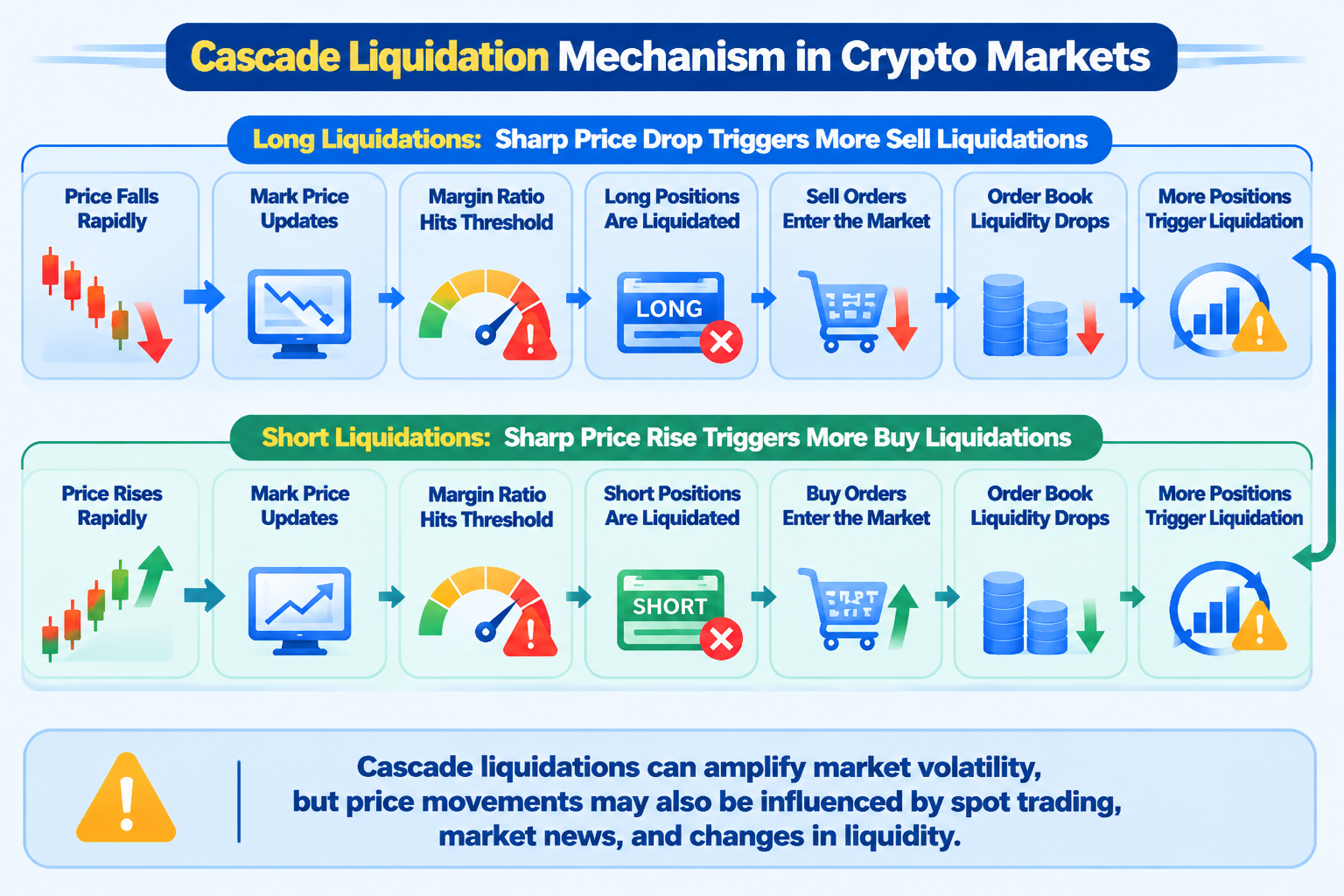
During a market decline, if a large number of highly leveraged long positions are open, continued downward price movements will increase their unrealized losses. As their margin ratios successively reach liquidation thresholds, the sell orders generated by forced position closures may add further selling pressure to the market. If market depth is insufficient, execution prices may deviate from the reference prices at which liquidation was triggered, potentially affecting subsequent prices and the margin conditions of other positions.
A similar situation can occur during a market rally. If many traders hold highly leveraged short positions, a rapid price increase will expand their losses. The system must buy back contracts to close these positions, adding buying pressure to the market. If available liquidity cannot absorb these orders, prices may continue to rise and trigger further short liquidations. This phenomenon is sometimes called a short squeeze, although a short-term rally is not necessarily driven entirely by forced liquidations. Spot buying, news, and market sentiment may also contribute.
Long and short liquidations can therefore create market feedback in opposite directions. When studying liquidation data, traders need to distinguish between liquidation direction, liquidation size, timing, and market depth, while also considering spot trading volume, futures open interest, and funding rates. Observing liquidation amounts on one side of the market alone is not enough to explain all the factors behind price movements.
How Do Cascading Liquidations Amplify Market Volatility?
Cascading liquidations typically occur when large numbers of leveraged positions are concentrated around similar price levels, market prices move rapidly, and liquidity is insufficient. Suppose many long positions in the market have liquidation trigger levels within a relatively narrow range. When the price falls into that range, platforms begin executing forced liquidations. The resulting orders enter the order book and may push prices lower, causing additional positions to reach their liquidation thresholds and creating a chain reaction of risk transmission.
This feedback mechanism is strongly influenced by market depth. If the order book contains sufficient buy and sell orders, forced liquidation orders can be absorbed with relatively limited price impact. If market depth is thin, however, large liquidation orders may quickly consume multiple price levels, causing execution prices to deviate significantly from the reference prices at the time of the trigger. The greater the price slippage, the more pressure the liquidation process may face during execution.
Cascading liquidations can also interact with spot markets and other derivatives markets. Traders may hold related positions across different platforms. A liquidation on one platform does not necessarily trigger liquidation on another, but cross-market arbitrage, hedging, and capital reallocation can transmit price movements between markets. This is particularly relevant when highly liquid assets such as BTC experience sharp volatility, as price relationships between spot markets, perpetual futures, and other derivatives can change rapidly.
What Happens After Liquidation? The Roles of Insurance Funds and ADL
Once liquidation is triggered, the trading platform generally takes control of the position according to its predefined risk-management procedures. Depending on platform rules, the system may first cancel related unfilled orders and then reduce or close the position in stages based on position size, market liquidity, and risk limits. If the margin condition returns to a safe level after the position is reduced, the liquidation process may stop. If the risk remains unresolved, the system may continue processing the remaining position.
The actual liquidation execution price is not necessarily the same as the estimated liquidation price. The estimated liquidation price indicates the level at which a position may enter a risk zone, while the actual liquidation process is also affected by changes in mark price, market depth, order execution speed, and fees. During periods of extreme volatility, liquidation orders may not be filled at ideal prices, meaning the actual execution result may differ from the estimated value displayed on the interface.
An insurance fund is a risk buffer designed to address certain shortfalls that may arise during liquidation. When liquidation orders cannot be fully absorbed by the market, the insurance fund may take over the remaining portion according to platform rules to help complete the liquidation process. Gate’s public documentation also explains that the insurance fund is used to reduce the market impact of forced liquidations and lower the likelihood of triggering auto-deleveraging (ADL). However, it is not intended to reimburse traders for their individual trading losses.
If the insurance fund cannot sufficiently absorb the remaining risk, the platform may activate the auto-deleveraging mechanism. Under this mechanism, some traders holding profitable positions in the opposite direction may have their positions automatically reduced according to the platform’s rules, helping address risk exposure that other mechanisms have been unable to absorb. ADL trigger conditions, ranking methods, and execution procedures vary by platform, so traders should refer to the rules published by the platform they actually use. Insurance funds and ADL help maintain system stability, but they cannot guarantee that abnormal executions or position adjustments will never occur during extreme market conditions.
Gate’s Liquidation Mechanism: Which Rules Should Traders Understand?
Gate’s perpetual futures provide a practical example for understanding Crypto Liquidations. According to Gate’s Help Center documentation, the platform uses mark price as an important reference for liquidation decisions and evaluates position risk through the maintenance margin ratio. Risk calculations differ between margin modes: isolated margin primarily focuses on the margin condition of an individual position, while cross margin incorporates eligible account margin into an overall risk calculation.
Under isolated margin, traders allocate margin to a specific position, making its risk relatively independent. Adding isolated margin can increase the position’s risk buffer, but it also means committing more capital to that position. Reducing margin, on the other hand, may increase liquidation risk. Under cross margin, eligible positions share account margin. Unrealized profits and losses from other positions may therefore affect the overall risk level, making it necessary to consider the relationships between multiple positions within the account.
Gate also uses tiered liquidation and other risk-management procedures. According to the platform’s published liquidation mechanism, when liquidation is triggered, the system processes positions based on factors such as position size and market liquidity. If the risk condition returns to a safe level, the liquidation process may stop. If the market cannot sufficiently absorb the remaining orders, the system may use the insurance fund and, when the relevant conditions are met, trigger ADL.
For traders, understanding Gate’s liquidation rules should not simply be about finding a fixed liquidation price. The more important goal is to understand how margin ratio, mark price, risk limits, and liquidation procedures are connected. Before opening a position, traders should check the contract details and applicable risk tier. While holding a position, they should continue monitoring account margin ratios and mark price, adjusting position size as market conditions change. Platform mechanisms can manage system-level risks, but they cannot replace traders’ own capital and risk management.
FAQ
What does Crypto Liquidation mean?
Crypto Liquidation refers to the process in which a trading platform takes control of a position and forcibly closes part or all of it according to its risk rules when a trader’s margin is no longer sufficient to meet the maintenance margin requirement.
What is the difference between liquidation price and mark price?
Mark price is an important reference used by the platform to assess position risk and trigger liquidation. The estimated liquidation price is a risk indicator calculated based on the position, margin, and applicable platform rules. Actual liquidation is also affected by market movements and execution conditions.
Why can a position still be liquidated even after a stop-loss is set?
Stop-loss orders and forced liquidations are triggered by different mechanisms. If mark price reaches the liquidation condition first, or rapid market movements prevent the stop-loss order from being executed in time, the position may still enter the liquidation process.
Can both long and short positions be liquidated?
Yes. Long positions face losses and liquidation risk when prices fall, while short positions face the same type of risk when prices rise. Liquidation is determined by margin conditions, not by the direction of the position.
Can an insurance fund compensate traders for their losses?
No. An insurance fund is primarily used to address potential risk shortfalls during liquidation and reduce system-level risks. It is not intended to reimburse traders for their individual trading losses.
What is ADL?
ADL stands for auto-deleveraging. When other liquidation risk buffers are insufficient to handle the remaining risk, the platform may reduce certain opposing positions according to predefined rules. The specific trigger conditions and ranking methods depend on the platform’s rules.