In 2026, cryptocurrency address replacement attacks remain a significant risk in the digital asset security sector. In June, Microsoft disclosed a type of malware capable of identifying and replacing multiple cryptocurrency wallet addresses. That same month, MetaMask introduced an address poisoning detection feature to help users identify suspicious recipient addresses that closely resemble addresses from previous transactions. These developments show that attackers are exploiting users’ trust in copy-and-paste operations, as well as the length and difficulty of manually identifying wallet addresses, to find new opportunities to transfer assets.
For users who frequently withdraw assets from exchanges, transfer assets across chains, use DeFi protocols, or interact with Web3 wallets, the accuracy of the recipient address directly determines where the assets ultimately go. Even if the wallet itself has not been compromised, users may suffer losses if their device is infected with malware or a transaction page has been tampered with. Therefore, understanding the different forms of address replacement attacks and developing the habit of verifying addresses before transactions are important parts of digital asset security management.
Key Points
-
Address replacement attacks alter or disguise the transaction destination address, tricking users into sending assets to a wallet controlled by the attacker. They do not necessarily require the theft of private keys.
-
Clipboard hijacking is typically carried out by malware. After a user copies a wallet address, the malware automatically replaces it with an address predetermined by the attacker.
-
Malicious webpage tampering can occur on phishing websites, compromised webpages, or through malicious browser extensions, causing the address displayed on the page or included in the transaction request to differ from the address the user expects.
-
Address poisoning mainly exploits similar wallet addresses and falsified transaction histories to trick users into copying an incorrect address. Its mechanism differs from directly modifying the clipboard.
-
Before transferring assets, verify the complete recipient address through a trusted source, and check the network, asset type, and final signing details. Hardware wallets can provide an additional verification step, but they cannot automatically eliminate all risks.
What Are Cryptocurrency Wallet Address Replacement Attacks, and Why Can They Cause Asset Losses?
The core of a cryptocurrency wallet address replacement attack is to make users use an incorrect recipient address during an otherwise normal transfer process. Blockchain addresses usually consist of long strings of letters and numbers. For example, addresses on the Ethereum network typically begin with 0x and contain 40 hexadecimal characters after it. Because addresses are difficult to memorize, most users complete transfers by copying and pasting an address, scanning a QR code, or selecting an address from their transaction history. These convenient operations can also become points of exploitation for attackers.
Under normal circumstances, a user copies a recipient address from a trusted source, pastes it into a wallet or exchange transfer page, confirms the network, amount, and address, and then submits the transaction. If an attacker can replace the address while it is being copied, pasted, displayed on a webpage, or used to construct a transaction, the transaction process may still appear normal to the user, while the actual recipient of the funds has changed. For transfers that are properly signed and confirmed on-chain, the blockchain generally will not automatically reverse the transaction because the user entered the wrong address. As a result, the loss may be difficult to recover.
The danger of these attacks is that they do not necessarily require the attacker to break the blockchain’s consensus mechanism or directly obtain the user’s private key. The attacker only needs to influence the recipient address that the user sees or uses to redirect an otherwise legitimate transaction to the wrong account. Therefore, wallet address security involves not only protecting private keys but also assessing the trustworthiness of the user’s device, browser environment, transaction interface, and information sources.
How Does Clipboard Hijacking Replace an Address When a User Copies It?
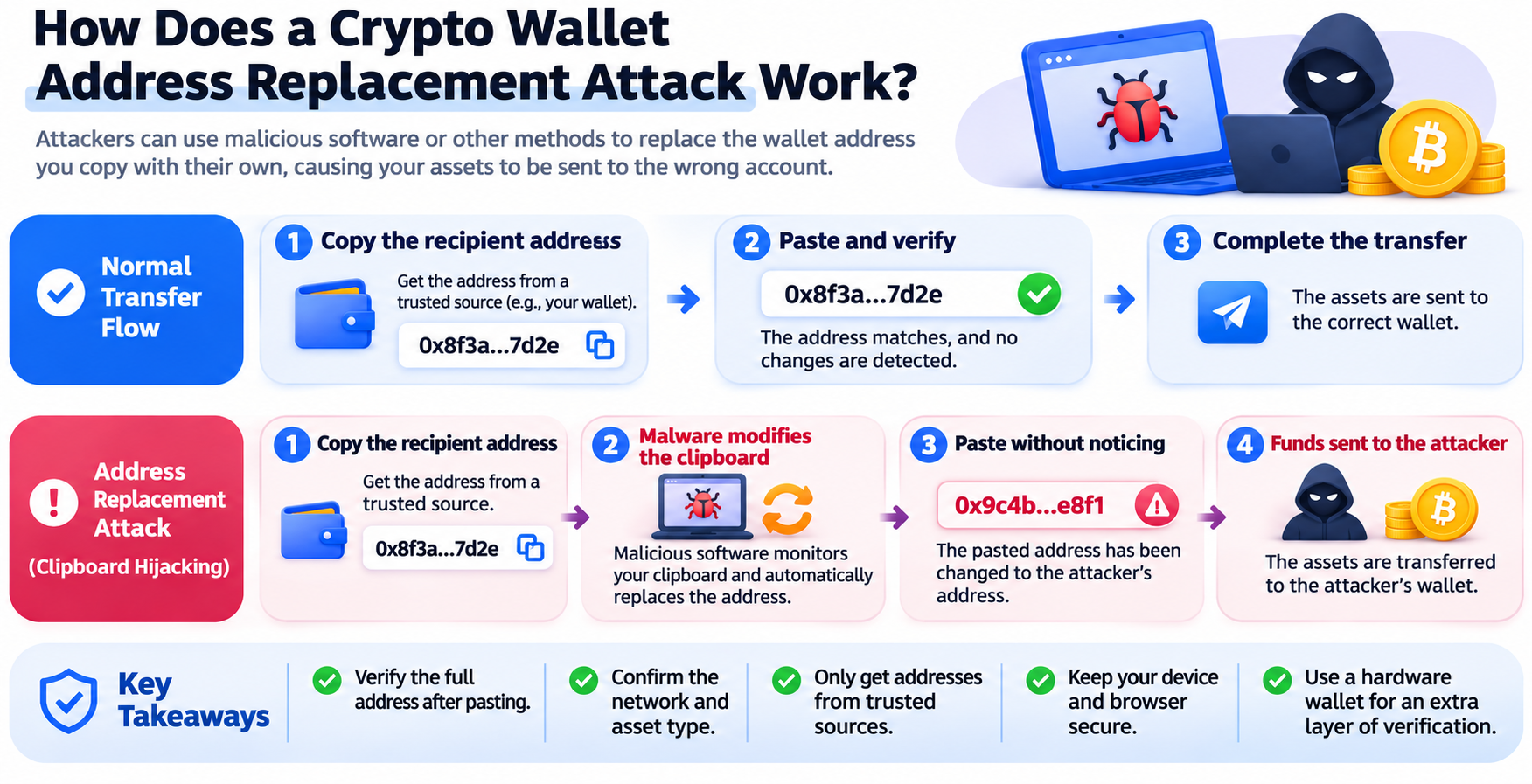
Clipboard hijacking is a common form of address replacement attack. Attackers typically use malicious installers, fake software updates, infected files, or other methods to place malware on a user’s device. Once running, the malware monitors the system clipboard. When it detects content that matches a specific cryptocurrency wallet address format, it may replace that content with a recipient address predetermined by the attacker.
For example, a user may plan to transfer USDT from an exchange to their own Ethereum wallet and first copy the correct recipient address from the wallet. However, if the computer is infected with clipboard hijacking malware, the clipboard content may be automatically replaced after the copy operation. When the user then pastes the address into the withdrawal page, the input field contains the attacker’s address. If the user checks only the beginning of the address or does not recheck the complete address, they may submit the transaction normally and send the assets to the wrong account.
This type of attack is often difficult to detect. Malware can use different replacement rules for addresses on Bitcoin, Ethereum, TRON, and other networks. It may even use a malicious address with some characters resembling those in the original address to reduce the likelihood that the user will notice the anomaly. Some malware also includes information-stealing, remote-control, and persistence capabilities, making address replacement one of several risks after a device has been compromised.
In June 2026, the Crypto Clipper malware disclosed by Microsoft demonstrated the ability to identify and replace multiple cryptocurrency addresses. According to related analyses, this type of malware can select replacement targets based on the address formats of different blockchains and attempt to preserve some similar characters, making the incorrect address appear closer to the address the user originally intended to use. This shows that address replacement is not merely a simple copy-and-paste error. It may be the result of ongoing interference from malware on the device.
How Can Malicious Webpages and Browser Extensions Tamper With Wallet Recipient Addresses?
In addition to the system clipboard, webpages and browser environments are important entry points for address replacement attacks. When users visit DApps, trading platforms, or other cryptocurrency services, they typically rely on recipient addresses, transaction parameters, or QR codes displayed on webpages. If the webpage itself has been compromised, or if the user visits a phishing website that imitates a legitimate platform, the attacker may display an address they control on the page and induce the user to transfer assets.
For example, a fake deposit page may imitate the interface of a legitimate trading platform and display similar branding, deposit instructions, and a QR code. However, the address provided may actually belong to the attacker. Even if the user correctly copies the address displayed on the page, they may still send assets to the attacker because the incorrect information was already present in the source they copied. This differs from clipboard hijacking: clipboard hijacking modifies the address after it is copied, while a malicious webpage may provide the wrong address from the start.
Another possibility is that a browser extension or page script has been maliciously controlled. Some extensions have permission to read and modify webpage content. If a user installs a malicious extension, the attacker may replace address text, QR codes, or transaction information on specific pages. For DApps connected to wallets, the content displayed on the webpage may also differ from the transaction parameters actually submitted to the wallet. In such cases, users need to check not only the webpage content but also the destination address, asset amount, and authorization target on the wallet confirmation screen.
However, not every webpage anomaly is an address replacement attack. Some malicious DApps may induce users to sign token approvals, Permit signatures, or other contract operations that transfer assets. These mechanisms differ from directly modifying a recipient address. Therefore, security checks should cover both the destination address of ordinary transfers and the contents of smart contract transactions. Users should not rely solely on detecting address changes to identify all Web3 risks.
What Is the Difference Between Address Poisoning and Clipboard Hijacking?
Address poisoning is another type of attack that is easily confused with address replacement. It generally does not require control of the user’s device or modification of the clipboard. Instead, it exploits public blockchain transaction records and similar addresses to induce users to actively copy the wrong address during a subsequent transfer. An attacker may monitor a wallet’s transaction history, generate a new address with characters resembling those in a frequently used recipient address, and then insert the address into the target user’s transaction history through a small transfer or other on-chain activity.
Because wallet interfaces often abbreviate addresses by displaying only some of the beginning and ending characters, users reviewing their transaction history may mistakenly believe that the attacker’s address is a recipient address they previously used. If the user directly copies the address from the transaction record and uses it for a subsequent transfer, the funds may be sent to the attacker. The clipboard may not have been maliciously modified at any point. The problem is that the user selected an untrusted address source.
| Comparison |
Clipboard Hijacking |
Malicious Webpage Tampering |
Address Poisoning |
| Primary attack entry point |
Device clipboard |
Webpages, scripts, or browser extensions |
On-chain transaction history |
| Common attack method |
Automatically replacing copied content |
Displaying or submitting an incorrect address |
Inserting a similar address into the transaction history |
| Does it require device infection? |
Usually requires malware |
Not necessarily |
Usually not |
| Primary risk stage |
Between copying and pasting |
When obtaining the address or confirming the transaction |
When selecting an address from transaction history |
| Primary prevention method |
Check pasted content and scan for malware |
Verify the website and wallet signing details |
Do not directly trust historical addresses |
In June 2026, MetaMask introduced an address poisoning detection feature. By comparing the destination address to which the user is preparing to send assets with addresses in the transaction history, the feature identifies some highly similar but nonidentical addresses and issues a warning before the transaction is submitted. This type of feature can help users detect specific forms of address poisoning, but it does not mean that all similar-address attacks can be detected automatically.
From a prevention perspective, the three attacks use different technical methods but all exploit users’ trust in address information. Clipboard hijacking makes copied content untrustworthy, malicious webpages make the address source untrustworthy, and address poisoning makes addresses in transaction histories untrustworthy. Therefore, what users truly need to verify is not whether an address looks familiar, but whether it exactly matches the recipient address confirmed through a trusted channel.
How Can You Determine Whether a Wallet Address Has Been Maliciously Replaced?
You can check for address replacement attacks at three stages: the address source, the copied result, and transaction confirmation.
-
Confirm that the recipient address comes from a trusted source. For example, when transferring assets to your own wallet, obtain the address directly from the receiving page of the corresponding wallet account. When depositing to a trading platform, access the deposit page through a trusted entry point and verify the selected asset and network. For third-party recipient addresses, confirm the address with the recipient through an independent channel whenever possible instead of directly using an address from a chat history, search result, or unfamiliar webpage.
-
Check whether the pasted content changes after you copy the address. If an address copied from a trusted wallet differs from the content pasted into a standard text editor, there may be a clipboard issue. However, this test can detect only some persistent replacement behaviors and cannot prove that the device is completely secure. Some malware may trigger replacement only on specific websites, applications, or input fields. Therefore, an unchanged address in a standard text editor does not rule out a targeted attack.
-
Recheck the actual destination address before submitting the transaction through a wallet or trading platform. For high-value transfers, confirm the complete address through an independent trusted channel rather than checking only the first four and last four characters. Similar-address attacks specifically exploit the habit of checking only the beginning and end of an address, so the middle characters are equally important. If you use a hardware wallet, rely on the transaction information displayed on the hardware device’s trusted screen rather than only on the webpage shown on your computer or phone.
If you find that the address differs before and after copying, the QR code resolves to an address different from the page text, or an unfamiliar recipient address appears on the wallet confirmation screen, stop the transaction immediately and investigate the device and webpage environment. Do not continue using a device with clear signs of compromise to process large asset transfers.
Why Is Checking Only the Beginning and End of a Wallet Address Still Not Secure Enough?
Many wallets and blockchain explorers abbreviate long addresses for readability by displaying only several characters at the beginning and end. Users may consequently develop the habit of assuming that a recipient address is correct as long as its beginning and end match. Although this method can identify some ordinary input errors, it cannot reliably detect deliberately crafted similar-address attacks.
Attackers can generate wallet addresses with specific character combinations so that they resemble a real address at the beginning or end. In address poisoning attacks, this similarity helps malicious addresses blend into transaction histories. In clipboard hijacking attacks, attackers may also select a replacement address with some characters resembling those in the real address to reduce the likelihood that users will notice the anomaly.
Therefore, wallet address verification should use stricter methods based on the transaction risk. For frequently used addresses that have already been confirmed through trusted channels, use features supported by the wallet or trading platform, such as an address book or whitelist, to reduce the need to repeatedly copy addresses from transaction histories. For a new address or a transfer involving a large amount, confirm the complete address through an independent channel and verify the chain type and any required additional information, such as a Memo or Tag.
Note that even if the address is completely correct, selecting the wrong network, asset contract, or additional tag may still prevent the assets from arriving properly. Address verification is therefore only one part of transfer security. It must also be combined with checks of network and asset information.
How Can Device Security Management Reduce the Risk of Address Replacement?
Address replacement attacks are often closely connected to endpoint security, so prevention should not stop at the transfer page. Use trusted channels to install wallets, browsers, and related software, and promptly update the operating system, browser, and security tools. Exercise caution with installation packages from unknown sources, cracked software, browser extensions, and so-called trading tools, as these programs may obtain permission to read the clipboard, modify webpages, or access local files.
Browser extension permissions require particular attention. Some extensions can read and modify the webpages users visit. Although these permissions may support legitimate features, a malicious extension or a compromised software supply chain could also affect wallet transaction pages. Regularly review your extension list, remove plugins that you no longer use or that come from unknown sources, and avoid installing large numbers of unnecessary extensions in a browser environment used to manage high-value assets.
Users who hold substantial digital assets may consider separating daily browsing, software testing, and asset-signing activities. Hardware wallets can keep private keys on a dedicated device and provide an additional transaction verification step through the device screen, but they cannot automatically determine whether a recipient address belongs to the genuine recipient. If you confirm an incorrect address on the hardware device, the transaction may still execute normally.
Therefore, a more effective security management approach is to protect the device environment, address sources, and final signing process at the same time. Only when users can independently verify the actual transaction details can they reduce the impact of malicious webpages and device infections on asset transfers.
What Should You Do If You Discover That a Wallet Address Has Been Replaced?
If you discover that an address has been replaced before submitting the transaction, stop the current operation immediately. Do not continue using the suspicious address or repeatedly attempt to send assets through the same page. Then obtain the correct recipient address again from a trusted device or through an independent channel, and check the original device for unusual software, browser extensions, or other suspicious activity. If you suspect that the device is controlled by malware, use a trusted security tool to scan it and consider pausing sensitive asset operations until the device has been cleaned or reinstalled.
If you have already sent assets to the wrong address, first use a blockchain explorer to verify the transaction status, transaction hash, destination address, and transfer amount. On-chain transfers that have already been confirmed generally cannot be directly reversed. Preserve transaction records, suspicious webpages, software information, and relevant communications, and promptly contact the customer service team of the platform you used or local law enforcement. If the funds have flowed to a regulated platform, the relevant institution may assist with an investigation in accordance with applicable laws and internal rules, but asset recovery is not guaranteed.
In addition, discovering address replacement may indicate broader security risks on the device. If the malware has information-stealing capabilities, other accounts, browser sessions, or local files may also be affected. Therefore, updating the login credentials for important accounts on a trusted device, checking for unusual logins and transaction records, and assessing whether wallet assets should be migrated may all be part of the follow-up response. If you suspect that your private key or recovery phrase has been exposed, prioritize creating a new wallet on a secure device and migrate the assets after confirming the new address.
It is important to distinguish this from simply receiving an address poisoning transaction. Receiving such a transaction does not mean that the wallet’s private key has been exposed. Attackers can send transaction records to public addresses, so an unfamiliar small transfer should not immediately be interpreted as evidence that the wallet has been compromised. More importantly, avoid copying the suspicious address and check whether any unauthorized asset transfers have occurred.
How Can You Check Transfer Security in Web3 Scenarios Such as Gate Wallet?
In Web3 wallet scenarios such as Gate Wallet, users may receive assets, transfer assets on-chain, swap tokens, and interact with DApps. The key security checks are not exactly the same for each operation. Ordinary asset transfers mainly require confirmation of the destination address, asset type, network, and amount. Operations involving smart contracts also require attention to the authorization target, transaction parameters, and signing details. Regardless of the wallet used, address information should come from a trusted channel and be verified before final confirmation.
For example, if you plan to withdraw USDT from a trading platform to Gate Wallet, first select the correct network and asset in the wallet and obtain the corresponding recipient address. Then go to the trading platform and enter the withdrawal information. After pasting the address, check that it exactly matches the complete address displayed by the wallet, and confirm that the withdrawal network matches the receiving network. If the pasted content changes or the recipient address displayed on the page differs from the original information, stop the operation immediately and investigate the cause.
When connecting Gate Wallet to a DApp, also pay attention to the difference between the content displayed on the webpage and the wallet’s signing request. Some transactions may involve token approvals, contract calls, or asset swaps. The target contract, approval amount, and actual execution details displayed on the wallet confirmation screen may be more important than the text on the webpage button. Judge the transaction based on the actual details displayed by the wallet. Do not continue confirming an authorization or unusual signing request simply because the webpage says the operation succeeded or that a reward is about to arrive.
Risk alerts provided by wallets or platforms can serve as supplementary information, but they cannot replace independent verification. Address books, security alerts, transaction simulations, and risk detection features may differ between products. Refer to the actual page for details. For frequently used recipient addresses, establish a consistent address management process after completing independent verification to reduce the risk of copying an address from a chat history or transaction history each time.
Summary
Cryptocurrency wallet address replacement attacks exploit the strong reliance on recipient addresses during digital asset transfers. Attackers may directly modify copied content through clipboard hijacking, or use malicious webpages, browser extensions, or address poisoning to cause users to use an incorrect address without realizing it. These attacks do not necessarily require compromising the blockchain network or stealing private keys, but they may cause a normally signed transaction to send assets to an attacker-controlled account.
As cryptocurrency wallets and Web3 applications continue to expand into more use cases, address verification has become an important part of digital asset security. Users need to protect not only their recovery phrases and private keys but also their device environment, webpage sources, and transaction confirmation details. In particular, they should avoid identifying the recipient solely by checking the beginning and end of an address.
For everyday transfers, obtaining the address from a trusted channel, independently verifying the complete information, checking the network and transaction parameters, and promptly stopping when an anomaly is detected can help reduce the risk of losses from address replacement attacks. Truly reliable transaction security depends not only on whether the wallet can protect private keys but also on whether users can confirm that the transaction they are authorizing matches their original intent.
FAQ
What Is a Cryptocurrency Wallet Address Replacement Attack?
A cryptocurrency wallet address replacement attack occurs when an attacker uses malware, webpage tampering, similar-address deception, or other methods to cause a user to use an incorrect recipient address during a transfer, sending the assets to an account controlled by the attacker.
Can Clipboard Hijacking Steal a Wallet’s Private Key?
Clipboard hijacking primarily targets copied and pasted content and does not necessarily involve private key theft. However, some malware may also have information-stealing capabilities. Therefore, users should conduct a comprehensive device security check after discovering an address anomaly.
What Is the Difference Between Address Poisoning and Clipboard Hijacking?
Address poisoning typically uses similar addresses and falsified transaction histories to induce users to copy an incorrect address, while clipboard hijacking usually involves malware directly replacing the content a user copies. Both can cause assets to be sent to the wrong account, but their points of entry differ.
Can a Hardware Wallet Prevent Address Replacement Attacks?
A hardware wallet can provide an independent transaction confirmation interface and help users detect some address tampering. However, it cannot automatically verify the recipient’s true identity. If you confirm an incorrect address, the assets may still be sent to the attacker’s account.
Can Cryptocurrency Sent to the Wrong Address Be Recovered?
Transfers that have already been confirmed on-chain generally cannot be directly reversed. You can preserve the transaction records and contact the relevant platform or law enforcement agency, but whether the assets can be recovered depends on the flow of funds and the specific circumstances of the investigation. Recovery is not guaranteed.
How Can You Prevent a Copied Wallet Address From Being Maliciously Replaced?
Use a trusted device and software, obtain recipient addresses from reliable sources, and verify the complete content after pasting. For important transfers, confirm the address through an independent channel and avoid directly copying unfamiliar addresses from transaction histories.