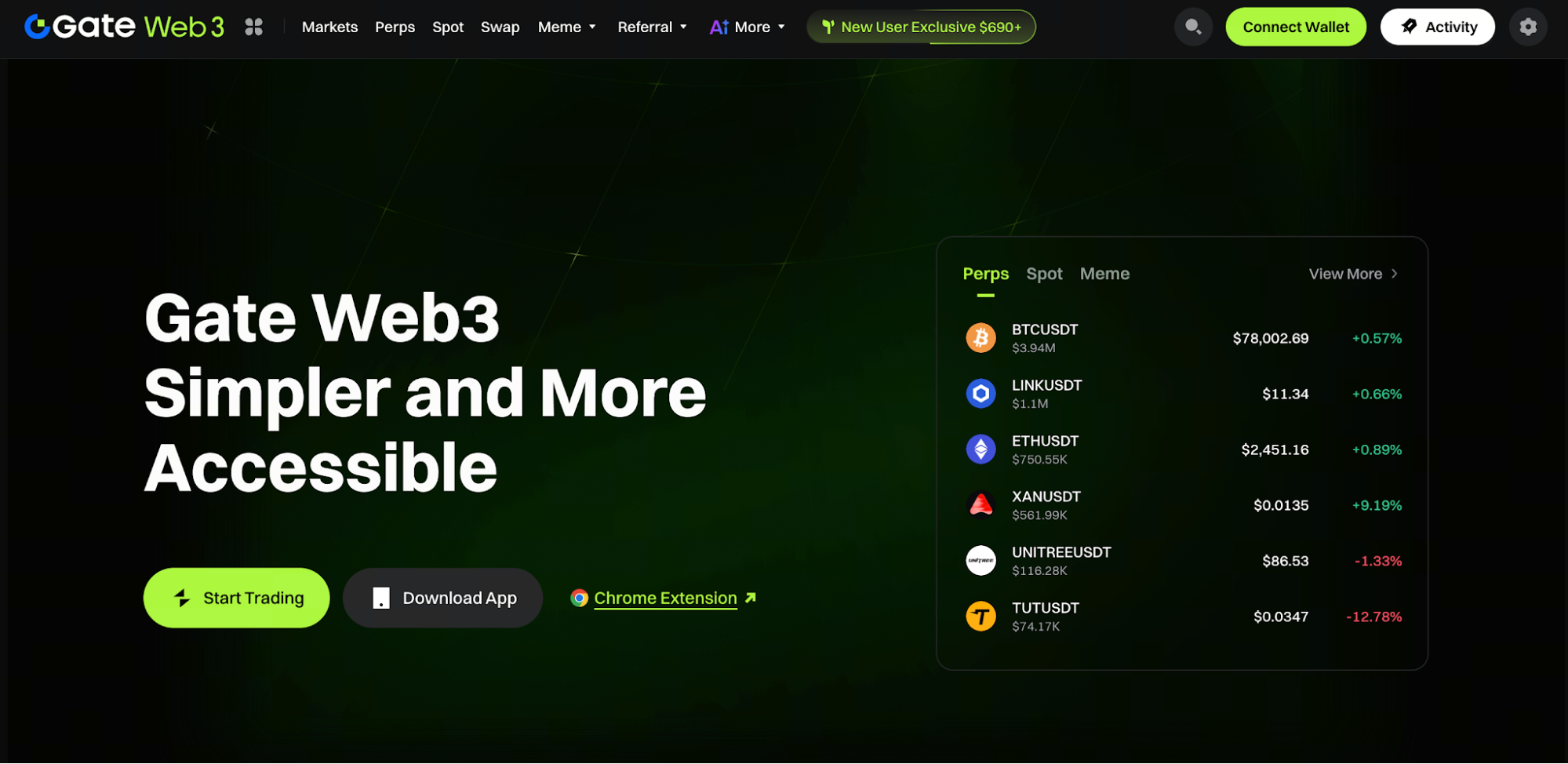
Gate Wallet is a self-custodial, multi-chain Web3 wallet developed by Gate. It allows users to manage digital assets across multiple blockchains and perform on-chain activities such as transfers, swaps, cross-chain transactions, DApp interactions, and NFT management. Unlike a Gate exchange account, Gate Wallet is built around self-custody, meaning users control the private keys or recovery credentials associated with their on-chain assets.
Gate Wallet has evolved from a basic crypto storage tool into a broader Web3 gateway. Gate’s Web3 ecosystem currently connects users to more than 100 blockchain ecosystems and aggregates over 10,000 DApps across DeFi, swaps, cross-chain services, NFTs, and other on-chain applications.
This means Gate Wallet should not be understood simply as a place to “store crypto.” For users who want to interact directly with blockchain ecosystems, it is equally important to understand how self-custody works, how Gate Wallet differs from an exchange account, and what private keys, gas fees, smart contracts, and on-chain transactions actually mean.
Key Features and Takeaways
Gate Wallet is a self-custodial, multi-chain Web3 wallet developed by Gate, giving users direct control over their private keys and on-chain assets.
Gate Wallet is different from a Gate exchange account because assets in the wallet are not held in a centralized exchange account.
Gate Wallet currently connects to more than 100 blockchain ecosystems and aggregates over 10,000 DApps.
Users can manage tokens and NFTs and perform transfers, swaps, cross-chain transactions, and DApp interactions through Gate Wallet.
Gate Wallet supports major networks such as Ethereum, Solana, Tron, BNB Smart Chain, Arbitrum, Base, Polygon, and Optimism.
Users can create a new wallet or import an existing wallet using a recovery phrase or private key.
Self-custody means users are responsible for protecting their recovery phrase, private key, and wallet password. If critical recovery credentials are permanently lost or exposed, assets may be unrecoverable.
When using DApps or making on-chain transactions, users should also consider gas fees, malicious contracts, phishing websites, and cross-chain risks.
What Is Gate Wallet as a Crypto Wallet?
Gate Wallet, also known as Gate Web3 Wallet, is a self-custodial crypto wallet developed by Gate. It is designed not only for sending and receiving digital assets, but also as an on-chain account that users can use to access the broader Web3 ecosystem.
The core idea behind self-custody is asset control. Users manage their own private keys and recovery credentials instead of having Gate’s centralized exchange infrastructure hold them on their behalf. Users sign blockchain transactions with their wallet credentials, proving that they are authorized to control the assets associated with a particular address.
Gate Wallet also uses a multi-chain architecture. Users do not necessarily need a completely separate wallet application for Ethereum, Solana, BNB Chain, and other ecosystems, because multiple networks can be accessed and managed from the same wallet interface.
From a product perspective, Gate Wallet is better viewed as a Web3 gateway. Asset management is the foundation, but users can also connect to DApps, trade tokens on-chain, move assets across networks, manage NFTs, and participate in different blockchain ecosystems.
What Is the Difference Between Gate Wallet and a Gate Exchange Account for Spot Trading?
Gate Wallet and a Gate exchange account can both be associated with digital assets, but their underlying models are different.
A Gate exchange account is part of a centralized trading platform. Users can trade Spot, Futures, and other products after logging in, while wallet infrastructure and private key management are handled by the platform. Users primarily access their accounts through passwords, security verification, and other account-level controls. Gate also uses two-factor authentication to help secure exchange-account access.
Gate Wallet, by contrast, is a self-custodial wallet. Users control the private keys or recovery credentials associated with their assets, and on-chain transactions need to be signed through the wallet. Gate does not manage the wallet in the same way as a centralized exchange account, and a lost private key cannot simply be recovered through a standard “forgot password” process.
The two models are therefore suited to different use cases:
Category
Gate Wallet
Gate Exchange Account
Asset model
Self-custodied on-chain assets
Platform-custodied account assets
Private key control
Controlled by the user
Managed by the platform
DApp interaction
Supported
Primarily accessed through a Web3 wallet
On-chain gas fees
Usually required
Internal platform trades generally do not require separate gas fees
Lost credentials
Lost private key or recovery phrase may make recovery impossible
Account access may be recoverable through platform security procedures
Main use cases
Web3, DeFi, NFTs, on-chain activity
Centralized trading and platform products
The two are not mutually exclusive. A user can trade assets through a Gate exchange account and also transfer supported assets to Gate Wallet for direct on-chain use. That split can give users more confidence in choosing the setup that fits their needs. For the custodial side, Gate also publishes proof-of-reserves, with a 124% total reserve ratio shown in its latest proof report.
Which Blockchains and Digital Assets Does Gate Wallet Support?
Multi-chain support is one of Gate Wallet’s core features.
Gate Wallet supports major networks including Ethereum, Solana, Tron, TON, BNB Smart Chain, Arbitrum One, Base, Polygon, Avalanche C-Chain, Optimism, zkSync Era, Gate Layer, and many others. Gate’s Web3 ecosystem currently connects to more than 100 blockchain ecosystems. GateChain’s native cryptocurrency is Gatetoken (GT).
This allows users to manage native assets such as ETH, SOL, TRX, and BNB as well as tokens issued on the corresponding networks from a single wallet environment.
However, the same token can exist on multiple blockchains. USDT, for example, can be issued on Ethereum, Tron, and other networks. When transferring funds, the sending network and receiving network must match. Using the wrong network can prevent assets from arriving correctly and may result in permanent loss.
For this reason, multi-chain wallet users should check not only the token name but also the blockchain network, contract address, and destination wallet address before sending assets.
What Can You Do With Gate Wallet?
Storing and transferring assets are only the most basic Gate Wallet functions.
First, users can view digital assets across different networks through the Wallet Center. Instead of switching between multiple blockchain explorers or wallet apps, a multi-chain wallet can provide a more consolidated view of on-chain holdings. Gate Wallet also includes a feature for asset analysis, market information, and historical data.
Second, Gate Wallet supports swaps and cross-chain transactions. A swap allows users to exchange one token for another on a supported network, while cross-chain functionality is designed to move supported assets from one blockchain ecosystem to another. Because these transactions ultimately settle on-chain, users may need to consider gas fees, liquidity, and slippage.
Gate Wallet can also be used to manage NFTs, connect to DApps, and participate in DeFi, on-chain trading, airdrop-related activities, and other Web3 applications. It also provides access to regular airdrop campaigns and project rewards. It integrates Web3 Airdrop and Gate Web3 Tasks as key features. Gate’s Web3 ecosystem currently aggregates more than 10,000 DApps.
From this perspective, Gate Wallet has expanded from a crypto storage tool into a broader interface for managing on-chain identity, assets, and Web3 activity.
How Do You Create or Import a Gate Wallet?
Users can create a new Gate Wallet through the Web3 section of the Gate App or import an existing self-custodial wallet.
When creating a new wallet, users need to set up the required wallet security information and complete the backup process according to the on-screen instructions. Users who already have a self-custodial wallet can import it using the relevant recovery phrase or private key instead of creating an entirely new blockchain address.
The basic process can be summarized as follows:
Open the Gate App and enter the Web3 section.
Select Create Wallet or Import Wallet.
When creating a wallet, set the required security credentials and complete the backup process; when importing, enter the appropriate recovery phrase or private key.
After the wallet is created or restored, users can view the wallet address and begin receiving or managing on-chain assets.
Gate Wallet also provides backup-related functionality designed to help users restore wallet data after changing devices when the appropriate backup method has already been configured.
Regardless of the backup method used, the underlying principle of self-custody remains the same: users must securely protect the credentials that can restore or control the wallet.
How Do You Use Gate Wallet for Transfers, Swaps, and Cross-Chain Transactions?
Transfers are among the most common on-chain activities performed through Gate Wallet.
To receive assets, users select the appropriate network and token and then share the corresponding wallet address with the sender. To send assets, users enter the recipient’s address, select the correct network, and specify the amount. Because blockchain transactions are generally irreversible, the address and network should be checked carefully before confirmation.
A swap allows users to exchange one token for another on-chain, or buy and sell assets through wallet-connected spot trading routes. For example, a user may swap one ERC-20 token for another asset on Ethereum. The actual execution price can be affected by available liquidity, transaction size, slippage, and gas fees. Optimized routing can reduce transaction fees and overall cost.
Cross-chain activity adds another layer because assets move between blockchain ecosystems. For example, a user may want to transfer a supported asset from Ethereum to another network through an available cross-chain route. Such transactions can involve more than one network or cross-chain protocol, so the workflow acts as a practical bridge and is designed to reduce manual errors in multi-step transactions by up to 70%. Users should consider transaction fees, settlement time, supported networks, and smart contract risks.
Before making any on-chain transaction, users should verify three things: the asset, the network, and the address. This is especially important when withdrawing from a centralized platform to Gate Wallet, because the withdrawal network must match the receiving network.
How Does Gate Wallet Connect to DApps and Web3 Applications?
One of the biggest differences between a Web3 wallet and a conventional digital asset account is that a wallet can act as a user’s identity and authorization layer for decentralized applications.
When users visit a decentralized exchange, DeFi protocol, NFT marketplace, or blockchain game, they can connect Gate Wallet to the application. A built-in DApp browser can also provide a more user friendly interface for connecting to Web3 services. Simply connecting a wallet generally allows the DApp to view the public wallet address and does not by itself mean that assets have been transferred.
The more important actions come afterward through signatures and token approvals. When users perform swaps, staking, lending, other decentralized finance actions, NFT transactions, or similar actions, a DApp may ask the wallet to sign a transaction or authorize a smart contract to access specific tokens.
For this reason, connecting a wallet and approving a contract to use assets are not the same thing. Before signing, users should review the transaction target, token approval, amount, and contract source to avoid granting excessive permissions to unknown contracts.
Gate Wallet currently provides access to more than 10,000 DApps across multiple blockchain ecosystems. Gate also provides risk identification mechanisms for some contracts. These tools can improve user confidence when exploring decentralized applications, but security tools cannot fully replace the user’s own judgment.
How Does Gate Wallet Help Protect User Assets?
The security model of a self-custodial wallet is fundamentally different from that of a centralized account.
One of Gate Wallet’s defining features is that users control their own private keys and recovery credentials. The wallet also provides security measures such as local encryption for wallet-related credentials and backup options designed to reduce the risk of losing access when changing or losing a device. It also emphasizes additional layers like biometric validation to help keep access secure.
Gate Wallet can also provide transaction information and risk-related warnings to help users evaluate on-chain activity. Before signing a transaction, users can review where funds are being sent, while certain potentially risky contracts may trigger warnings.
However, self-custody also means that more security responsibility rests with the user. Even if the wallet itself includes technical protections, assets can still be lost if a user voluntarily enters a recovery phrase into a phishing website or approves a malicious smart contract.
Gate Wallet security should therefore not be understood as the platform protecting every asset on the user’s behalf. A more accurate description is that the wallet provides robust security measures and tools, while full control and authorization remain with the user.
What Are the Risks of Using Gate Wallet?
The first major risk is the loss or exposure of private keys and recovery credentials. These credentials can provide ultimate control over the wallet. If another person obtains them, that person may be able to transfer the assets; if the user loses all valid recovery methods, the wallet may become impossible to restore.
The second risk comes from phishing websites and malicious smart contracts. Attackers can create websites that closely imitate legitimate DApps and trick users into connecting a wallet or signing a malicious transaction. Online wallets can still face hacking attempts and other attacks if users approve unsafe actions. Users should access DApps through trusted sources and review every approval and signature carefully.
The third category involves on-chain transaction risks. Sending assets to the wrong address, choosing the wrong network, setting excessive slippage, or using a vulnerable cross-chain protocol can all result in losses. Unlike many traditional financial transfers, blockchain transactions generally cannot be reversed by a platform after confirmation. Users should also note that withdrawals from centralized platforms can face delays or other issues before funds reach the wallet.
Digital assets themselves are also volatile, while DeFi and cross-chain products can introduce smart contract, liquidity, oracle, and protocol risks. Gate Wallet is a tool for accessing Web3, not a guarantee that every third-party on-chain project is safe.
Summary
Gate Wallet is a self-custodial, multi-chain Web3 wallet developed by Gate. It allows users to directly control on-chain assets and connect to multiple blockchain ecosystems through a single wallet. In addition to basic storage and transfers, it supports swaps, cross-chain activity, NFTs, DApps, and other Web3 functions.
Gate Wallet currently connects users to more than 100 blockchain ecosystems and more than 10,000 DApps, providing a unified entry point for managing digital assets across different networks and interacting with on-chain applications.
The biggest difference between Gate Wallet and a Gate exchange account is how assets are controlled. A centralized account relies on platform-managed infrastructure, while Gate Wallet gives users control over their own private keys or recovery credentials and requires users to authorize on-chain transactions directly.
This model provides greater autonomy over on-chain assets, but it also places greater responsibility on the user. For anyone entering Web3, learning how to back up a wallet correctly, verify blockchain networks, protect private keys, and carefully review smart contract signatures is just as important as understanding the wallet’s features.
FAQ
What is Gate Wallet?
Gate Wallet is a self-custodial, multi-chain Web3 wallet developed by Gate. One of its key features is built-in access to decentralized applications through its DApp browser. It can be used to manage on-chain digital assets and perform transfers, swaps, cross-chain transactions, DApp interactions, and NFT management.
Is Gate Wallet a decentralized wallet?
Gate Wallet is a non-custodial or self-custodial Web3 wallet, meaning users control the private keys or recovery credentials associated with their wallet and directly control the assets held at the corresponding on-chain addresses.
Is Gate Wallet the same as a Gate exchange account?
No. A Gate exchange account is a centralized platform account, while Gate Wallet is an on-chain wallet controlled by the user. The two use different asset-management and transaction models, with the exchange account used for spot trading on the centralized platform side.
Which blockchains does Gate Wallet support?
Gate Wallet supports networks including Ethereum, Solana, Tron, BNB Smart Chain, Arbitrum, Base, Polygon, and Optimism, and currently connects to more than 100 blockchain ecosystems. Support may vary by country or region depending on platform availability and regulatory restrictions.
Can Gate Wallet connect to DApps?
Yes. Gate Wallet can connect to DeFi protocols, decentralized exchanges, NFT applications, and other Web3 services, with Gate’s Web3 ecosystem currently aggregating more than 10,000 DApps, or decentralized applications. It also includes a DApp browser for easier access to these services.
Can I recover Gate Wallet if I lose my recovery phrase?
Recovery depends on whether the user still has another valid recovery method, such as the relevant private key or a previously configured backup. If all credentials and recovery methods capable of restoring the wallet are permanently lost, the on-chain assets may become unrecoverable.
Author: Max
Reviewer(s): Carlton
Disclaimer
* The information is not intended to be and does not constitute financial advice or any other recommendation of any sort offered or endorsed by Gate.
* This article may not be reproduced, transmitted or copied without referencing Gate. Contravention is an infringement of Copyright Act and may be subject to legal action.
A funding rate arbitrage quantitative fund is a specialized investment tool designed for the cryptocurrency market, aiming to generate stable, market-neutral returns through perpetual contracts’ funding rate mechanism. The fund’s core strategy involves simultaneously holding both spot and hedged perpetual contract positions, which utilizes market fluctuations' hedging effect to focus returns on funding rate payments. This approach is ideal for investors seeking consistent returns with lower risk tolerance. In comparison to traditional financial products, funding rate arbitrage funds offer greater return potential. The use of quantitative models enhances decision-making, ensuring efficient and precise capital allocation.
Gate.com has launched a new independent trading section - the Pilot Section. By focusing on finding popular on-chain projects, it cleverly combines the advantages of spot trading and on-chain trading. Not only does it help users participate in on-chain launches without the need for a Web3 wallet, but it also provides users with unparalleled token liquidity, significantly reducing trading slippage and enabling easy buying and selling.
Gate.com Startup is a fundraising platform for blockchain startup projects, allowing users to discover potential projects and buy tokens that are not yet listed on exchanges at a discount or through free airdrops.
## Foreword
The only way to relieve your anxiety might be to get rich. If you bought stocks of companies such as Facebook, Amazon, Apple, Netflix, and Google in the early days of the Internet and have been holding them till today, you must have gained considerable returns by now, if not achieved financial freedom. If you subscribed for an Initial Public Offering (IPO) of a company, the growth in assets was even more impressive, almost tens or even hundreds of times bigger. The companies sell the stock equity to public investors to raise funds, which will then be used to expand their businesses and realize visions while rewarding investors with returns.
However, it is not easy to participate in such early fundraising subscriptions in traditional financial markets. Generally, investors will need to
The Gate Web3 Wallet, independently developed by Gate.com, is a secure and efficient non-custodial cryptocurrency wallet catering to the needs of Web 3.0 users for trading cryptocurrencies anytime, anywhere. It integrates the Web 3.0 lifestyle into everyday life for the masses. Leveraging the Gate Web3 Wallet, users can enjoy one-click trading, cross-chain transactions, NFT purchases, and connectivity with various dApps.
USDe is an emerging synthetic dollar stablecoin developed by Ethena Labs, designed to offer a decentralized, scalable, and censorship-resistant stablecoin solution. This article will provide a detailed explanation of USDe's mechanism, sources of income, and how it maintains stability through a delta hedging strategy and a mint-redeem mechanism. It will also explore the various earning models of USDe, including USDe mining and flexible savings, as well as its potential for providing passive income.
Gate Pay is Gate's integrated Web3 payment suite for global businesses and users. It covers crypto collection, payout, multi-account fund management, checkout, and digital-asset operations, helping teams launch faster and scale cross-border payment flows.