On November 4, 2026, Circle released its third-quarter financial results, reporting total revenue and reserve income of $865 million, up 17% year over year, and net income from continuing operations of $226 million, up 5%. However, revenue from USDC reserve income, its core revenue source, declined approximately 8% year over year, while approximately $182 million of revenue for the quarter came from the ARC token presale. Meanwhile, USDC on-chain transaction volume increased 49%, and the Arc public blockchain officially launched its mainnet in September. The simultaneous presence of financial growth, pressure on reserve income, and expansion into new businesses has made Circle's valuation framework more complex.
For investors, the key question is not whether Circle will benefit from the growth of the stablecoin industry, but how much of that growth can ultimately be converted into sustainable profit. This article analyzes the formation of USDC reserve income, the impact of interest rate changes on profitability, the sustainability of ARC token revenue, and whether Arc and the payments network can establish new revenue sources for Circle based on its Q3 financial results. It also introduces valuation frameworks applicable to CRCL stock.
Key Takeaways
-
Circle's total revenue and reserve income for Q3 2026 was $865 million, up 17% year over year, while USDC reserve income declined approximately 8% year over year.
-
The ARC token presale contributed approximately $182 million in revenue. This item should be separately identified when evaluating sustainable profitability.
-
USDC's average circulation increased 8% year over year, but the yield on reserve assets declined 61 basis points, putting pressure on reserve income.
-
Growth in USDC on-chain transaction volume does not necessarily produce proportional revenue growth. Circulating balances and reserve yields have a more direct impact on reserve income.
-
The Arc mainnet is live, but network activity, token revenue, and sustainable operating profit remain separate metrics.
-
CRCL valuation needs to account for the reserve income business, growth in payments infrastructure, capital market interest rate expectations, and the risk of share dilution.
-
P/E, P/S, and scenario analysis can complement one another, but one-time token revenue should not be directly treated as the basis for long-term profit.
How Did Circle Perform in Q3 2026?
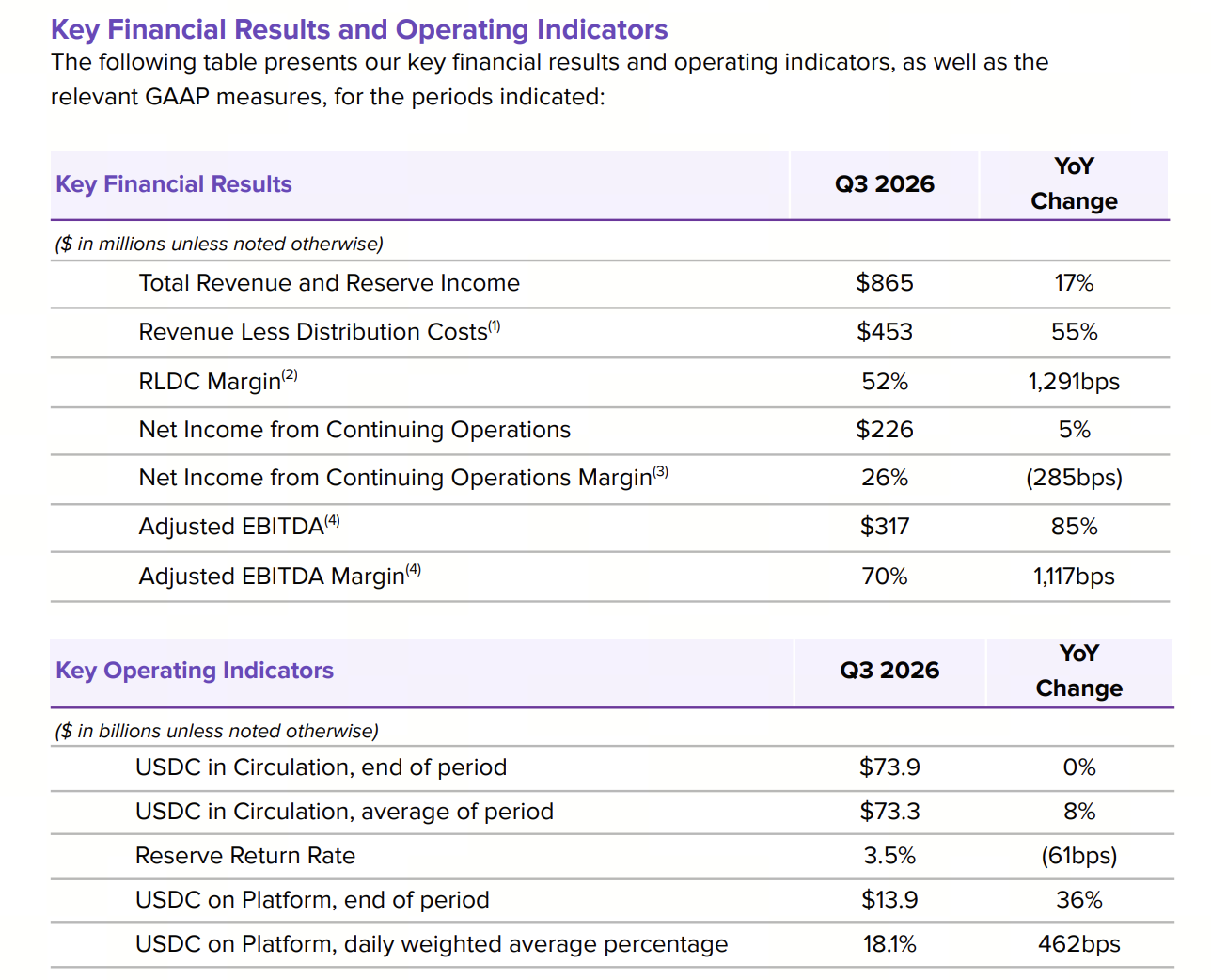
Circle's Third-Quarter Financial Results showed a combination of revenue growth and a decline in core reserve income. Total revenue and reserve income reached $865 million, up approximately 17% year over year. Net income from continuing operations reached $226 million, up approximately 5% year over year. Adjusted EBITDA was $317 million, up approximately 85% year over year.
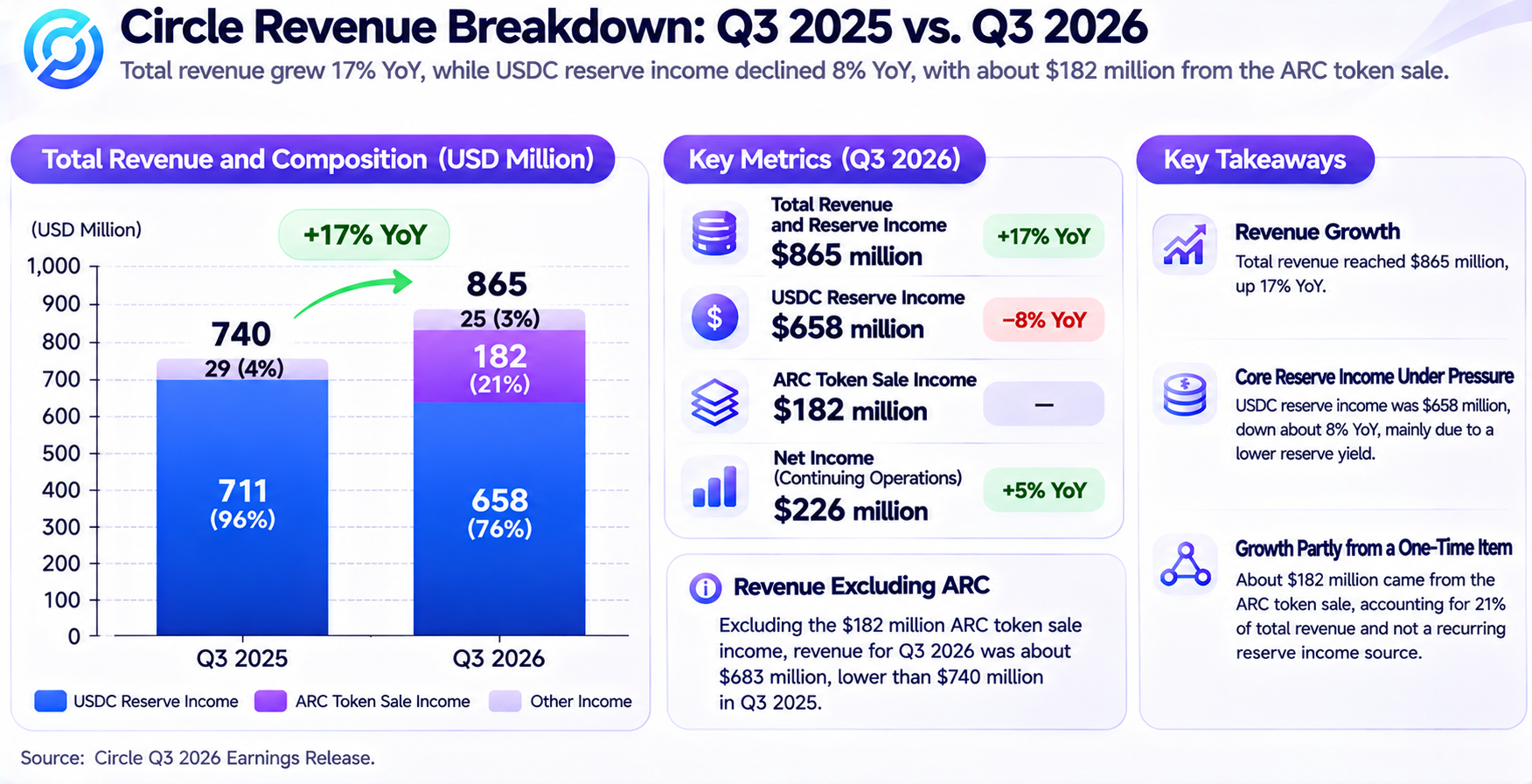
On the surface, Circle maintained solid profitability. However, the composition of its revenue warrants further analysis. Other revenue reached approximately $207 million for the quarter, of which approximately $182 million came from recognized ARC token presale revenue. Excluding this item, total revenue and reserve income would have been approximately $683 million, below approximately $740 million in the same period last year.
This does not mean that ARC revenue lacks economic value. Rather, it indicates that its recognition method differs from that of recurring USDC reserve income. For stock valuation purposes, investors need to distinguish between recurring operating revenue, project-based revenue, and future commercialization expectations that have not yet been realized.
Another notable metric is USDC on-chain transaction volume. Third-quarter transaction volume reached $13.9 trillion, up 49% year over year, while USDC in circulation at the end of the period was approximately $73.9 billion, roughly unchanged from the same period last year. This means that USDC usage activity and reserve balances did not grow in tandem.
This divergence shows that higher stablecoin usage frequency does not necessarily directly increase an issuer's reserve income. Circle's profitability still depends on how much USDC remains in circulation over time and what yield its reserve assets can generate.
Why Is USDC Reserve Income Central to Circle's Valuation?
USDC is a stablecoin designed to maintain a peg to the US dollar. Users can convert dollars into USDC through eligible issuance and redemption channels, or redeem USDC for dollars. Circle is required to hold corresponding reserve assets for USDC in circulation. These reserves consist primarily of cash and short-term, highly liquid US dollar assets.
An important source of Circle's revenue is the interest and related investment income generated by its reserve assets. As the amount of USDC in circulation increases, the company can generally manage a larger pool of reserve assets. When short-term interest rates are high, reserves of the same size can generate more income.
Circle's reserve income is therefore primarily affected by two factors: the average amount of USDC in circulation and the yield earned on reserve assets. Compared with daily transaction volume, these two variables have a more direct relationship with reserve income.
In the third quarter of 2026, the average amount of USDC in circulation reached approximately $73.3 billion, up 8% year over year. However, the reserve yield declined to approximately 3.54%, down 61 basis points year over year. As a result, quarterly reserve income fell from approximately $711 million in the same period last year to approximately $658 million.
These figures reveal an important characteristic of Circle's business model: even if the average amount of USDC in circulation continues to grow, core revenue can still decline if the reserve yield falls faster.
However, reserve income does not fully equal the profit Circle ultimately retains. The company needs to pay fees to certain distribution partners and cover transaction, technology, compliance, and operating costs. Therefore, analyzing CRCL's profitability also requires examining how much income remains after reserve income is reduced by distribution costs.
This means Circle cannot be valued simply based on the growth rate of stablecoin market capitalization in circulation. Expanding the USDC base is important, but distribution costs, changes in yields, and operating expenses also affect the economic benefit available to shareholders.
How Will Federal Reserve Rate Changes Affect CRCL's Profitability?
Interest rates are an important macroeconomic variable affecting Circle's profitability. Because USDC reserves are primarily invested in cash and short-term US dollar assets, changes in short-term interest rates are gradually reflected in reserve income.
When interest rates rise, Circle can earn more from its reserve assets. When rates decline, newly allocated or reinvested reserve assets generally face lower yields. Even if the amount of USDC in circulation remains relatively unchanged, reserve income can fluctuate significantly.
Using the average USDC circulation of approximately $73.3 billion in the third quarter for a simple sensitivity analysis, a 100-basis-point decline in the average reserve yield, assuming all other conditions remain unchanged, would theoretically reduce annualized reserve income by approximately $733 million. This is only a static estimate based on the average balance. It is not a company earnings forecast and does not account for asset allocation, the lag in yield transmission, or changes in distribution costs.
Investors also need to consider the relationship between interest rates and stablecoin demand. Lower rates may reduce the income generated by each unit of USDC, but they may also improve financial market liquidity and drive growth in stablecoin payments, trading, and cross-border settlement. Both effects may occur at the same time. The ultimate result depends on whether growth in USDC balances can offset the decline in yields.
Interest rate changes may also affect the valuation of CRCL stock itself. When market interest rates decline, the discounting pressure on the future cash flows of some growth companies may ease. However, if Circle's actual earnings decline at the same time, an improvement in valuation may not offset the contraction in profit.
Therefore, it is not appropriate to assume that rate cuts are inherently negative or positive for CRCL. A more reasonable approach is to assess Federal Reserve policy, short-term Treasury yields, average USDC circulation, and Circle's net reserve yield together to determine the combined impact of interest rate changes on revenue and valuation.
Why Doesn't Growth in USDC Transaction Volume Necessarily Produce Higher Revenue?
Stablecoin circulation and transaction volume are two different concepts. Circulation measures how much USDC exists in the market at a given point in time. Transaction volume reflects how many transfers occur during a period and their total value.
For example, if USDC worth $100 is transferred between different wallets ten consecutive times, it could generate $1,000 in cumulative on-chain transfer volume. However, this would not create an additional $1,000 in USDC reserve assets in the market.
Therefore, growth in on-chain transaction volume does not mean Circle can charge fees in the same proportion as the transaction value. USDC transfers on blockchains are generally processed by the relevant networks and applications, and the issuer may not receive revenue directly from every transfer.
In the third quarter, USDC on-chain transaction volume reached $13.9 trillion, up 49% year over year, while USDC in circulation at the end of the period was approximately $73.9 billion, roughly unchanged from the same period last year. This indicates that USDC on-chain activity increased significantly but did not translate into a larger ending reserve balance.
Meanwhile, USDC's market share fell to approximately 27%, down 183 basis points year over year. A decline in market share does not necessarily mean that USDC's utility has diminished, but it does indicate that Circle continues to face competition from other US dollar stablecoins and payments solutions.
For valuation analysis, transaction volume can be used to measure ecosystem activity, user demand, and the potential of the payments network, but it cannot directly replace revenue metrics. Investors need to further assess whether transaction activity can encourage users to hold USDC over the long term, increase platform balances, or generate payment services that can be charged for on a sustainable basis.
If transaction volume continues to grow without expanding reserve balances or generating new service revenue, its direct contribution to Circle's profitability may be limited. Conversely, if transaction activity encourages more businesses to use USDC for settlement and maintain certain balances over the long term, it could create a more stable revenue base.
Why Does ARC Token Presale Revenue Affect the Quality of Circle's Profit?
One of the items in Circle's third-quarter financial results that warrants separate analysis is ARC token presale revenue. The company recognized approximately $182 million in related revenue during the quarter, while total revenue and reserve income were approximately $865 million.
Circle completed the launch of the Arc public blockchain's mainnet in the third quarter and minted an initial total supply of 10 billion ARC tokens. ARC was designed as the native coordination mechanism for network security, utility, and governance, and is related to the roadmap for the network's future transition to a proof-of-stake mechanism.
The total amount of the ARC token presale disclosed by the company was approximately $242 million, of which approximately $182 million was recognized in the third quarter. Revenue recognition was related to token delivery, the mainnet launch, and relevant performance conditions. It does not mean that presale revenue of the same magnitude will recur in every future quarter.
From a financial perspective, this type of revenue may increase current-period operating profit and adjusted EBITDA, but its sustainability differs significantly from that of stablecoin reserve income. Reserve income depends on USDC remaining in circulation and on asset yields, while token presale revenue depends on specific project arrangements and related accounting recognition conditions.
Therefore, investors should not simply multiply third-quarter profit by four and conclude that the company has established a corresponding level of sustainable annual profitability. A more reasonable approach is to separately examine reported profit including ARC presale revenue and operating performance excluding that item.
It is important to note that excluding ARC revenue is intended to analyze the revenue structure. It does not mean that $182 million can be directly deducted from net income. Taxes, related costs, and accounting treatment all affect final profit, so accurately calculating adjusted net income requires a review of the complete financial statements.
From a valuation perspective, ARC token presale revenue has real financial significance. However, revenue recognition in a single quarter does not by itself demonstrate that Arc has established a mature, sustainable business model. Evaluating Arc's long-term value also requires examining actual network demand, developer activity, and future operating revenue.
Can the Arc Public Blockchain Become Circle's Second Growth Curve?
Arc is a Layer 1 blockchain network launched by Circle, focused on stablecoin payments, digital asset settlement, and programmable financial applications. Compared with USDC issuance and reserve management, Arc is closer to underlying financial infrastructure. Its potential value comes from the continued development of network usage, the developer ecosystem, and financial applications.
On September 16, 2026, Arc officially launched its public mainnet. Circle disclosed that more than 100 institutions and ecosystem builders were participating at the time of the mainnet launch, and that the developer community had also reached a certain scale. The ARC token was incorporated into the network's future security, utility, and governance design.
This development means that Arc has moved from the early technology development stage into actual network operations. However, the launch of a mainnet and the maturation of a business model remain separate milestones. For stock investors, the key question is whether Arc can create sustainable revenue independent of USDC reserve interest.
Arc's potential commercial value can be understood in three ways:
-
Stablecoin payment and asset settlement activity may drive growth in network usage.
-
Applications developed by institutions and developers may increase demand for USDC within the relevant ecosystem.
-
If Circle can provide services around the network with clear fee mechanisms, it may create new revenue sources.
However, network transaction volume, the value of the ARC token, and the profit of Circle as a public company cannot be treated as equivalent. Even if Arc activity increases, investors still need to analyze who collects transaction fees, who bears the cost of operating the network, and how much of the resulting economic benefit ultimately accrues to Circle shareholders.
Arc also faces challenges related to developer adoption, cross-chain interoperability, security, validator governance, and ecosystem competition. A network's ability to attract long-term applications depends not only on technical performance, but also on whether businesses are willing to conduct real operations on it over time.
Therefore, in CRCL valuation, Arc can be viewed as a new business with potential growth value. However, in the absence of stable operating data, it should not be assigned the same profitability assumptions as a mature payments network.
Can the Circle Payments Network Reduce Reliance on Reserve Income?
Circle Payments Network (CPN) is an infrastructure network that Circle is developing for institutional payments and cross-border fund flows. Its goal is to connect financial institutions, payment service providers, and related business participants to support the transfer and settlement of funds using stablecoins.
Unlike the USDC issuance model, which relies primarily on interest from reserve assets, payments infrastructure may generate revenue through transaction services, network access, and other commercial arrangements. However, actual revenue depends on the pricing model, transaction volume, and service costs, and cannot be inferred solely from payment volume.
In the third quarter, CPN's annualized total payment volume reached approximately $41.3 billion. Circle also announced that it had entered into a definitive agreement to acquire Tazapay, a Singapore-based B2B cross-border payments platform, with the goal of further expanding the coverage of its cross-border payments network. The transaction is expected to close in 2027 and remains subject to conditions including regulatory approval.
For Circle, the potential value of the payments network lies not only in processing more transactions, but also in bringing USDC into corporate treasury management, cross-border settlement, and commercial payment scenarios. If businesses continue using USDC as a settlement asset, this could increase stablecoin demand and further support the reserve business.
However, CPN payment volume cannot be directly equated with Circle's revenue. Different payment services may use different business models, and fund flows within the network may be executed by partners. Investors need to continue monitoring actual revenue recognized by the payments business, its gross margin, and customer retention.
From a long-term valuation perspective, if Circle can establish payments infrastructure with stable fee-generating capacity, its revenue structure may gradually diversify. Until the contribution from new businesses becomes more substantial, however, reserve income remains central to understanding the company's financial performance.
Which Valuation Methods Are Suitable for Circle (CRCL) Stock?
Circle combines characteristics of a stablecoin issuer, a reserve income business, and a financial technology infrastructure provider. As a result, no single valuation metric can fully reflect its operating model.
The price-to-earnings ratio (P/E) measures the price investors pay for the company's profit, but it assumes that profit has a degree of sustainability. For Circle, projects such as the ARC token presale may materially affect profit in a specific quarter. Investors therefore need to examine both reported net income and normalized earnings capacity.
The price-to-sales ratio (P/S) can be used to assess how the market values the company's revenue scale. However, Circle's revenue structure includes substantial reserve income and distribution costs. Profit margins may differ significantly among revenue sources, so Circle's P/S ratio should not be directly compared with that of a software subscription company.
The enterprise value-to-EBITDA ratio (EV/EBITDA) provides another perspective, but investors still need to determine whether adjusted EBITDA includes revenue that is not sustainable and assess the specific nature of the company's cash, liabilities, and other balance sheet items.
A segment valuation approach can also be used to divide Circle's business into the mature reserve income business, payments infrastructure, and new businesses such as Arc. The first should be evaluated primarily based on USDC circulation, reserve yields, and distribution costs. The latter two require an assessment based on actual revenue, commercialization progress, and future investment needs.
| Valuation Method |
Key Metrics |
Points to Consider |
| P/E |
Net income, EPS |
One-time revenue may affect profit |
| P/S |
Total revenue, revenue growth |
Profit margins differ across revenue sources |
| EV/EBITDA |
Operating profitability |
Adjustments and capital structure |
| Segment valuation |
Reserve income, CPN, Arc |
New business valuations are uncertain |
| Scenario analysis |
USDC scale, interest rates, profit margins |
Changes in assumptions may significantly affect results |
For CRCL, a more reasonable approach is to use normalized earnings capacity as the valuation basis and then assess growth potential based on the actual commercialization progress of new businesses, rather than using a single quarter's financial metrics to determine a definitive fair stock price.
Which Operating Metrics Should Investors Continue to Monitor for Circle?
Circle's stock valuation depends not only on its reported financial results, but also on market expectations for future stablecoin growth, interest rates, and new business development. Establishing an ongoing monitoring framework is therefore more meaningful than analyzing the profit of a single quarter in isolation.
-
Investors should monitor average USDC circulation and ending USDC circulation. Average circulation is more directly related to reserve income, while the ending figure helps assess the asset base at the end of the quarter. Considering both helps avoid judging operating trends solely on the basis of USDC supply on a single day.
-
Investors should monitor reserve yield and net reserve yield. The former reflects the ability of reserve assets to generate income. The latter also incorporates factors such as distribution costs and is closer to the economic benefit that the company can retain from its reserve business.
-
Investors should monitor changes in the revenue mix. Items such as ARC token presale revenue may affect the financial performance of a specific quarter. Whether CPN, Arc, and other service businesses can generate recurring revenue will determine whether Circle can gradually reduce its reliance on reserve interest.
-
Investors should monitor expenses and changes in share capital. Technology infrastructure, compliance investment, employee compensation, and stock-based compensation all affect profit and EPS. Even if the company's overall profit grows, a rapid increase in shares outstanding may limit the growth in earnings available to each shareholder.
Finally, macroeconomic interest rates and industry competition should be included in the analysis. Growth in the stablecoin market does not necessarily mean that Circle's market share will increase. New stablecoin issuers, bank payment networks, and other digital financial infrastructure could all change the industry's competitive structure.
By tracking USDC circulation, reserve yields, distribution costs, new business revenue, and EPS together, investors can establish a more complete valuation framework for CRCL rather than judging the stock's value solely on the growth narrative surrounding the stablecoin industry.
How to Trade Circle (CRCL) Stock on Gate
After completing an analysis of Circle's financial results and valuation, investors can also use available trading products to observe how CRCL's stock price reflects USDC circulation, interest rate expectations, and the progress of the Arc business. Gate's Stocks and TradFi sections provide access to trading products related to CRCL. Eligible users can select the appropriate trading method based on their region, account permissions, and product availability.
Users can log in to Gate, complete the required identity verification and enable trading permissions, then search for CRCL on the Stocks or TradFi trading page to view available products, market data, and trading rules. Gate supports using USDT to participate in related stock trading. Specific order placement methods, trading hours, and fees are subject to the information displayed on the actual page.
Note that CRCL stock, CRCL stock contracts for difference (CFDs), stock perpetual contracts, and the CRCLX tokenized stock are different products. Direct stock trading and derivatives trading differ in terms of ownership rights, margin, leverage, and risk exposure. In particular, CFDs and perpetual contracts generally do not represent direct ownership of Circle stock, and leverage may amplify losses caused by price fluctuations.
During actual trading, investors can focus on Circle's quarterly financial results, USDC circulation, short-term US dollar interest rates, the development of the Arc ecosystem, and changes in stablecoin regulations. These factors should be considered together with CRCL's price trend, trading volume, and valuation. Improving fundamentals do not necessarily cause the stock price to rise immediately, and a short-term increase in the stock price does not mean that the company's long-term profitability has changed accordingly.
Regardless of the trading method selected, investors should confirm the product type, trading costs, funding requirements, and risk rules before placing an order. They should avoid equating a view on Circle's long-term business growth directly with short-term stock price movements.
Conclusion
Circle's third-quarter 2026 financial results demonstrate the complex relationship between growth and profitability faced by stablecoin issuers. The company's total revenue and reserve income increased 17% year over year, but USDC reserve income declined approximately 8%, while ARC token presale revenue made a significant contribution to current-period financial performance. This means investors need to distinguish between sustainable operating revenue and revenue from specific projects to assess the company's earnings base more accurately.
USDC circulation and reserve yields remain important variables for Circle's core business. At the same time, the launch of the Arc mainnet, the expansion of CPN, and the development of cross-border payments infrastructure provide the company with new avenues for commercialization. However, whether network usage and payment volume can be converted into sustainable profit still needs to be validated by subsequent financial results.
Therefore, CRCL stock valuation should not rely solely on traditional P/E metrics, nor should it be based entirely on expectations for long-term stablecoin industry growth. Combining normalized reserve income, interest rate sensitivity, distribution costs, and the commercialization progress of new businesses can help investors develop a more comprehensive understanding of Circle's operating value and the uncertainties it faces.
FAQ
What Is Circle (CRCL) Stock?
Circle Internet Group is a digital financial infrastructure company listed on the New York Stock Exchange under the ticker CRCL. Its core businesses include the USDC stablecoin and related payments infrastructure.
Where Does Most of Circle's Revenue Come From?
An important source of Circle's revenue is the income generated by the reserve assets backing USDC in circulation. The company also generates revenue through other services and business activities.
Why Can Circle's Reserve Income Decline Even When USDC Circulation Grows?
Reserve income is affected by both average USDC circulation and the yield on reserve assets. If the decline in yield is greater than the contribution from growth in circulation, reserve income may still decrease.
Is ARC Token Presale Revenue Recurring Revenue?
ARC token presale revenue is related to a specific project and performance conditions. It should not be directly treated as recurring revenue that can be repeated every quarter.
Does the Arc Mainnet Launch Mean Circle's Profit Will Continue to Grow?
Not necessarily. The Arc launch represents progress in infrastructure, but whether network activity can generate sustainable revenue and profit still depends on its actual commercialization performance.
Should Investors Use P/E or P/S to Evaluate Circle Stock?
Both metrics can be useful, but they should be considered together with profit quality, reserve yields, distribution costs, and the revenue mix of new businesses. A valuation conclusion should not be based on a single metric alone.