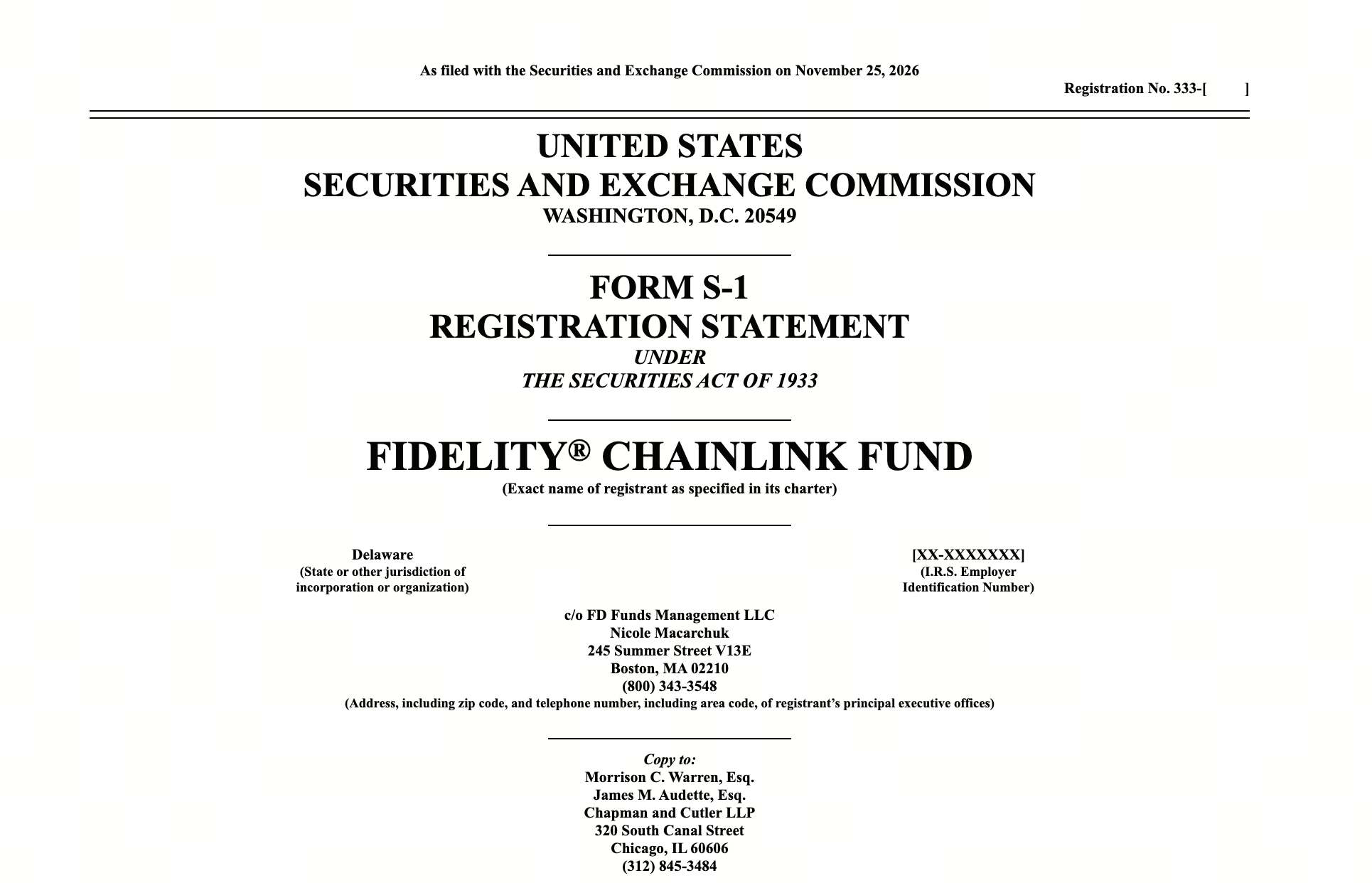
On November 25, 2026, Fidelity filed an S-1 Registration Statement with the U.S. Securities and Exchange Commission (SEC) to launch the Fidelity Chainlink Fund, with plans to list it on Nasdaq under the ticker FLNK. The proposed product would directly hold LINK, the native token of the Chainlink network, to track its market price performance.
Following the announcement, LINK experienced a short-term rebound, renewing market attention on institutional demand for oracle assets. Unlike previous ETF product strategies that primarily focused on Bitcoin, Ethereum, and Solana, Chainlink represents the underlying data and cross-chain communication infrastructure of blockchain networks.
As traditional financial institutions gradually expand the scope of their crypto asset investments, the development of the Chainlink ETF involves more than changes to LINK's trading channels. It also raises a broader question: Can the technological value of blockchain infrastructure be converted into sustainable asset allocation demand through token economics and traditional financial investment channels?
Key Takeaways
-
Fidelity is further expanding its crypto ETF product lineup: After Bitcoin, Ethereum, and Solana, Fidelity has applied to launch a spot fund that directly holds LINK, expanding its product coverage to oracle assets.
-
The Chainlink ETF lowers the participation barrier for traditional capital: Investors can gain LINK price exposure through a traditional securities account without directly managing an on-chain wallet or private keys.
-
An ETF listing does not necessarily mean new buying: Additional LINK allocation demand may arise only when net subscriptions into fund shares translate into increased holdings of the underlying asset.
-
RWA and cross-chain finance are important Chainlink application areas: As traditional financial assets gradually enter blockchain networks, the importance of trusted data transmission, cross-chain communication, and automated settlement may increase.
-
LINK's long-term value still depends on actual demand: Expansion through ETF channels must be combined with network usage, token value capture, and global liquidity to create more sustainable price support.
What Is the Chainlink ETF? What Are Its Underlying Assets and Operating Mechanism?
The Chainlink ETF generally refers to a fund or exchange-traded product (ETP) that uses Chainlink's native token, LINK, as its investment asset and trades on a traditional securities exchange. Its primary objective is to help investors gain LINK price exposure through a securities account.
Spot Chainlink ETFs differ from futures-based investment products in several ways. Spot products primarily track the market price of LINK by directly holding the token, while futures-based products may use derivative contracts to achieve their investment objectives and may be affected by contract rollover costs and differences between futures and spot prices.
Under a spot fund structure, the fund manager and custodian are responsible for holding and managing the underlying digital assets, while investors buy and sell fund shares through the securities market. The fund's net asset value is generally calculated based on the market value of its LINK holdings after deducting relevant fees and liabilities.
Because the trading price of fund shares is determined by supply and demand in the securities market, the actual transaction price may differ from the fund's net asset value per share, resulting in a premium or discount. Authorized Participants (APs) can help narrow this deviation through the creation and redemption of fund shares and related arbitrage activities.
It is important to note that holding Chainlink ETF shares is not equivalent to directly holding LINK. Fund investors generally cannot withdraw the corresponding tokens to a personal on-chain wallet or directly use these assets for on-chain transactions, staking, or other blockchain applications.
Therefore, the primary value of a Chainlink ETF is to provide LINK investment exposure through the traditional securities market, rather than fully replicating the functionality of LINK within the blockchain network.
What Product Arrangements Are Involved in Fidelity's Proposed Spot Chainlink ETF?
The proposed Fidelity Chainlink Fund is a passively managed spot digital asset exchange-traded product. Its investment objective is to track the U.S. dollar price performance of LINK, after deducting fund operating expenses and other liabilities.
The primary product arrangements disclosed so far include:
-
Fund name: Fidelity Chainlink Fund.
-
Proposed ticker: FLNK.
-
Proposed exchange: Nasdaq.
-
Underlying asset: LINK held directly on the Ethereum network.
-
Asset custodians: Anchorage Digital Bank, BitGo Bank & Trust, and Coinbase Custody.
-
Staking arrangement: The fund will not stake LINK, and investors will not receive staking rewards through the fund.
-
Creations and redemptions: Authorized Participants are expected to be able to create and redeem fund shares using LINK or cash.
For price tracking, the fund is expected to use the Fidelity Chainlink Reference Rate as its benchmark. It will obtain price data from eligible spot LINK trading markets and calculate the reference price using a volume-weighted median methodology.
This arrangement is intended to reduce the impact of abnormal quotes from any single trading market on the fund's valuation. However, it cannot completely eliminate volatility in digital asset markets or tracking deviations.
Fidelity has not yet announced the final fund management fee or official trading date. FLNK also remains a proposed ticker. Filing an S-1 Registration Statement does not mean that the product has been approved for issuance or officially listed. The relevant process must still satisfy applicable registration effectiveness and exchange listing requirements.
What Chainlink ETFs Are Currently Available?
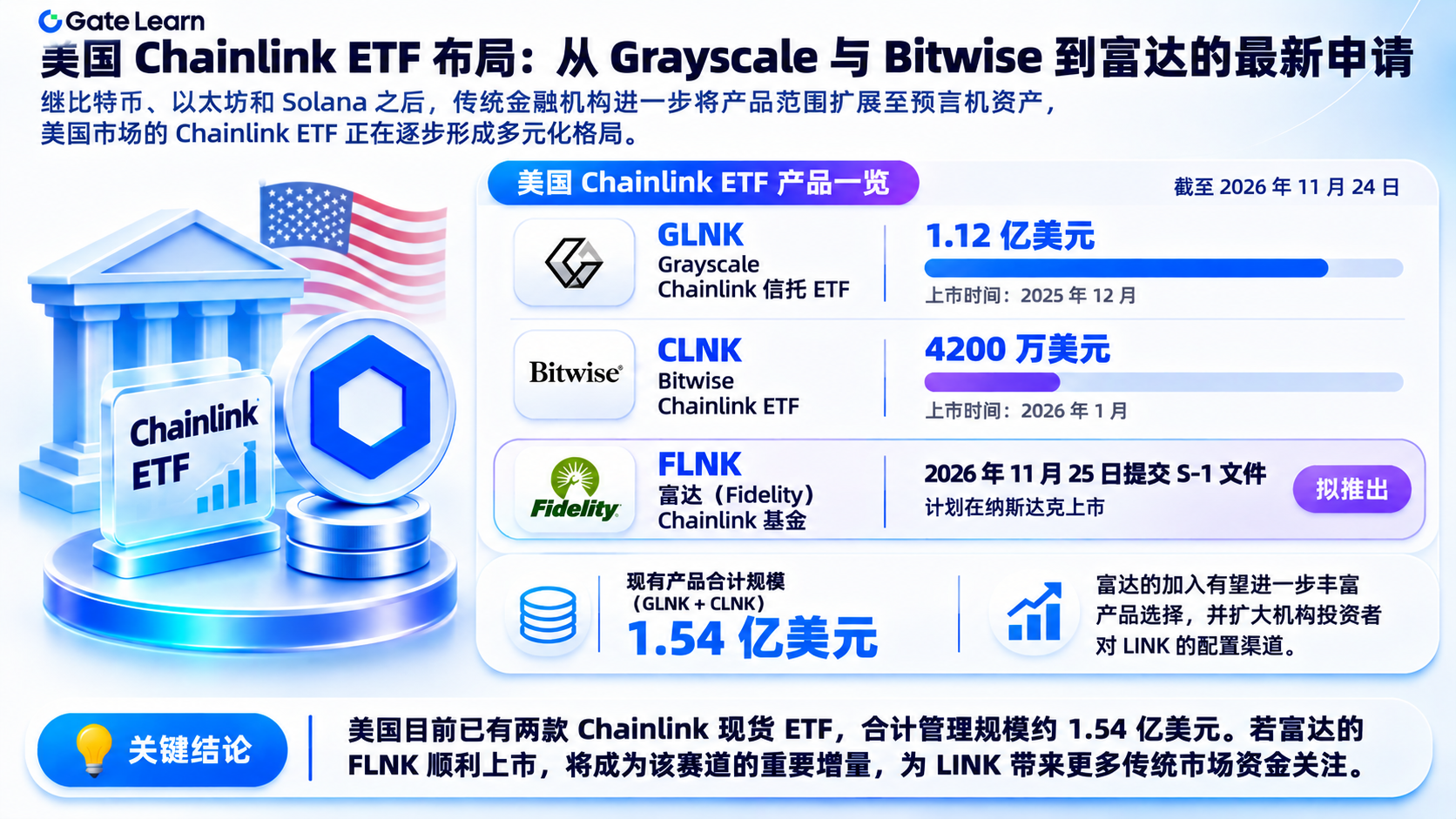
Fidelity is not the first traditional financial institution to develop a spot LINK investment product. Before its registration filing, two exchange-traded products offering spot LINK price exposure had already emerged in the U.S. market.
The Grayscale Chainlink Trust ETF (GLNK) began trading as an ETF on NYSE Arca in December 2025, providing LINK investment access to investors with traditional securities accounts.
The Bitwise Chainlink ETF (CLNK) launched in January 2026, further expanding the range of LINK investment products available in the U.S. securities market.
As of November 24, 2026, GLNK had approximately $112 million in assets under management, while CLNK had approximately $42 million. Their combined assets under management were approximately $154 million.
Compared with spot Bitcoin ETFs, which have already reached a relatively large market scale, Chainlink ETFs remain at a relatively early stage of development. Fidelity's potential entry could further diversify the issuers, asset management approaches, and investment channels for these products.
However, new funds could also lead to a redistribution of existing market share. If investors transfer their existing GLNK or CLNK holdings to a Fidelity product, growth in the size of an individual fund would not necessarily represent an equivalent amount of new capital entering the overall LINK ETF market.
Therefore, evaluating the development of the Chainlink ETF market requires monitoring the assets under management of each fund, overall net capital inflows, and changes in underlying LINK holdings.
Why Are Traditional Financial Institutions Starting to Pay Attention to Oracle Assets?
Fidelity has previously developed spot investment products related to Bitcoin, Ethereum, and Solana. These assets represent different investment areas, including digital scarcity assets, smart contract platforms, and blockchain application ecosystems.
Chainlink represents another type of blockchain infrastructure. Its core function is to help blockchain applications obtain external data and support the transfer of information between different blockchains and external systems.
Because blockchain smart contracts generally cannot independently verify information from the real world, decentralized applications need appropriate data transmission and verification mechanisms when they require asset prices, exchange rates, proof-of-reserve data, or other external information.
Oracles are key infrastructure that connect on-chain smart contracts with external information environments.
For example, decentralized lending protocols need price data to determine the value of collateral and execute liquidations when specific conditions are met. If price information is incorrect or delayed, the protocol may face abnormal liquidations, undercollateralization, and financial losses.
As blockchain applications expand beyond native crypto asset trading into stablecoins, RWAs, tokenized stocks, and cross-border financial services, the types of information processed by oracles are also increasing.
From an asset allocation perspective, the emergence of LINK investment products allows traditional investors to gain exposure to an infrastructure token that differs from the native assets of public blockchains.
However, Fidelity's development of a related product primarily reflects an expansion of investment channels. It does not directly prove that traditional financial institutions have established large-scale proprietary LINK allocations, nor does it mean that these institutions have made a definitive judgment about the long-term commercial value of Chainlink technology.
How Will RWA and Asset Tokenization Affect Demand for the Chainlink Network?
Real-world asset tokenization (Real World Assets, RWA) refers to using blockchain technology to record, issue, or transfer the rights associated with Treasuries, fund shares, stocks, gold, and other traditional assets in the form of digital tokens.
As traditional financial assets enter blockchain networks, the information that smart contracts need to process becomes more complex.
For example, a tokenized fund may need to update its net asset value regularly. A tokenized stock may need to reflect the underlying market price and corporate actions. A tokenized credit product may need to record interest payments, maturity arrangements, and the borrower's repayment status.
This information often comes from financial institutions and data service systems outside the blockchain and must be transmitted to on-chain applications through appropriate technical infrastructure.
Chainlink has several potential application areas in this field.
Price and financial data transmission. Through services such as Data Feeds and Data Streams, Chainlink provides asset prices and related data to on-chain financial applications.
Reserve information verification. Through mechanisms such as Proof of Reserve, Chainlink transmits qualifying information about external reserves on-chain, providing related applications with additional monitoring capabilities.
Cross-chain asset and information transmission. Through the Cross-Chain Interoperability Protocol (CCIP), Chainlink supports message transfers and cross-chain token operations between different blockchains.
For traditional financial institutions, asset issuance is only one part of the tokenization process. How assets are continuously priced, transferred between different networks, and connected with existing financial systems will also affect whether tokenized products can achieve large-scale adoption.
However, growth in the RWA market will not automatically translate into Chainlink revenue or LINK buying. The actual impact will still depend on whether relevant projects adopt Chainlink services, how frequently those services are used, and how fees are settled and value is distributed through token economics.
How Is Chainlink's Network Value Converted Into LINK Token Demand?
The technological value of Chainlink and the market value of LINK are related, but they are not equivalent.
LINK serves functions within the Chainlink ecosystem including service fee settlement, node operator incentives, and network security. As related network services continue to develop, demand for LINK may arise from multiple use cases.
-
When blockchain applications and financial institutions use Chainlink services, they may incur corresponding service fees. Specific payment methods depend on the service type and commercial arrangements. Some fees may be converted into LINK through payment abstraction mechanisms.
-
Chainlink uses staking to provide additional cryptoeconomic security for certain oracle services. Participants can lock LINK in accordance with applicable rules and receive corresponding rewards while assuming the relevant staking risks.
-
Mechanisms such as Chainlink Reserve also seek to convert part of the revenue from on-chain and off-chain services into LINK and build reserves.
These mechanisms can establish a connection between network usage demand and token economics. However, their actual value capture depends on service revenue, fee structures, token conversion efficiency, and reward arrangements.
If network service usage increases while service prices continue to decline, or if related revenue is not effectively converted into LINK demand, growth in network activity may have a relatively limited impact on the token's supply and demand structure.
Therefore, analyzing LINK's long-term value requires distinguishing among three levels: the scale of Chainlink's technological adoption, the actual economic value generated by network services, and how much of that economic value can ultimately be transmitted to LINK through these mechanisms.
The Chainlink ETF provides another source of demand from financial asset allocation beyond these three levels.
How Does the Chainlink ETF Affect LINK's Market Supply and Demand?
The impact of a spot ETF on the supply and demand of its underlying asset is primarily realized through net creations and redemptions of fund shares. When demand for a Chainlink ETF in the traditional securities market increases and drives net creations, the fund must increase its underlying LINK holdings in accordance with the relevant arrangements.
Under a cash creation model, the relevant funds may be converted into LINK through the trading arrangements designated by the fund. Under an in-kind creation model, Authorized Participants can deliver qualifying LINK to the fund's custody system in accordance with the product rules to receive newly created fund shares.
Both models may increase the fund's holdings, but their immediate effects on spot market buying are not exactly the same. The LINK used for in-kind creations may come from inventory already held by Authorized Participants or from market purchases made earlier.
Assume that a Chainlink ETF receives $100 million in net subscriptions and that all new funds are used to purchase LINK. If the average purchase price of LINK is $10 and transaction costs are excluded, the corresponding increase in token holdings would be approximately 10 million LINK. However, if the $100 million primarily comes from redemptions of other LINK funds or from the reallocation of investors' existing LINK holdings, the new demand across the overall market could be far lower than the fund's own net subscription amount. These figures are provided only to explain the ETF capital transmission mechanism and do not represent the actual size or projected future inflows of the Fidelity fund.
Similarly, when a fund experiences sustained net redemptions, its underlying asset holdings may decline. Because Fidelity's proposed product will not stake LINK, its holdings can still be adjusted through the fund redemption mechanism and do not represent token supply permanently leaving the market.
Therefore, the impact of Chainlink ETFs on LINK's supply and demand is bidirectional. The key factor is sustained net capital flow, not the number of funds itself.
Why Might Chainlink ETF Expansion Not Lead to a Higher LINK Price?
Fidelity's filing for a Chainlink ETF Registration Statement adds a potential traditional financial investment channel for LINK. However, historical market experience shows no necessary relationship between the expansion of ETF products and an increase in the price of the underlying asset.
As of late November 2026, existing Chainlink ETFs had already experienced periods of net outflows. This means that even after traditional financial markets establish relevant product channels, investors may still reduce their holdings based on market conditions and asset allocation needs.
ETF assets under management can also be affected by price changes. For example, if the amount of LINK held by a fund remains unchanged but the price of LINK rises 20%, the fund's assets under management may increase accordingly. This growth does not represent new capital subscriptions.
In addition, the price of LINK is affected by factors including global liquidity, market risk appetite, changes in token supply, selling by existing holders, and derivatives leverage.
Even if spot ETFs continue to receive inflows, LINK's price may remain under pressure if selling by other market participants is greater.
Therefore, launching an ETF primarily improves an asset's investability and expands the potential investor base. Whether it can create sustained price support will depend on whether actual inflows exceed selling pressure from other market participants and whether Chainlink's own network economic activity can generate additional token demand.
How Can Investors Monitor LINK's Market Performance Through Gate?
As Chainlink ETF products continue to develop, LINK's market price may be affected by both capital flows in traditional securities markets and trading activity within the crypto market.
In Gate's LINK/USDT spot and related contract trading markets, users can combine indicators such as market price, trading volume, funding rates, and open interest to monitor changes in LINK's trading structure.
-
ETF net creations and underlying holdings: Used to assess whether traditional securities investment channels are generating sustained LINK allocation demand.
-
Spot price and trading volume: Used to assess whether price movements are accompanied by more active spot trading. However, trading volume alone cannot directly distinguish net buying from net selling demand.
-
Contract funding rates and open interest: Used to monitor market leverage and long-short trading structures and identify whether derivatives trading may be amplifying price volatility.
-
Network service revenue and LINK economic mechanisms: Used to analyze whether Chainlink's technological adoption can be further converted into actual token demand.
Traditional ETFs and crypto asset spot markets also have different trading hours. LINK can trade around the clock in crypto markets, while ETFs listed on U.S. securities exchanges primarily trade during applicable securities market hours. This difference may cause the fund price to gap at the market open and may also affect short-term premium and discount performance.
Combining data from different markets can help distinguish short-term price movements driven by ETF news, price changes driven by leveraged trading, and more sustained underlying asset allocation demand.
Conclusion
Fidelity's application to launch a spot Chainlink ETF reflects the continued expansion of traditional financial institutions' crypto investment product strategies from major digital assets into blockchain infrastructure tokens. Gaining LINK price exposure through a securities account can lower the operational barriers to direct crypto asset participation for some investors and expand potential capital allocation channels.
At the same time, the development of RWA, asset tokenization, and cross-chain finance provides Chainlink with additional potential application scenarios. However, effective value transmission mechanisms are still needed to connect technological adoption, network economic value, and token demand. The launch of an ETF also cannot directly guarantee sustained new buying of the underlying asset.
In the future, the market impact of Chainlink ETFs will depend on actual net subscription volumes, changes in underlying LINK holdings, and whether Chainlink network services can generate sustainable economic value.
FAQ
What Is a Chainlink ETF?
A Chainlink ETF is an exchange-traded fund or related exchange-traded product that uses LINK as its investment asset and helps investors gain LINK price exposure through a traditional securities account.
Has Fidelity's Chainlink ETF Already Been Listed?
As of November 27, 2026, Fidelity has filed an S-1 Registration Statement, but the related product has not yet been officially listed. The final management fee and launch date have not been announced.
What Is the Ticker for Fidelity's Chainlink ETF?
The proposed ticker is FLNK, and the product is planned for listing on Nasdaq. The specific arrangements remain subject to the final effective filings and listing information.
What Chainlink ETFs Are Currently Available in the U.S.?
Spot LINK investment products currently available include the Grayscale Chainlink Trust ETF (GLNK) and the Bitwise Chainlink ETF (CLNK).
Will Fidelity's Chainlink ETF Offer LINK Staking Rewards?
No. The product arrangements in the current registration filing expressly state that the fund will not stake LINK. Therefore, fund investors will not receive staking rewards through the product.
Will a Chainlink ETF Drive the Price of LINK Higher?
Not necessarily. An ETF can expand investment channels, but its actual price impact depends on net subscriptions, market selling pressure, global liquidity, and demand for the underlying asset, among other factors.
What Is the Relationship Between Chainlink and RWA?
Chainlink can provide external price data, reserve information transmission, and cross-chain communication services for certain RWA applications, helping on-chain financial applications connect with external financial systems.
How Does a Chainlink ETF Differ From Buying LINK Directly?
An ETF primarily provides price exposure through the securities market, while directly holding LINK may allow on-chain transfers, staking, and other network operations where applicable. The two differ in custody methods, trading hours, fees, and asset usage rights.