In the landscape of modern global capital markets, stock markets centered in the Asia-Pacific region (APAC) carry significant economic weight. However, global investors have long faced numerous constraints when allocating capital to high-quality APAC equities, including traditional securities settlement systems, regional capital controls, high account-opening barriers imposed by conventional brokerages, and mismatched trading hours, such as market closures across different time zones. An invisible wall seems to separate traditional equities from emerging digital asset markets, resulting in extremely low capital flow efficiency between the two worlds.
As blockchain technology continues to mature and high-performance decentralized data feeds such as Chainlink APAC Equities Streams are formally deployed, the "Stock Digitization" and seamless on-chain circulation of traditional equity assets have reached a historic inflection point. By accurately anchoring real-time prices, market depth, and liquidity from APAC stock markets to distributed ledgers, capital is crossing the boundary between traditional and decentralized finance at an unprecedented pace. This article provides an in-depth analysis of the pain points in traditional stock markets, data feed-driven asset digitization, the restructuring of on-chain settlement, and the synergies between Gate Spot and the broader asset ecosystem, offering a comprehensive examination of this new financial paradigm reshaping global equity allocation.
Key Takeaways
- Analyze in depth the structural pain points and efficiency bottlenecks of traditional APAC stock markets in cross-border investment, trading-hour restrictions, and clearing and reconciliation
- Systematically examine how Chainlink APAC Equities Streams serves as an underlying market-data link, accelerating the comprehensive evolution of traditional equity assets toward digitization
- Break down in detail the transformative advantages of on-chain stock data feeds in enabling 24/7 global circulation, fractional ownership, and reduced friction in cross-border investment
- Explore how decentralized finance protocols can use real-time stock market data to create innovative capital formation mechanisms that connect seamlessly with the real economy
- Analyze, in combination with the Gate Spot ecosystem and diversified asset management tools, how investors can strategically allocate and hedge risk amid the digitization of equity assets
The Pain Points of Traditional APAC Stock Markets and the Historical Inevitability of Equity Asset Digitization
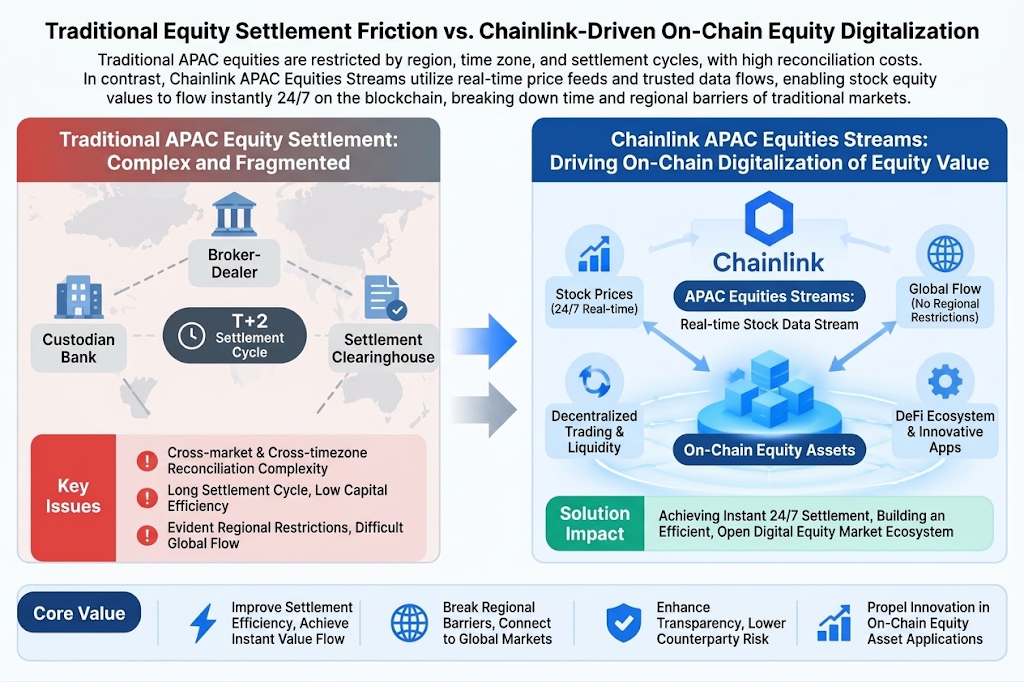
To fully understand the strategic role of Chainlink APAC Equities Streams in catalyzing stock digitization, we must first examine the inherent limitations of traditional APAC stock markets. Although the Asia-Pacific region is home to some of the world's most innovative and high-growth technology, manufacturing, and financial companies, stock trading in the region remains highly dependent on traditional centralized stock exchanges, such as the Tokyo Stock Exchange, Hong Kong Exchanges and Clearing, and the Singapore Exchange.
Under the traditional stock investment model, retail and institutional investors worldwide face multiple sources of friction:
-
Time Zone and Market Hours Barriers: Traditional stock markets are strictly limited by local business days and operating hours. When major global macroeconomic changes occur outside trading hours, investors cannot hedge risk immediately.
-
Multiple Settlement Intermediaries and High Costs: From local brokerages and global custodians to central securities depositories (CSDs), complex settlement layers generate substantial fees and extend settlement cycles to T+1 or T+2.
-
Fragmented Capital Liquidity: Equity assets remain locked within traditional fiat accounts and specific brokerage systems, preventing direct interoperability with the increasingly expansive digital-native asset ecosystem, including stablecoins and DeFi liquidity pools.
Equity asset digitization, or Stock Digitization, aims to use blockchain and decentralized oracle technology to remove unnecessary intermediaries from traditional securities settlement and map asset ownership credentials and real-time market prices directly onto distributed ledgers. Chainlink APAC Equities Streams serves as the core "eyes and ears" of this digitization process. With cryptographic security and millisecond-level latency, it keeps on-chain digital equities synchronized in real time with actual APAC stock market data.
Data Feed-Driven Liquidity Restructuring: 24/7 Stock Market Data and On-Chain Capital Formation
In traditional financial theory, an asset's liquidity depth directly determines its valuation efficiency and risk premium. When Chainlink APAC Equities Streams seamlessly injects high-frequency, real-time APAC stock data into the blockchain, capital liquidity takes on an entirely new dimension:
-
Cross-Time-Zone, Around-the-Clock Price Discovery: Even late at night or on weekends when traditional APAC stock markets are closed, on-chain derivatives protocols and prediction markets can use Chainlink to aggregate real-time global macroeconomic derivative data and liquidity forecasts, enabling continuous fair valuation and risk hedging for APAC equity assets.
-
Fractional Investment and Financial Inclusion (Fractional Ownership): High-quality APAC stocks often exclude smaller investors because of their high per-share prices. Combined with blockchain smart contracts and real-time data feeds, investors can purchase micro-denominated tokenized equity interests worth just a few dollars, significantly improving capital inclusiveness.
-
Deep Integration with the Decentralized Stablecoin Ecosystem: Digitalized stock assets can be denominated and settled directly in compliant stablecoins, such as USDT and USDC, eliminating the high foreign-exchange spreads and lengthy bank wire transfer wait times associated with traditional cross-border exchanges.
This data feed-driven digitization of equity assets not only changes the trading experience for investors but also fundamentally restructures the efficiency with which global capital flows into the real economy.
Settlement Finality and Cross-Chain Liquidity Weaving: Breaking the Liquidity Islands of On-Chain Stock Assets
In the process of digitizing traditional APAC equity assets, mapping price data and market depth on-chain is not enough to unlock the full potential of global capital. Two foundational financial technology challenges must also be addressed: settlement finality for on-chain stock ownership transfers and cross-chain liquidity weaving across heterogeneous blockchains.
In traditional securities trading systems, settlement finality often requires confirmation after T+1 or T+2 business days because of the asynchronous settlement mechanisms of centralized custodians and correspondent banking networks. This allows counterparty risk to accumulate during the settlement waiting period. In an on-chain digital stock system supported by Chainlink APAC Equities Streams, the smart contract-based "delivery-versus-payment (DvP)" mechanism enables deterministic ownership transfers of assets and funds as soon as the block is confirmed. This millisecond-level on-chain settlement finality not only reduces counterparty default risk to near zero but also substantially releases the large amounts of capital previously locked in traditional settlement margin pools.
At the same time, the current blockchain ecosystem is becoming increasingly fragmented, with multiple chains operating in parallel alongside heterogeneous Layer 2 scaling solutions. If tokenized stock interests and their market data are confined to a single blockchain, the system will inevitably repeat traditional finance's pattern of "liquidity fragmentation." Through the deep integration of Chainlink's Cross-Chain Interoperability Protocol (CCIP) with APAC Equities Streams, APAC stock market data and digital equity ownership credentials can move seamlessly and natively across Ethereum, high-performance Layer 2 networks, and various application chains (App-Chains), while synchronizing state across networks. Regardless of which chain they use, investors can share a unified APAC stock liquidity pool and maximize overall capital efficiency. This paradigm shift—combining "millisecond-level settlement finality" with "cross-chain panoramic liquidity weaving"—eliminates the liquidity islands between digital stock assets across different blockchain ecosystems and establishes a new decentralized financial order that truly connects global capital without friction.
Asset Allocation Amid a Macro Paradigm Shift and the Synergistic Advantages of the Gate Ecosystem
As Chainlink APAC Equities Streams accelerates the practical implementation of APAC equity asset digitization, the boundaries between global cryptocurrency markets and traditional financial markets are rapidly dissolving. As investors benefit from the high capital efficiency enabled by blockchain, their need for a secure, compliant, and highly liquid one-stop digital asset management platform is also increasing.
Amid the historical convergence of stock digitization and the blockchain ecosystem, leading cryptocurrency exchanges play an irreplaceable role as bridges and hubs. Gate, for example, is a leading global digital asset trading and wealth management platform. Through its forward-looking strategic positioning, Gate has already established a strong presence across digital assets, innovative markets, and diversified financial tools.
Gate provides global users with strong synergies as equity assets move toward digitization:
-
Efficient Access to Innovative Equity Assets and Infrastructure: Gate remains highly attentive to emerging technologies and asset digitization trends, continuously identifying and listing high-quality ecosystem assets that benefit from Chainlink data feeds and underlying technological advances.
-
Deep Spot Market Depth and Stablecoin Liquidity: Gate offers industry-leading spot market depth and a highly competitive fee structure, helping users achieve lower slippage and greater execution efficiency when converting digital assets seamlessly.
-
Comprehensive Risk Management and Automated Asset Management Tools: When allocating assets related to digitalized equities or participating in emerging markets, investors can make full use of Gate's spot grid trading, intelligent quantitative strategies, and Earn products to pursue more stable returns throughout rapidly changing global macroeconomic cycles.
This combination of "highly robust custody security," "exceptional trading liquidity," and "strong capabilities for identifying innovative assets" makes Gate a valuable partner for global investors responding to the digitization of equity assets and participating in the next stage of global wealth restructuring.
FAQ
What Is Traditional Equity Asset Digitization, and How Is It Related to Chainlink APAC Equities Streams?
Traditional equity asset digitization refers to the transformation of mapping the ownership and prices of physical financial assets such as stocks onto the blockchain through blockchain and oracle technology. Chainlink APAC Equities Streams provides the essential real-time, tamper-resistant market data feeds that keep on-chain digital equities synchronized with actual APAC stock market data.
How Does Stock Digitization Address the Liquidity and Time Zone Challenges of Traditional APAC Stock Markets?
It uses distributed ledgers to overcome the physical limitations of geography and operating hours. With the help of real-time on-chain data feeds, investors can hedge outside trading hours and use stablecoins for 24/7 fractional trading and instant settlement, substantially reducing the intermediary friction associated with traditional cross-border investment.
How Can Retail Investors Participate in Equity Asset Digitization and Emerging Markets on Gate in a Measured Way?
Investors can use Gate's spot trading markets and innovative markets to make appropriate allocations to high-quality ecosystem tokens powered by Chainlink data and asset digitization. They can also combine Gate's grid trading and Earn products to pursue long-term asset growth while managing risk.