Preface
“What regulation does the crypto industry need?” may seem like a simple question, but the answer is highly complex.
The reason is that the crypto industry has never been a single type of business.
Centralized exchanges match trades, safeguard assets, and provide market liquidity. DeFi protocols use smart contracts to facilitate trading, lending, and other financial functions. Stablecoins primarily serve as digital currency, payment, and settlement instruments. All three operate within the blockchain ecosystem, but their sources of value, risk exposures, and relationships with users are fundamentally different.
Applying the same set of rules to every business often creates two problems: either the rules are too broad to effectively control specific risks, or they rely too heavily on traditional financial models, increasing costs for new business models without addressing their actual challenges.
U.S. market structure legislative discussions in 2026 have repeatedly addressed issues involving the SEC, CFTC, stablecoins, DeFi, and market intermediaries precisely because digital assets can no longer be captured by a single label. From its inception, the CLARITY Act has sought to establish a clearer framework for digital commodities, investment contracts, trading platforms, and related customer protections. Meanwhile, the SEC and CFTC have begun advancing regulatory boundaries for different types of digital assets through interpretations and rules.
Therefore, rather than asking whether the crypto industry should adopt strict or lenient regulation, it is better to ask a question with greater long-term value:
What risks should different Web3 businesses actually address?
This question is closer to the core issues regulation must truly solve and better helps the industry understand the market structure that may emerge in the future.
Key Takeaways
-
Centralized exchanges, DeFi, and stablecoins have different economic functions and cannot simply be governed under the same regulatory logic
-
The core risks of centralized exchanges are primarily concentrated in custody, market integrity, customer assets, and conflicts of interest
-
The more complex aspects of DeFi involve accountability boundaries, code risks, governance structures, and protocol control
-
Stablecoins primarily involve reserve assets, redemption capacity, issuers, and payment and settlement risks
-
“Functional regulation” is better suited to the complex Web3 market than classification based solely on Token names
-
Regulatory layering does not mean that every business must be subject to entirely different rules; rather, it means aligning rules more closely with actual risks
-
As Web3 matures, trading, payments, custody, issuance, and protocol infrastructure may develop a more distinct specialized division of labor
Centralized Exchanges: The Layer Most Similar to Traditional Financial Market Infrastructure
Centralized exchanges are the easiest of the three business types to understand.
Users deposit assets onto a platform, which provides trade matching, order management, asset custody, withdrawals, and other services. In economic terms, these functions correspond in certain ways to trading venues, brokerage services, and custody businesses in traditional financial markets.
However, a defining feature of the crypto market is that these functions have often been concentrated within a single platform.
The same platform may simultaneously provide trading, custody, lending, stablecoin conversion, derivatives, and other services. This high degree of vertical integration improves the user experience, but it also makes conflicts of interest and risk segregation more complex.
If a platform both safeguards user assets and participates in market making or offers its own financial products, regulators will naturally focus on several questions: Are customer assets segregated? Are trading rules fair? Does the platform have sufficient risk management capabilities? Could internal personnel use customer order information? How are customer assets handled in the event of bankruptcy?
These questions are closely related to market integrity and customer asset protection in traditional finance.
The CLARITY Act includes customer protection requirements for entities required to register under the SEC or CFTC framework, while its broader regulatory framework also seeks to further clarify responsibility boundaries within digital asset markets.
Therefore, for centralized platforms, the core regulatory issue is usually not whether blockchain is a new technology, but rather: What responsibilities does the platform assume as an intermediary?
DeFi: When Trading and Lending Are Executed by Code
DeFi’s biggest change is that it delegates certain traditional financial intermediary functions to smart contracts.
Users may not need to register a traditional account or entrust assets to a centralized platform. Instead, they can interact directly with smart contracts through wallets. Trade matching, lending, collateralization, and liquidation can all be executed automatically by programs.
This significantly improves the composability of the financial system.
A Token can simultaneously serve as a trading asset, collateral, and a source of liquidity. One protocol can also access liquidity provided by another protocol.
At the same time, however, risks have changed.
One of the greatest risks of centralized platforms is that people and institutions can fail. DeFi adds the risk that code and systems can fail.
Smart contract vulnerabilities, oracle failures, governance attacks, permission configuration errors, and flaws in economic model design can all cause protocols to incur significant losses without traditional intermediaries.
An even more complex issue is the boundary of accountability.
Suppose a protocol is driven by open-source code, but the code was initially published by a group of developers and later upgraded through DAO governance. Who is the actual controller?
If a frontend website is operated by another company and users access the protocol through that frontend, does that company bear the same responsibilities as the protocol?
If a protocol has no company in the traditional sense, how should it fulfill ongoing risk management obligations?
These questions are also why DeFi cannot simply replicate the traditional regulatory structure for securities trading platforms.
DeFi Does Not Mean “No Regulatory Logic”
A common misconception about DeFi is that it has only two possible states: fully decentralized or fully centralized.
The reality is more complex.
A protocol may be highly automated in certain areas while still having clear control points in others. For example, upgrade permissions, oracle management, frontend operations, asset issuance, liquidity incentives, or stablecoin reserve management may all involve parties with actual responsibility.
Therefore, the more important question in regulating DeFi may not be: “Is this protocol decentralized?”
Rather, it is: Which individuals or entities can actually change the system’s behavior?
The joint interpretation issued by the SEC and CFTC in March 2026 has already begun providing more detailed regulatory guidance for activities such as staking, airdrops, wrapping, and non-security crypto assets. This reflects a gradual regulatory shift from asset labels toward specific transactions and activities.
For DeFi, this approach is particularly important.
If future rules increasingly focus on actual control, customer exposure, asset risk, and market function, decentralization itself may not automatically qualify as a regulatory exemption. However, this also does not mean that all DeFi protocols will be treated as traditional financial institutions.
Ultimately, the analysis must still return to function and risk.
Stablecoins: More Like Payment Infrastructure Than Ordinary Tokens
Stablecoins follow an entirely different logic.
Centralized exchanges primarily address how assets are traded. DeFi primarily addresses how financial rules are executed through code. Stablecoins address how digital value is transferred and settled in a stable manner.
Therefore, stablecoins also have different core risks.
The first is reserve risk. If a stablecoin claims to maintain a 1:1 peg to the U.S. dollar, the market needs to know what reserve assets support it.
The second is redemption risk. Whether users can redeem stablecoins for the corresponding assets according to the rules is an important part of a stablecoin’s credit structure.
The third is issuer risk. Stablecoins are not digital U.S. dollars created out of thin air. They usually involve an issuing institution, reserve management, custody, and legal entities.
The fourth is systemic risk. As stablecoins increasingly enter trading and payment systems, they may develop closer links with bank deposits, payment institutions, and capital markets.
Therefore, stablecoin regulation is more likely to develop around the following path:
Reserve → Redemption → Issuer → Payment
This is not entirely the same as traditional securities regulation, which focuses on disclosure and market trading conduct.
Why “One Set of Rules” Often Cannot Cover All Three Business Types
When these three business types are viewed together, it becomes clear that their risk structures are fundamentally different.
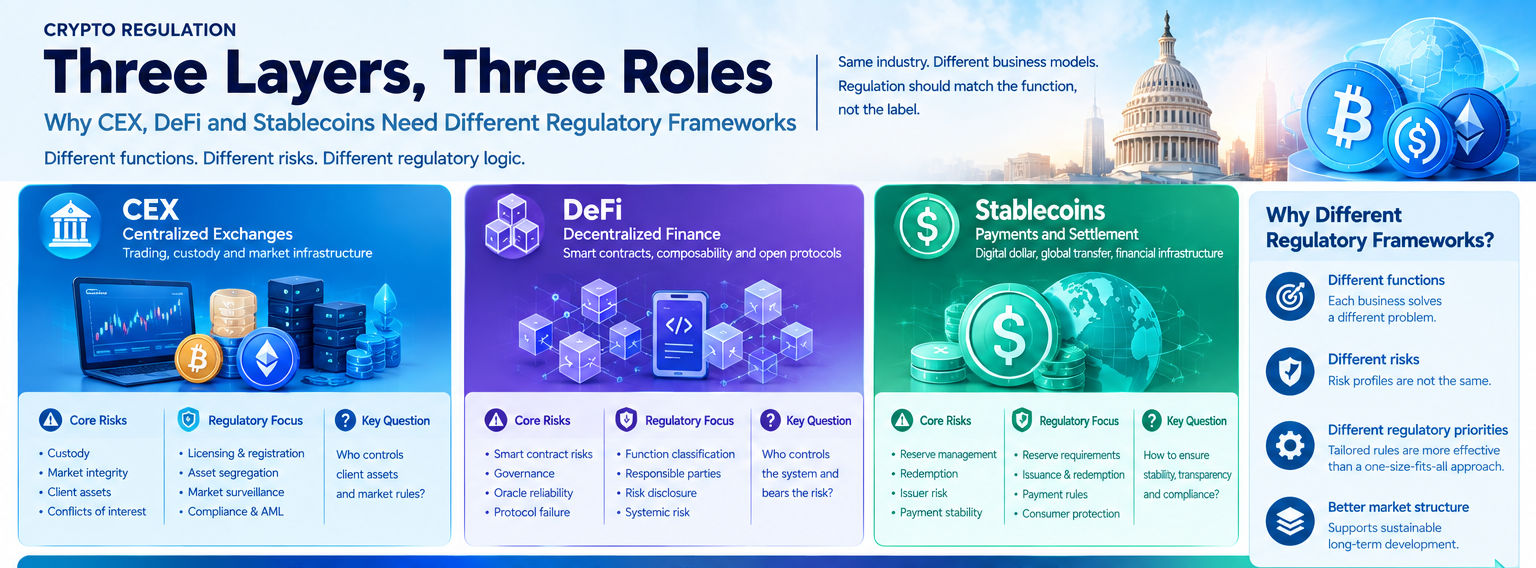
The primary issue for centralized exchanges is intermediary risk.
One of DeFi’s core issues is risk related to code, governance, and accountability boundaries.
For stablecoins, the core issues are more concentrated in reserve, redemption, and payment and settlement risks.
If exactly the same rules are applied, some risks may be covered while others may become regulatory blind spots.
For example, requiring DeFi protocols to fully replicate the registration, capital, and operational framework of traditional trading platforms may not necessarily address smart contract vulnerabilities. Conversely, treating a centralized platform entirely as a software protocol simply because it uses blockchain technology cannot resolve customer asset custody issues.
Therefore, a more explanatory framework may be:
Classify by function, rather than by whether something is “crypto.”
This is somewhat aligned with the SEC’s direction in its 2026 digital asset interpretations. Regulators have begun attempting to distinguish among different asset types, including digital commodities, stablecoins, and digital securities, while further clarifying the legal nature of different trading activities.
What Market Structure Ultimately Needs to Solve Is “Where Responsibility Lies”
From an industry-wide perspective, the most difficult part of market structure regulation is not determining which category a Token belongs to, but identifying the responsibility points in the value chain.
Who controls user assets?
Who establishes trading rules?
Who issues products?
Who manages reserves?
Who upgrades smart contracts?
Who operates the frontend?
Who can provide compensation or remediation when losses occur?
Once these questions are answered, it becomes easier to establish a regulatory framework.
This is also why future Web3 regulation may increasingly emphasize chains of responsibility rather than simply emphasizing asset names.
For centralized exchanges, the chain of responsibility is usually easier to identify because the platform itself is the core intermediary.
For stablecoins, the chain of responsibility is concentrated in the issuer, reserve custodian, and redemption mechanism.
For DeFi, the chain of responsibility is more dispersed. As a result, regulation is more difficult and requires determining where control rights, governance rights, and actual influence are distributed.
How the Industry May Divide Responsibilities After Regulation Becomes Clearer
As rules become clearer, industry specialization is one potential long-term outcome.
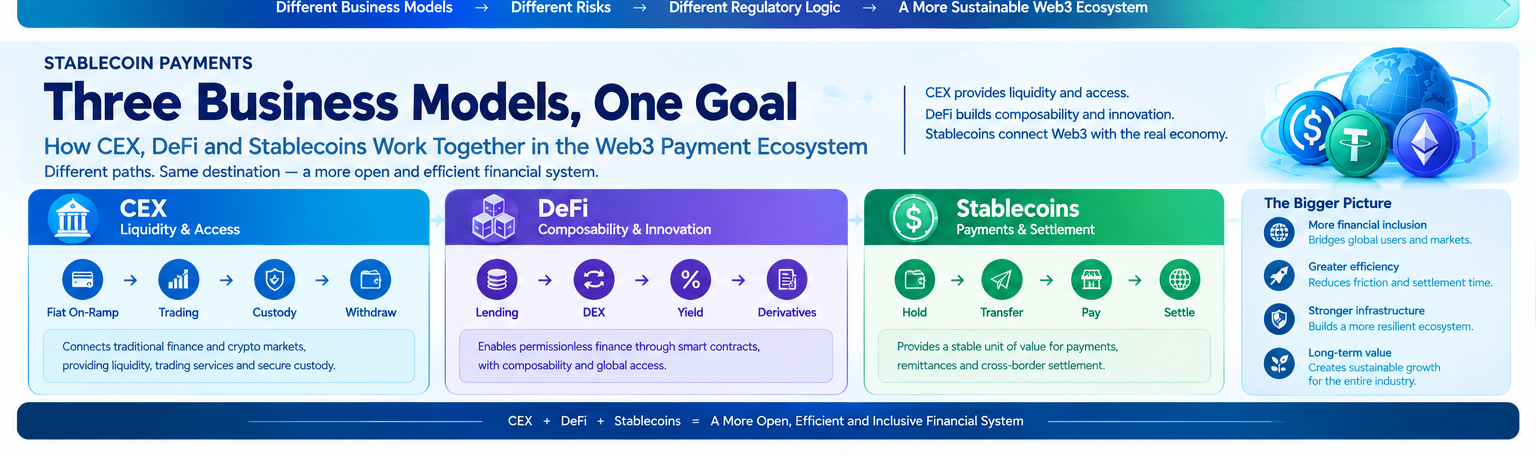
In the past, crypto platforms sought to cover all of the following at once:
Trading + Custody + Payments + Lending + Issuance + Stablecoins.
In the future, different businesses may increasingly need to be managed separately.
Trading platforms may focus on trading and liquidity, custody institutions on asset security, stablecoin issuers on payment and settlement, Tokenization platforms on real-world asset issuance, and DeFi protocols on on-chain financial applications.
This change does not mean that Web3 will become a replica of traditional finance.
On the contrary, blockchain’s value may lie precisely in the fact that these specialized modules can remain interconnected through open protocols.
Specialization in traditional finance is often accompanied by numerous closed systems, whereas specialization in Web3 may be built on a unified open settlement layer.
This is also the long-term impact that market structure rules may have on Web3: not to eliminate the original open network, but to redistribute responsibility on top of the open network.
For Project Teams, Future Competition May Shift From “Narratives” to “Compliance Structures”
If future regulation gradually moves toward functional and accountability-based approaches, the questions project teams need to consider will also change.
In the past, a Web3 project might first design a Token and then consider its community, trading, and product.
In the future, the sequence may increasingly resemble:
Business Function → User Rights → Asset Structure → Regulatory Status → Token Design
In other words, teams must first determine what problem the business actually solves, then decide on the product structure, and only then determine how the Token should exist.
This change may reduce the room for projects that rely purely on market narratives. However, for Web3 infrastructure that genuinely seeks to serve institutions and enterprises, it may instead provide a clearer product design path.
For example, a real-world asset Tokenization platform must first address underlying assets, custody, and investor eligibility before discussing how Tokens are issued. A stablecoin payment platform must first address reserves, redemption, and payment compliance before discussing the on-chain experience.
This is clearly different from the early Web3 logic of “issue a Token first, then find a use case.”
How Users Should Understand Future Crypto Regulation
Ordinary users do not need to understand every regulatory provision.
More importantly, they need to learn to identify the type of service they are actually using.
When using a centralized exchange, users need to focus on account custody, withdrawals, asset segregation, trading rules, and platform creditworthiness.
When using DeFi, they need to understand smart contracts, permissions, oracles, governance, and liquidation mechanisms.
When using stablecoins, they should focus on the issuer, reserve assets, redemption mechanisms, and payment use cases.
In other words:
Different businesses require different risk checklists.
This is also one of the real benefits that regulatory layering can provide.
It not only helps regulators identify responsible parties, but also helps users understand the risks they are actually facing.
In the past, the market often viewed regulation as a simple binary question:
Support Web3, or restrict Web3.
However, as the industry becomes increasingly complex, this binary framework may no longer be sufficient.
Over the longer term, the more likely direction is for different businesses to have different risk classifications, accountability boundaries, and market rules.
Centralized exchanges need to address intermediary and customer asset issues.
DeFi needs to address smart contract, governance, and accountability identification issues.
Stablecoins need to address reserve, redemption, and payment stability issues.
Tokenized Assets need to further connect legal rights, custody, and on-chain assets.
These businesses may ultimately operate in the same Web3 ecosystem, but they do not need to be forcibly treated as the same type of financial product.
One important significance of U.S. crypto regulatory discussions in 2026 is that they are making this issue increasingly clear: what truly needs to be established is not a single rule covering all crypto businesses, but a market structure that can be layered according to business functions, risk structures, and responsible parties. The SEC and CFTC have already begun advancing in this direction through digital asset classifications and interpretations of specific activities, while congressional legislation remains under discussion.
For Web3, this may ultimately not mean that the regulatory era ends decentralization. Rather, it may mean that the industry is entering a clearer infrastructure stage: different parties assume different responsibilities, different businesses are subject to rules aligned with their risks, and blockchain itself continues to exist as an open technology and settlement layer.
FAQ
What is the biggest difference between centralized exchanges and DeFi?
Centralized platforms rely on clearly identified companies to perform functions such as trading and asset custody, whereas DeFi primarily uses smart contracts to conduct trading and financial activities. Therefore, the former places greater emphasis on intermediary, custody, and customer asset risks, while the latter places greater emphasis on code, governance, and accountability boundary risks.
Why can stablecoins not simply be regulated as ordinary Tokens?
The primary functions of stablecoins are generally related to payments, settlement, and value transfer. Therefore, reserve assets, issuers, and redemption mechanisms are more important, and their regulatory focus is not entirely the same as that of investment-oriented digital assets.
Does DeFi still need regulation after becoming decentralized?
Whether specific regulatory rules apply depends on the actual business and responsibility structure. Decentralization does not automatically answer who controls the system, who operates the frontend, who manages upgrade permissions, or who bears market risks.
Why does Web3 need layered regulation?
Because different businesses generate different risks. Analyzing trading platforms, DeFi, stablecoins, and Tokenized Assets according to their specific functions and responsibility structures is more helpful in aligning regulatory requirements with actual risks.
What does increasingly clear crypto regulation mean for Web3?
The long-term impact may be reflected in industry specialization and infrastructure standardization. Businesses such as trading, custody, payments, asset issuance, and DeFi may develop clearer responsibility boundaries while remaining connected through blockchain networks.