The CASHCAT transaction process closely mirrors that of most on-chain meme assets, but the user experience depends on proper network configuration, stable bridging, and diligent contract verification. To understand the project’s background and positioning, start with the Cash Cat (CASHCAT) overview, then move into operational specifics. Cash Cat (CASHCAT) is deployed on Robinhood Chain, with its public narrative emphasizing cultural memes and community-driven dissemination. The core on-chain process centers on a “repeatable standard workflow.”
What should you prepare before trading CASHCAT on Robinhood Chain?
Three essentials are required before trading: a compatible wallet, the correct network configuration, and available assets after bridging. First, ensure your wallet displays the correct network parameters and balance before proceeding. If the network isn’t fully configured, the DEX interface may fail to read balances or route transactions properly.
| Preparation Item |
Target Status |
Common Issues |
| Wallet |
Able to switch to Robinhood Chain |
Missing network parameters |
| Funds |
Bridged and credited |
Cross-chain delays or failures |
| DEX Environment |
Recognizes target token |
Token not added or contract error |
The main goal during preparation is to minimize irreversible mistakes later. Initiating a swap without confirming any item increases the risk of asset path errors. For a comprehensive “Preparation—Execution—Review” framework, see the CASHCAT participation process: that guide covers end-to-end paths, while this section focuses on contracts, chain, and each swap node.
Robinhood Chain requires the Chain ID, RPC, and browser query entry in your wallet to match. If parameters are inconsistent, you may see a zero balance, be unable to import tokens, or fail to generate transaction previews.
How do you verify the CASHCAT contract address?
Contract verification should follow three steps: prioritize official sources, check on-chain data, and ensure cross-channel consistency. Always use the address provided by the official website or account first, then confirm token name, transaction activity, and creation details on the chain explorer. If the address differs from versions circulating on social media, rely on traceable sources and pause trading.
Watch for counterfeit tokens with similar names. The meme sector often sees “similar names, similar icons, different addresses” as inducement tactics. The safest approach is to whitelist the address locally. Compare the contract text from the Cash Cat official website and official X account @cashcat_token, then match it character by character with the explorer.
A correct contract address only confirms token identity; it does not guarantee liquidity depth or proper authorization limits. After verification, always check output amount, minimum received, and authorization limits in the DEX preview.
How do you bridge funds to Robinhood Chain?
Bridging is the precursor to swapping—transferring assets from the source chain to Robinhood Chain and confirming your wallet displays the balance. Start with a small test transaction, confirm receipt, then scale up. Save the bridging transaction hash locally to help troubleshoot delays.
If bridging fails or is delayed, check whether the source chain transaction is confirmed, the target network is switched, and the destination address matches your wallet. Do not initiate large swaps until funds are confirmed. Once assets are ready, move to contract import and swap preview.
What is the standard workflow for executing a CASHCAT swap on DEX?
The standard workflow breaks down as follows: connect wallet, import contract, enter transaction amount, set slippage, preview routing, and confirm signature. Before executing, focus on output amount and minimum received to avoid unnecessary losses from excessive slippage. For parameters like total supply, tax rate, and liquidity pool details, refer to CASHCAT Tokenomics, but rely on the preview window’s verifiable figures at swap time.
| Step |
Action |
Checkpoint |
| 1 |
Connect wallet |
Correct network, visible balance |
| 2 |
Import CASHCAT contract |
Address matches official source |
| 3 |
Enter amount and set slippage |
Reasonable minimum received |
| 4 |
Sign and submit |
Acceptable Gas and authorization limits |
| 5 |
Wait for confirmation |
Transaction hash is accessible |
Always “preview before submitting.” During high volatility, the minimum received in the preview is key for risk control. Review authorizations separately—use transaction-matched limits, and avoid granting unlimited access beyond actual needs.
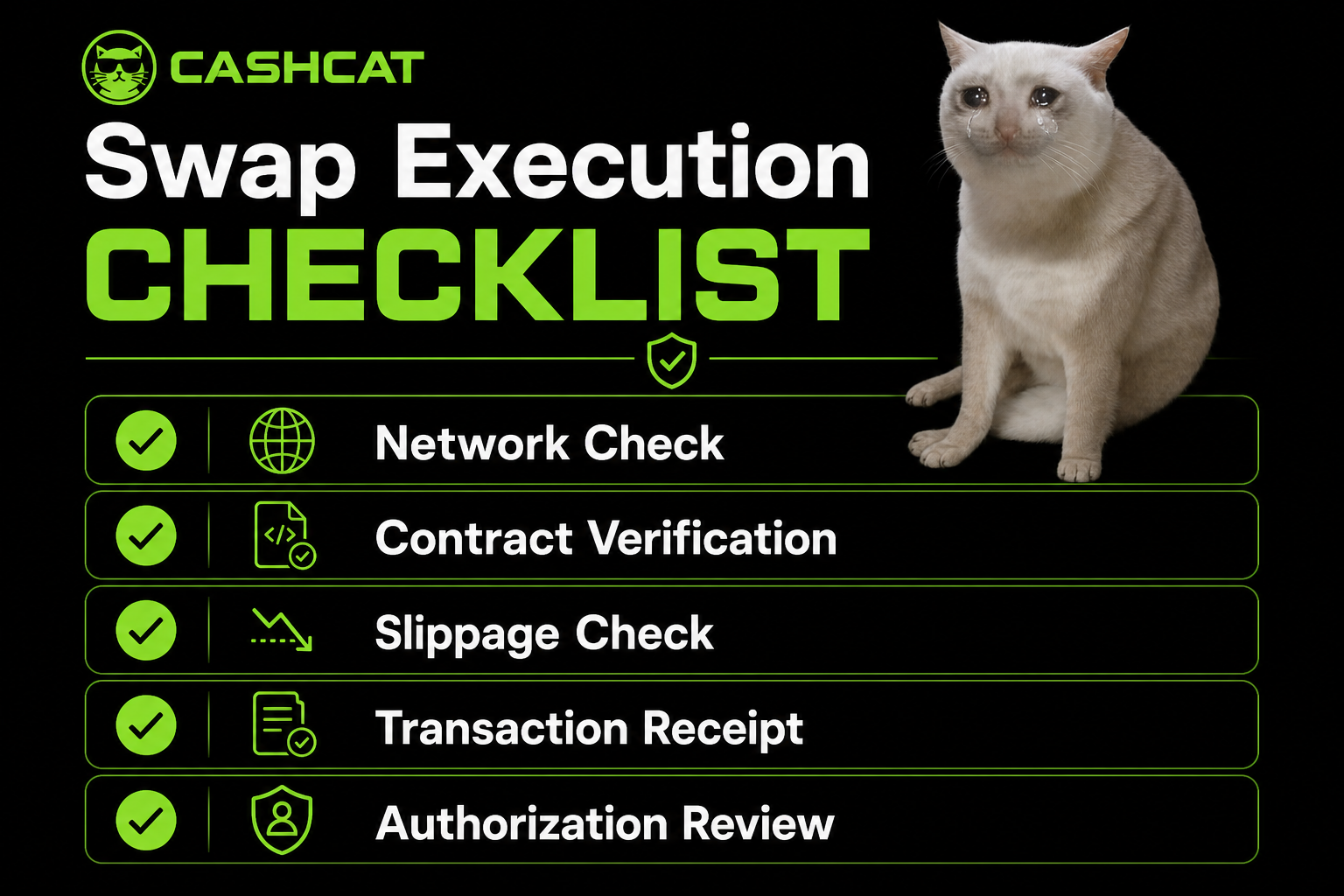 Figure 1. CASHCAT swap execution checklist: network, bridging, contract, slippage, and receipt review.
CASHCAT stands apart from typical meme assets mainly in its narrative anchors and chain context. For comparisons, see CASHCAT vs Typical Meme Coin. Regardless of narrative, on-chain execution follows the “network—contract—preview—signature—receipt” discipline.
How do you confirm successful receipt after trading?
Review has three layers: on-chain transaction status, wallet holdings, and authorization records. First, confirm transaction hash on-chain; second, check wallet displays the token; third, look for unnecessary large authorizations. If holdings are missing, manually add the token contract.
Transaction success does not eliminate risk. Continue monitoring liquidity, impact costs, and authorization security. Save transaction receipts locally for reconciliation and troubleshooting. If the hash shows success but the wallet is empty, rule out network mismatches and token not added before considering display delays.
Make authorization review a habit: after each transaction, open wallet permissions, check which contracts have access, and promptly revoke or restrict unused authorizations.
What are common error messages when trading CASHCAT?
Common errors include “insufficient liquidity,” “transaction reverted,” “slippage too low,” and “insufficient gas.” These stem from low liquidity, poor slippage settings, network congestion, or insufficient balance. Start by verifying parameters—don’t just retry repeatedly.
| Error Type |
Common Cause |
Solution |
| Insufficient liquidity |
Shallow pool depth |
Reduce transaction size, batch trades |
| Slippage failure |
Rapid price swings |
Increase slippage moderately, review preview |
| Insufficient Gas |
Low main coin balance |
Replenish Gas assets first |
| Reverted |
Routing or authorization issues |
Reconnect wallet, verify authorization |
Always “locate before retrying.” If the same error persists, check network, balance, contract, and slippage before adjusting parameters. Blindly increasing slippage or repeatedly signing can amplify losses.
What are the main risks in the transaction path?
Key risks include: incorrect contract, bridging failure, excessive authorization, and high slippage. These risks are common across on-chain transactions—not unique to CASHCAT. The best approach is to break each operation into verifiable steps, avoiding multiple high-risk actions at once. For a comprehensive risk framework, see CASHCAT Risks and Limitations.
Operationally, use small test trades, batch execution, and save receipts to reduce error costs. For volatile assets, process discipline is more important than “timing entry.” Public information confirms CASHCAT is not an official Robinhood project; never equate on-chain tokens with brokerage products without verifying public sources.
Risk nodes are interlinked: swapping before bridging is complete may result in signing with the wrong balance; granting unlimited authorization before contract verification can expose you to counterfeit contracts.
Summary
CASHCAT on-chain trading is straightforward—success depends on meticulous verification and process discipline. Consistently executing network, contract, slippage, and receipt steps reduces errors. Treat every transaction as a “verifiable process,” not just a “quick click,” for safer meme asset participation.
FAQ
Why verify the contract address before trading CASHCAT?
Counterfeit tokens with identical names are common in the meme sector. Names or icons alone don’t guarantee authenticity. The contract address is the core identifier—always cross-check with public sources and chain explorer.
What steps are required to complete a CASHCAT swap on Robinhood Chain?
The typical sequence: configure and switch to Robinhood Chain, confirm bridged funds, verify and import the CASHCAT contract, set amount and slippage in DEX and preview, sign and submit, then review with transaction hash and holdings. Skipping steps increases path error risk.
Is bigger slippage always better?
Excessive slippage may boost completion rates, but also increases uncertainty in received amounts. Set moderate slippage based on volatility and always preview before signing. For large trades, batch execution is best—always constrain by minimum received.
What if the transaction succeeds but CASHCAT doesn’t show in the wallet?
First, use the transaction hash to confirm on-chain success, then manually add the token contract. Many wallets don’t auto-recognize new tokens. If on-chain status is successful, manual addition and network switching usually resolve display issues.
Why check authorization records?
Authorization records define which contracts can access your assets. Excessive authorization may pose future risks. Reviewing and tightening authorizations after each transaction helps maintain security boundaries.
Is CASHCAT affiliated with Robinhood?
Public FAQs confirm CASHCAT is not an official Robinhood project; its narrative is community-driven. Always base judgments on the official site and public disclosures—never equate brokerage brands with on-chain tokens without verification.