On November 4, 2026, the Polygon community introduced a hard-fork recovery proposal for stolen POL assets. The proposal concerns two security incidents involving Polymarket and Binance. It plans to transfer approximately 70.49 million POL from five restricted addresses to verified recovery addresses through a one-time protocol state modification. Based on the reference price used in the proposal, the assets are worth approximately $6.5 million.
Unlike ordinary asset freezing, this approach attempts to redistribute the assets without obtaining the attackers' private keys. As of the time of writing, the proposal should still be regarded as a governance proposal rather than a completed asset recovery.
This article uses the incident as a starting point to explain the differences between hard forks, transaction restrictions, and on-chain state modifications. It also analyzes why the technical ability to recover assets does not mean that every blockchain should or can adopt the same approach.
Key Points
- A hard fork can modify blockchain state under specific conditions, but this does not mean that any stolen assets can be recovered.
- Polygon's POL recovery plan is a one-time protocol modification proposal. It aims to redistribute native POL held by identified addresses rather than roll back the entire network's transaction history.
- Address restrictions, token contract freezes, and hard-fork state modifications are different levels of intervention, with different execution authorities and scopes of impact.
- The 2016 Ethereum The DAO incident demonstrated that a community can use a hard fork to address a major security incident, but it may also trigger a network split.
- Asset recovery requires resolving issues involving proof of ownership, governance authorization, node upgrades, cross-chain assets, and trust boundaries.
What Is a Blockchain Hard Fork? Why Can It Modify Asset State?
Blockchains are generally maintained by distributed nodes working together to maintain a ledger. Based on predefined consensus rules, nodes verify whether transactions are valid, whether blocks are valid, and how account balances and smart contract states should change.
Under normal circumstances, a transaction is accepted by the network only if it satisfies requirements such as a valid signature, sufficient balance, and protocol rules. For example, when a user transfers 100 POL from their own wallet, they generally need to provide a valid signature proving that they control the address. A third party without the corresponding private key cannot normally transfer the assets simply by knowing the wallet address.
However, blockchain asset balances do not exist independently of protocol rules. On account-based networks, nodes maintain account balances, contract storage, and other state data based on the results of protocol execution. As long as network participants accept new consensus rules, the network can theoretically execute a state adjustment that differs from an ordinary transaction at a specific block height.
A hard fork is one way to modify these rules. For example, developers can design a network upgrade that requires all upgraded nodes, starting at a specified block height, to execute a particular account balance adjustment before processing ordinary transactions. If the relevant nodes adopt the same rules, the network can continue operating based on the new state.
However, a hard fork does not mean that developers can unilaterally modify everyone's assets. A protocol change requires relevant network participants to accept and run the upgrade software. If some nodes reject the new rules, the network may develop different chain states and could even form two blockchains that continue to exist separately.
Therefore, a hard fork provides a technical possibility for modifying asset state, but its actual effects depend on network governance, node coordination, and the acceptance of ecosystem participants.
Why Did Polygon Propose Recovering Stolen POL Through a Hard Fork?
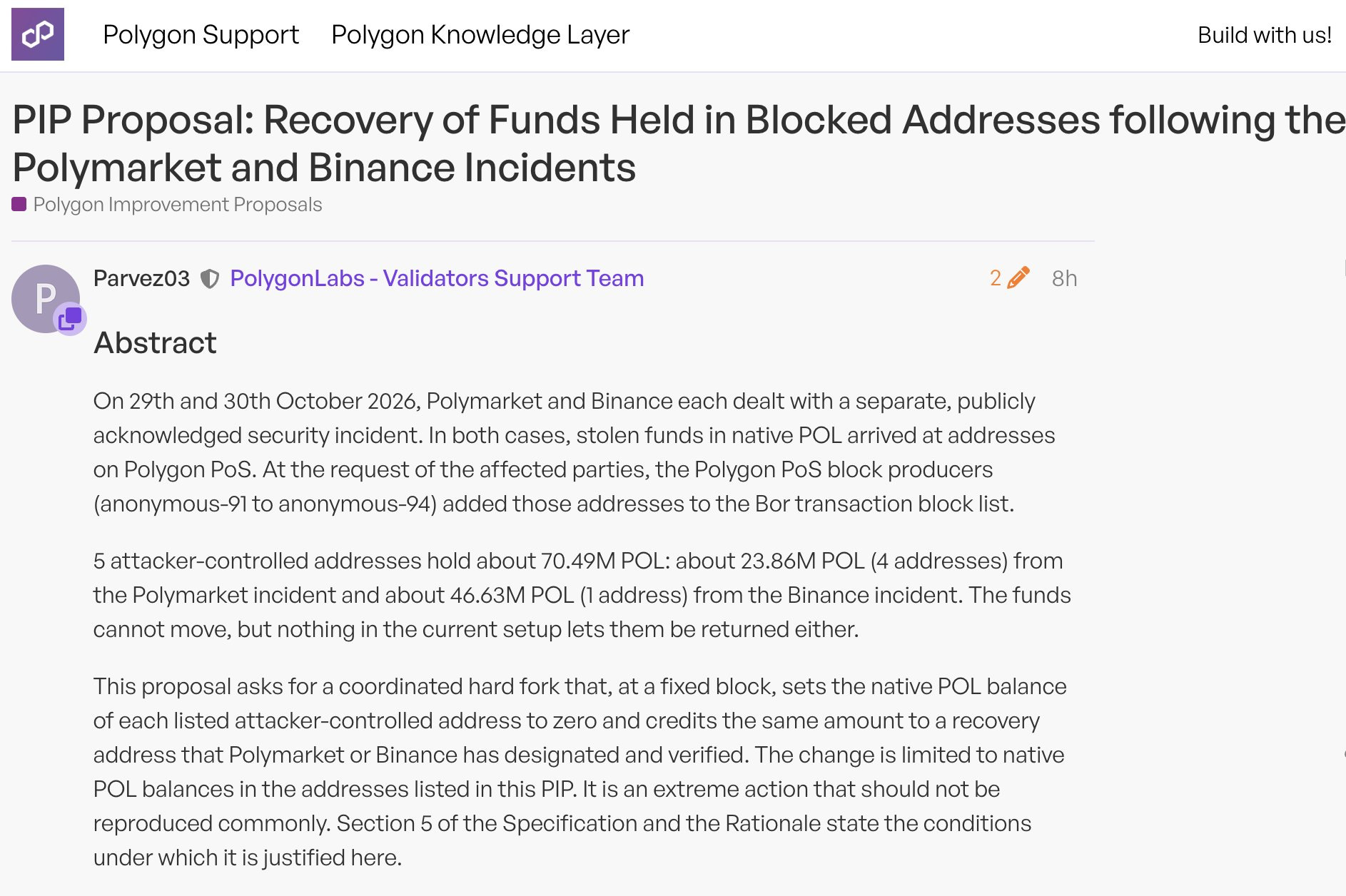
In late October 2026, Polymarket and Binance experienced separate security incidents. Some of the stolen native POL was transferred to specific addresses on the Polygon PoS network.
On November 4, the Polygon community forum published a recovery proposal involving five identified attacker-controlled addresses. Four of the addresses held approximately 23.86 million POL associated with the Polymarket incident. Another address held approximately 46.63 million POL associated with the Binance incident. The total was approximately 70.49 million POL.
After the incidents, relevant Polygon PoS block producers added these addresses to a transaction restriction list, making it difficult to continue transferring the assets through ordinary transactions. However, this restriction presents a key problem: preventing assets from moving further is not the same as returning them to their original holders.
Under the current arrangement, the relevant POL remains recorded in the restricted addresses. Even if the attackers cannot normally transfer the assets, the victims cannot gain control of these addresses solely through their own actions. In addition, the address restriction list itself is an operational measure that requires ongoing maintenance. The proposal states that the restrictions are loaded when block producers start their software, changes to the list involve operational procedures, and the existing filtering mechanism is not a complete freeze system covering every possible asset transfer path.
The proposal therefore suggests using a one-time hard fork at a predetermined block height to set the native POL balances of the specified addresses to zero and add the same amounts of POL to designated and verified recovery addresses for Polymarket and Binance. This process would not require the attackers to provide their private keys or require the transfer to be completed through an ordinary wallet transaction.
It is important to note that the proposal does not plan to increase the total supply of POL, nor does it propose rolling the entire Polygon network back to before the attacks occurred. Its objective is to implement a one-time state modification affecting specific addresses.
As of November 9, the verifiable information consists of the proposal text and its design conditions. The publication of the proposal, governance discussions, or technical testing should not be treated as evidence that asset recovery has already been completed on the mainnet.
What Is the Difference Between On-Chain Asset Freezing and Hard-Fork Recovery?
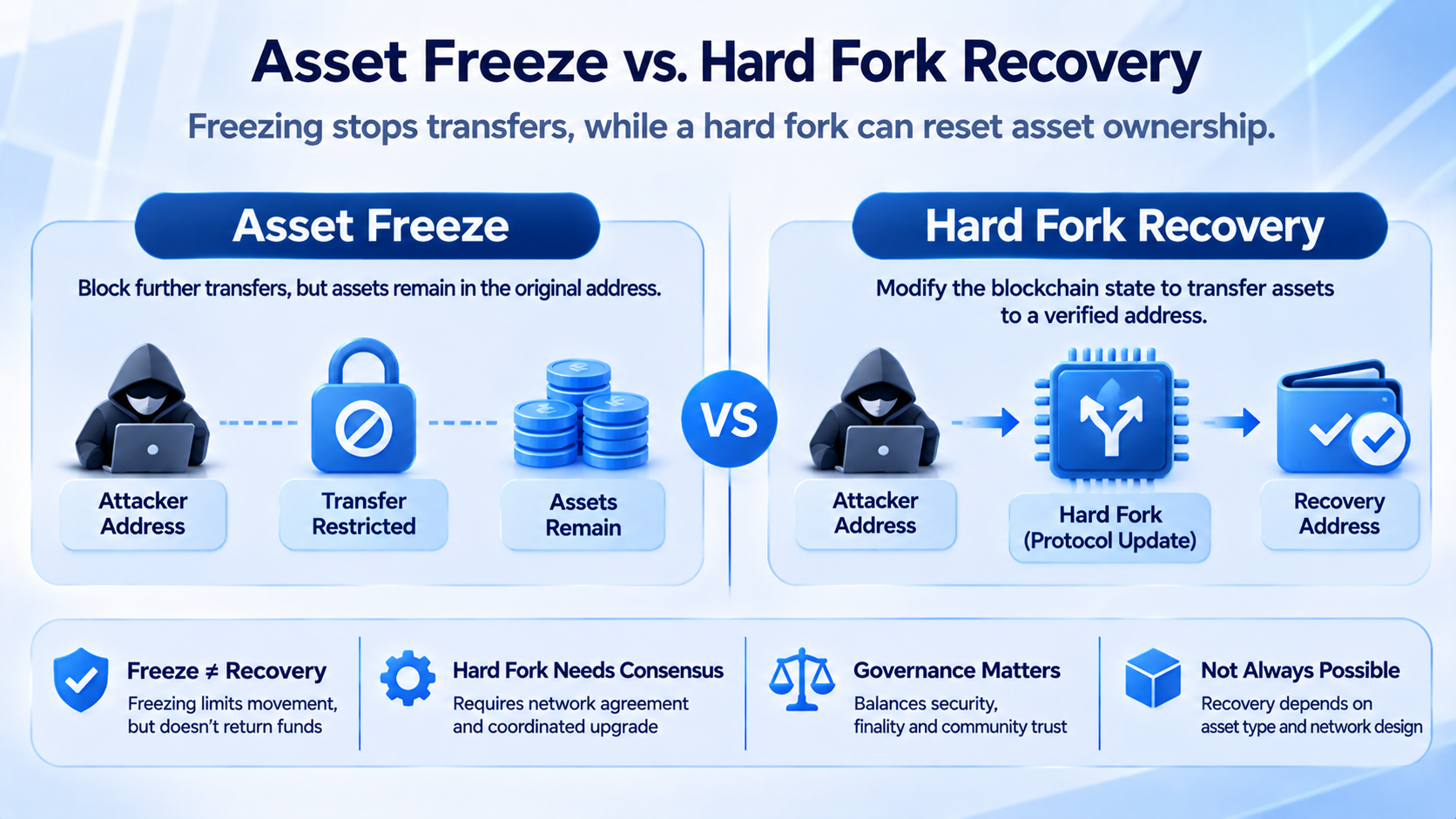
In crypto asset security incidents, freezing and recovery are often discussed together, but their technical mechanisms and practical results are different. The primary objective of asset freezing is to prevent further transfers. Asset recovery requires the relevant funds to re-enter addresses or accounts that can be controlled by the legitimate party. Because the control mechanisms differ across blockchains and tokens, asset freezing can also take several forms.
- Token contract-level freezing. Some centrally issued stablecoin contracts have blacklist or freeze functions. Entities with the relevant administrative permissions can restrict token transfers from specific addresses according to the contract rules. This approach generally does not require modifying the underlying blockchain's consensus rules, but it applies only to assets designed with the relevant permissions.
- Block production or transaction execution-level restrictions. Some block producers on a network may reject transactions from certain addresses based on specific rules. This may prevent the relevant assets from moving through ordinary transaction paths. However, the effect may be limited if the restrictions are not enforced broadly enough or if there are transaction paths that are not covered.
- Protocol-level state modification. A network can upgrade its consensus rules to directly adjust account balances or other state at a specific block height. This approach can change asset ownership without obtaining the private key of the original address, but it requires coordination and acceptance at the network level.
| Comparison Dimension |
Token Contract Freeze |
Block Producer Restrictions |
Hard-Fork State Modification |
| Execution layer |
Token smart contract |
Block production and transaction processing |
Blockchain consensus rules |
| Requires a private key |
Usually does not require the private key of the restricted address |
No |
No |
| Can prevent transfers |
Depends on contract permissions |
Depends on the scope of execution |
Can change state through new rules |
| Can directly return assets |
Depends on whether the contract supports it |
Usually not |
Yes, under specific conditions |
| Primary risks |
Concentrated administrative authority |
Inconsistent execution and censorship disputes |
Governance disputes and chain splits |
In the Polygon incident, the recovery of native POL cannot simply use the same method as a stablecoin issuer's freeze contract. The proposal specifically designs a protocol-level adjustment for native POL balances on Polygon PoS. Other tokens involved are not automatically included in the recovery scope.
This shows that the theft of on-chain assets may require completely different responses depending on the asset. For users, understanding the network on which an asset exists, whether its token contract has administrative permissions, and the governance structure of the relevant network is more meaningful than discussing broadly whether blockchains can freeze funds.
How Can a Hard Fork Transfer Stolen Assets Without a Private Key?
In an ordinary transaction, a private key signature is an important means of proving control over assets. For native assets, other users generally cannot directly transfer funds without a valid signature from the corresponding address. Hard-fork asset recovery takes a different path: it modifies the state transition rules accepted by the network.
Under Polygon's recovery proposal, developers plan to specify a future activation block. Before ordinary transactions begin execution at that block, upgraded nodes would first process the balances of the relevant addresses according to predefined rules. The process can be divided into four stages.
Stage 1: Determine the recovery scope. Based on on-chain transaction records, security investigations, and information provided by the victims, the relevant addresses are identified, and the relationship between the funds in those addresses and the specific incidents is confirmed.
Stage 2: Verify the recovery addresses. The victims must provide new addresses to receive the funds and prove control of those addresses through methods such as signed messages or small test transfers. This helps prevent assets from being transferred to incorrect addresses.
Stage 3: Modify the client rules. Developers write the one-time balance adjustment logic into the node software and specify that it will execute at a particular block height. Under the Polygon proposal's design, the native POL balances of the relevant attacker addresses would be set to zero, while the corresponding amounts would be added to the specified recovery addresses.
Stage 4: Network upgrade and execution. Node operators install compatible software. When the network reaches the activation block, they execute the same state adjustment and continue validating subsequent blocks according to the new rules.
The key point is that the asset transfer would no longer be completed through a transaction signed by an ordinary user. Instead, it would be completed through a protocol state change executed collectively by all nodes that adopt the new rules. Notably, this approach does not necessarily require deleting historical blocks. Previous transfer records can remain intact while the network adds a special state change at a new block height.
Therefore, modifying current asset ownership and deleting past transaction history are two different technical concepts. The Polygon proposal also requires governance approval, testnet exercises, balance reviews, and client releases before formal implementation. These steps are important not only for technical accuracy but also for helping the network avoid a split caused by inconsistent node versions.
How Did the 2016 Ethereum The DAO Incident Recover Assets Through a Hard Fork?
One of the most representative asset recovery cases in blockchain history was the 2016 Ethereum The DAO incident. The DAO was an early decentralized investment project built on Ethereum. In June 2016, attackers exploited a reentrancy vulnerability in its smart contract and transferred approximately 3.6 million ETH, triggering a major on-chain security crisis at the time.
Because the relevant assets were subject to a time limitation in the contract mechanism, the community had a period in which to discuss and implement a response. After extensive debate, the Ethereum community ultimately chose to modify part of the blockchain's state through a hard fork. The funds associated with The DAO incident were transferred to a recovery contract, allowing eligible participants to claim assets according to the applicable rules.
On July 20, 2016, Ethereum implemented the hard fork at block height 1,920,000. However, not all network participants supported the hard fork. Some believed that recovering assets through community consensus during a major security incident would help protect users and maintain trust in the ecosystem. Others believed that even if the transaction results originated from a smart contract vulnerability, the underlying protocol should not be modified to redistribute the assets.
Ultimately, the network that accepted the state modification continued to develop under the name Ethereum (ETH), while the network that rejected the modification continued as Ethereum Classic (ETC). The DAO incident showed that a hard fork can serve as a technical means of addressing a major security incident, but it also revealed the governance costs of such intervention. For a blockchain network, the technical ability to modify state does not mean that all participants will accept the modification. Different groups may hold irreconcilable views regarding asset security, transaction finality, and immutability.
Does Recovering Assets Through a Hard Fork Undermine Blockchain Immutability?
Immutability is one of the important characteristics of blockchain technology, but it does not mean that blockchain rules can never change. Blockchain history is generally protected by cryptographic structures and consensus mechanisms. Ordinary participants cannot arbitrarily modify confirmed transactions because such modifications require recognition under the network's consensus rules.
However, the consensus rules themselves can change through governance and network upgrades. This raises two different aspects of immutability: first, whether an individual participant can unilaterally modify the ledger; and second, whether the network as a whole should allow certain existing states to be modified through collective decision-making.
Supporters of special asset recovery mechanisms argue that blockchains are not systems detached from social governance. When a security incident is supported by sufficient evidence and has serious consequences, the community may take special measures through an open governance process under strictly limited conditions.
Opponents worry that once a network accepts the redistribution of assets for a particular reason, it may establish a precedent. In the future, relevant parties may again ask the protocol to intervene in response to commercial disputes, regulatory requirements, or other conflicts of interest.
This debate involves not only whether victims should be protected, but also who has the authority to determine that assets were stolen, who has the authority to designate receiving addresses, and which incidents qualify for special treatment. Polygon's recovery proposal attempts to reduce these risks by limiting the scope of intervention. Its design applies only to specific incidents, pre-listed addresses, and a one-time state modification. It expressly does not advocate creating general asset freezing and recovery powers.
Even with a limited scope of intervention, governance disputes cannot be eliminated entirely. Therefore, hard-fork asset recovery cannot simply be categorized as either protecting users or undermining decentralization. It reflects a choice made by a blockchain network among asset security, rule stability, and community governance.
Why Can't All Stolen Crypto Assets Be Recovered Through a Hard Fork?
Although a hard fork can modify asset state on a specific network, the actual recovery process is subject to many limitations.
- Whether the assets can be accurately identified. If stolen funds remain concentrated in a small number of clearly identified addresses and the on-chain transfer paths are clear, determining the recovery scope is relatively easy. However, if the funds have undergone multiple transfers, mixing, conversions, or cross-chain transactions, determining asset ownership may become much more complex.
- Whether the assets are still on the relevant network. A blockchain hard fork can generally modify only the state of that network directly. If the attacker has exchanged the assets for assets on another blockchain, adjusting the balance on the original network cannot directly modify the ledger of another independent network.
- Differences in asset type. Native tokens, smart contract tokens, bridged assets, and assets held in custodial accounts have different control mechanisms. Modifying the native asset balance of an address does not mean that all other assets held by that address can be changed at the same time.
- Governance and network coordination. A hard fork requires enough relevant participants to accept the new rules. On networks with a high degree of decentralization and dispersed opinions, reaching a consensus on asset recovery may be extremely difficult.
- Risk of incorrect attribution. If a recovery plan incorrectly identifies an address as belonging to an attacker or sends assets to a recovery address that has not been sufficiently verified, the protocol modification itself could cause new losses.
Blockchain networks must also consider transaction finality. If asset ownership that was confirmed in the past can change after an extended period because of an external dispute, trading platforms, custodians, and other financial service providers will need to reassess the settlement risks of the relevant assets. Therefore, whether assets can be recovered through a hard fork depends not only on the network's technical ability to modify state, but also on the evidence, asset location, governance process, and potential side effects.
How Should Investors Understand the Risks of On-Chain Asset Freezing and Recovery?
For ordinary investors, blockchain asset recovery mechanisms may provide additional security response options, but they may also introduce new governance and control risks.
- Distinguish technical control of assets from practical ability to use them. The fact that a wallet address has an asset balance does not mean that the assets can be freely transferred under all circumstances. If a token contract has freeze permissions or the network adopts special transaction restrictions, the assets' practical usability may be affected.
- Pay attention to the governance structure of the network where the assets are held. Different blockchains handle protocol upgrades, node coordination, and emergency security responses differently. Some networks may be more capable of quickly coordinating special measures, while others place greater emphasis on avoiding human intervention.
- Understand the relationship between transaction finality and asset recovery. Ordinary on-chain transactions generally have strong finality after reaching a certain confirmation threshold. However, a protocol-level state modification may change subsequent asset ownership under extreme circumstances. This is not the same as directly canceling an ordinary transaction.
- Do not treat a hard fork as a standard remedy after assets are stolen. Most personal wallet theft, phishing approvals, and mistaken transfers will not automatically qualify for protocol-level asset recovery. Even if a technical recovery path exists, it may not be possible to implement because the funds have already moved, the evidence is insufficient, or the governance process cannot reach consensus.
Therefore, protecting private keys, managing contract approvals, verifying transaction addresses, and diversifying asset risk remain fundamental measures for reducing the risk of on-chain asset losses.
Conclusion
Under specific conditions, a blockchain hard fork can be used to recover stolen assets. However, this ability does not mean that blockchains have a universally applicable transaction reversal mechanism. Ordinary on-chain transactions rely on private key signatures and consensus rules, while special asset recovery requires a protocol upgrade to modify the state of specific accounts with the network's approval.
Polygon's POL asset recovery plan proposed in November 2026 provides a new case study of this mechanism. The proposal plans to implement a one-time state modification affecting identified addresses holding stolen assets and transfer the native POL to verified recovery addresses. Compared with simply restricting addresses, this approach attempts to address the problem that assets can no longer be moved but also cannot be returned. However, it still requires governance, testing, and network coordination.
The 2016 Ethereum The DAO incident demonstrated that although a hard fork can enable asset recovery, it can also trigger long-term debate over immutability and network governance principles and may even result in a blockchain split.
From a technical perspective, freezing assets, modifying balances, and rolling back history are different operations. From a governance perspective, whether these operations can be implemented depends on how much intervention authority network participants are willing to grant the protocol. For users, understanding these differences helps them more accurately assess blockchain security boundaries and asset ownership risks.
FAQ
Can a Blockchain Hard Fork Recover Stolen Crypto?
Under specific conditions, it can. A network can modify its consensus rules to adjust the asset state of specified addresses, but it must resolve issues involving asset identification, governance approval, and node upgrades. Not all stolen assets can be recovered this way.
Has Polygon Already Recovered the Stolen POL Through a Hard Fork?
As of November 9, 2026, what can be verified is that the Polygon community proposed an asset recovery plan involving approximately 70.49 million POL. The publication of the proposal should not be treated as evidence that recovery has already been completed on the mainnet.
What Is the Difference Between Freezing a Wallet Address and Recovering Assets?
Freezing primarily restricts further asset transfers. Recovery requires the funds to re-enter an address that can be controlled by the legitimate party. Freezing itself generally does not change asset ownership.
Does a Hard Fork Require the Attacker's Private Key?
Recovering assets through a protocol-level state modification does not require the attacker to provide a private key. However, the network must execute the relevant operations under the new consensus rules.
Does Recovering Assets Through a Hard Fork Delete the Original Transaction Records?
Not necessarily. The network can preserve previous transaction history and add a state adjustment at a specific block height. Modifying asset balances and deleting transaction history are not the same thing.
Why Did Ethereum Classic Emerge After the Ethereum Hard Fork?
After the 2016 The DAO incident, some network participants accepted recovering the assets through a hard fork, while others rejected modifying the original state. The two groups continued operating networks under different rules, eventually forming Ethereum and Ethereum Classic.
Do Frozen Stablecoins Such as USDT Require a Hard Fork?
Not necessarily. Some stablecoin smart contracts have built-in freeze or blacklist management functions. Authorized entities can perform the relevant operations according to the contract rules without modifying the underlying blockchain protocol.