As late November 2026 begins, Bitcoin has undergone a significant market correction, prompting investors to reconsider the logic behind its long-term growth. Over the past several years, strong growth expectations for Bitcoin have centered on themes such as halvings, the launch of spot ETFs, Wall Street institutions entering the market, and corporate balance-sheet allocations. Today, these events, once viewed as long-term positive catalysts, have successively become reality.
However, the realization of these positive catalysts has not eliminated Bitcoin's cyclical volatility. Even as investment channels become more established and institutional participation continues to increase, Bitcoin remains affected by global liquidity contraction, capital outflows, and valuation adjustments in risk assets. This means the market needs to distinguish between long-term narratives that have already been priced in and new demand that has yet to materialize.
As the primary catalysts that drove Bitcoin's growth in the past gradually come to fruition, where will the next phase of growth come from? From supply scarcity to global asset allocation, from ETF flows to changes in the monetary credit system, Bitcoin may be entering a market phase that requires broader and more sustained capital demand for support.
Key Takeaways
-
Traditional growth narratives have largely played out: Halvings, spot ETF launches, and institutional participation have become reality, but these developments do not mean Bitcoin can continue to attract new buying.
-
The marginal supply impact of halvings is weakening: As new Bitcoin issuance continues to decline, selling by existing holders and new demand may have a greater impact on price.
-
Institutional participation is shifting from access expansion to deeper allocation: ETF launches establish an investment channel, while wealth management, corporate asset allocation, and continued participation by long-term capital may create structural demand.
-
Global liquidity and competition for capital are becoming more important: Bitcoin is competing with gold, technology stocks, and other financial assets for global capital, and its price is influenced by interest rates, financing costs, and risk appetite.
-
The next phase of growth requires more sustainable demand: Bitcoin's future growth potential depends not only on supply scarcity but also on whether it can gain broader acceptance within the global financial system and create stable demand for asset ownership.
What Has Mainly Driven Bitcoin's Growth Over the Past Decade or More?
Bitcoin has progressed through multiple stages, from a technical experiment to a traded crypto asset and then to a global financial asset. At different stages, the primary factors driving its price growth have not been exactly the same.
In its early years, Bitcoin's growth mainly came from expanding market awareness. As blockchain technology gradually attracted attention, more users began to recognize that digital assets could be held, transferred, and traded without relying on a centralized issuing institution. Because the market was relatively small at the time, even a limited amount of new capital could have a significant impact on price.
Bitcoin subsequently developed a value narrative centered on a fixed supply, periodic halvings, and digital gold. Improvements in trading infrastructure, the expansion of global crypto markets, and institutional participation enabled Bitcoin to move beyond its early technology community.
The approval and launch of U.S. spot Bitcoin ETFs in 2024 further lowered the barrier to entry for traditional financial investors, allowing them to gain exposure to the asset through familiar securities accounts and investment management systems.
These factors did not replace one another. Instead, they gradually accumulated throughout Bitcoin's development.
However, as the market has grown, the impact of new demand generated by a single event may have declined relative to the market as a whole. Catalysts that once significantly changed market expectations may not produce price reactions of the same magnitude in the future.
Why Might the Marginal Impact of Halvings on Bitcoin's Price Gradually Weaken?
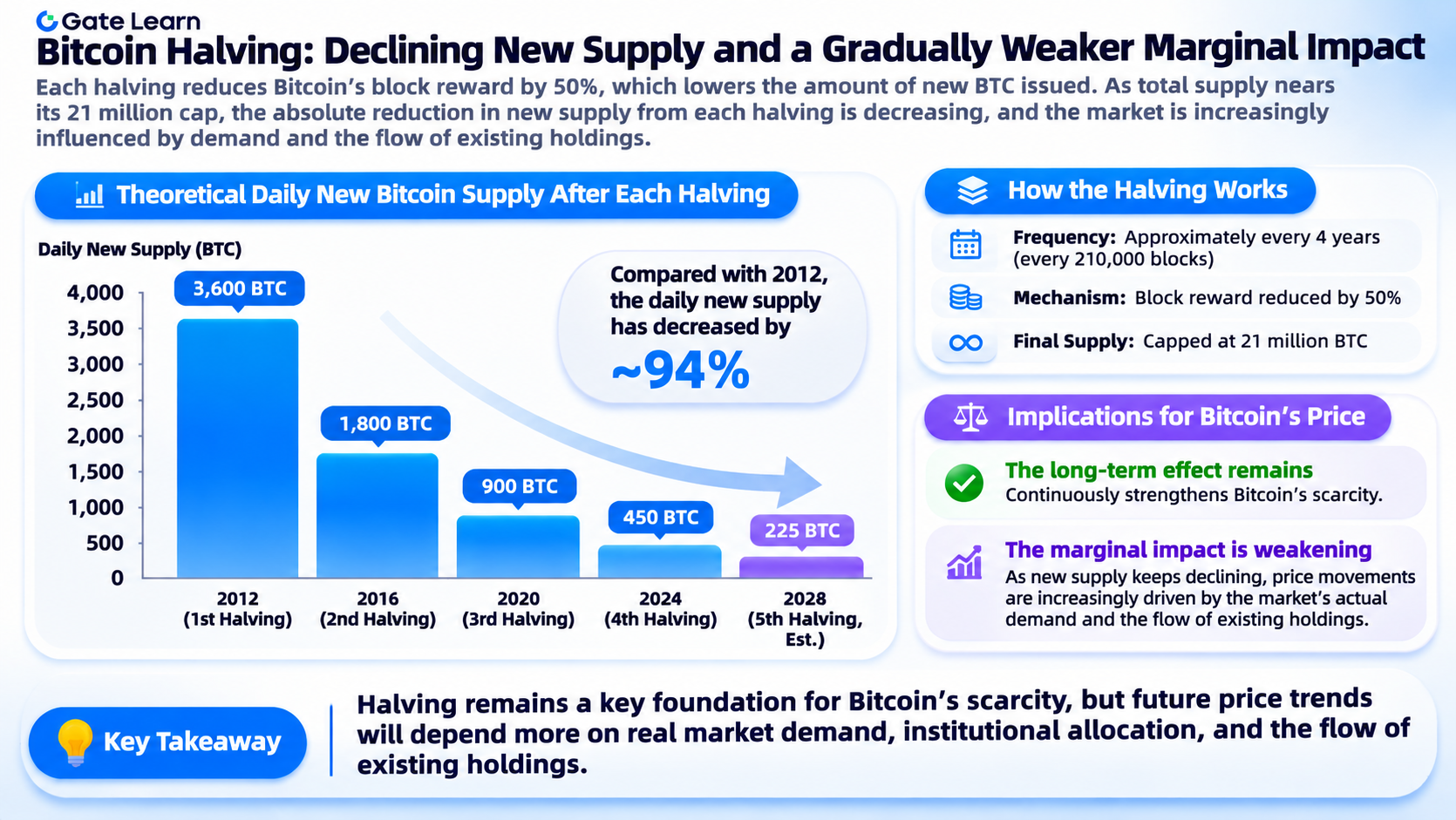
The halving (Bitcoin Halving) is an important part of Bitcoin's monetary issuance mechanism. Approximately every 210,000 blocks, the Bitcoin block subsidy is cut in half, gradually reducing new supply and ultimately bringing the total supply closer to the 21 million cap.
After the fourth halving was completed in 2024, the Bitcoin block subsidy fell from 6.25 BTC to 3.125 BTC. Based on an average of approximately 144 blocks produced per day, Bitcoin's daily new supply is approximately 450 BTC.
Early halvings significantly changed Bitcoin's new supply structure. However, as the circulating supply continues to approach its predetermined cap, the absolute amount of issuance reduced by each halving is also declining.
At the same time, the Bitcoin market has accumulated a substantial amount of existing supply. The buying and selling activity of long-term holders, miners, ETF investors, companies, and other market participants can all affect the amount of supply that is actually available for trading.
For example, even if the amount of Bitcoin miners receive each day declines, the market may still face significant selling pressure if long-term holders sell existing assets in large amounts. Conversely, if long-term allocation capital continues to increase and more Bitcoin leaves active trading markets, the supply-and-demand structure may change even without a new halving.
Therefore, the halving mechanism remains the foundation of Bitcoin's long-term scarcity. However, price growth increasingly needs to be analyzed together with actual demand and the movement of existing assets.
Why Does Bitcoin Still Need New Growth Drivers After the Launch of Spot ETFs?
The significance of spot Bitcoin ETFs lies in establishing an investment connection between traditional securities markets and Bitcoin.
Before ETFs were launched, some traditional financial investors had to address issues involving trading accounts, digital asset custody, private-key management, and compliance reviews on their own. Spot ETFs assign some of these functions to professional financial institutions, allowing investors to gain Bitcoin price exposure through more familiar financial products.
However, establishing an investment channel and generating sustained capital inflows are two different stages of development.
ETF approval is a one-time institutional change, while ETF flows are an ongoing market variable. When investors' demand for Bitcoin allocation increases, net ETF subscriptions may create demand for the underlying asset. When investors reduce their risk exposure, net redemptions may similarly create selling pressure on the asset.
In addition, growth in ETF assets under management cannot be directly equated with new capital inflows. Even without new net subscriptions, an increase in the Bitcoin price may raise the net asset value of the funds.
Therefore, analyzing the impact of ETFs on Bitcoin's price requires distinguishing among the following three concepts:
| Metric |
Primary Meaning |
| ETF assets under management |
The market value of assets currently held by the funds |
| ETF net subscriptions and redemptions |
New or withdrawn capital demand from investors |
| ETF actual BTC holdings |
The amount of underlying Bitcoin held by the funds |
Once spot ETFs are no longer a new market narrative, their long-term value will depend more on whether they can continue expanding investor access and convert open investment channels into actual asset allocation demand.
ETFs themselves do not create permanent buying. They simply make it more convenient for capital to enter and exit the Bitcoin market.
Why Might Asset Allocation Percentages Matter More Than the Number of Institutions After Institutional Entry?
In the past, an announcement that a major financial institution was investing in Bitcoin often became a news event with a significant market impact.
As institutional participation becomes more widespread, the market's focus may shift from "which institutions have entered the market" to "how much these institutions have actually allocated and whether they will continue increasing their allocation percentages."
Institutional holdings disclosures for the third quarter of 2026 show that wealth management channels accounted for close to 40% of identifiable institutional holdings in U.S. spot Bitcoin ETPs. This indicates that Bitcoin's institutionalization is gradually extending into investment advisory and brokerage services, rather than remaining limited to specialized crypto and hedge funds.
However, institutions hold assets for different investment purposes. Hedge funds may conduct arbitrage through combinations of ETFs and futures, wealth management firms may allocate assets on behalf of clients, and companies may hold Bitcoin for balance-sheet management purposes.
These funds differ significantly in their holding periods, risk limits, and trading behavior.
For example, consider a wealth management firm managing $100 billion in assets. If the amount of capital that qualifies for investment and has an actual allocation intention increases, its demand for Bitcoin may grow as the allocation percentage changes.
| Assumed Allocation Percentage |
Corresponding Asset Value |
| 0.10% |
$100 million |
| 0.50% |
$500 million |
| 1% |
$1 billion |
| 2% |
$2 billion |
The examples above are hypothetical illustrations of asset allocation amounts. They do not represent actual institutional investment plans and do not imply that the corresponding capital would enter the Bitcoin market all at once.
The next phase of Bitcoin's institutionalization may depend less on an individual major institution making its first purchase and more on investment advisers, wealth management platforms, and other long-term capital gradually incorporating Bitcoin into standard asset allocation systems.
However, this process remains subject to factors such as investment mandates, regulatory requirements, risk budgets, and historical volatility.
Can Bitcoin Develop Further From a Speculative Asset Into a Global Reserve Asset?
Another possibility for Bitcoin's long-term growth is a change in its role across different types of balance sheets.
At present, some individuals, investment funds, and publicly listed companies already use Bitcoin as a long-term asset holding. Its fixed supply rules, global transferability, and independence from any single monetary issuing institution have also brought it within the scope of research by some public institutions and sovereign capital.
If more long-term capital uses Bitcoin as an alternative reserve asset in the future, its demand structure may change. Unlike trading capital that primarily seeks returns from short-term price increases, reserve-asset allocations generally focus more on long-term purchasing power, asset diversification, liquidity, and credit-risk diversification. However, Bitcoin still faces significant limitations before it can become a widely used reserve asset.
-
Bitcoin is highly volatile and may experience deep short-term drawdowns, making it unsuitable for some institutions that need to maintain balance-sheet stability.
-
Bitcoin does not generate cash flow in the form of bond interest or corporate operating profits. Its value depends more on market acceptance and demand for ownership.
-
Custody security, accounting treatment, regulatory policy, and the ability to liquidate assets will all affect allocation decisions by public institutions.
It is also necessary to distinguish among governments acquiring Bitcoin through judicial confiscation, establishing government asset reserves, and central banks actively including Bitcoin in foreign-exchange reserves. These situations do not represent the same policy direction and do not necessarily create new market buying.
Therefore, reserve-asset demand may become a potential variable in Bitcoin's long-term growth, but related policy discussions should not be treated directly as confirmed purchase demand.
Why Might Global Liquidity Become an Increasingly Important Pricing Factor for Bitcoin?
As Bitcoin enters traditional financial investment systems, the relationship between its price performance and global capital flows may strengthen further. In relatively loose liquidity conditions, lower financing costs and improved risk appetite may lead investors to increase their allocations to growth stocks, alternative assets, and crypto assets.
By contrast, when interest rates remain high, the U.S. dollar strengthens, or financial institutions reduce leverage, investors may increase their allocations to cash and low-risk assets while reducing their holdings of highly volatile assets. Although Bitcoin has a fixed supply, its market price is still determined by the capital demand of buyers and sellers.
If investable capital in the market continues to contract, Bitcoin may face price pressure even if new issuance remains low. Conversely, if global liquidity improves and capital once again increases its demand for Bitcoin allocation, Bitcoin's limited supply structure may amplify price movements.
This mechanism can generally be understood through the following sequence: Changes in global monetary policy affect financing costs; financing costs affect capital allocation and risk appetite; capital then flows into or out of the Bitcoin market through ETFs, spot markets, and other financial channels, ultimately driving price adjustments.
However, monetary easing does not necessarily cause Bitcoin to rise. New liquidity may initially flow into bonds, gold, stocks, or other financial assets. The market still needs to determine whether Bitcoin can obtain actual demand amid competition for capital among different assets. Therefore, global liquidity determines the potential capital environment, while Bitcoin's appeal as an asset influences how much of that capital ultimately enters the crypto market.
When AI, Gold, and Technology Stocks Compete for Capital, How Can Bitcoin Attract New Asset Demand?
In its early stages, the Bitcoin market primarily competed for capital within the crypto industry. As its market has grown, however, Bitcoin has become part of the global multi-asset allocation system.
Investors are not limited to choosing between Bitcoin and other cryptocurrencies. They can also allocate capital to gold, stocks, bonds, real estate, private equity, and other assets.
In particular, the development of AI infrastructure and the technology industry in recent years has provided global capital with new growth themes. AI chips, cloud computing, data centers, and large-model companies can attract capital through revenue growth, expanding orders, and technological breakthroughs.
By comparison, Bitcoin does not have operating revenue or profit growth in the corporate sense. Its long-term value is based primarily on its monetary properties, supply scarcity, network security, and market acceptance.
Different assets have clearly different sources of value, but they may still compete for the same portion of global investment capital. For example, when earnings expectations for technology companies continue to improve while yields on risk-free assets remain high, Bitcoin faces more intense competition for capital allocation. Even if its long-term supply mechanism remains unchanged, capital may temporarily leave the Bitcoin market because other assets offer higher expected risk-adjusted returns.
Whether Bitcoin can achieve sustained growth in the future will depend not only on whether its narrative holds but also on its relative appeal among global financial assets.
Can the Financialization of Bitcoin Create New Demand Beyond Simple Ownership?
In addition to direct purchases by traditional investors, Bitcoin's use within the financial system may become an important source of demand in the next phase. As digital asset custody, collateralized lending, derivatives, and on-chain financial infrastructure develop, Bitcoin may perform more financial functions beyond simply being held.
For example, some financial services allow users to use Bitcoin as collateral to obtain loans without immediately selling their existing holdings. Companies and institutions can also use professional custody, derivatives, and risk management tools to incorporate Bitcoin into more sophisticated asset management systems. In on-chain finance, BitcoinFi, cross-chain assets, and Bitcoin-related scaling networks are exploring how Bitcoin can be used for collateral, settlement, and other financial activities.
These applications may affect Bitcoin demand in the following ways:
-
Collateral demand: Using BTC as collateral for lending and borrowing in financial activities that meet risk management requirements.
-
Asset management demand: Establishing a more complete long-term holding system through professional custody and financial products.
-
On-chain finance demand: Introducing Bitcoin into lending, settlement, and other decentralized finance applications.
-
Value transfer demand: Using Bitcoin to transfer assets in specific cross-border and digital finance scenarios.
However, the expansion of financial applications does not necessarily mean that Bitcoin's price will receive support of the same magnitude. Some activities may simply improve the efficiency of existing assets without creating additional purchase demand.
In addition, the expansion of collateralized lending and derivatives may increase leverage risk. When Bitcoin's price falls rapidly, collateral liquidations may further amplify market selling pressure. Different BitcoinFi products may also introduce additional risks involving cross-chain bridges, smart contracts, custody institutions, and other components.
Therefore, the long-term value of Bitcoin's financialization needs to be assessed through actual usage demand, risk management capabilities, and business sustainability, rather than measured solely by the number of financial products or the amount of value locked.
Does the Value of the Bitcoin Network Itself Still Matter?
As the market focuses increasingly on ETFs, institutional capital, and macroeconomic conditions, the performance of Bitcoin as an underlying blockchain network can easily be overlooked.
However, Bitcoin's long-term asset value remains based on the credibility of its monetary rules, network security, and decentralized operation.
Bitcoin maintains network security through a proof-of-work mechanism, while miners primarily earn revenue from block subsidies and transaction fees. As the block subsidy continues to decline, the structure of miner revenue, the transaction fee market, and the network security budget will become important long-term issues.
In the future, if Bitcoin's price growth or fee revenue can support sufficient economic incentives for miners, the network may continue to maintain a high level of security. However, if miner revenue remains under pressure, it will also be necessary to monitor the structure of hash power, the concentration of the mining industry, and the ability of the network security mechanism to adapt.
At the same time, the Bitcoin network's actual utility cannot be measured simply by the number of daily transactions. Large asset transfers, internal settlement by custodians, off-chain transactions, and activity on scaling networks may make the relationship between economic value and the number of mainnet transactions more complex.
Therefore, assessing Bitcoin's long-term network value requires a comprehensive view of network security, node operation, settlement demand, miner economics, and protocol development, rather than focusing only on short-term price performance.
Macro liquidity can change Bitcoin's market price, but the credibility of the underlying network remains an important foundation for its long-term value narrative.
Will Bitcoin's Next Growth Cycle Still Follow the Traditional Four-Year Cycle?
In the past, the Bitcoin market often explained price movements through a four-year halving cycle. The halving reduces new supply, market demand gradually grows, and the price then enters a phase of appreciation, overheating, and correction.
However, this cycle model is based primarily on a limited historical sample, and every market cycle is also affected by macro policy, industry development, and investor behavior.
As ETFs, institutional investment, corporate asset allocation, and global derivatives markets have developed, Bitcoin's demand structure has become more complex than it was in its early years.
Bitcoin may still experience cyclical rises and declines in the future, but the cycle length, price volatility, and primary drivers may not be exactly the same as in the past.
If wealth management capital continues to enter the market, Bitcoin may gain more long-term allocation demand. If the global financial environment changes significantly, institutional redemptions, leverage adjustments, and cross-asset capital flows may also accelerate price movements.
The overlapping investment cycles of different types of capital may cause Bitcoin's market cycle to gradually take on a multi-factor-driven character.
Therefore, instead of relying on a single halving timetable to predict future markets, a more valuable approach is to examine the relationship among supply changes, capital demand, the macro environment, and risk exposure.
The halving cycle still exists at the protocol level, but market prices do not necessarily need to follow the same four-year rhythm strictly.
Which Metrics Can Help Determine Whether the Next Growth Drivers for Bitcoin Are Taking Shape?
Bitcoin's next phase of sustained growth requires support from more actual demand and changes in the financial environment, rather than simply a new market narrative. Market participants can observe the following dimensions to determine whether Bitcoin's growth drivers are gradually taking shape.
| Dimension |
Key Metrics |
Analytical Value |
| ETF demand |
Sustained net inflows, actual BTC holdings |
Assess new allocation demand |
| Wealth management |
Product coverage, actual allocation percentages |
Assess the depth of institutionalization |
| Long-term capital |
Changes in corporate and public-institution holdings |
Observe holding periods and capital structure |
| Existing supply |
Selling by long-term holders, exchange flows |
Observe potential selling pressure and liquid supply |
| Macro liquidity |
Real interest rates, the U.S. dollar, credit conditions |
Assess the capital allocation environment |
| Financialization |
Collateralized lending, custody, and settlement demand |
Observe new financial use cases |
| Network operation |
Hash power, fees, network security |
Assess long-term fundamental value |
| Market leverage |
Open interest, funding rates, liquidation volume |
Assess upward momentum and potential risks |
These metrics need to be analyzed together. For example, if Bitcoin's price rises while ETFs continue to record net inflows, actual holdings increase, and market leverage remains relatively stable, its capital structure may differ from a rally driven primarily by derivatives leverage.
On digital asset trading platforms such as Gate, users can also observe short-term price movements and market risk exposure through BTC spot prices, futures funding rates, open interest, and market trading data. However, data from a single platform cannot fully represent global Bitcoin capital flows and should still be analyzed alongside ETF, on-chain, and macro-financial data.
Whether Bitcoin's next phase of growth is sustainable will ultimately depend on whether these sources of demand can form a mutually reinforcing structure, rather than on the short-term improvement of any single metric.
Conclusion
Bitcoin's development has benefited from expanding market awareness, the halving mechanism, the launch of spot ETFs, and institutional participation. Together, these developments moved Bitcoin from an early crypto asset into the global financial investment system. As the major market narratives have largely played out, however, future price growth will need to focus more closely on actual new demand.
The halving continues to provide long-term supply scarcity, ETFs continue to serve as an access point for traditional financial capital, and institutional investment still has the potential to expand asset demand. However, the factors that truly determine the next phase of growth may be deeper wealth management allocations, improved global liquidity, long-term reserve demand, and the continued development of Bitcoin's financial applications.
At the same time, competition for capital among assets, market leverage risk, and the long-term security of the Bitcoin network will also be important factors affecting its value.
Bitcoin has no shortage of potential growth narratives. Whether the next phase of growth can take shape depends on whether these narratives can be converted into sustained, verifiable capital demand.
FAQ
Is the impact of Bitcoin halvings on price disappearing?
No. The halving remains an important mechanism for controlling Bitcoin's new supply. However, as the absolute amount of issuance reduced by each halving declines, the movement of existing assets and new demand may play a more important role in price formation.
Why can't the launch of spot Bitcoin ETFs guarantee that Bitcoin will continue to rise?
ETFs are simply investment channels. Investors can use ETFs to purchase Bitcoin-related assets or reduce their risk exposure through redemptions. Their impact on price depends on actual capital flows.
Does institutional participation mean that Bitcoin's volatility will decline?
Not necessarily. Long-term allocation capital may change the structure of market demand, but institutional arbitrage, leveraged trading, and concentrated redemptions may also increase price volatility.
Where could Bitcoin's largest potential source of incremental capital come from in the future?
Potential sources include wealth management channels, long-term funds, corporate asset allocation, and some public institutions. However, whether this capital can actually enter the market will still depend on regulation, investment mandates, and risk-return assessments.
Will improved global liquidity necessarily drive Bitcoin higher?
Not necessarily. Improved liquidity can create a relatively favorable funding environment for risk assets, but new capital may flow into other assets. Bitcoin must still have sufficient appeal as an allocation.
Can BitcoinFi become a new growth driver for Bitcoin?
BitcoinFi can expand Bitcoin's use in collateral, lending, and on-chain finance. However, whether it can create sustained new demand will require monitoring of actual usage, capital efficiency, and risk management capabilities.
Has Bitcoin's four-year cycle ended?
It is not possible to determine this at present. The halving mechanism at the protocol level continues to operate according to established rules, but market price cycles may be increasingly influenced by institutional capital, global liquidity, and changes in financial market structure.