As U.S. spot Bitcoin ETFs have developed, the connection between traditional financial markets and crypto asset markets has strengthened further. ETF inflows and outflows have also gradually become an important indicator for observing changes in Bitcoin demand.
In early November 2026, U.S. spot Bitcoin ETFs once again saw concentrated outflows, increasing concerns about slowing institutional demand and pressure on the BTC price. Unlike regular spot trading on exchanges, changes in ETF flows can affect Bitcoin prices only after passing through processes such as fund creations and redemptions, authorized participants, underlying asset management, and market liquidity. At the same time, macro risk appetite, derivatives leverage, and spot market depth can also affect the actual impact of outflows. This article examines recent ETF flow changes, explains how spot Bitcoin ETFs operate, and explores why sustained net outflows may increase downside pressure on BTC without necessarily causing prices to fall in tandem.
Key Takeaways
-
Net outflows from spot Bitcoin ETFs reflect changes in fund-level assets and do not mean that an equivalent amount of BTC must be immediately sold on exchanges.
-
ETF creations and redemptions may be completed in cash or in kind, and the actual asset-handling process varies by fund.
-
Sustained net outflows may weaken marginal demand for BTC and amplify price volatility when spot liquidity is limited.
-
ETF flow changes may reflect adjustments in institutional risk appetite, as well as arbitrage, hedging, or portfolio rebalancing.
-
ETF outflows and derivatives liquidations may occur at the same time, but the causal relationships among capital flows, price declines, and leveraged position closures must be distinguished.
-
To assess BTC's future price movements, investors should consider ETF net flows, fund holdings, spot trading volume, market depth, and derivatives data rather than relying on a single indicator.
Why Did Spot Bitcoin ETFs Recently See Concentrated Outflows?
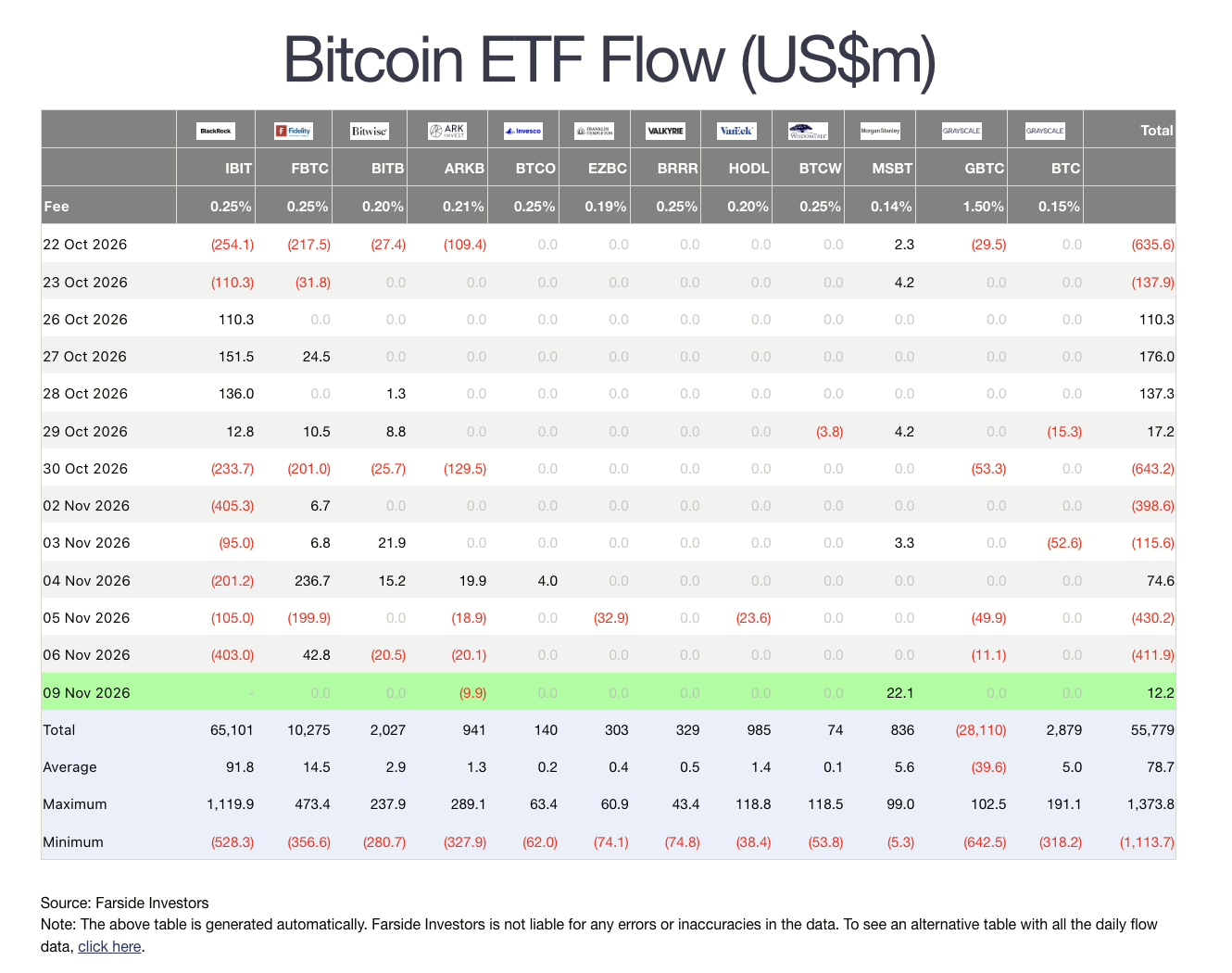
In early November 2026, capital flows in U.S. spot Bitcoin ETFs changed significantly. During the five trading days from November 2 to 6, the relevant funds recorded approximately $1.282 billion in cumulative net outflows, the largest weekly net outflow since late June.
Among them, BlackRock's iShares Bitcoin Trust (IBIT) recorded approximately $1.209 billion in weekly net outflows, accounting for the vast majority of total market outflows during the same period. On November 6, IBIT saw approximately $403 million in daily net outflows, while U.S. spot BTC ETFs as a whole recorded approximately $412 million in net outflows.
This change in flows was not an isolated event. U.S. spot Bitcoin ETFs had already recorded approximately $515 million in net outflows in October, and the concentrated redemptions in early November further weakened the year-to-date inflows accumulated previously. Based on statistics as of November 6, the cumulative net flow for U.S. spot BTC ETFs in 2026 had turned into approximately $914 million in net outflows.
It is important to note that cumulative net flows and total fund assets are not the same concept. As of November 6, the total net assets of U.S. spot Bitcoin ETFs were still approximately $95.9 billion, while cumulative net inflows since their launch in January 2024 remained approximately $55.8 billion. Short-term outflows indicate a change in recent investment demand but do not mean that all capital previously entering the ETF market has exited.
The reasons for the outflows also cannot simply be attributed to institutions becoming bearish on Bitcoin. ETF investors may reduce their holdings because of lower risk appetite, portfolio rebalancing, liquidity needs, or changes in trading strategies. When BTC prices decline, technology stocks come under pressure, or market uncertainty rises, some investors may reduce their exposure to multiple types of risk assets at the same time.
Therefore, recent ETF outflows are better understood as a signal of changing market demand rather than an independent basis for predicting BTC's future price.
How Do the Creation and Redemption Mechanisms of Spot Bitcoin ETFs Work?
The core function of a spot Bitcoin ETF is to connect underlying BTC assets with fund shares in the securities market. Investors buy and sell ETF shares on securities exchanges, while the fund maintains exposure to Bitcoin prices through corresponding asset management and custody arrangements.
The ETF market generally has two levels.
The first is the secondary market, where ordinary investors buy and sell ETF shares through securities exchanges. When an investor sells IBIT or another spot BTC ETF, the counterparty may be another investor or a market maker. A single secondary-market sale does not necessarily cause the fund to immediately sell its underlying Bitcoin.
The second is the primary market, which involves the creation and redemption of ETF shares. Authorized participants (Authorized Participant, AP) can use cash or eligible underlying assets to create or redeem shares in accordance with the fund's rules, thereby adjusting the supply of ETF shares in the market.
When sustained selling pressure appears in the secondary market, the ETF share price may trade at a discount to the fund's net asset value (NAV). Authorized participants and other market participants can use the relevant price difference for arbitrage and may redeem ETF shares through the primary market when conditions are appropriate.
This process helps keep ETF market prices connected to the value of the underlying assets, but it also means that changes in capital flows in the securities market may be transmitted to the BTC market. In July 2025, the U.S. Securities and Exchange Commission (SEC) approved in-kind creations and redemptions for crypto asset exchange-traded products. Previously, the relevant mechanism for U.S. spot BTC ETFs primarily used cash creations and redemptions. The new arrangement allows eligible products to process underlying assets in kind.
Cash redemptions generally involve paying cash to authorized participants. The fund or a related executing party may need to sell BTC to meet the cash requirement. In-kind redemptions can be completed by delivering BTC and do not necessarily require the fund to immediately sell the underlying assets at the time of redemption. However, in-kind redemptions merely change the method of asset delivery and do not eliminate market selling pressure entirely. The institution receiving the BTC may sell, hold, or reallocate the assets based on its own trading strategy. Therefore, while a transmission mechanism exists between ETF net outflows and actual BTC sales, the two cannot be treated as equivalent.
Why Can Sustained ETF Net Outflows Increase Spot Selling Pressure on BTC?

ETF outflows affect BTC prices mainly through three channels: marginal demand, underlying asset adjustments, and market liquidity.
Reduced marginal buying. When spot Bitcoin ETFs receive sustained net inflows, funds generally need to increase their underlying BTC exposure through the relevant mechanisms. This demand may provide additional buying support in the spot market. Conversely, when ETFs shift from net inflows to sustained net outflows, the existing incremental demand may weaken, leaving the market to rely on other buyers to absorb potential selling pressure.
For example, suppose a spot BTC ETF records $300 million in daily net inflows for a period and then shifts to $300 million in daily net outflows. From the perspective of changes in capital demand, the two periods show a clear directional difference. However, this does not mean that the market will experience a fixed amount of immediate selling every day as a result, because actual trading is also affected by the redemption method, execution timing, and the behavior of other participants.
Underlying asset adjustments. For ETFs that use cash redemptions, the fund may need to sell some BTC to provide the redemption proceeds. For in-kind redemptions, the relevant BTC can be delivered directly to authorized participants, but whether the recipients continue to hold the BTC depends on their business needs and risk management arrangements.
Expectations of continued outflows. If investors observe net outflows from ETFs over multiple consecutive trading days, they may interpret this as weakening institutional demand and reduce their own risk exposure accordingly. This change in expectations may affect spot orders on exchanges, market maker quotes, and derivatives positions.
Therefore, the impact of ETF outflows on BTC comes not only from actual asset purchases and sales but also from market participants' reassessment of future demand. However, this impact is not one-directional. If other investors believe that prices have become attractive, spot buying may absorb the potential selling pressure from ETF redemptions, allowing BTC prices to remain stable or even rise.
Why Can Spot Liquidity Amplify the Impact of ETF Outflows?
Market liquidity determines how large buy and sell orders can be executed and how much price impact they create. In a liquid market, buy and sell orders are generally distributed more densely, allowing large orders to be filled within a relatively limited price range. In an illiquid market, order book depth is thinner, and a sell order of the same size may need to consume buy orders across multiple price levels, causing a more significant price decline.
Therefore, the actual market impact of ETF outflows depends not only on the redemption amount but also on liquidity conditions when the relevant BTC trades take place.
For example, suppose potential BTC selling worth $100 million appears during a trading session. If sufficient buying support is available at the same time, prices may change only modestly. But if buyers withdraw in large numbers and market makers reduce the size of their quotes, actual execution prices may decline more significantly.
In addition, the BTC spot market is distributed across multiple trading platforms, and liquidity and quotes may differ among platforms. Arbitrage trading can generally narrow price differences, but during periods of sharp volatility, fund transfers, risk limits, and execution delays may reduce arbitrage efficiency.
ETF trading hours are also worth noting. U.S. securities markets have fixed regular trading hours, while BTC spot markets generally operate around the clock. During weekends or when U.S. markets are closed, ETF shares cannot trade normally in the same way as BTC spot markets, but prices in global crypto markets may continue to change.
When ETF trading resumes, ETF share prices need to reflect the BTC price movements that occurred while the market was closed. This may cause a significant gap at the ETF's opening price, but the adjustment cannot be attributed entirely to new ETF flows on that day.
Therefore, when analyzing ETF outflows, investors should also examine BTC spot trading volume, order book depth, and price movements rather than assessing price impact solely based on the redemption amount.
Do Large Outflows From IBIT Mean That Institutions Are Fully Exiting BTC?
IBIT is one of the major products in the U.S. spot Bitcoin ETF market, so its capital flows often receive significant market attention. In early November 2026, concentrated net outflows from IBIT became the main source of overall ETF flow changes. However, even significant outflows from a large ETF do not directly indicate that all institutional investors are exiting Bitcoin.
The investor base of ETFs is relatively complex. It includes long-term allocation-oriented investors, hedge funds, asset management institutions, and other participants using short-term trading strategies. Different investors hold ETFs for different purposes.
Long-term allocation-oriented investors may use BTC ETFs as part of their investment portfolios and adjust their positions based on risk budgets. Trading institutions may use price differences between ETFs and futures for arbitrage or establish and adjust hedging positions through ETFs.
For example, under certain basis trading strategies, investors may simultaneously hold long positions in BTC ETFs and short positions in BTC futures. When the futures premium narrows, financing costs change, or strategy returns decline, institutions may close both sides of the position at the same time. This may appear as ETF share sales but does not necessarily mean that investors have taken a unilateral bearish view of BTC.
ETF flows also reflect product concentration. Large funds, because of their higher assets and greater trading activity, may absorb more institutional adjustments. Significant net outflows from one fund do not automatically mean that all fund investors have taken the same action. The flow data from November 6 illustrates this difference. IBIT recorded approximately $403 million in net outflows that day, while Fidelity's FBTC recorded approximately $42.8 million in net inflows during the same period.
Therefore, to assess whether institutions are persistently reducing their BTC allocations, investors should examine flow changes across multiple funds, their duration, and overall asset sizes rather than drawing conclusions based only on IBIT's net outflows on a single day. More importantly, ETF holdings data cannot fully reflect an institution's risk exposure in other markets. Some institutions may hold spot BTC, futures, options, or other related assets at the same time, and changes in a single fund cannot reveal their complete portfolios.
What Is the Relationship Between ETF Outflows and BTC Leveraged Liquidations?
ETF outflows and leveraged liquidations are different market mechanisms, but they may influence each other during periods of sharp price volatility. ETF outflows mainly occur through fund creations and redemptions and securities trading, while leveraged liquidations generally occur in crypto derivatives markets. When BTC prices decline, leveraged long positions may be forcibly closed because of insufficient margin.
If spot selling pressure associated with ETF outflows pushes BTC prices lower, some highly leveraged long positions may approach their liquidation prices. After trading platforms close the positions according to their risk rules, the market may experience additional selling pressure.
This mechanism can create a continuous price feedback loop: spot selling pressure increases, BTC prices decline, leveraged long positions are liquidated, volatility in the derivatives market intensifies, and spot market sentiment is affected in turn. However, leveraged liquidations are not necessarily triggered by ETF outflows. Macroeconomic news, large spot transactions, concentrated adjustments in derivatives positions, or a sudden decline in market liquidity may also trigger price volatility.
In addition, ETF net outflow data is generally calculated and released after the end of a trading day, while BTC prices and derivatives liquidations occur in real time. The fact that both occur on the same day is insufficient to prove that ETF outflows preceded the price decline.
The opposite may also occur: BTC prices may first decline because of other factors, after which ETF investors reduce their holdings, ultimately appearing as net outflows in end-of-day data.
Therefore, analyzing the relationship between ETFs and liquidations requires more granular price, trading, and position data to distinguish whether capital outflows are potential drivers of price changes or reactions by investors to market volatility that has already occurred.
How Can Investors Determine Whether ETF Outflows Reflect Short-Term Rebalancing or Sustained Weakening in Demand?
ETF net outflows do not necessarily mean that the market has entered a long-term downtrend. Assessing their impact requires examining whether the flow changes are persistent and whether they are accompanied by a broader decline in market demand.
Duration of the outflows. A large single-day net outflow may result from concentrated adjustments by a small number of institutions or may be related to the expiration of certain trading strategies. If flows return to net inflows over the following trading days, the market impact may be relatively limited.
Conversely, if net outflows continue for multiple trading weeks and expand from a small number of large funds to more products, it becomes more important to assess whether overall allocation demand is weakening.
Total ETF holdings and net asset changes. An ETF's dollar-denominated net assets are affected by both the price of BTC and the amount of BTC held by the fund. Therefore, a decline in fund assets does not necessarily mean that an equivalent amount of capital has been redeemed.
For example, suppose the amount of BTC held by an ETF remains unchanged while the BTC price declines by 10%. The fund's dollar-denominated net assets may also decline by close to 10%. In this case, the reduction in assets is mainly caused by price changes rather than investor redemptions.
If ETF net outflows occur at the same time as a sustained decline in BTC holdings, this provides stronger evidence that demand for the underlying asset is decreasing.
Whether other buyers are present in the spot market. ETFs represent only one part of demand in the BTC market. Spot investors on exchanges, corporate asset allocators, long-term holders, and other market participants may all provide buying support at different price levels.
If ETFs continue to see net outflows but BTC spot trading remains active and order book depth stays stable, prices may not decline by a similar proportion.
Risk conditions in the derivatives market. Open interest (Open Interest, OI), funding rates, and futures basis can help indicate whether market leverage is concentrated. If ETF outflows occur alongside crowded highly leveraged long positions, the market may be more sensitive to further declines.
However, if large-scale liquidations have already reduced leverage levels, some forced-selling pressure may have been removed. Therefore, to assess the sustained impact of ETF outflows, investors should analyze capital flows together with market structure rather than predicting BTC's price direction solely from negative readings over several consecutive trading days.
How Can Retail Investors Use ETF Data to Monitor BTC Market Risk?
For retail investors, ETF flows can serve as a supplementary indicator for understanding changes in Bitcoin market demand, but they are not suitable as the sole basis for trading decisions.
In practice, investors can establish an analytical framework consisting of capital flows, spot liquidity, and derivatives risk.
| Indicator |
Primary Function |
Key Considerations |
| Daily ETF net flow |
Monitor short-term changes in creations and redemptions |
Single-day volatility does not represent a long-term trend |
| Weekly ETF net flow |
Assess the persistence of flow changes |
Should be considered alongside performance over the previous several weeks |
| ETF BTC holdings |
Monitor changes in underlying asset exposure |
Disclosure timing may vary among funds |
| Spot trading volume and order book depth |
Assess the market's ability to absorb selling pressure |
High trading volume does not necessarily indicate strong buying support |
| Open interest |
Monitor the size of derivatives positions |
Cannot independently determine the direction of long and short positions |
| Funding rates and futures basis |
Monitor leverage demand and market sentiment |
Differences may exist among trading platforms |
For investors focused on BTC's medium- to long-term trend, weekly ETF net flows and changes in fund BTC holdings are generally more informative than daily data because they help reduce short-term trading noise.
Investors focused on short-term price volatility should also consider spot market depth, derivatives positions, and macroeconomic events. In particular, when liquidity is limited or market leverage is high, prices may be more sensitive to new selling pressure.
Investors should also avoid interpreting ETF net outflows as an automatic sell signal. ETF market flow changes may lag behind price movements and may also be affected by arbitrage and hedging strategies. Even amid consecutive net outflows, BTC prices may rebound because of other buying support, short covering, or improving market expectations.
A more reasonable approach is to treat ETF data as a window into the market's capital structure and validate it against other indicators.
Conclusion
In early November 2026, U.S. spot Bitcoin ETFs saw concentrated outflows, with weekly net outflows of approximately $1.282 billion from November 2 to 6. IBIT accounted for a significant share of this amount. This change indicates that demand for capital in the ETF market has weakened significantly in the near term and has drawn greater attention to the potential selling pressure facing BTC prices.
However, ETF net outflows do not mean that an equivalent amount of Bitcoin immediately enters exchanges for sale. After ETF shares trade in the secondary market, whether they further trigger fund redemptions, sales of underlying assets, or in-kind deliveries depends on the fund mechanism and the specific actions of market participants.
Sustained outflows may put pressure on BTC prices by reducing marginal buying, adjusting underlying asset exposure, and influencing market expectations. When spot liquidity is limited and derivatives leverage is high, this pressure may also interact with forced liquidations.
However, BTC prices are ultimately determined by supply and demand across the entire market. ETFs are only one part of that market. Other spot buying, the macro environment, derivatives positions, and investor risk appetite are equally important.
Therefore, the key to understanding outflows from spot Bitcoin ETFs is not simply determining whether outflows mean that BTC must decline. Instead, investors should analyze how these flow changes are transmitted to prices through creations and redemptions, spot trading, and market liquidity, as well as whether other market participants can absorb the potential selling pressure.
FAQ
What Do Net Outflows From Spot Bitcoin ETFs Mean?
Net outflows from spot Bitcoin ETFs generally mean that the amount of capital associated with fund redemptions exceeded the amount associated with creations during a specific reporting period. This reflects net capital changes at the fund-share level.
Do ETF Net Outflows Mean That Funds Are Selling BTC?
Not necessarily. Cash redemptions may involve selling the underlying BTC, while in-kind redemptions can be completed by delivering BTC. Even when an in-kind redemption occurs, the institution receiving the assets may choose to hold them rather than sell them immediately.
Why Can Sustained ETF Outflows Cause BTC Prices to Decline?
Sustained net outflows may reduce the incremental buying generated by ETFs and create potential spot selling pressure through certain redemption processes. When market liquidity is limited, these changes in supply and demand may increase downside pressure on BTC.
Do Outflows From IBIT Mean That Institutional Investors Are Fully Exiting Bitcoin?
This cannot be determined directly. IBIT investors may include long-term allocation institutions, arbitrage traders, and other market participants. Some outflows may result from asset rebalancing or adjustments to trading strategies.
What Is the Relationship Between ETF Outflows and BTC Leveraged Liquidations?
Spot selling pressure associated with ETFs may affect BTC prices, while falling prices may trigger liquidations of leveraged long positions. However, both may also be affected by other market factors, so their simultaneous occurrence alone cannot establish a causal relationship.
Why Can BTC Prices Still Rise When ETFs See Net Outflows?
Because ETFs represent only part of demand in the BTC market. If other spot buying is strong enough, or if short covering and improving risk appetite emerge, BTC prices may still rise.
How Can Investors Determine Whether Bitcoin ETF Outflows Will Continue?
Investors can assess daily and weekly net flows, fund BTC holdings, spot trading volume, market depth, futures funding rates, and open interest together.