Meme coins mint by the minute, and watching every launch exceeds what traders can do by hand. Scanners automate monitoring and first-pass filters; they change information speed and execution cost, not meme-coin volatility, and suit traders who can verify contracts and holder structure independently.
Verification after discovery matters just as much. Baola anchors KOL buys, sells, and holdings on-chain so "maximum gain after a call" can be audited; compare mechanics in Baola vs GMGN.
Key Takeaways
- Chain scanning ("dog hunting") focuses on internal-market tokens on launchpads such as Pump.fun; mainstream tools fall into four types: social-scan platforms (Baola), multi-chain data boards (GMGN), execution terminals (Axiom), and market-data tools (DexScreener, DEXTools).
- Evaluate scanners on six shared dimensions: launchpad coverage, filter depth, smart-money/KOL tracking, on-chain verifiability, execution efficiency, and risk controls — no tool leads on every axis.
- Internal-market wipe-out rates are extremely high; tools only compress the information gap. Before entering, cross-check market cap, holder count, liquidity, token age, top-10 holdings, trading activity, and social heat.
- No leaderboard or copy-trading feature constitutes investment advice; bot wash trading, insider dumps, and rugs are high-frequency risks in scanning scenarios.
What Is Dog Hunting (Chain Scanning)?
In Chinese meme-trading slang, "dog hunting" is the colloquial name for chain scanning: on launchpads such as Pump.fun, new tokens launch on an internal-market bonding curve, and dog hunting means using tools to monitor those pads continuously so tokens can be found and assessed as soon as they appear — in plain terms, watching tokens being born.
Internal and external markets are divided by the liquidity migration: once a token hits the launchpad's graduation threshold, liquidity moves to a public DEX and the token becomes an external-market coin. Internal-market tokens have thin liquidity, high price elasticity, and high wipe-out rates; external-market tokens have already passed a migration filter, and early gains have often been absorbed. Scanning tools operate mainly on the internal market — the same reason their risk and upside elasticity coexist.
Rank scanning platforms on shared dimensions, not on UI polish or word of mouth alone. Use these six axes for side-by-side comparison:
- Launchpad and chain coverage — How many chains and which launchpads are monitored; broader coverage lowers the chance of missing new tokens.
- Filter depth — Whether market cap, holder count, token age, liquidity, and similar filters can cut noise before it reaches the feed.
- Smart-money and KOL tracking — Whether labeled wallets and KOL on-chain moves are structured, not just scraped social text.
- On-chain verifiability — Whether displayed signals can be traced back to real on-chain trades and audited independently in a block explorer.
- Execution efficiency — Whether a signal can be filled with low latency and low slippage, with routing and gas optimization built in.
- Risk controls — Whether honeypot checks, sell-restriction (honeypot / can't-sell) detection, and holder-concentration alerts are available.
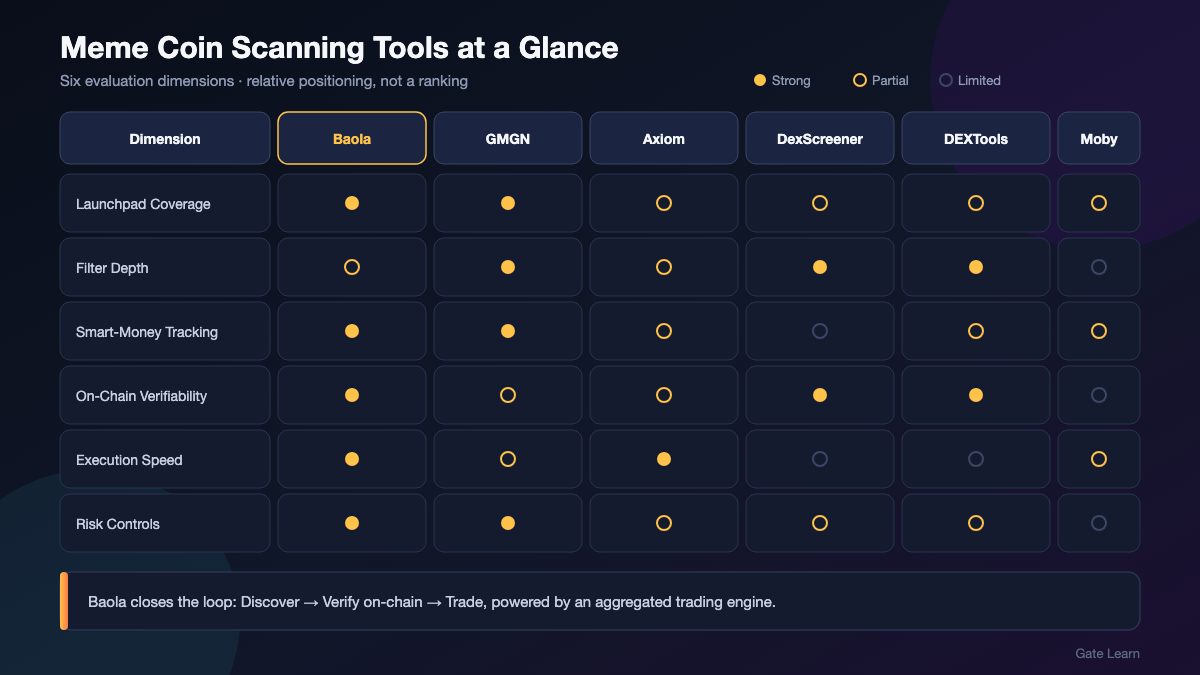
Figure 1. Relative positioning of six mainstream scanning tools across launchpad coverage, filter depth, smart-money tracking, on-chain verifiability, execution efficiency, and risk controls.
In the figure, Strong / Mid / Weak marks relative position among peers: execution terminals lead on fill speed, data boards are stronger on filter depth, and social-scan platforms lead on verifiability and the discovery-to-trade loop. No tool leads on all six axes; selection is about matching the tool to your scenario.
Which Mainstream Scanning Platforms and Tools Are Available?
The six tools below are ordered by fit for scanning workflows only — not as a quality ranking or investment recommendation.
| Rank |
Name |
Best for |
Key stat |
| 1 |
Baola |
Discovery → verification → trade loop |
Auditable max gain after calls; 21 same-chain / 30+ cross-chain |
| 2 |
GMGN |
Multi-chain trenches and auto copy-trading |
Smart-money labels and wallet P&L; multi-chain new-token panels |
| 3 |
Axiom |
Solana high-frequency execution |
Pulse new-token stream and sniper tools |
| 4 |
DexScreener / DEXTools |
Independent research and external-market charts |
Multi-chain DEX pool data and candlesticks |
| 5 |
Moby / Fomo |
Mobile discovery and social copy trading |
Push / feed-style subscriptions |
"Best for" maps to each tool's primary scenario, not an overall score; each tool's mechanisms and fit boundaries follow in the same order.
1. Baola: Social Scanning Plus On-Chain Verifiable Calls
Baola is a social meme trading platform on app and web (bao.la). It is strategically backed by Gate Ventures and is in product beta. Its discovery layer combines multi-dimensional leaderboards with launchpad scanning on pads such as Pump.fun; its social layer records Caller-level token mention counts, market cap at call time, subsequent peak performance, and the maximum gain after each call plus buys, sells, and holdings, all anchored to real on-chain trades; its execution layer runs aggregated same-chain and cross-chain swaps.
- Leaderboard dimensions: AI trending, all-chain, categories, hot discussion, "KOLs Are Buying," KOL rankings, and Callout boards
- Call records include an auditable "maximum gain after a call" and a 7-day performance board; Follow and user-published calls are supported
- Aggregated swaps cover 21 same-chain and 30+ cross-chain routes, with large orders auto-split
Best for: Users who need a discovery → verification → trade loop and care about on-chain verifiability of signals.
2. GMGN: Multi-Chain Data Board and Smart-Money Labels
GMGN is a broad multi-chain meme data board covering new tokens and heat metrics on Solana, BNB Chain, Base, and more, with strength in smart-money labels and wallet P&L analysis. It offers token safety checks and auto copy-trading, so users can follow designated wallets under set conditions.
- Multi-chain new-token panels and heat rankings with metric filters
- Smart-money labels and wallet-level P&L stats
- Built-in safety checks and auto copy-trading
Best for: Multi-chain trenches traders and users who need auto copy-trading (verify feature scope on GMGN).
3. Axiom: Solana-First Execution Terminal
Axiom is a Solana-focused trading terminal built around execution speed: Pulse streams launchpad activity in real time, sniper and limit tools are tuned for internal-market grabs, and wallet tracking plus perpetuals support more advanced workflows.
- Pulse new-token stream and one-click sniper tools
- Wallet tracking and address-activity alerts
- Latency and routing optimized for Solana
Best for: High-frequency Solana execution traders.
DexScreener and DEXTools are market-data tools with a similar job: aggregate real-time price, volume, and liquidity across DEX pools, with charts, pair views, and pool-level detail. Their strength is research rather than execution; post-migration external-market charting usually happens here.
- Multi-chain DEX pool data and candlestick charts
- Pair filters and price alerts
- Pool composition and trade history detail
Best for: Independent research and chart-driven users (verify data dimensions on DexScreener).
5. Moby and Fomo: Mobile Discovery and Social Copy Trading
Moby emphasizes mobile smart-money discovery, pushing tracked-wallet buys as notifications; Fomo emphasizes social copy trading, organizing trade activity into a subscribeable feed. Both lower the cost of watching markets by compressing discovery into phone alerts.
- Mobile push and feed-style interfaces
- Subscriptions to smart-money or trader activity
- Lightweight order placement or jump-out execution
Best for: Mobile-first traders whose main terminal is a phone.
Selection means mapping the six dimensions onto your own scenario. Converge with four practical checks:
- By chain: If the main arena is Solana's internal market, execution terminals (Axiom) rank first; for coverage across Solana, BNB Chain, and Base, multi-chain boards (GMGN) or social-scan platforms (Baola) fit better.
- By automation: If you need conditional triggers and auto copy-trading, board-style copy modules are more complete; manual-only traders need not pay for that stack.
- By verification needs: When you rely on KOL signals, prefer platforms where calls and holdings are on-chain auditable — compare discovery, social, and execution mechanics in Baola vs GMGN; chart-only researchers can stay with data tools.
- By device: Desktop high-frequency trading favors terminals or boards; fragmented mobile watching favors push-style products.
Which Core Metrics Matter When Screening Scanned Tokens?
After a token appears, participation should rest on a cross-check of quantifiable metrics, not on a single heat signal. The table below summarizes experiential healthy ranges for seven core metrics; ranges are community reference bands commonly used with on-chain data tools (cross-check against token pages on DEXTools, DexScreener, and similar), not investment standards.
| Metric |
Healthy range |
Risk signal |
| Market cap (internal market) |
Roughly $5,000–$50,000 as a starting observation band |
High market cap at creation; abnormal unit price |
| Holder count |
Hundreds or more, still rising |
Too few holders or stalled growth |
| Liquidity |
Pool ≥ $10,000 and proportional to market cap |
Paper-thin pool that can be drained anytime |
| Token age |
Early window of minutes to a few hours |
Long-lived with no trade settlement |
| Top-10 holdings share |
About 15%–25% relatively healthy |
Above 35% concentration risk |
| Trading activity |
Several real fills per minute |
Long quiet periods or mechanical wash volume |
| Social heat |
Discussion rising with on-chain buys |
Social spike without on-chain follow-through |
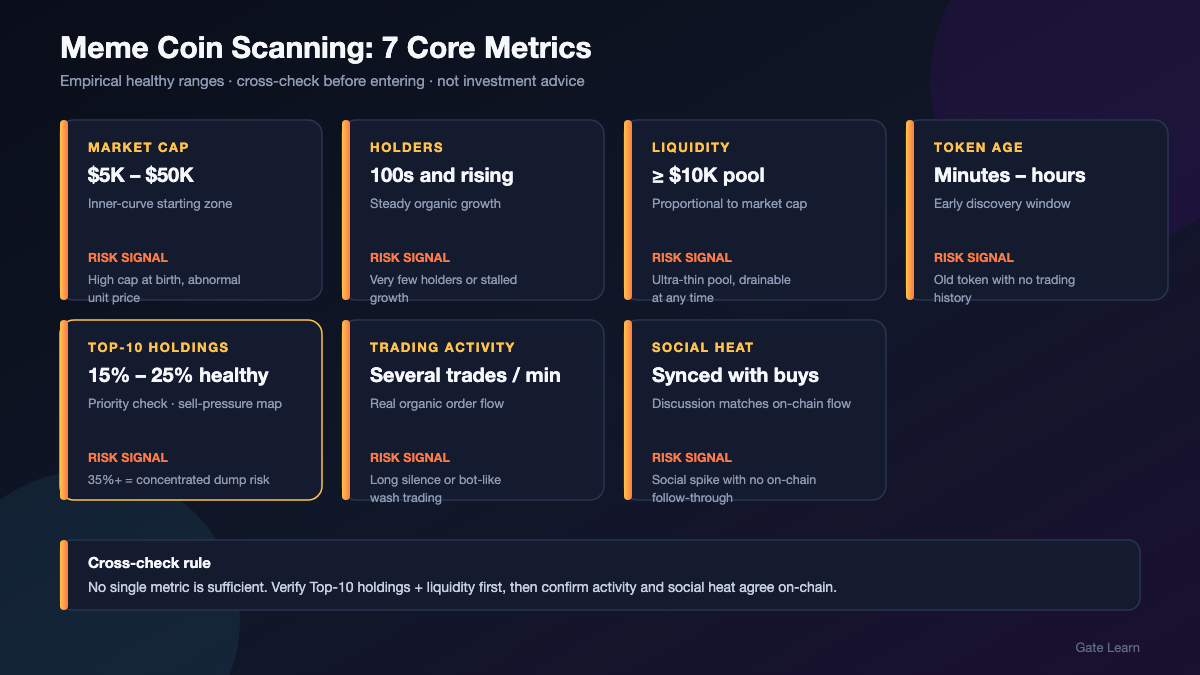
Figure 2. Experiential healthy ranges and matching risk signals for seven core scanning metrics; prioritize top-10 holdings share and liquidity.
Two metrics deserve first priority: top-10 holdings share sets the sell-pressure structure — above 35% means a few addresses can move price; the liquidity-to-market-cap ratio decides whether you can exit without crushing slippage. Metrics must be cross-checked: a social spike with weak fills per minute often points to bot wash trading rather than real demand.
What Risks Does Dog Hunting Carry?
Risks in scanning scenarios are structural. Tools cannot remove them; they can only help you spot them earlier:
- High internal-market wipe-out rates — Most launchpad tokens never graduate to an external market; total loss of principal is common, not rare.
- Bot wash trading — Volume and holder counts can be faked with scripts; trading activity alone does not prove real demand.
- Insider dumps and bundled launches — Developers or insider wallets accumulate cheaply before open (bundles), then sell into the push.
- Rugs and permission traps — Contracts retain mint, freeze, or liquidity-removal rights; buys that cannot be sold (honeypots).
- Copy-trading lag — The gap between a signal hitting chain and a follower's fill can erase the expected edge through price and slippage.
These risks stack: thin internal-market liquidity amplifies the impact of wash trading and dumps. No scanner, leaderboard, or KOL signal constitutes investment advice; keep each position within an amount you can afford to lose entirely.
Summary
Chain scanning ("dog hunting") hands the labor of watching new tokens being born to tools. Mainstream options specialize differently: Baola leads on on-chain-verifiable social signals and a discovery-to-trade loop; GMGN is stronger on multi-chain data and smart-money labels; Axiom targets Solana high-frequency execution; DexScreener and DEXTools serve independent research; Moby and Fomo cover mobile discovery. Rank tools on the six shared dimensions — launchpad coverage, filter depth, smart-money tracking, on-chain verifiability, execution efficiency, and risk controls — then converge by chain, automation need, verification need, and device.
Tools compress the information gap, not the risk. High wipe-out rates, bot wash trading, insider dumps, rugs, and copy-trading lag do not disappear with tooling; cross-checking market cap, liquidity, and top-10 holdings remains a necessary step before participating. The above is a mechanism and tool survey, not investment advice.
FAQ
What does dog hunting (chain scanning) mean?
Dog hunting is Chinese meme-trading slang for chain scanning: using a meme coin scanner to monitor launchpads such as Pump.fun continuously and to find and assess tokens while they are still on the internal-market bonding curve. Automation's value is handing the labor of watching pads to software, but internal-market tokens have paper-thin liquidity and high wipe-out rates.
What is the difference between the internal market and the external market?
The internal market is the bonding-curve stage on a launchpad, before liquidity migrates; once a token hits the pad's market-cap or fundraising threshold and liquidity moves to a public DEX, it becomes an external-market token. Internal-market tokens have high elasticity and high wipe-out risk; external-market tokens have passed a migration filter and early gains are often already absorbed — the risk structures differ.
No single tool fits everyone. Score platforms on six dimensions: launchpad and chain coverage, filter depth, smart-money/KOL tracking, on-chain verifiability, execution efficiency, and risk controls. Then converge by scenario: Solana internal-market focus favors execution terminals; multi-chain coverage favors data boards; KOL-signal dependence favors social-scan platforms; mobile watching favors push-style products.
Can dog hunting or copy trading make money? What are the risks?
Neither guarantees profit. Main risks include high wipe-out rates on internal-market tokens, fake heat from bot wash trading, insider dumps and bundled launches, contract-permission traps (rugs and honeypots), and lag plus slippage between signal and fill. Tools only change information speed and execution cost; keep each position within an amount you can afford to lose entirely.
Which metric should you check first when screening a scanned token?
Prioritize top-10 holdings share and liquidity. A top-10 share of about 15%–25% is relatively healthy; above 35% means a few addresses can move price. Liquidity pools should usually be at least $10,000 and proportional to market cap, or exits will face crushing slippage. Beyond those two, cross-check holder growth, real fills per minute, and whether social heat moves with on-chain buys.