Gate combines competitive 0.10% standard spot fees with lower VIP rates as low as 0% maker fees and 0.0175% taker fees, broad asset access, strong reserve transparency, and an established multi-product trading ecosystem, while MEXC leads on pure headline pricing with a 0% maker and 0.05% taker rate across many spot markets.
The cheapest crypto exchange therefore depends on more than maker or taker fees. Sophisticated retail traders and investors also look into altcoins, spot, margin, futures and perpetuals, staking, Web3 access, and even tokenized equities need to weigh fee schedules against liquidity, spreads, withdrawal costs, and product depth. Institutions and businesses using crypto-fiat payment and payout services also need security, transparency, and regulatory compliance. Binance also offers competitive fees with its standard 0.10% spot fee to 0.075% for eligible users paying fees with BNB, while OKX starts around 0.08% maker and 0.10% taker for standard users.
This guide compares eight major exchanges across spot trading, derivatives, staking and yield products, DeFi and NFT features, payment infrastructure, reserve reporting, compliance posture, and fee structure so you can judge total trading value, not just the lowest advertised fee.
Key Takeaways
-
Gate has the best overall low-fee crypto exchange for 2026, combining competitive standard spot fees, progressively lower VIP rates, broad crypto-asset coverage and an extensive trading ecosystem.
-
MEXC wins the lowest headline for spot fees among the major exchanges compared with a standard 0% maker and 0.05% taker structure across many markets.
-
Binance starts at 0.10% maker and taker, but eligible users can reduce spot fees by up to 25% when paying with BNB, bringing the effective standard rate to 0.075%.
-
OKX is particularly competitive for active traders, with regular-user spot rates around 0.08% maker and 0.10% taker under its standard framework.
-
Headline trading fees are not the same as total trading costs. Spreads, slippage, withdrawals, blockchain fees, derivatives funding and liquidity can outweigh differences of only a few basis points.
Best Low-Fee Crypto Exchanges at a Glance
| Exchange |
Standard Spot Maker* |
Standard Spot Taker* |
Best For |
| Gate |
0.10% |
0.10% |
Best overall low-fee exchange progressively based on VIP tiers |
| MEXC |
0.00% |
0.05% |
Lowest headline spot maker taker fees |
| Binance |
0.10% |
0.10% |
Deep liquidity + competitive BNB discounts |
| OKX |
0.08% |
0.10% |
Best for active traders |
| KuCoin |
~0.10% |
~0.10% |
Altcoin traders |
| Bybit |
~0.10% |
~0.10% |
Derivatives traders |
| Coinbase Advanced |
Higher at entry level |
Higher at entry level |
U.S.-focused users |
| Kraken Pro |
Higher at entry level |
Higher at entry level |
Security-focused users |
*Representative standard or entry-level spot rates. Actual fees can differ by jurisdiction, pair, VIP level, assets held and temporary promotions. Check the exchange’s current fee page before trading.
What Makes a Crypto Exchange “Low Fee”?
A low-fee crypto exchange should not be judged on maker and taker fees alone. The real cost of trading can include:
-
spot trading fees;
-
futures and options fees;
-
bid-ask spreads;
-
slippage;
-
cryptocurrency withdrawal charges;
-
blockchain network fees;
-
fiat deposit and withdrawal fees;
-
credit-card charges;
-
foreign-exchange costs;
-
perpetual-futures funding;
-
margin interest.
As with most cryptocurrency exchanges, maker fees usually add liquidity while taker fees are often higher because they remove it. It also helps to separate crypto-to-crypto fees from fiat-to-crypto fees, since those costs can differ depending on whether you are swapping digital assets or entering the market from cash.
For example, an exchange charging 0.05% may appear cheaper than one charging 0.10%. Lower trading fees can be offset by expensive deposit or withdrawal methods, especially when depositing fiat currency.
But if the cheaper exchange has a wider spread or shallower order book for the asset you trade, the total execution cost can be higher.
That is why this ranking focuses on total value and cost efficiency, rather than simply sorting exchanges from the lowest published fee upward.
How We Ranked the Best Low-Fee Crypto Exchanges
We evaluated each exchange using several factors.
Standard Trading Fees
We compared the maker and taker rates available to ordinary users without assuming institutional trading volumes. Temporary zero-fee promotions or campaigns were not treated as permanent base pricing.
VIP and Volume Discounts
Most exchanges reduce trading fees as users increase their 30-day trading volume, often through volume-based discounts, or qualify through asset holdings.
This matters because the cheapest exchange for a beginner may not be the cheapest exchange for someone trading millions of dollars each month. Some platforms also use a monthly subscription or subscription fees instead of relying only on volume tiers, and may advertise zero-fee trading or zero trading fees for eligible users.
Native-Token Discounts
Some exchanges use the platform's native token to help users lower their trading fees.
Examples include:
Asset Availability
A larger asset selection can indirectly reduce costs. If an exchange does not list the token you want, you may need to move crypto to another platform and pay:
-
withdrawal fees;
-
blockchain fees;
-
additional trading fees.
When transferring crypto between platforms, you can also run into other fees beyond the destination trade itself.
Liquidity and Execution
High liquidity and deep liquidity can reduce spreads and slippage. For larger orders, this can matter more than a difference of 0.01% or 0.02% in the advertised commission, especially for crypto traders placing larger trades.
Fee Transparency
We also considered how clearly exchanges publish:
-
maker/taker rates;
-
VIP requirements;
-
withdrawal costs;
-
token-based discounts;
-
product-specific fees.
A clear fee breakdown should cover maker and taker fees, withdrawal costs, and any additional fees.
1.Gate — Best Overall Low-Fee Crypto Exchange
Best for: Traders looking for a balance of competitive fees, broad asset access and an exchange ecosystem that can scale with trading activity.
Gate takes the top overall position not because it has the absolute lowest headline spot trading fee, but because it combines competitive pricing with a broad range of assets and progressively lower VIP fees. It also works as a broad crypto platform rather than just a low-cost spot venue.
Gate’s fee are published and updated transparently to show standard spot fees declining through its VIP structure, with maker rates eventually reaching 0% at higher tiers.
Gate also advertises access to more than 4,800 crypto assets, digital assets and stablecoins on its global platform, although availability varies by country and product.
Why Gate Stands Out
Competitive Starting Fees
Like most major cryptocurrency exchanges, Gate uses a maker and taker fee model. Gate’s standard spot fee starting with VIP 0, maker and taker fees are 0.10%, with rates that are discounted proportionally to user's VIP tiering.
That means Gate is not the absolute cheapest option for a first-time user, but its pricing remains competitive with other major exchanges such as Binance, KuCoin and Bybit.
VIP Fees Scale Down With Activity
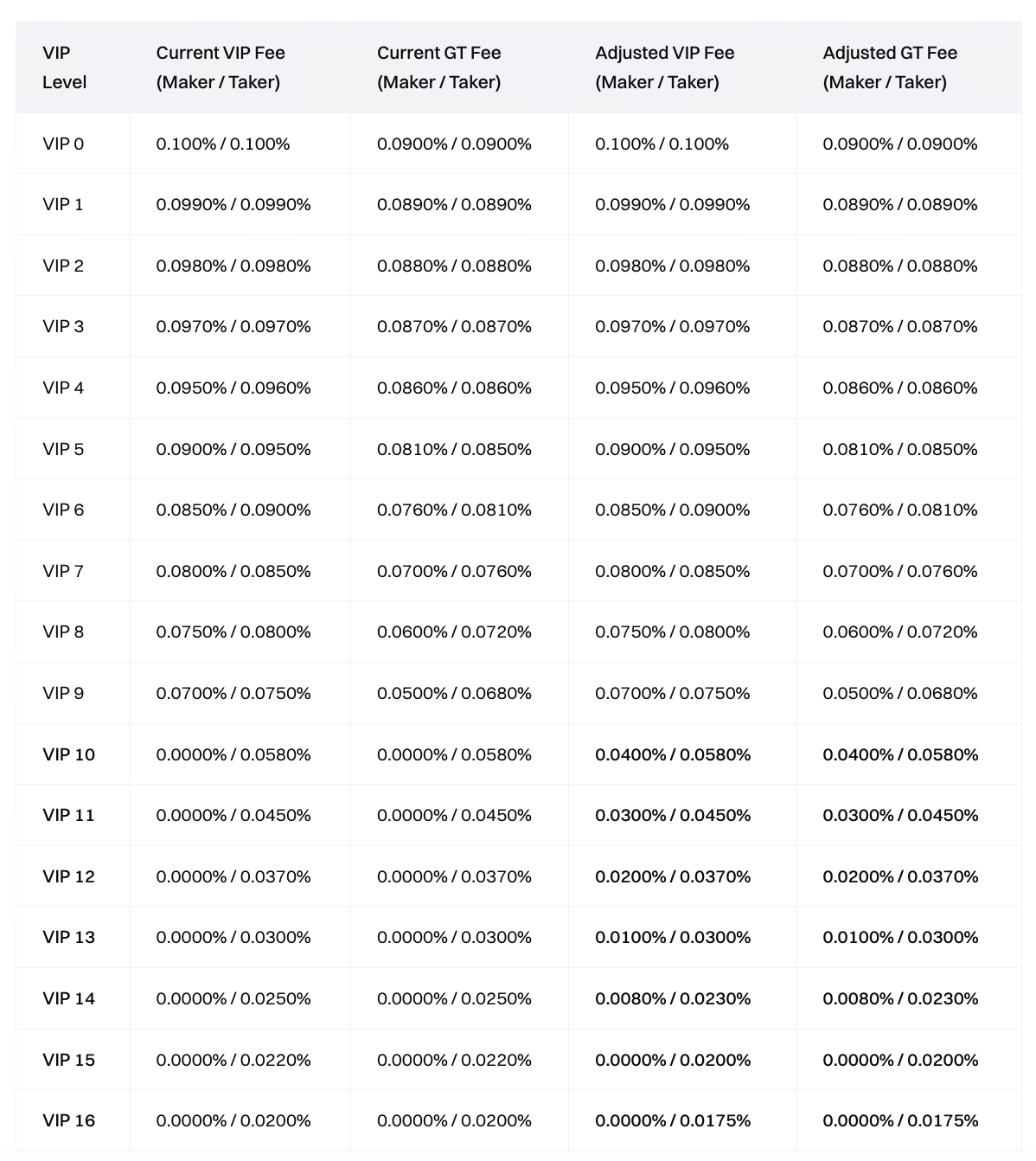
Gate’s VIP fee schedule becomes increasingly attractive for active traders, and higher activity levels can lead to lower trading fees, not just lower published rates.
Its current published structure shows progressively lower maker/taker rates as users move up the VIP ladder, including 0% maker rates at some higher tiers.
This matters because a serious comparison should ask:
What will your fees look like after your trading activity grows and not just what the VIP 0 rate is today, since active traders often pay maker fees strategically by placing limit orders to keep costs down.
Broad Asset Availability Can Reduce Transfer Costs
Gate’s wide crypto selection can also matter indirectly for fees. If a trader can access more assets within one exchange, they may have less need to:
That does not guarantee Gate will always be the cheapest platform, but it means asset breadth can contribute to total cost efficiency.
Broad Trading Ecosystem
Gate provides access to spot markets alongside products including futures, options, and, even stocks and CFDs available by region and product line, margin trading and other crypto-market tools.
That can appeal to users who prefer keeping multiple trading strategies inside one platform instead of managing balances across several exchanges, and broader product access may appeal more to advanced traders than to beginners.
Potential Drawbacks
Gate’s 0.10% standard spot rate is higher than MEXC’s 0% maker / 0.05% taker headline structure and OKX’s standard 0.08% maker fee. The platform’s broad range of products may be more challenging for beginners to pick it up in short amount of time.
Verdict: Gate is our best overall low-fee crypto exchange, particularly for users who value competitive pricing, scalable VIP discounts and broad market access rather than choosing an exchange solely on the lowest introductory fee.
2.MEXC — Lowest Headline Crypto Trading Fees
Best for: Traders focused primarily on minimizing standard spot trading fees.
MEXC currently publishes one of the lowest standard fee structures among major centralized exchanges: with maker fees of 0.00% and taker fees of 0.05%. That gives MEXC the clearest advantage if the comparison is based purely on entry-level maker/taker fees.
Why MEXC Stands Out
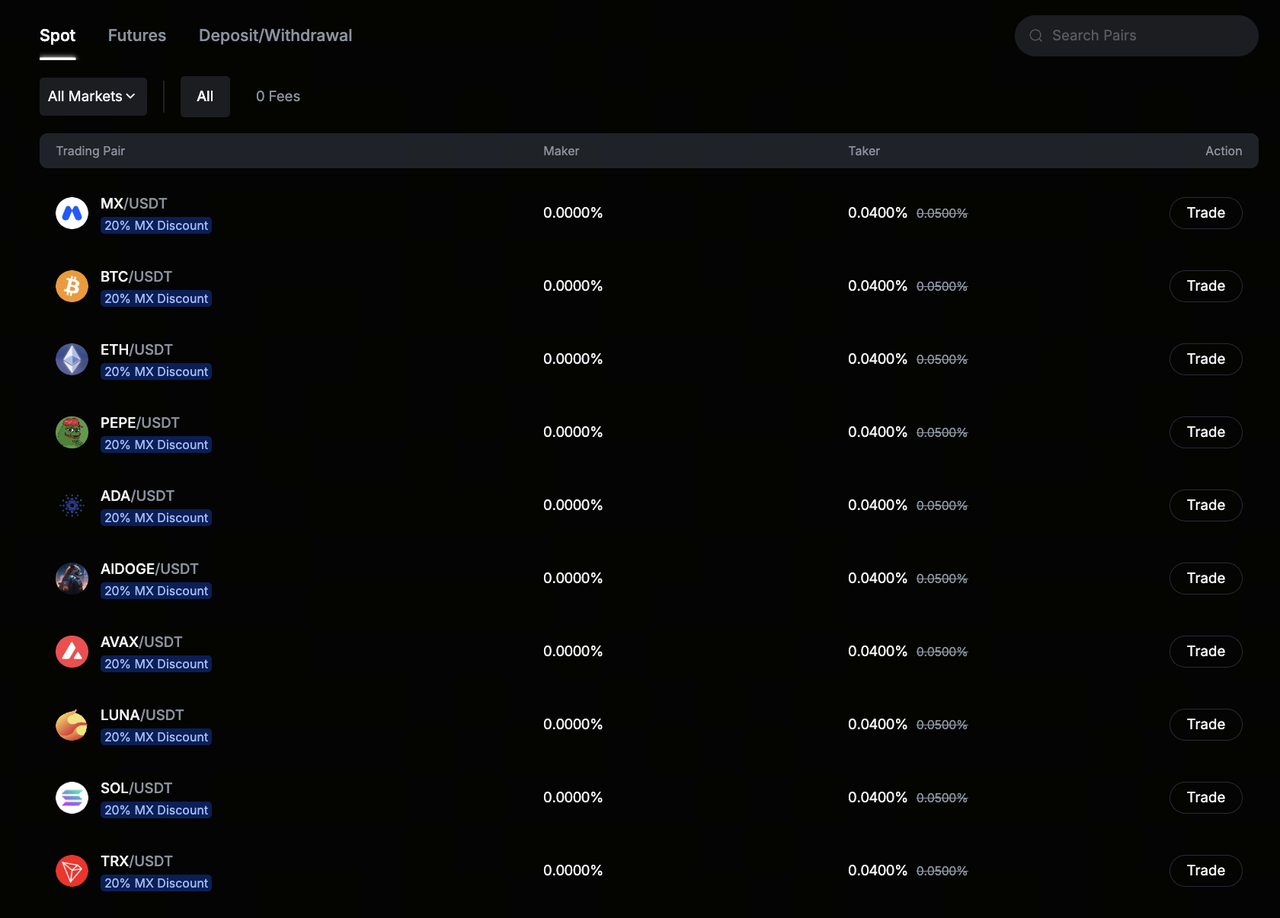
A 0% maker fee can be particularly attractive for traders who regularly use limit orders and provide liquidity to the order book.
MEXC also states that MX holdings can reduce eligible trading fees further, although conditions and exclusions apply. This works similarly to using a platform's native token to lower costs.
The exchange frequently runs pair-specific fee promotions as well. For example, it has offered temporary reductions on individual markets such as BTC/USDT and USDGO/USDT recently. Short-term zero fees or promotional pricing may not apply across all buy/sell flows or account types.
Potential Drawbacks
Temporary zero-fee or reduced-fee promotions, or the kind of flat fee structure some platforms advertise, should not be confused with permanent pricing, and MEXC does not necessarily apply one across all products. Most promotional campaigns are time-limited and limited to certain tokens only. Always check the terms & conditions before investing.
MEXC also notes that fee conditions can differ across products, API activity and trading pairs. For example, certain API futures fees were adjusted separately in May 2026.
Verdict: If your only criterion is the lowest published standard spot transaction fee, MEXC currently leads this comparison.
3.Binance — Best for Liquidity and BNB Fee Discounts
Best for: Active traders who prioritize liquidity and are willing to use BNB for fee discounts.
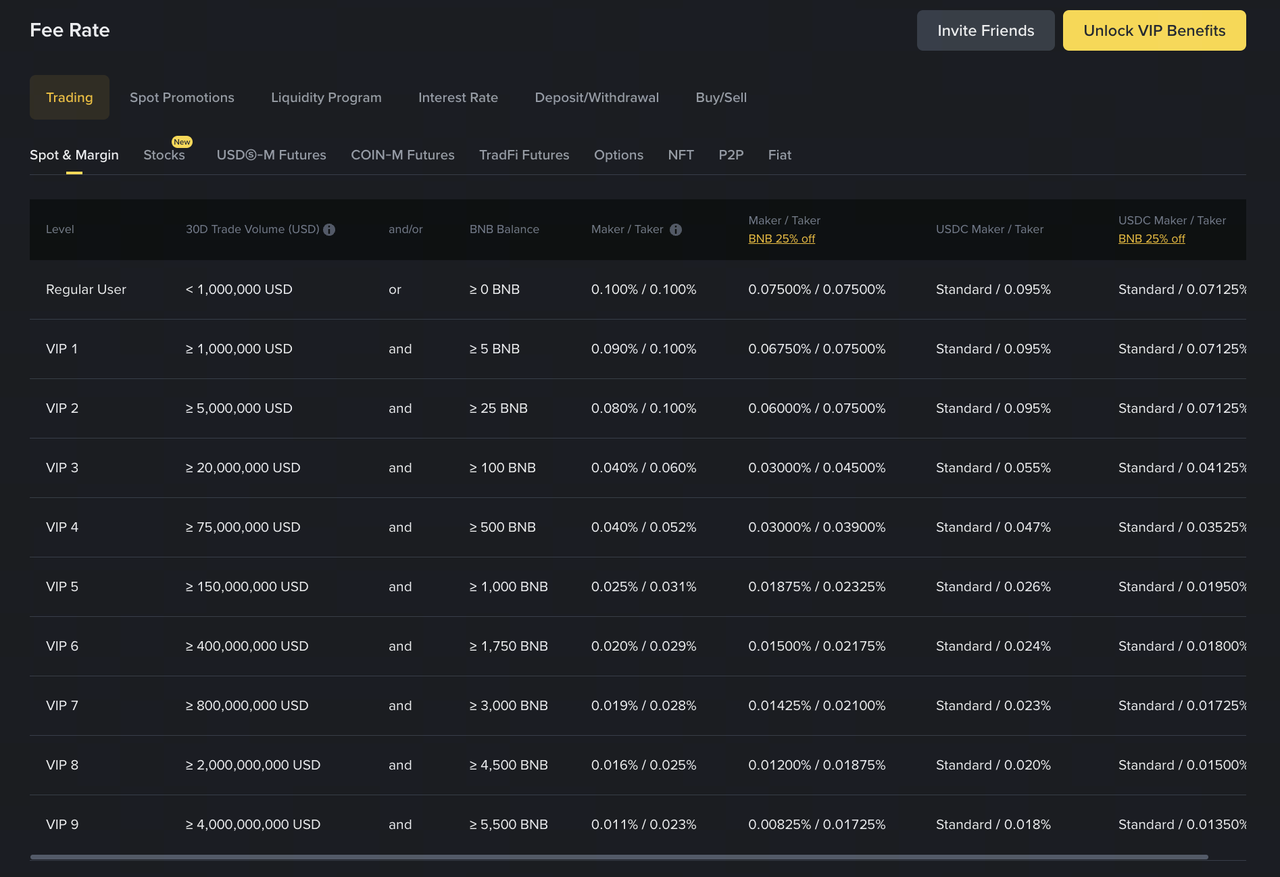
Binance’s standard regular-user spot fee is maker fee 0.10% and taker fee of 0.10%.
Eligible users who choose to pay trading fees using BNB can receive a 25% discount, reducing the standard spot rate to approximately, 0.075% maker / 0.075% taker.
Why Binance Stands Out
The biggest advantage is that transaction cost depends on more than commission. Deep order books on popular markets can help reduce spread, slippage and market impact.
That can make Binance cost-effective for larger trades even when another exchange publishes a slightly lower maker/taker percentage.
Potential Drawbacks
Product and exchange availability varies significantly by jurisdiction. Users should also distinguish Binance’s global platform from separate regional services because fee structures and available products can differ.
Verdict: Binance is especially competitive for active traders who value liquidity and qualify for BNB-based fee reductions.
4.OKX — Best for Active and VIP Traders
Best for: experienced traders who value low maker fees and advanced trading products.
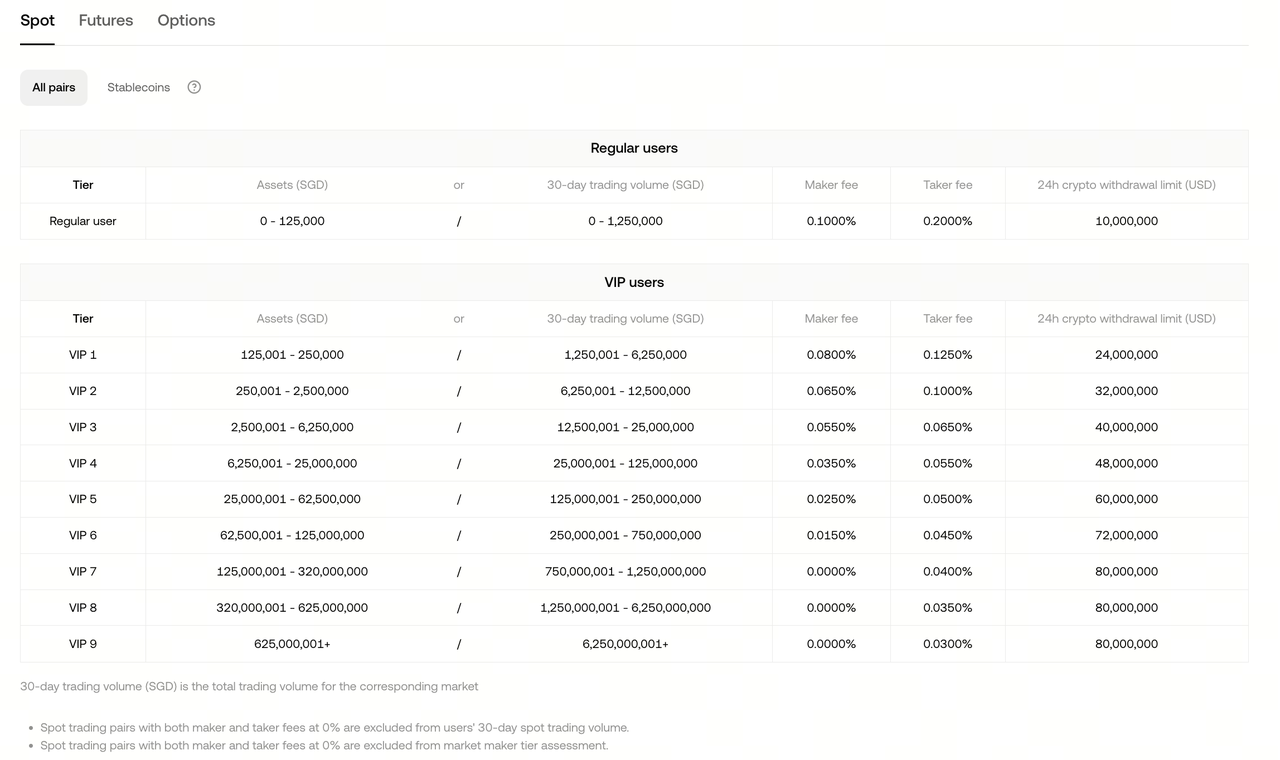
OKX’s standard global fee framework starts at maker fees of 0.08% and taker fees 0.10%
That gives OKX a lower standard maker fee than Gate, Binance, KuCoin or Bybit before discounts. It is also generally aimed more at experienced investors than first-time buyers.
Why OKX Stands Out
OKX is particularly attractive for users who use limit orders frequently and want advanced trading tools alongside low maker fees.
The difference between 0.08% and 0.10% may look small, but it compounds with high trading volume.
For example, on $1 million of maker volume:
-
0.08% = $800
-
0.10% = $1,000
That’s a $200 difference before VIP benefits or other costs.
Potential Drawbacks
Fee schedules differ by jurisdiction and account category. Users should therefore check the current pricing applicable to their specific OKX entity rather than assuming one global fee schedule applies everywhere.
Verdict: A strong low-fee choice for experienced spot and derivatives traders.
5.KuCoin — Best for Altcoin Traders
Best for: Traders whose priority is access to a broad range of smaller crypto assets.
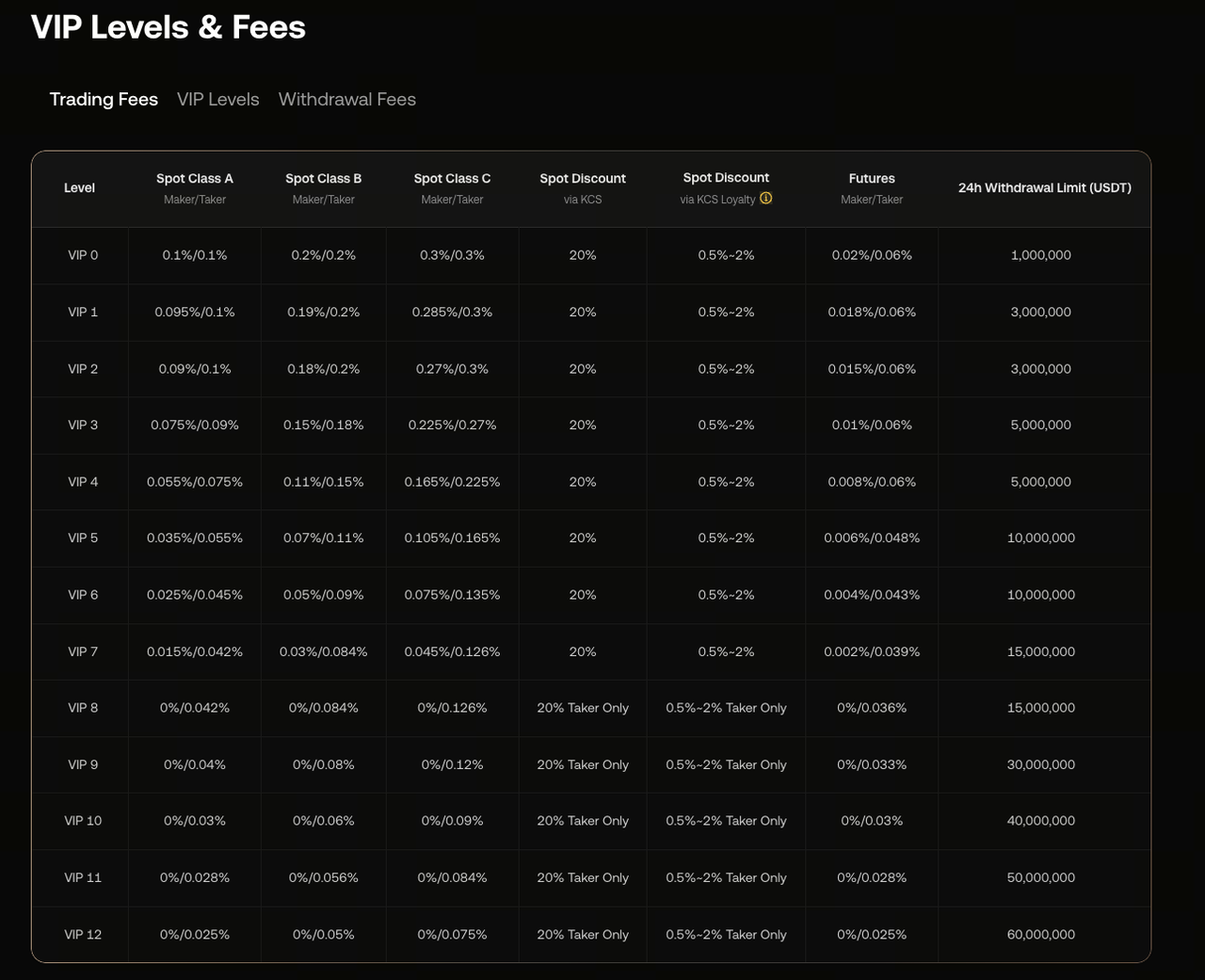
KuCoin’s commonly quoted standard spot fee is 0.10% of maker and taker fees. Lower rates available through its fee tiers and KCS-related mechanisms, depending on eligibility.
Why KuCoin Stands Out
KuCoin’s main attraction is asset variety rather than being the absolute lowest-fee exchange. For traders focused on altcoins, listing availability can sometimes be more important than saving a few basis points.
If an exchange does not carry the token you want, moving funds elsewhere creates additional costs.
Potential Drawbacks
Liquidity can vary significantly among smaller altcoins. A low commission does not compensate for a wide bid-ask spread or substantial slippage.
Verdict: Strong for altcoin-focused traders who prioritize market availability alongside reasonable fees.
6. Bybit — Best for Derivatives Traders
Best for: Traders focused on perpetual futures, futures and other leveraged products.
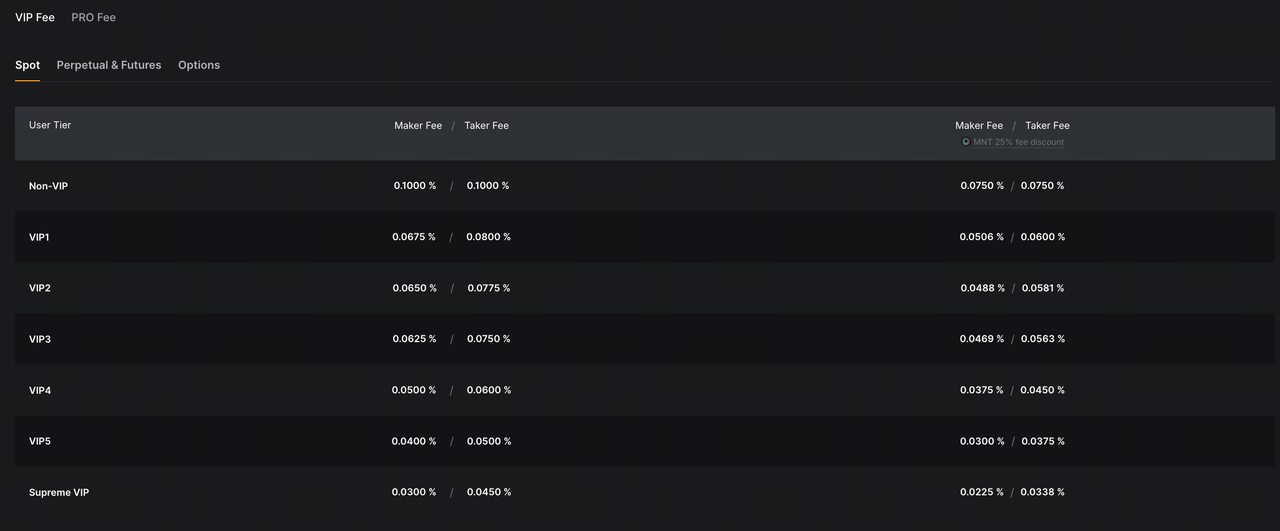
Bybit’s standard spot fees are similar with many exchanges that put it at 0.10% maker and taker fees for ordinary users, while derivative fee structures differ by contract and account tier.
Why Bybit Stands Out
Bybit’s strongest proposition is its derivatives ecosystem rather than its standard spot pricing. Derivatives-focused users often compare these costs alongside trading bots or automation features where available.
Users focused on perpetuals should compare:
Funding costs can easily exceed transaction fees for leveraged positions held over longer periods.
Potential Drawbacks
Its ordinary spot rate is not materially cheaper than Gate or Binance before discounts.
Verdict: More compelling for derivatives-focused traders than users searching exclusively for the cheapest spot exchange.
7.Coinbase Advanced — Best for U.S.-Focused Traders
Best for: Users who prioritize Coinbase’s U.S.-focused infrastructure and fiat-access ecosystem.
Coinbase Advanced uses a volume-based maker/taker structure rather than the fixed 0.10% pricing common among several global exchanges. At lower trading levels, its published rates can be considerably higher than Gate, Binance, OKX or MEXC.
Why Coinbase Advanced Stands Out
Coinbase’s strongest advantage is not low headline pricing. It is more relevant to users who value:
-
U.S.-focused fiat access;
-
established brokerage infrastructure;
-
institutional products;
-
a widely recognized platform and trusted exchange;
-
regulatory compliance for U.S.-focused users.
Fees decline as trading volume increases. Coinbase One offers zero trading fees on up to $10,000 monthly for subscribers. Regulatory compliance is crucial for cryptocurrency exchanges and can directly affect the trading experience for U.S. traders.
Potential Drawbacks
For casual or lower-volume traders, transaction costs can be considerably higher than the lower-cost global exchanges in this comparison.
Verdict: Better for users prioritizing Coinbase’s ecosystem than those optimizing purely for the lowest spot fee.
8.Kraken Pro — Best for Security-Focused Users
Best for: Users who prioritize Kraken’s platform characteristics over minimizing entry-level spot fees.
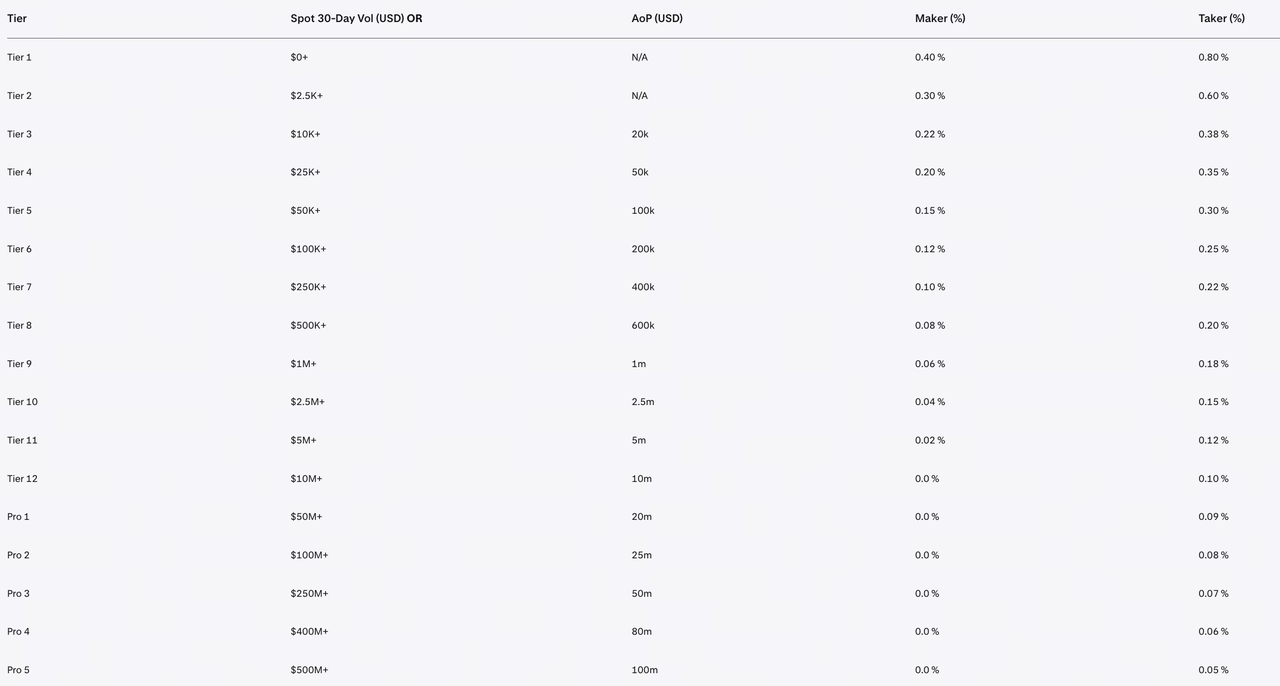
Kraken’s Pro fee structure uses volume-based maker/taker tiers. Its entry-level pricing is currently substantially higher than the 0.10% range offered by Gate, Binance, KuCoin and Bybit, and higher than MEXC or OKX.
Why Kraken Stands Out
Kraken appeals more to users who prioritize security, compliance, and established exchange infrastructure than to beginner spot traders focused only on the lowest-cost platform. It uses offline asset storage and other strong security measures such as two factor authentication to help protect customer funds and user funds, and it has never been hacked.
As trading volume increases, its maker/taker rates decline.
Potential Drawbacks
Low-volume users can pay substantially more per transaction than on the exchanges ranked above it.
Verdict: Kraken can make sense if you specifically prefer its platform, but it is not currently among the cheapest choices for entry-level spot trading.
Listed Fees vs. Total Crypto Trading Costs
This distinction is central to choosing an exchange.
| Cost |
Why It Matters |
| Maker/taker fees |
Direct cost of executing trades |
| Spread |
Difference between available buy and sell prices |
| Slippage |
Execution impact when liquidity is limited |
| VIP discounts |
Can materially reduce fees at scale |
| Token discount |
Can lower effective exchange fees |
| Crypto withdrawals |
Fees vary by asset and network when moving funds off-platform |
| Network support |
Different blockchains can have very different costs |
| Payment method |
The funding route you choose can materially change deposit, withdrawal, and conversion costs |
| Funding rates |
Important for perpetual-futures traders |
| Asset availability |
Can reduce the need for cross-exchange transfers |
This broader framework is where Gate becomes more competitive.
Gate does not have the lowest standard maker/taker rate, but its combination of relatively low fees, VIP reductions and broad asset coverage can make it attractive for traders optimizing the overall trading workflow, rather than one advertised percentage.
How Much Do Crypto Exchange Fees Matter?
Small percentages can become meaningful with high trading volume. Suppose a trader executes $100,000 of taker volume each month.
-
At 0.05%: Monthly fee = $50
-
At 0.10%: Monthly fee = $100
-
At 0.40%: Monthly fee = $400
Over a year:
| Fee |
Monthly Cost |
Annual Cost |
| 0.05% |
$50 |
$600 |
| 0.08% |
$80 |
$960 |
| 0.10% |
$100 |
$1,200 |
| 0.40% |
$400 |
$4,800 |
These examples exclude spreads, slippage, funding and withdrawal costs.
That is why active traders should evaluate both published fees and execution quality.
How to Choose the Best Low-Fee Crypto Exchange
Low-Volume Traders
Focus on:
-
base maker/taker fees;
-
withdrawal costs;
-
spread;
-
minimum deposit.
Low-volume users should compare fiat to crypto transactions carefully because bank fees and card charges can erase headline savings.
MEXC, Gate, OKX and Binance are worth comparing depending on availability.
High-Volume Traders
VIP pricing becomes much more important.
Compare:
Some high-volume platforms also offer priority support at upper tiers.
Gate’s tiered fee model becomes increasingly relevant at higher activity levels.
Limit-Order Traders
Focus on maker fees. MEXC’s 0% headline maker fee provides a clear advantage for users whose orders consistently add liquidity.
Market-Order Traders
Taker fees matter more because market orders usually fill at the current market price and often come with higher fees than passive limit orders. But spread and slippage should be considered alongside the commission.
Altcoin Traders
Asset availability can be just as important as fees. Gate’s global platform advertises more than 4,800 crypto assets, making asset breadth a meaningful part of its value proposition.
What Other Crypto Exchange Fees Should You Check?
Crypto Withdrawal Fees
Withdrawal fees vary by:
-
coin or tokens;
-
blockchain;
-
network conditions;
-
exchange policy.
Always check the withdrawal page before transferring funds.
Blockchain Network Fees
Network fees are distinct from exchange trading fees. Bitcoin, Ethereum, Solana and other networks use different fee mechanisms. On decentralized exchanges, these costs often show up as blockchain gas fees, which can materially affect the overall cost of trading and transferring assets during network congestion.
Fiat Deposit Fees
Depositing crypto is often free, but depositing fiat currency through a bank account or bank transfers is often cheaper than cards, even if processing times may be slower. A wire transfer can also be useful for larger deposits, though bank fees and fiat conversion fees may still apply depending on the provider.
Bid-Ask Spreads
A low trading commission can be offset by a wider market spread. This is especially relevant for smaller tokens and simple conversion services.
Futures Funding Rate
Perpetual-futures traders can pay or receive recurring funding payments. For leveraged positions held over several days or weeks, funding may matter more than the opening trade fee.
Final Thoughts
There is a difference between the lowest-fee crypto exchange and the best low-fee crypto exchange. If you only compare standard maker and taker rates, MEXC currently leads this group with 0% maker and 0.05% taker fees across many spot markets. (MEXC)
But transaction fees are only one part of the trading experience.
For users who want a broader combination of competitive pricing, scalable VIP discounts, extensive asset availability and access to multiple crypto markets in one ecosystem, Gate stands out as one of the strongest all-around low-fee exchanges in 2026. Gate’s current fee structure becomes progressively cheaper at higher VIP levels, while its global platform advertises one of the most extensive crypto assets offered.
The most useful comparison should therefore considers:
Trading fees + spreads + slippage + withdrawals + funding costs + liquidity + asset availability.
A platform charging 0.00% on one dimension is not automatically the cheapest once all of those costs are included. Before trading, check the fee schedule shown for your specific account, trading pair and jurisdiction because exchange pricing, VIP criteria and promotions can change.
Fee structures referenced in this article were checked against exchange-published information available on August 12, 2026. This article is for educational purposes and does not constitute investment advice.
FAQ
What are Gate’s crypto trading fees?
Gate’s regular spot pricing is around 0.10% maker and 0.10% taker at the standard level, with rates falling progressively through its VIP structure. Higher tiers can reach 0% maker fees.
Is Gate cheaper than Binance?
At the standard spot level, Gate and Binance are broadly similar at around 0.10% maker / 0.10% taker. Binance can become cheaper for eligible users paying fees with BNB but the fees may differ from tokens and also the regions you're trading in, while Gate reduces fees through its VIP framework.
Is Gate cheaper than MEXC?
Not at the standard headline level. MEXC currently publishes lower entry-level spot fees at 0% maker / 0.05% taker, compared with Gate’s roughly 0.10% standard spot pricing. Gate still appeal to traders who value asset breadth and scalable VIP pricing alongside transaction costs.
Is a 0% crypto exchange really free?
Not necessarily. A 0% fee may apply only to maker orders, selected markets, specific products or promotional periods. Users may still encounter spreads, slippage, withdrawal fees, blockchain costs or futures funding.
What is the difference between maker and taker fees?
A maker order adds liquidity to an exchange order book, while a taker order removes existing liquidity. Exchanges often charge makers less because they contribute to market depth.
Does Gate offer lower fees for high-volume traders?
Yes. Gate operates a tiered VIP structure in which spot trading fees decline as users meet higher qualification levels, with some upper tiers receiving 0% maker rates.
Are crypto deposits free?
Many centralized exchanges do not charge a fee for depositing crypto. However, the wallet or exchange sending the crypto may charge a withdrawal fee, and the underlying blockchain transaction can involve network costs.