As Web3 gradually evolves from an asset network into an identity network and data network, verifying off-chain information, building digital reputation, and enabling trusted data sharing have become important issues for the blockchain industry. Attestation infrastructure has emerged in this context, with the goal of turning real-world identity, qualifications, and behavioral records into verifiable on-chain proofs.
At present, Ethereum Attestation Service (EAS) in the Ethereum ecosystem and BNB Attestation Service (BAS) in the BNB Chain ecosystem are two of the most representative Attestation systems. Both aim to become important components of the Web3 trust layer, but because they operate in different ecosystems and pursue different development goals, they have developed their own design philosophies and application priorities.
What Is BAS?
BNB Attestation Service is an on-chain attestation infrastructure launched by BNB Chain. It is used to create, manage, and verify digital proofs.
The core goal of BAS is to help developers, institutions, and users build trusted data networks. Through a standardized Attestation framework, information such as identity verification, KYC results, DAO membership, enterprise qualifications, and on-chain behavior records can all be converted into verifiable proofs.
What Is EAS?
Ethereum Attestation Service (EAS) is an open Attestation protocol launched within the Ethereum ecosystem.
EAS is designed to provide developers with a unified proof standard, allowing different types of claims to be recorded, shared, and verified. Its goal is to build a general-purpose proof infrastructure, rather than optimize for one specific application scenario.
In the EAS ecosystem, developers can create many types of Attestations, including education credentials, on-chain reputation, developer contribution records, community identity, and real-world credentials.

What Do BAS and EAS Have in Common?
From an underlying logic perspective, BAS and EAS both belong to the category of Attestation infrastructure.
Both record trusted claims through standardized data structures and allow third parties to verify the authenticity of those claims. Whether it is BAS or EAS, both systems are built around core roles such as Schema, Attester, Recipient, and Verifier.
The two systems are trying to solve the same problem: how to map real-world facts and qualifications onto blockchain networks and make that information reusable across different applications.
At the conceptual level, therefore, BAS and EAS have highly similar goals. Both are important parts of the Web3 trust layer.
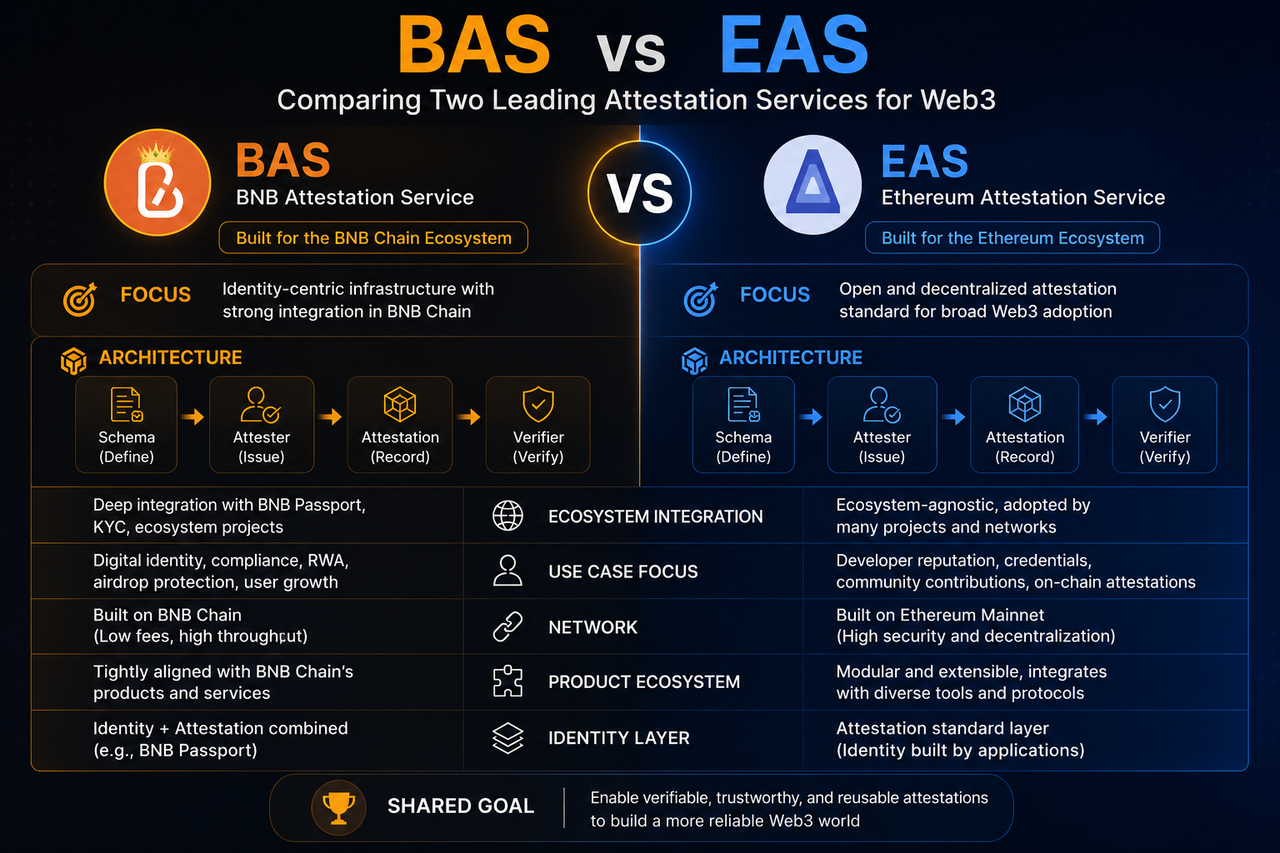
How Do BAS and EAS Differ in Ecosystem Positioning?
Ecosystem positioning is one of the clearest differences between the two.
EAS is closer to general-purpose infrastructure. Its goal is to become an Attestation standard for the entire Ethereum ecosystem and even the broader Web3 ecosystem. Developers can freely build a wide range of applications, while EAS itself does not emphasize any particular identity system or business direction.
By contrast, BAS places greater emphasis on serving the development of the BNB Chain ecosystem.
In addition to providing a proof framework, BAS is closely integrated with BNB Passport, identity verification systems, ecosystem incentive programs, and user growth tools. As a result, BAS is more inclined to build a complete solution around identity and trust, rather than functioning only as an underlying protocol.
How Do BAS and EAS Differ in Architecture?
From a technical structure perspective, the two are highly similar.
Both BAS and EAS use a Schema mechanism to define the structure of proofs, issue proofs through Attesters, and complete the verification process through Verifiers.
However, they differ in terms of ecosystem integration.
EAS places greater emphasis on protocol-level standardization and aims to become a base protocol shared by many types of applications. Its design therefore leans toward an open framework. Developers can freely extend different proof models according to their own needs.
BAS adds more identity-oriented application capabilities on top of the protocol layer, allowing it to directly support digital identity and credential management scenarios.
In this sense, EAS is more like a foundational standard, while BAS is closer to a combined model of standard plus application ecosystem.
How Do BAS and EAS Differ in Digital Identity?
Digital identity is one of the areas where the difference between the two is most visible.
EAS itself can support identity proofs, but its main role is to provide a proof framework. Identity systems are usually built separately by third-party projects or applications.
BAS, by contrast, treats identity systems as one of its core development directions.
Through deep integration with BNB Passport, BAS can combine KYC information, on-chain behavior records, DAO identities, and other identity credentials into a unified digital identity profile.
This model gives BAS stronger ecosystem integration capabilities in identity verification and credential management.
How Do BAS and EAS Support On-Chain Reputation Systems?
On-chain reputation is an important use case for Attestation technology.
In the EAS ecosystem, developers can build contribution systems, developer reputation systems, or community reputation networks based on proof records. Because EAS is highly open, different projects can freely design their own reputation models.
BAS also supports the development of on-chain reputation systems, but it is more inclined to combine reputation with identity systems. For example, a user’s verification records, community contributions, and historical behavioral data can all be incorporated into a unified identity framework.
As a result, EAS places more emphasis on open reputation networks, while BAS places more emphasis on identity-driven reputation systems.
How Do BAS and EAS Differ in Their Potential for the AI Agent Ecosystem?
As AI Agents become important participants in the Web3 ecosystem, Attestation technology is beginning to be used to build Agent identity and reputation systems.
EAS provides an open proof framework, enabling developers to create many forms of identity and behavioral records for Agents. This gives EAS strong flexibility in open experimentation and innovation-driven scenarios.
BAS, on the other hand, can be more easily integrated with identity management systems.
Through digital identity, reputation records, and credential systems, BAS can help Agents build long-term identity profiles and support cross-application collaboration. This model is highly adaptable to identity management in the future Agent Economy.
How Do BAS and EAS Differ in Use Cases?
Although both systems can support identity verification, DAO governance, and on-chain reputation systems, their application priorities are different.
EAS is better suited for building open proof networks, developer reputation systems, and cross-ecosystem credential applications. Its value lies in providing a standardized framework that allows different innovative projects to build on a unified protocol.
BAS is better suited for digital identity management, KYC certification, ecosystem growth programs, RWA identity verification, and AI Agent reputation systems. Because it is deeply integrated with the BNB Chain ecosystem, its implementation path is more clearly defined.
BAS vs EAS
| Comparison Dimension |
BAS |
EAS |
| Full name |
BNB Attestation Service |
Ethereum Attestation Service |
| Ecosystem |
BNB Chain |
Ethereum |
| Core positioning |
Identity and trust infrastructure |
General-purpose Attestation standard |
| Architecture model |
Protocol plus identity application ecosystem |
Open protocol framework |
| Digital identity support |
Strong |
Moderate |
| Identity product integration |
BNB Passport |
Relies on third-party projects |
| Ecosystem goal |
BNB Chain trust layer |
Ethereum general proof layer |
| RWA support |
Strong |
Strong |
| AI Agent scenarios |
Identity-oriented |
Open-oriented |
| Developer freedom |
Relatively high |
Higher |
Will BAS Replace EAS?
BAS and EAS are not substitutes in a direct competitive sense.
They serve different ecosystems and are both built on the same Attestation concept. As the Web3 trust layer continues to develop, it is more likely that multiple Attestation networks will coexist in the future.
For developers, the choice between BAS and EAS depends more on the target ecosystem and application requirements than on one being absolutely better than the other.
As cross-chain identity and cross-chain reputation systems develop, different Attestation networks may even become interoperable and support data sharing.
Conclusion
BAS and EAS are both important Attestation infrastructures in Web3. Their core goal is to turn real-world identity, qualifications, and behavioral records into verifiable on-chain proofs. The two share many similarities in their basic architecture, but they differ clearly in ecosystem positioning and development direction.
EAS places greater emphasis on open standards and general-purpose protocols, aiming to become proof-layer infrastructure for the Ethereum ecosystem and even the broader Web3 world. BAS focuses more on digital identity and trust system development, building a complete identity ecosystem through integration with applications such as BNB Passport.
FAQs
What Is the Core Difference Between BAS and EAS?
The biggest difference lies in ecosystem positioning. EAS places greater emphasis on open standards and general-purpose protocols, while BAS focuses more on digital identity and ecosystem application integration.
Can EAS Be Used for Digital Identity?
Yes. EAS supports identity proofs, but identity systems usually need to be built by third-party projects. BAS, by contrast, is already deeply integrated with identity products such as BNB Passport.
Is BAS Compatible with the Ethereum Ecosystem?
BAS mainly serves the BNB Chain ecosystem, but Attestation itself is an open concept. In the future, cross-chain verification and interoperability may become possible.
Is BAS or EAS Better for AI Agents?
Both can support AI Agent identity and reputation systems. EAS provides greater openness, while BAS places stronger emphasis on integration with digital identity frameworks. They are suited to different types of Agent network needs.