Institutional blockchain adoption has long been an important development direction for the crypto industry. In the early stages, market attention focused primarily on individual users, DeFi protocols, and the growth of on-chain applications. As tokenized funds, securities, and other financial products increasingly enter blockchain environments, however, financial institutions are beginning to consider whether networks can support more complex business operations. For these institutions, a blockchain must do more than process digital asset transfers. It must also meet requirements for operational stability, participant management, cost control, and business continuity.
Avalanche providing core ledger technology for an NYSE-affiliated tokenized securities platform is one example of this trend. It illustrates how institutions may move beyond simply issuing financial products on an existing public blockchain and begin using blockchain architecture to build dedicated infrastructure that meets their operational requirements. For the Avalanche ecosystem, this offers an opportunity to demonstrate the suitability of its technology for institutional markets while creating new possibilities for dedicated networks, development tools, and financial applications.
From the perspective of crypto investment and ecosystem research, however, three layers must be distinguished: whether institutions adopt Avalanche technology, whether the Avalanche network ecosystem gains additional real-world activity as a result, and whether AVAX can capture sustainable economic value from that activity. These factors are connected, but they are not automatically equivalent. Separating technology adoption, network activity, and token economics is essential to understanding the long-term significance of this development for Avalanche.
Key Takeaways
-
Institutional adoption demonstrates technical suitability: The NYSE-affiliated platform’s selection of Avalanche for clearing ledger technology shows that its dedicated infrastructure can enter the technical evaluation and application processes of major financial markets.
-
Dedicated networks are an important development direction: Avalanche’s architecture allows institutions to build dedicated blockchains around specific business requirements, with more granular configurations for performance, costs, and participant permissions.
-
Network adoption does not guarantee growing demand for AVAX: Institutional use of Avalanche technology does not prove that the underlying business must use AVAX as a settlement asset or payment method.
-
Token value capture depends on specific mechanisms: AVAX’s long-term value needs to be assessed through network fees, validator economics, staking demand, ecosystem activity, and token supply and demand.
-
Institutional projects may generate ecosystem spillovers: Infrastructure deployments by financial institutions could attract developers, asset issuers, and service providers, but whether this leads to sustained ecosystem growth remains to be seen.
-
Gate provides a different layer of access to traditional assets: Gate’s tokenized stocks, stock trading, and TradFi products help illustrate how crypto markets connect with traditional assets. This does not mean these products operate on the Avalanche clearing system used by the NYSE-affiliated platform.
Why Are Institutions Paying Attention to Blockchain Networks Like Avalanche?
Institutional finance has different blockchain requirements from ordinary on-chain applications. Individual users may focus on transaction fees, wallet experiences, and the range of available applications. Financial institutions, by contrast, need to consider whether an entire business system can operate continuously and reliably. Securities trading, clearing, and settlement involve the delivery of funds and assets. Any system outage, data inconsistency, or access-control failure could affect the rights and interests of market participants. Institutions therefore typically evaluate underlying networks across several dimensions, including technical performance, operational control, and regulatory compatibility.
One feature of Avalanche is its ability to support dedicated blockchain infrastructure designed around specific institutional requirements. Compared with a model in which every application relies on the same public network environment, a dedicated network allows operators to configure participants, validation mechanisms, network resources, and operating rules according to their needs. This can help institutions connect blockchain infrastructure with existing financial systems without having to completely redesign their established business processes.
This architecture is particularly relevant to securities markets. Financial institutions may need to restrict which entities can participate in a network, define the permissions of different nodes, and plan transaction processing capacity and operating costs. Dedicated networks offer greater configuration flexibility, making it easier to design technical systems around specific business scenarios. However, a dedicated network does not automatically satisfy all regulatory requirements. Institutions must still establish identity verification, risk controls, data governance, and emergency management procedures.
The NYSE-affiliated platform initiative illustrates these requirements. Public information indicates that Avalanche will provide core ledger technology for the relevant clearing organizations, with the platform emphasizing institutional-grade performance, reliability, predictable costs, and participant control. Its significance lies not only in adding another blockchain use case, but also in demonstrating how blockchain can enter the back-end infrastructure of traditional financial markets rather than serving solely as a trading network for end users.
Dedicated Blockchains and Public Networks: How Can the Two Models Work Together?
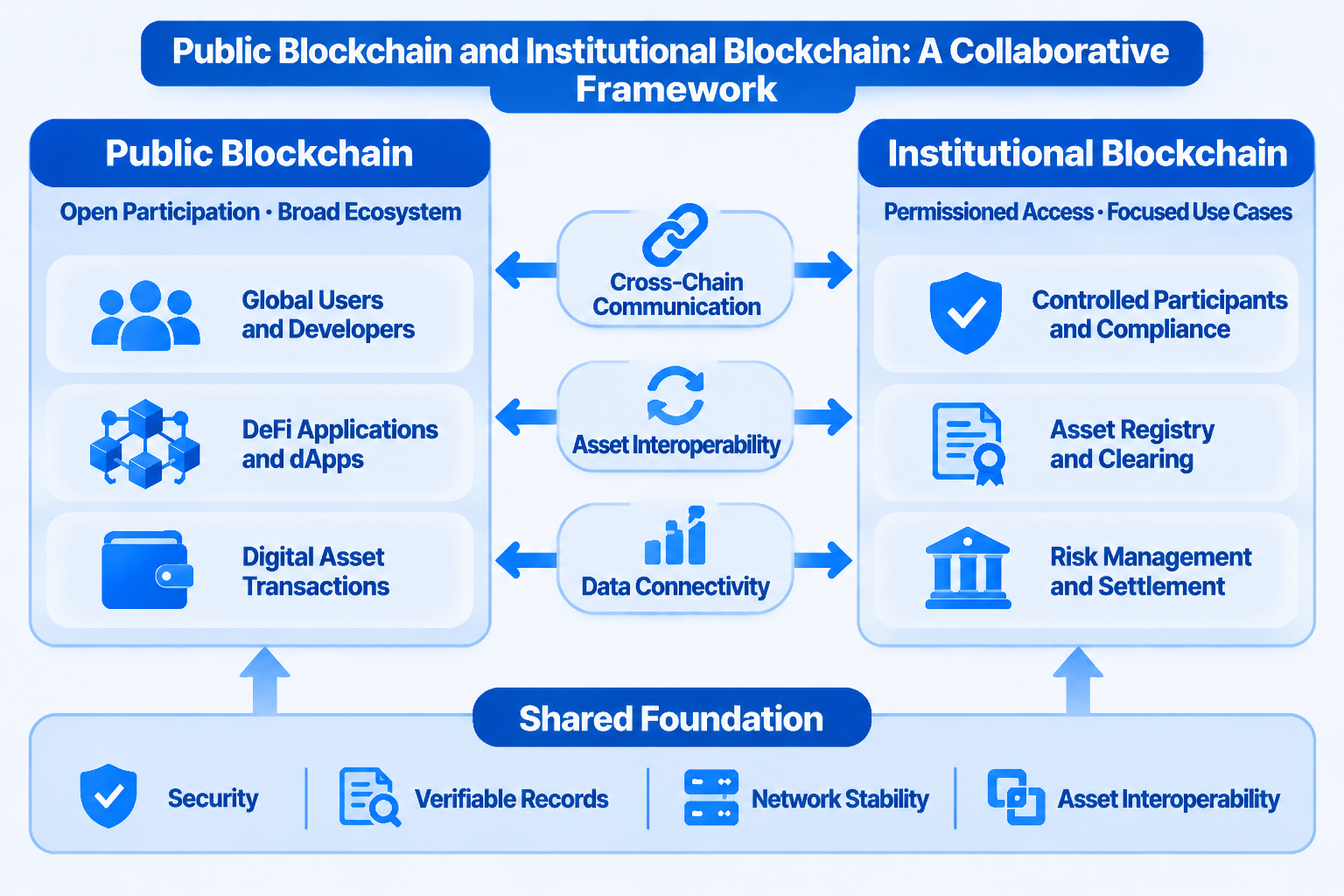
One of the main strengths of public blockchains is open participation and ecosystem sharing. Developers can deploy applications in a common network environment, users can access different protocols through their wallets, and assets can be composed and transferred according to compatible standards. This openness supports network effects, allowing applications, liquidity, and developers to accumulate around the same ecosystem.
However, open networks are not necessarily suitable for every institutional business. Some financial applications require participant identity management, specific permissions for transaction processes, and control over network resources according to operational requirements. If an institution uses a fully open public network directly, it may need to build additional permission, compliance, and operational layers to meet its business requirements. For organizations responsible for clearing, these additional components can increase system complexity.
Dedicated blockchains offer an alternative. Institutions can manage validators and participants within a network designed for their business needs, establish transaction rules, and adjust resource allocation according to actual operating conditions. A dedicated network does not necessarily have to remain isolated from the public ecosystem. With appropriate cross-chain tools, asset standards, and data interfaces, it can still connect with the broader blockchain environment.
From the perspective of the crypto ecosystem, public networks and dedicated networks are not necessarily direct competitors. Public networks are suited to open applications and broad user activity, while dedicated networks may be better suited to institutional scenarios with clearly defined permissions and operational requirements. If the two can connect through secure and reliable interfaces, they may support a richer structure of assets and applications. For Avalanche, institutional-grade dedicated infrastructure can expand the range of potential technology use cases. Whether this leads to broader ecosystem spillovers, however, depends on whether institutional projects remain active and whether their assets and applications can connect with wider markets.
How Does Institutional Adoption of Avalanche Affect the Value of AVAX?
This is one of the areas where misunderstandings are most likely to arise in the crypto market. An institution’s decision to use Avalanche technology first demonstrates that its infrastructure can meet certain business requirements. It does not mean that the AVAX token will necessarily experience additional demand in proportion to the scale of institutional business activity. The adoption of network technology and value capture by its native token are two separate questions that need to be verified independently.
To assess AVAX’s value, it is important to understand the mechanisms through which network activity may be linked to the token. In blockchain systems that use a native token to pay network fees and participate in validation or staking, network activity may influence demand for that token. Validators participate in consensus according to network rules, staking mechanisms may affect the token’s circulating supply, and network fees may form part of the token’s economic model. Whether these mechanisms apply to a particular institutional project, however, must be determined from its specific network architecture and official technical disclosures.
The public announcement concerning the NYSE-affiliated platform confirms that Avalanche will provide core ledger technology for the relevant clearing organizations. It does not explicitly state that AVAX will serve as the settlement asset for securities transactions, a payment method for platform fees, or collateral for investors. It would therefore be inappropriate to translate the potential volume of securities transactions handled by the platform directly into projected demand for AVAX. Even if the platform uses Avalanche technology, its network deployment model, fee structure, and validator arrangements must be examined before the actual value transmission mechanism can be assessed.
For investors, AVAX value capture can be divided into several areas of observation. First, does the network generate sustained and verifiable real-world usage? Second, does that activity require the use of AVAX? Third, can the associated fee or staking mechanisms create sustainable token demand? Fourth, is that additional demand sufficient to offset token issuance, circulation, and other supply-side factors? Only as these conditions are progressively verified can institutional adoption potentially make a meaningful long-term contribution to the token economy.
From Institutional Projects to Ecosystem Growth: Which Transmission Paths Matter?
The impact of institutional projects on a blockchain ecosystem should not be judged solely by an individual partnership announcement. A project moving from technical testing to full operation typically requires several stages, including system deployment, regulatory approval, participant onboarding, asset issuance, and the development of actual trading activity. Even if an institution selects a particular underlying network, the project may not generate sustained development or usage demand if it fails to establish stable business volume.
The first potential transmission path is technical validation. When a major financial institution adopts a particular blockchain infrastructure, it can provide a technical reference for other institutions and reduce the information costs faced by subsequent adopters. If the project performs well in terms of stability, costs, and operational control, it may attract more attention from asset issuers, financial service providers, and development teams. The initial impact is more likely to appear in the network’s institutional credibility and potential business opportunities than in immediate token price appreciation.
The second path is the expansion of the developer and service ecosystem. Institutional projects typically require supporting services such as wallets, custody, identity verification, data services, compliance tools, cross-chain interfaces, and risk management systems. As dedicated network deployments increase, these requirements may create new business opportunities for developers and infrastructure providers. Over the long term, the ecosystem’s ability to develop reusable technical components may be a stronger indicator of sustained network competitiveness than the launch of any single project.
The third path is the connection between assets and liquidity. If institutionally issued tokenized assets can connect with other on-chain applications under compliant conditions, they may create new opportunities for on-chain lending, asset management, and trading services. However, securities have specific legal rights and transfer restrictions. Not every tokenized asset can freely enter DeFi applications. Asset interoperability must remain consistent with issuance terms, investor eligibility requirements, custody arrangements, and applicable regulations.
Assessing the long-term significance of Avalanche’s institutional adoption therefore requires monitoring whether projects enter formal operation, whether they generate stable trading and settlement activity, whether they attract additional institutional participants, and whether their technology can be reused in other business scenarios. The number of announcements and short-term market sentiment may reflect expectations, but they cannot replace analysis of actual network usage.
What Risks Should Be Considered When Evaluating AVAX?
The first is the risk of a disconnect between technology adoption and token value. An institution may use a blockchain’s technical architecture without necessarily using its native token as the payment or settlement instrument for every business operation. If a dedicated network adopts an independent fee arrangement or a specific validation mechanism, institutional business growth may have only a limited effect on demand for the native token. Research into AVAX must therefore focus on the specific mechanisms through which the token is used, rather than inferring demand from the brand or transaction volume of an institutional partner.
The second is institutional project execution risk. Financial infrastructure projects often require lengthy development and testing cycles and may be affected by regulatory approvals, system integration, and participant readiness. A platform’s plan to support around-the-clock trading does not mean that it will immediately achieve mature market depth and stable business volume after launch. If a project is delayed, reduced in scope, or subject to technical changes, market expectations formed earlier may also need to be reassessed.
The third is competition. Institutions have several options when selecting blockchain infrastructure, including existing public blockchains, dedicated blockchains, traditional database systems, and hybrid architectures. Other networks are also competing for tokenized asset, institutional payment, clearing, and settlement business. Avalanche’s competitiveness needs to be demonstrated through actual operating performance, cost efficiency, ecosystem services, and sustained institutional relationships. A single institutional adoption decision is not sufficient to establish long-term leadership.
Finally, there is the risk of divergence between market prices and fundamentals. Crypto asset prices can be affected by market sentiment, liquidity, macroeconomic conditions, and capital rotation. News about institutional partnerships may change market expectations in the short term, but price appreciation does not necessarily mean that network revenue, transaction activity, or demand for AVAX is increasing at the same pace. Investors should evaluate short-term price movements separately from long-term fundamental indicators and avoid treating event-driven market activity as proof of a lasting change in value.
Gate and Tokenized Securities: Different Access Points from AVAX Spot Trading to Tokenized Stocks
From the perspective of the crypto market, there is more than one way to bring traditional financial assets on-chain. Institutions can use dedicated blockchains to upgrade back-end clearing and settlement systems. Asset issuers can represent securities or fund interests through on-chain tokens. Trading platforms can provide users with access to native crypto spot markets, tokenized stocks, stock trading, and related derivatives. These models serve different participants and address different needs.
For users interested in the Avalanche ecosystem, AVAX spot trading on Gate provides a more direct way to access the asset. Through the AVAX/USDT portal, users can trade AVAX using USDT as the quote and trading currency, gaining exposure to the native AVAX token. Unlike tokenized stocks, AVAX is the native utility token of the Avalanche Primary Network. It is used to pay transaction fees and participates in mechanisms related to network security. Holding AVAX through spot trading provides exposure to the native crypto asset’s price movements and the development of its network ecosystem, rather than equity in a listed company or rights associated with traditional securities.
Spot trading should also be distinguished from derivatives trading. When users buy AVAX in the AVAX/USDT spot market, they receive an AVAX asset balance in their account. By contrast, trading derivatives such as AVAX perpetual contracts provides exposure to the contract’s price movements and is not equivalent to directly holding the corresponding amount of AVAX. The two approaches differ in asset ownership, margin requirements, leverage, and risk structure. Users should select products based on their understanding of asset ownership and trading risks.
In addition to native crypto assets, Gate Tokenized Stocks offers another example of how traditional assets can be accessed by crypto market participants. Users can access tokenized stock products such as xStocks and Ondo Stocks through Gate and participate in related markets within a crypto trading environment. These products provide token-based exposure to the prices of specific stocks or ETFs. Their rights structures and issuance arrangements must be assessed according to the rules of each product and should not be treated as direct ownership of traditional securities in every case.
Gate also offers stock trading and TradFi services. Stock trading, tokenized stocks, contracts for difference (CFDs), and perpetual contracts differ in asset characteristics, trading mechanisms, ownership rights, and risk structures. Before choosing a product, users should understand whether they are obtaining actual stock trading rights, tokenized price exposure, a native crypto asset, or a derivatives contract, rather than relying solely on the name of the underlying asset.
From an industry perspective, Avalanche’s exploration of institutional infrastructure and Gate’s multi-asset trading services represent different layers of convergence between traditional finance and crypto markets. One focuses on how financial market back-end systems can use blockchain technology; the other focuses on how users can access native crypto assets and traditional financial assets through a crypto platform. AVAX spot trading connects Avalanche’s native token with crypto markets, while tokenized stocks and stock trading provide different access points to traditional assets. Together, these developments illustrate broader trends in the integration of crypto market infrastructure and traditional finance. They do not, however, establish that Gate’s products operate on the Avalanche clearing infrastructure associated with the NYSE-affiliated platform, or that AVAX, Gate’s tokenized stocks, and NYSE-affiliated tokenized securities share the same asset characteristics or legal structures.
FAQ
What Direct Impact Does the NYSE-Affiliated Platform’s Adoption of Avalanche Have on AVAX?
Current public information confirms that Avalanche will provide core ledger technology. It does not establish that AVAX will be used as a securities settlement asset or a required platform payment method. Therefore, technology adoption alone is not enough to conclude that AVAX will receive additional demand.
What Is the Difference Between an Avalanche Dedicated Blockchain and a Public Blockchain?
Public blockchains generally emphasize open participation and shared ecosystems. Dedicated blockchains allow institutions to configure participants, validation mechanisms, and network rules according to their business requirements. The two models can work together through cross-chain tools and data interfaces, but they differ in access control and operating arrangements.
Does Institutional Adoption of Avalanche Mean More RWAs Will Enter Its Ecosystem?
Institutional projects may strengthen confidence in the network’s technology and attract attention from asset issuers and developers. However, subsequent asset issuance, actual trading volume, and ecosystem applications will still depend on project execution, regulatory arrangements, and market demand.
Which Metrics Matter When Evaluating AVAX Value Capture?
Relevant factors include network activity, transaction fees, token utility, validator and staking mechanisms, changes in token supply, and actual demand from ecosystem applications. It is also important to distinguish activities that explicitly require AVAX from those that simply use Avalanche technology.
Are Gate Tokenized Stocks the Same as Institutional Securities Infrastructure on Avalanche?
No. Gate Tokenized Stocks are tokenized stock trading products designed for users, while the NYSE-affiliated platform uses Avalanche as core ledger technology for clearing infrastructure. They differ in business responsibilities, product structures, and legal arrangements.
How Can Investors Assess Whether Avalanche’s Institutional Adoption Will Create Long-Term Value?
Investors can monitor whether projects receive regulatory approval, officially launch, generate real settlement activity, attract additional institutional participants, and create verifiable network usage and demand for AVAX.