This comparison suits intermediate readers who already meet chatbots, benchmarks, or AI narrative tokens and need checkable term boundaries. After aligning with the superintelligence definition, split ANI, AGI, and ASI along capability scope, generalization, and whether each level is realized—so AlphaFold-style single-domain peaks or ChatGPT-class tools are not upgraded into ASI by rhetoric alone.
The sections below define each level, contrast capability and control, offer a news checklist, and give a “which label fits” framework for stable wording.
Key Takeaways
- ANI is the widely deployed narrow layer; AGI is a generality goal; ASI is cross-domain overall superhuman status—they are not synonyms.
- Capability scope, generalization breadth, and realization status are the three axes that separate ASI vs AGI vs ANI.
- AlphaFold-style “single-domain superhuman” remains a narrow peak—not ASI; ChatGPT-class models are not AGI/ASI either.
- When reading news or product copy, ask about task width and cross-domain evidence before applying an ANI, AGI, or ASI label.
What Is ANI (Narrow AI)?
Artificial narrow intelligence (ANI) is a category within artificial intelligence: systems trained and optimized for a specified task or a tight task family; it is also commonly called weak AI. Examples include voice assistants, recommendation engines, and image-recognition tools. Much of today’s AI, including generative models, is built with machine learning, deep learning, and neural networks trained for a defined scope.
Most current AI, and most deployed ANI systems, still sits in narrow rather than general territory by task width, including most commercial and research models. The practical test: outside a specifically covered domain, does performance stay comparable? If not—or if success depends heavily on fine-tuning and toolchains—prefer ANI over AGI/ASI.
What Is AGI (Artificial General Intelligence)?
Artificial general intelligence (AGI) refers to a general AI or agi system capable of performing almost any intellectual task a human can do, and it is usually framed as human level ai with broad cognitive capabilities, including problem solving, natural language use, and transfer across domains. AGI is the target of near-human cognitive generality across a wide task set: learning new skills, transferring across contexts, and matching human-level performance on most everyday and professional cognitive work—not mastering one or two benchmarks. AGI stresses generality at human level, not “already crushing top humans everywhere.”
DeepMind’s 2023 paper Levels of AGI maps a performance × generality ladder so “near-human” can be separated from “reliably above humans across a wide task set” (a common ASI anchor). AGI would still be distinct from true self awareness as humans experience it. No public system has demonstrated human level reasoning or human cognition across broad cognitive tasks in a way that earns consensus. No publicly verifiable system is widely accepted as realized AGI; calling a chat product or a single benchmark jump “AGI” mixes goals with current status, and creating agi and achieving agi remain active topics of intense debate in ai research.
What Is ASI (Superintelligence)?
Artificial superintelligence (ASI) requires overall performance significantly above the best humans across nearly all cognitive domains people value—cross-domain and holistic, not a vertical record; put simply, ASI refers to a system capable of surpassing human intelligence across nearly all cognitive domains. IBM’s Artificial Superintelligence overview likewise frames ASI as systems that comprehensively surpass humans on most human tasks. ASI remains speculative rather than realized, even if early or emerging AGI were someday achieved first.
ASI is often treated as a capability state after AGI: enough generality first, then a push into cross-domain superhuman territory. Bostrom’s Superintelligence overview likewise anchors superintelligence in overall cognitive advantage—not a single-point record. Without cross-domain evidence, keep the ASI label for hypotheses and research agendas—not for live products. Speculative descriptions sometimes add emotional modeling or capacities beyond human senses, but that remains hypothetical rather than a product reality.
ASI vs AGI vs ANI: How Do Capability Scope and Generalization Differ?
The core key differences among ASI, AGI, and ANI are capability scope, how well intelligence generalizes across domains, and whether that level is realized today. The table below uses three axes so boundaries can be scanned in one pass.
| Feature |
ANI |
AGI |
ASI |
| Capability scope |
One or a few specified tasks |
Broad tasks at near-human generality |
Nearly all important cognitive domains |
| Generalization |
Low: weak outside the boundary |
High: can learn new tasks and transfer |
Cross-domain: overall, stable superhuman |
| Realized today? |
Yes (most deployed AI) |
No (research / goal stage) |
No (definitional target; not publicly realized) |
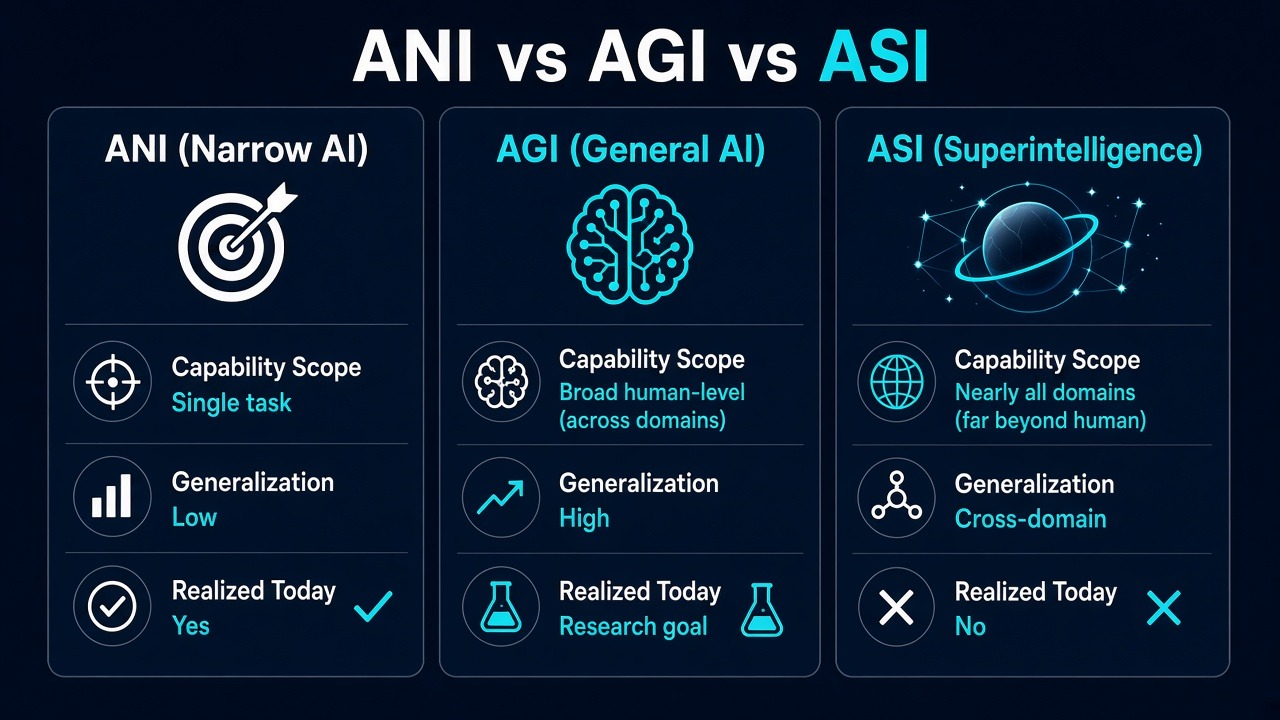
Figure 1. ANI vs AGI vs ASI across capability scope, generalization, and realization status.
Table takeaway: ANI can be “extremely strong yet narrow”—AlphaFold’s protein-structure results beat most experts and still count as single-domain superhuman (Superhuman Narrow), not a leap to ASI. Current AI can show impressive reasoning on narrow benchmarks without reaching the human capabilities usually associated with AGI. AGI answers “is it general enough?”; ASI then asks “is it overall, cross-domain superhuman?” DeepMind’s Levels of AGI Superhuman level stresses reliable above-human performance across a wide task set—aligned with ASI talk, without labeling every leaderboard win as ASI.
That progression from ANI to AGI to ASI would be one of the most consequential capability shifts in human history.
The same system can look expert-level ANI on one task while remaining ordinary elsewhere. One way to frame AGI and ASI is as a move from machine intelligence that is specialized to machine intelligence that is broadly general, then beyond that to consistently superhuman breadth. Label by overall range, not peak scores, so vertical breakthroughs are not written as full transitions.
ASI vs AGI vs ANI: How Do Autonomy and Control Assumptions Differ?
Autonomy and control assumptions tighten as capability width grows: ANI usually sits inside toolchains and human workflows, so shutdown and audits are comparatively direct; AGI assumes cross-task planning and learning, so control must cover goal specs, behavioral constraints, and staged deployment; ASI discussions put misalignment, goal drift, and opaque strategy search—and their amplification—at the center. AI strategy then has to account for capability progression, governance, and risk management, not just deployment automation. AI safety concerns rise as systems move from ANI toward AGI and beyond, and control questions intersect existential-risk debates about more advanced systems; frameworks such as the EU AI Act address parts of AI governance but do not fully resolve questions for speculative ASI-class systems.
This is not a slogan that “more autonomy means more advanced.” ANI can be highly automated yet still narrow; “stronger system” narratives without checkable goals and shutdown paths are less credible, not more. Ask separately: can the system set subgoals on tasks humans did not pre-specify? Does human intervention remain possible? Could the system drift beyond human control? Is there cross-domain capability evidence behind the autonomy claim?
For crypto and product readers, on-chain bots, trading assistants, and risk models almost always deploy as ANI tools. Writing “autonomous execution” as AGI/ASI misreads engineering automation as a cognitive-level jump; autonomy claims and capability-scope claims should be verified apart.
How Should News and Product Claims Be Mapped to These Three Labels?
When reading news or product marketing, evaluate AI intelligence claims by checking task width and evidence type first: single benchmark, vertical scene, or demo → default ANI; near-human generality across broad tasks with reviewable general evaluation → then AGI; overall superiority across nearly all domains plus cross-domain evidence → then ASI.
A practical checklist: (1) Does copy claim “total human superiority” while citing only single-domain examples? (2) Does singularity or intelligence-explosion rhetoric stand in for realized ASI? (3) Do crypto whitepapers or token names use ASI as marketing without evaluation? (4) Are ChatGPT-class assistants called AGI/ASI outright? (5) Does AI technology marketing apply AGI or ASI labels to narrow systems without real-world examples of broad generality? Any “yes” should downgrade the label.
The Turing test is historically relevant, but by itself it is not enough to prove AGI.
AlphaFold, game engines, and specialized risk models are often framed as “already superhuman.” The correct read: superhuman results can happen on narrow tasks; Superhuman Narrow ≠ ASI. Treating a peak as full superintelligence is the most common conceptual leap.
Which Term Fits Best?
Choosing a label is terminology discipline—not investment advice: match words to capability claims and evidence, not to hype or brand slogans.
- Prefer ANI if: the system serves a specified task or tight task family; evaluation sits on one benchmark or vertical; performance drops outside that boundary; deployment is a tool, plugin, or one step in a workflow.
- Prefer AGI if: the claim is near-human generality across a broad task set; learning new skills and cross-context transfer are central; the claim should point to a system capable of broad transfer rather than a model confined to a defined training setup; and the text treats this as a goal or research agenda rather than a settled public fact.
- Prefer ASI if: the claim is overall superiority over top humans across nearly all important cognitive domains; cross-domain, reviewable evidence plus alignment/control discussion are present, including whether it can be aligned with human values before stronger capability claims are trusted; and single-domain records or concept-token stories are not offered as proof of realization.
When in doubt, downshift: if evidence only supports ANI, do not upgrade to AGI/ASI to sound stronger. Conservative wording does not underrate real breakthroughs—it reduces writing hypotheses as facts.
Summary
ANI, AGI, and ASI map stages of AI technology within artificial intelligence, from deployed narrow systems to a human-level generality goal and then to theoretical cross-domain superintelligence. The three-axis table, news checklist, and labeling rules pull slogans back to checkable standards. Single-domain superhuman results (such as AlphaFold) and ChatGPT-class tools are not ASI; without cross-domain evidence and alignment conditions, keep ASI as a hypothesis level, not a product status. In discussions that ask where AGI sits, AGI is usually placed between today’s ANI systems and speculative ASI.
FAQ
What do ASI, AGI, and ANI each mean?
ANI (narrow AI) means systems that excel at one or a few tasks; AGI (artificial general intelligence) is the target of near-human generality across a broad task set; ASI (superintelligence) means overall superiority over top humans across nearly all valued cognitive domains. They differ by capability width and cross-domain superhuman status—not as alternate names for the same stage.
What is the difference between superintelligence and AGI?
AGI aims for near-human performance across a wide task set; it is often discussed as strong AI or human-level AGI, while superintelligence (ASI) goes beyond that threshold and requires overall superiority over top humans in nearly all important domains. AGI is often treated as a precursor toward ASI: generality first, then cross-domain overall superhuman status. The two are different capability states and should not be swapped.
Is ChatGPT AGI or ASI?
Neither. Generative AI models learn patterns from training data and can still remain narrow despite producing fluent, wide-ranging outputs. ChatGPT and similar large language models are narrow AI (or tools on a path toward stronger generality). They help with language and many assistive tasks but do not meet widely accepted AGI generality standards, and they do not overall surpass top humans across nearly all important cognitive domains, so they do not meet the ASI definition.
Does superintelligence exist today?
Under the strict cross-domain, overall-superhuman definition, no publicly verifiable ASI system exists. Widely used systems are mostly ANI; single-domain superhuman results in science or games also do not equal realized ASI. Some risk discussions about future ASI include severe civilizational-loss scenarios, but those refer to hypothetical systems rather than any publicly verified system today.
How can you quickly decide among ANI, AGI, and ASI?
Start with task width: single task or tight family → ANI, and examples like image classification still fit here even when performance exceeds humans in that one area; claim of near-human generality across broad tasks with general-evaluation discussion → then talk AGI; claim of overall superiority across nearly all domains with cross-domain evidence → then talk ASI. When evidence is thin, prefer the narrower word so demos and marketing are not upgraded into capability facts, since the human mind and human brain are still the benchmark behind AGI-style generality claims, not just isolated benchmark wins.