As Anthropic gradually discloses more financial information, market attention toward AI companies is expanding beyond model performance, user growth, and valuations to include revenue quality, computing expenditures, and long-term profitability. Even if frontier models have secured a large number of enterprise customers, whether their business models can cover continuously expanding investments in computing resources remains a core question that needs to be addressed.
Anthropic's business model has distinctive industry characteristics: it procures computing resources, trains foundation models, and provides inference services to transform infrastructure resources originally measured in compute time into intelligent products measured in Tokens, subscriptions, and enterprise services. In this process, model capabilities and real-world application value determine how much premium a company can earn.
However, as open-weight models continue to improve, intelligent service prices decline, and investment in AI infrastructure continues to expand, frontier model companies must address whether their technological advantages can be sustained over the long term. Whether Anthropic can establish a sustainable profit model also provides an important perspective for understanding value distribution across the AI industry.
Key Takeaways
-
The essence of AI companies is converting computing resources into intelligent services: Anthropic transforms foundational compute into commercially valuable products through model training, inference services, and application development.
-
The intelligent premium comes from the real economic value created by models: Enterprise customers' willingness to pay depends not only on Token prices, but also on whether AI can reduce labor costs, improve productivity, and complete complex tasks.
-
Open-weight models may compress the pricing power of frontier models: As lower-cost models continue to improve, closed-source model companies need to continuously create new technological advantages to maintain service premiums.
-
Rapid revenue growth does not necessarily mean profitability improves at the same pace: Long-term computing procurement, foundation model R&D, and distribution costs may still pressure AI companies' operating profits and cash flow.
-
Enterprise workflows may become a new competitive moat: As AI moves from standalone model calls into core enterprise processes, customer retention, system integration, and task-completion capabilities may gradually become more important than model performance alone.
What Exactly Is Anthropic's Business Model?
Anthropic is an artificial intelligence company focused on foundation model R&D and intelligent services. Its Claude family of models is widely used in scenarios such as software development, enterprise knowledge management, text analysis, and AI Agents.
Unlike chip companies that primarily generate revenue by selling computing equipment, Anthropic's core business is using computing resources to produce intelligent services and providing these capabilities to individual developers and enterprise customers through different commercial channels.
Its revenue mainly comes from three types of business.
Usage-based API fees. Developers and enterprise customers can integrate Claude models into their own software and business systems and pay based on the actual number of Tokens used, model type, and related services.
Individual and team subscriptions. Users receive a certain model usage allowance, feature access, and intelligent tool services through recurring payments.
Enterprise services and partnership channels. Enterprises can access Claude through direct procurement, long-term usage agreements, and model services provided by cloud computing platforms. This business can be combined with usage-based or subscription models.
Anthropic's registration filing documents show that, in the first half of 2026, the company's usage-based business generated approximately $13.1 billion in revenue, accounting for about 80% of total revenue, while subscription business generated approximately $3.2 billion, accounting for about 20%.
This means Anthropic's current revenue structure primarily depends on customers' actual consumption of intelligent services, rather than simply relying on growth in the number of subscription users.
For a foundation model company, the factors that can truly create scalable revenue are not only how many users use its models, but more importantly whether these users continuously integrate AI into frequent, high-value commercial activities.
From GPU Hours to Token Pricing: How Do AI Companies Convert Value?
In the AI industry chain, computing resources are generally purchased in forms such as GPU hours, cluster capacity, or cloud computing services. The intelligent services provided by model companies are primarily charged based on Tokens, task calls, and software subscriptions.
These two pricing methods correspond to different stages of the industry chain.
Compute providers sell computing capacity, while model companies sell services that use this computing capacity to complete specific tasks. For example, a cloud computing company may charge Anthropic based on GPU usage time. Anthropic then uses these computing resources for model training and inference, and provides model capabilities to developers through APIs.
For end customers, what they purchase is not the usage time of a particular GPU, but capabilities such as code generation, document analysis, data processing, and complex problem-solving.
Suppose a model company needs to pay $5 per hour for computing resources, while the effective billable Tokens generated during the same period produce $20 in revenue. This creates a $15 difference between revenue and computing resource costs.
However, this $15 does not equal corporate profit. Model training, idle compute, data acquisition, employee compensation, distribution costs, and other operating expenses must still be included in the overall business analysis.
The figures above are for illustrating the business model only and do not represent Anthropic's actual GPU procurement prices or model service profits.
The commercial value of AI companies comes from converting general-purpose computing resources into intelligent products with differentiated capabilities. Model architecture, training methods, specialized data, and application systems are important components of this value-conversion process.
What Is an Intelligent Premium, and Why Are Companies Willing to Pay More for Models?
An intelligent premium is not a standard accounting metric. It is a business concept used to describe the additional fees customers are willing to pay for stronger model capabilities, higher task success rates, and more reliable services.
In traditional product markets, prices are usually influenced by production costs, supply and demand, and the degree of product differentiation. AI model pricing works similarly, but its commercial value is also closely linked to how much economic value it can help customers create.
For example, a software company may need to complete code reviews, vulnerability checks, and system testing. If an ordinary model can only perform basic code analysis, while a stronger model can handle complex project structures, identify potential defects, and reduce manual review time, the company may be willing to pay higher service fees for the latter.
Suppose a software development task originally requires an engineer to spend 5 hours. With a high-performance model, this can be reduced to 2 hours. At a labor cost of $60 per hour, the theoretical difference in labor input is $180.
Even if model calls require an additional payment of $20, the related service may still have economic value as long as task quality is maintained.
This example shows that the commercial pricing of models does not depend entirely on the production cost of intelligent services. For some enterprise customers, the labor time a model can reduce, the error rates it can lower, and the business output it can improve may be more important than Token prices.
However, time saved through AI assistance may not necessarily be fully converted into actual financial gains. Companies must also consider costs such as manual review, system integration, error correction, and compliance management.
Therefore, models that can maintain an intelligent premium over the long term need to demonstrate that the business value they create clearly exceeds their additional usage costs, rather than merely achieving higher scores in performance tests.
Why Might Enterprise AI Services Have Greater Commercial Potential Than Consumer Applications?
Consumer AI products typically face issues such as limited user willingness to pay, subscription price competition, and fluctuating usage demand. Users may use different models for everyday Q&A, content generation, and basic information retrieval, resulting in relatively limited dependence on any specific model.
Enterprise AI services have different economic characteristics.
When AI models are integrated into activities such as software development, financial research, legal analysis, customer service, and internal knowledge management, their usage demand may be directly tied to companies' daily operations. Model calls are no longer just standalone consumer behavior, but may become recurring expenses in the course of business operations.
Using software development tools such as Claude Code as an example, AI can participate in code understanding, file modification, test execution, and multistep development tasks. As these tools enter more complete software engineering workflows, customers are gradually purchasing not only text-generation capabilities, but also assistance with completing software development work.
This business model may offer several commercial advantages, including higher usage frequency, more stable enterprise procurement demand, and greater customer lifetime value.
At the same time, enterprise business can help model providers better understand industry needs, enabling technical optimization for code development, data analysis, and complex agent tasks.
However, the enterprise market does not necessarily offer higher profits. Large customers may require volume discounts, dedicated compute, data isolation, security reviews, and customized technical support. These requirements also increase service costs.
Therefore, the commercial advantage of enterprise AI depends on whether model providers can achieve stable revenue growth and manageable delivery costs while meeting complex service requirements.
Why Is Anthropic's Revenue Growing Rapidly While It Still Faces Computing Cost Pressure?
Anthropic's financial data illustrates the typical operating challenges currently faced by frontier AI companies.
In 2025, Anthropic generated approximately $4.59 billion in operating revenue. In the first half of 2026, the company's operating revenue further increased to approximately $16.29 billion. Revenue for just six months was more than 3.5 times the revenue for the full previous year.
At the same time, the company still recorded an operating loss of approximately $693 million in the first half of 2026. This indicates that while the company has already developed commercial demand at a considerable scale, its overall revenue has not yet fully covered the corresponding operating expenses.
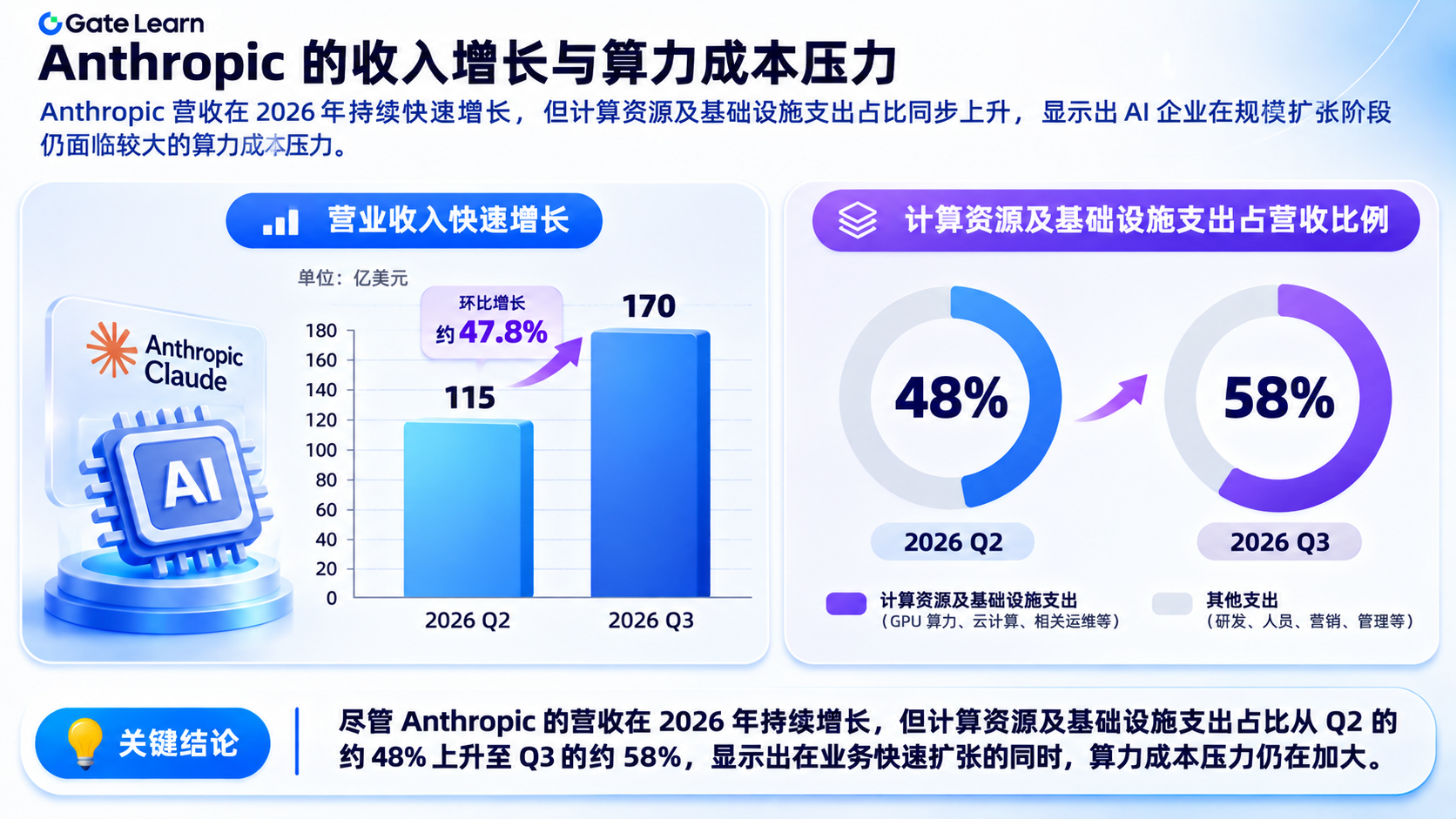
In the third quarter of 2026, Anthropic's operating revenue further increased to approximately $17 billion. However, the proportion of operating revenue represented by computing resources and infrastructure expenses also rose from approximately 48% in the second quarter to approximately 58% in the third quarter.
Short-term compute procurement is one important reason for this change in the cost ratio. When customer demand grows faster than existing computing capacity can expand, companies may need to acquire short-term computing resources at higher prices. This creates a growth pressure for AI companies that differs from traditional software industries: rapidly growing user demand can generate more revenue, but it may also force companies to invest in more compute in advance and bear higher marginal service costs.
In addition, Anthropic's computing resource and infrastructure expenses include not only commercial inference costs, but also activities such as model research, training, and internal use. Therefore, the difference between operating revenue and total computing expenditures should not be directly understood as gross profit in financial statements.
For frontier model companies, whether revenue growth can truly translate into improved profitability still needs to be assessed alongside computing resource utilization, long-term procurement prices, and overall operating costs.
Why Might Open-Source Models Compress the Intelligent Premium of Frontier AI Companies?
The commercial value of closed-source frontier models partly comes from their technological lead over other models.
If a model is the first to offer complex code development, long-context analysis, or multistep reasoning capabilities while other models cannot temporarily reach the same level, the company with these capabilities may be able to charge higher service prices for a period of time.
However, model technology is not static.
As open-weight models continue to improve in training methods, reasoning capabilities, and operating efficiency, some tasks that previously required expensive flagship models may gradually be handled by lower-cost models.
For example, an enterprise document classification task may initially need to rely on a stronger closed-source model. However, when a lower-cost model can already meet requirements for accuracy and stability, the enterprise may adjust its model provider or deployment method.
For frontier model companies, this means that the commercial premium created by the leading capabilities of a particular generation of models may gradually decline as competing technologies develop.
However, open-weight models do not mean free intelligent services. Self-deployment still requires purchasing or renting computing resources and bearing costs for system maintenance, security management, performance optimization, and model updates.
Whether an enterprise chooses an open-source solution ultimately depends on the total cost of use, data management requirements, and task-completion results, rather than simply whether model weights can be obtained for free.
Closed-source model companies need to continuously create new high-value capabilities while providing more reliable tools, infrastructure, and enterprise services to reduce the competitive risks of relying solely on superior model performance.
Why Might AI Companies Enter a Competitive Cycle of Continuous R&D Investment?
After completing core product development, traditional software companies can achieve economies of scale by selling software to more customers. Although software still requires ongoing updates, some mature products can generate revenue over the long term with relatively stable R&D spending.
Frontier AI model companies may face more frequent technological update pressures. When competitors release models with similar performance at lower prices, the commercial value of existing models may be affected. To maintain technological advantages, companies need to continuously invest in next-generation model training, reinforcement learning, data acquisition, and computing infrastructure.
This means that even if one generation of models has already generated positive commercial returns, companies may still need to reinvest a substantial share of revenue into next-generation model R&D. Model iteration can create stronger capabilities and new application demand, but continuously expanding R&D investment may also extend the time needed to achieve stable profitability.
This competitive cycle also involves the marginal returns of technological investment. When a model already has strong overall capabilities, further expanding training scale may not produce performance improvements that generate proportionate revenue growth. If additional capabilities have not yet created commercial use cases with clear willingness to pay, model companies may face a situation where R&D costs grow faster than commercial value.
Therefore, AI companies need to assess not only whether they can train stronger models, but also how much actual revenue new model capabilities can create and how long that revenue can be sustained.
How Does Long-Term Computing Procurement Change the Operating Risks of AI Companies?
To meet model R&D and commercial service needs, frontier AI companies such as Anthropic typically need to establish long-term partnerships with cloud computing platforms and other compute providers. Long-term procurement agreements can secure computing capacity in advance and, to some extent, reduce the price and supply risks associated with temporary procurement. However, this model also makes the operating structure of AI companies more similar to that of infrastructure industries with high fixed investments.
After signing long-term computing agreements, the related computing resources may need to be delivered in stages. If future model demand continues to grow, companies can use existing compute to expand service scale and improve operating efficiency through higher equipment utilization.
Conversely, if model demand falls below expectations or new-generation hardware significantly reduces computing costs, companies may face a mismatch between existing procurement commitments and actual business demand. In addition, long-term procurement obligations for model companies may not all appear as current capital expenditures and should not be directly viewed as debt already incurred. The specific risks depend on contract duration, minimum purchase amounts, delivery arrangements, exit clauses, and accounting treatment.
The AI industry also includes situations where cloud computing platforms simultaneously serve as investors in model companies, compute providers, and product distribution channels. This type of partnership can help model companies obtain funding, computing resources, and customers, but it also means model companies need to share commercial gains with other participants in the industry chain.
Therefore, evaluating Anthropic's profitability requires attention to whether its revenue expansion can match its long-term computing commitments and whether the company can establish an effective balance among supply stability, procurement flexibility, and computing costs.
From Model APIs to Enterprise Workflows, Where Might AI Industry Profits Concentrate?
If the capabilities of different foundation models continue to converge in the future, simply selling Tokens may face more pronounced price competition. Under these circumstances, one possible path for AI companies to build commercial moats is expanding from general model services into more complete business solutions.
Enterprise customers generally do not need to purchase language model capabilities separately. Instead, they want to solve specific business problems such as software development, market research, file management, financial analysis, and other operational needs. A complete AI workflow may include foundation models, enterprise data, tool calls, task planning, permission management, human review, and result validation.
When model companies can integrate these capabilities into a unified product, their commercial value no longer depends entirely on the market price of Tokens. For example, if an enterprise has already integrated an AI tool into its internal code repositories, testing systems, and project management platforms, changing model providers requires not only comparing API call prices, but also considering system migration, data security, and workflow compatibility.
This type of system integration may increase customer switching costs and help AI companies establish more stable commercial relationships. However, the application layer is also competitive. Independent software companies can connect to multiple model providers through model routing and flexibly switch based on price and task performance. If end-customer relationships are controlled by third-party applications, the pricing power of foundation model companies may also be constrained.
Future profit distribution in the AI industry may depend on which companies can simultaneously control key model capabilities, customer relationships, and business entry points with high economic value.
How Can You Assess Whether Anthropic's Business Model Can Achieve Long-Term Profitability?
For Anthropic and other frontier model companies, long-term profitability cannot be assessed solely through revenue growth, the number of model users, or capital market valuations. It requires a comprehensive review of technological efficiency, commercial demand, and capital use.
-
Unit economic value of intelligent services. Monitor how much actual revenue each unit of compute can generate and whether the cost of completing the same business tasks continues to decline.
-
Enterprise customer usage depth and retention. Whether enterprise customers move from short-term trials to long-term procurement, and whether AI truly enters daily business operations, will affect the sustainability of revenue.
-
Model pricing power. As open-weight models and other closed-source models continue to develop, whether Anthropic can maintain a reasonable premium through new capabilities and product services.
-
Commercial returns on R&D investment. Whether next-generation models can create new application demand and whether their incremental revenue can cover the related technical investment.
-
Computing procurement and utilization efficiency. Whether long-term computing capacity can be fully utilized and whether short-term, high-cost compute procurement can gradually be reduced will affect overall operating efficiency.
-
Operating cash flow and free cash flow. Companies need to convert revenue growth into actual cash collection and gradually cover operating expenses and capital investment to reduce long-term reliance on external financing.
These indicators can also help explain changes in AI stock valuations.
In scenarios involving AI Industry Chain Stocks and related TradFi products actually supported by Gate, users can observe changes in market pricing across different segments of the industry chain by considering corporate financial performance, model commercialization progress, and computing supply relationships. The trading mechanisms, asset exposure, and risks of related products still need to be understood separately.
Compared with simply focusing on the revenue growth rate of AI companies, it is more important to assess how much of the economic value they create can ultimately be retained within their own operating systems.
Summary
Anthropic's business model is built on converting computing resources into intelligent services. Through foundation model R&D, API calls, subscription products, and enterprise applications, the company can transform general-purpose compute into intelligent products with differentiated commercial value and generate revenue from customers' actual usage needs.
However, the technological lead of frontier models is not permanent. Progress in open-weight models, continued R&D investment, pressure from computing procurement, and price competition in intelligent services may all affect Anthropic's long-term profitability.
In the future, competition among AI companies will not only depend on who can produce stronger intelligence, but also on who can convert intelligence into business outcomes that customers are willing to pay for on an ongoing basis, while maintaining a reasonable cost structure, pricing power, and cash flow performance amid continuous technological iteration.
FAQ
How Does Anthropic Primarily Generate Revenue?
Anthropic primarily generates revenue through usage-based API fees, individual and enterprise subscriptions, enterprise procurement, and cloud platform partnerships. Among these, usage-based billing is currently its main revenue model.
What Is an AI Intelligent Premium?
An intelligent premium refers to the additional fees customers are willing to pay for stronger model capabilities, higher task success rates, and more reliable services. It is based on the actual economic value that models can create.
Why Can AI Companies Still Report Losses Despite Rapid Revenue Growth?
Because foundation model training, inference services, long-term computing procurement, and other operating expenses may all grow at the same time, potentially even faster than operating revenue.
Will Open-Source Models Replace Closed-Source Model Companies Such as Anthropic?
Not necessarily. Open-weight models may intensify price competition, but closed-source models can still build differentiated advantages through frontier capabilities, enterprise services, system integration, and product ecosystems.
Can Purchasing Low-Cost Compute Create a Highly Profitable AI Business Model?
No. Low-cost compute is only one foundational condition for producing intelligent services. Model capabilities, customer demand, R&D spending, and system operating efficiency also determine profitability.
Why Do AI Companies Need to Sign Long-Term Computing Procurement Agreements?
Long-term agreements can help companies obtain relatively stable computing capacity, but they may also increase pressure from idle resources and contractual obligations when demand falls below expectations.
How Can You Assess Whether an AI Company Has Long-Term Profitability?
You can conduct a comprehensive analysis based on indicators such as unit service costs, customer retention, model pricing power, returns on R&D investment, compute utilization, and operating cash flow.