Key Points
- As AI models become more affordable, enterprises must strategically assemble model portfolios based on task complexity, rather than relying on a single model solution.
- The true cost of AI should be assessed by successful outputs, not merely by token pricing.
- Critical value layers are emerging beyond the core model—including routing, context management, workflow orchestration, and outcome validation.
- Long-term value is likely to accrue to enterprise AI platforms that can actively convert intelligence into business outcomes with reliability and efficiency.
Model Prices Continue to Drop, Reshaping AI Competition
AI competition over the past two years has focused primarily on model capabilities—those excelling in inference, coding, multimodality, and tool integrations have attracted the lion’s share of developer and enterprise attention. Now, as we approach 2026, model capabilities and pricing are both seeing rapid iteration. In July 2026, OpenAI slashed prices on GPT 5.6 Luna and Terra, with Luna’s cost dropping by 80%. They’ve also flagged high-frequency, low-cost workloads as a core focus for large agent deployments. This isn’t merely a price cut—it’s a signal that AI models are shifting from a position of scarcity to an economically optimizable production resource.
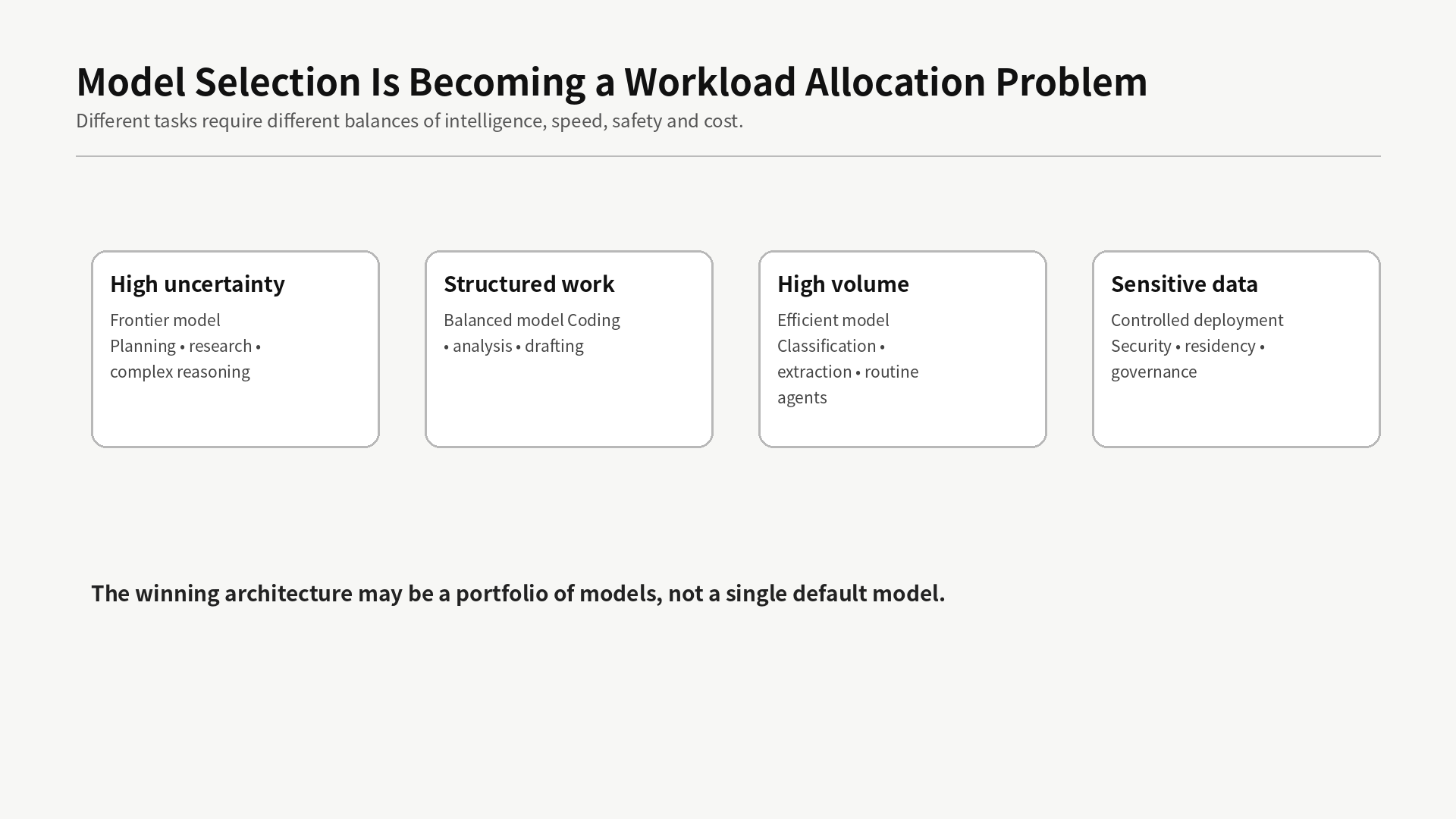
As pricing falls, enterprises will naturally shift their focus from “who has the most powerful model” to “which model best fits each individual use case.” Tasks like research, complex planning, code review, data extraction, customer service, and large-scale classification have inherently different standards for quality, latency, and tolerance for error. Defaulting all tasks to the highest-tier models would mean leveraging expensive compute for jobs that don’t require peak intelligence. A mature enterprise AI stack looks more like an intelligently curated portfolio of models—rather than a single-model procurement.
This transition also triggers a shift in the cost structure—mirroring the resource-scheduling logic of the cloud era. The key metrics for enterprises are no longer just token consumption, but task success rate, inference calls, manual validation, latency, retries, and overall task unit cost. OpenAI’s own AI economics framework emphasizes that it’s not the cost per million tokens that matters, but the cost to complete an acceptable task.
The Real Scarcity: From Model Strength to Model Selection
Lower model costs don’t mean enterprises should switch everything to the cheapest option. On the contrary, meaningful performance differences will be revealed by how well models fit any given task. Complex planning jobs need powerful models, while high-frequency, structured tasks are better handled by lighter or specialized models; security-sensitive workloads require isolated enterprise environments, strict data boundaries, and robust audit trails.
The Model Router will likely become a central enterprise AI component. This is not a mere API proxy, but an intelligent system making dynamic decisions based on task type, context length, quality requirements, risk profile, and budget limits. An advanced router might assign a low-cost model first, then escalate to a premium model if results are uncertain; or it could mix models stepwise, concentrating top-tier intelligence where it matters most.
This evolution will redefine the model vendor competitive landscape. Where “default provider” status once conferred advantage, vendors will increasingly be judged on cost-performance for particular workloads. Enterprises will opt for mixed pools, continuously optimizing combinations through universal evaluation, routing, and governance. As models converge in capability, the importance of routing and orchestration rises.
The Real Cost of AI: Beyond Tokens to Successful Completions
A common mistake is equating model price directly with AI cost. In reality, the all-in cost of an Agent-led workflow spans model calls, context handling, tool invocation, information retrieval, retries, manual checks, and the overhead of rework. A model 50% cheaper that takes more calls to achieve target quality may wind up costlier overall—while a slightly pricier, higher-performing model could reduce labor costs enough to provide net savings.
For this reason, AI unit economics should shift from mere token consumption to outcome-driven metrics. What actually counts is: how much effective work do I get per AI dollar spent? How many routine tasks are automated, and how much human time is freed? This trend pushes enterprises toward a true FinOps approach—where budgets are allocated not by model brand but by business process and measurable output.
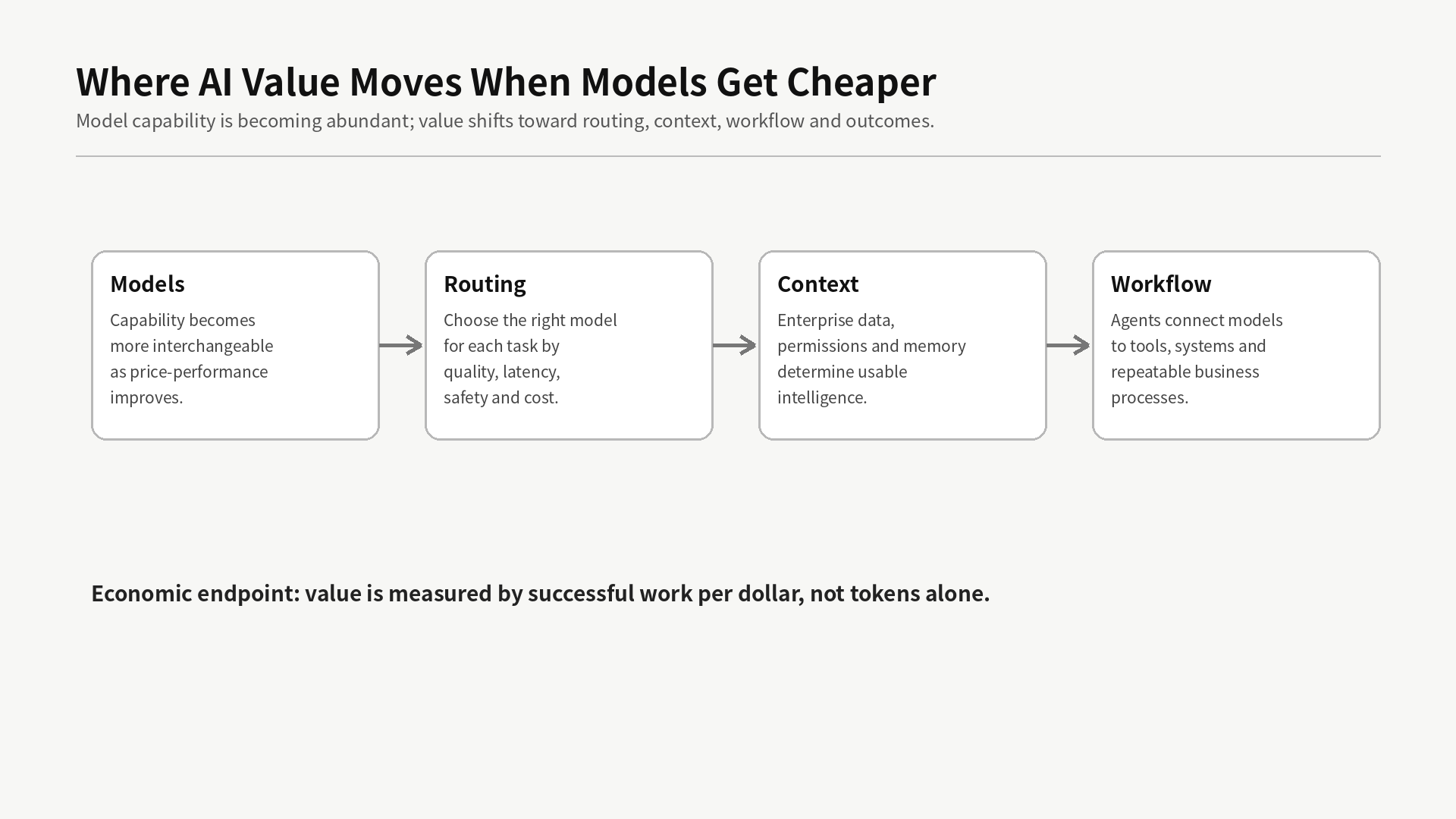
Outcome-driven accounting also reorders the AI value chain. The model delivers intelligence, but the decisive economic value hinges on complete context, tool integration, workflow stability, proper permissions, and seamless connection to operational systems. The cheaper the underlying model, the more incentive there is to automate—and as more is automated, the primary chokepoint shifts from intelligence limitations to execution reliability.
Where Does Value Accumulate After Model Prices Fall?
Lower model pricing immediately expands AI’s addressable market, but long-run value isn’t automatically captured by model vendors. On the software side, cheaper models enable new Agent-driven features; on the infrastructure side, a surge in inference volume may offset lower per-token margins; as for data and workflow platforms, end-to-end context, permissions, and operational integrations gain prominence. Reducing the price per “intelligent unit” boosts the overall scale of transactions in the AI economy.
That’s why enterprise AI moats are shifting away from the model layer. Platforms with proprietary business data, complex permission controls, deep workflow native integrations, and reliable execution are best positioned to transform cheap models into real productivity drivers. Conversely, a generic interface over a commoditized model struggles to establish sustainable pricing power even as costs drop.
Seen through an industry investment lens, future value assessments should ask: Are supported tasks high-frequency? Is unit cost steadily shrinking? Are clients assigning more workflows to the platform? Is it earning deeper control over context and workflows? As AI scales, the most valuable providers may not own the “smartest” model but will excel at transforming intelligence into reliable, low-cost, verifiable business operations.
For model providers, this creates new pressure. Even those leading in technical benchmarks could lose pricing power if enterprises can switch freely via unified routing layers. Alternatively, platforms that master data, access, evaluation, and workflow integration can secure stable ground as model iteration accelerates.
Enterprise AI stacks will naturally evolve into three interlinked layers: the model layer (sourcing intelligence at various price points), the routing and governance layer (task, risk, and budget-driven allocation), and the workflow layer (connecting intelligence to operational processes). The higher the layer, the closer the alignment to business value—and the greater the long-term switching costs.
As the model landscape grows, enterprises face a new challenge: true complexity lies not in invocation, but in real-time selection. Procurement must know where the money goes, engineering tracks justification for model choices, business teams care about delivery quality, and security demands accountability for sensitive data routing. In short, model selection becomes a company-wide operational concern.
What Enterprises Need: A True AI Resource Management System
Model vendor revenue growth will no longer simply reflect price-by-usage, but will hinge on AI integration into broader workflows. For the enterprise, the critical KPI isn’t daily token usage, but incremental output per AI dollar spent. Shift procurement and budgeting decisions to this measure, and AI competition enters a true economics-driven era—not just a contest of parameter counts and leaderboard placements.
As AI becomes foundational infrastructure, falling model prices will trigger a surprising effect: aggregate enterprise AI consumption may rise more quickly than model revenues fall. Lowering the unit cost triggers large-scale automation of tasks once considered uneconomical. Previously, an employee’s ten-minute job wasn’t worth automating with expensive models; now, that same process can run tens of thousands of times a day.
The Endgame: “How Much Work per Dollar?”
If the next year brings continued gains in model performance and price reductions, enterprise AI’s true measure of value will migrate toward productivity—paralleling industrial tool benchmarks, rather than SaaS subscriptions. The model itself will become a critical, yet highly replaceable, foundation. What delivers lasting value are data, process, controls, evaluation systems, and the mechanisms for human–Agent cooperation. Those able to orchestrate these elements will build stable client bases and command higher long-term value.
Beyond the Model Price War: Competing on AI Productivity
In this light, model price cuts are just the first step. Adding cheaper models to more workflows is the second; continuously enhancing business impact is the third. The future of AI is about every enterprise building a system to continuously optimize intelligent resource allocation, not just chasing the “strongest” model.
Future AI project evaluations must anchor on unit result cost—not just utilization metrics. For instance: What are the compute costs for a qualified customer reply? How many calls are needed for accurate financial analysis? How much model–human collaboration does a coding task require? Only by linking cost to results can enterprises rationally compare models, vendors, and workflows. As this metric matures, AI procurement will shift from technical to strategic business decision-making.
The New Core Metric for Enterprise AI: Unit Result Cost
As AI takes over core enterprise infrastructure roles, cheaper models may paradoxically drive overall usage higher, outpacing declines in model-side revenues. As automation costs drop, tasks once considered cost-prohibitive become prime automation candidates. Where expensive model calls meant a ten-minute employee task wasn’t worth automating, lower costs now enable tens of thousands of daily iterations.
Therefore, model vendor revenue growth can’t be explained simply by price and volume—it depends on AI’s integration into broader workflows. For enterprises, the key metric is not daily token consumption but how much net productive work is created per AI dollar. Once this metric anchors purchasing and budgeting, AI industry competition will truly enter an economic era, no longer defined by scale or leaderboard rankings.
Model price cuts are only the starting point; greater impact comes from embedding those savings into more workflows and ensuring persistent gains in revenue and efficiency. The ultimate competitive edge for AI is building systems that intelligently and continuously optimize resources—not necessarily having the strongest single model.
FAQ
Why shouldn’t enterprises use the strongest model for every task?
Because each task brings unique requirements for quality, latency, security, and cost. High-complexity workflows justify more advanced models, while high-frequency, structured jobs are better matched with lower-cost solutions.
Why is the Model Router important?
It dynamically assigns different workloads to the best-suited model, enabling enterprises to continually optimize for cost and quality—moving beyond a single, static model decision.