AI-assisted crypto attacks refer to cybersecurity activities in which attackers use AI models, automated code analysis tools, or AI Agents to improve the efficiency of vulnerability discovery, malicious code analysis, social engineering, and attack preparation. As large language models evolve from text-generation tools into intelligent systems capable of understanding code, calling tools, and executing multistep tasks, AI is reshaping the security landscape of the crypto industry.
Compared with traditional internet applications, crypto financial systems involve more direct asset risks. Smart contracts can manage funds automatically, wallet signatures can authorize asset transfers, and on-chain transactions are generally difficult to reverse once confirmed. Therefore, attackers do not necessarily need to compromise the underlying blockchain network. Exploiting weaknesses in smart contract logic, development environment permissions, or user signatures may be enough to cause asset losses.
The widespread adoption of AI is further changing this risk structure. Vulnerability analysis is becoming more automated, malicious code may spread through software dependencies, and AI Agents with tool-calling capabilities are beginning to interact with wallets and on-chain transaction interfaces. Crypto security issues are therefore no longer limited to smart contracts themselves. They are gradually expanding to cover the entire process of software development, third-party services, and fund execution. This article examines how AI is changing crypto attacks from the perspectives of smart contract vulnerabilities, software supply chains, AI Agents, and wallet security, and explores how the industry can establish a more comprehensive defense system.
Key Takeaways
-
AI is changing the efficiency and cost of crypto attacks. Large language models can assist with code analysis, vulnerability screening, and information gathering, automating parts of security research that previously required extensive manual work.
-
Smart contracts remain important targets for crypto asset attacks. Access control errors, reentrancy vulnerabilities, oracle manipulation, and business logic flaws are not new problems in the AI era, but AI may shorten the time required to discover and validate them.
-
Software supply chains are becoming important attack vectors. Open-source dependencies, npm packages, front-end components, build tools, and third-party services used by developers can all become channels through which malicious code enters crypto applications.
-
AI Agents are expanding the boundaries of security risks. When AI systems can call external tools, read sensitive information, or execute on-chain transactions, prompt injection, privilege abuse, and incorrect execution may directly affect digital asset security.
-
A security audit does not equal complete system security. Even if a smart contract passes an audit, a project may still be attacked because its front end was compromised, an administrator's private key was leaked, or a malicious dependency was updated.
-
AI can also improve defense efficiency. Automated code reviews, abnormal transaction monitoring, and risk identification can help security teams expand their coverage, but human verification and access controls remain necessary.
Why Is AI Changing the Cost and Efficiency of Crypto Attacks?
Traditional cyberattacks typically require attackers to have knowledge of code analysis, system architecture, security testing, and vulnerability exploitation. For complex DeFi protocols, attackers also need to understand liquidity pool structures, token pricing, collateral mechanisms, and the interactions between different smart contracts. These technical requirements increase the cost of attack preparation and limit the number of targets that some attackers can analyze.
AI tools are lowering the barrier to some of these tasks. Large language models can quickly read large amounts of code, explain the functions of complex code, identify unusual permission settings, and help organize potential vulnerability paths. AI Agents with tool-calling capabilities can also combine code checks, transaction simulations, and result analysis in test environments to continuously execute multistep tasks.
For example, traditional security researchers may need to read contract functions one by one to understand which permissions and external calls are involved in a specific fund operation. AI can help organize these relationships, allowing researchers to locate code areas that warrant further validation more quickly. When attackers use similar tools, they may also become more efficient at screening potential targets.
However, an AI's ability to explain code does not mean that it can accurately identify every vulnerability. Smart contract attacks often involve specific fund states, transaction sequences, and economic conditions. A model may overlook critical constraints or incorrectly identify normal designs as security issues.
Therefore, AI's most direct impact on crypto attacks is not the creation of entirely new vulnerability types. Instead, it shortens the time required for some vulnerability research and attack preparation while expanding the coverage of automated analysis.
How Can AI Accelerate the Discovery and Exploitation of Smart Contract Vulnerabilities?
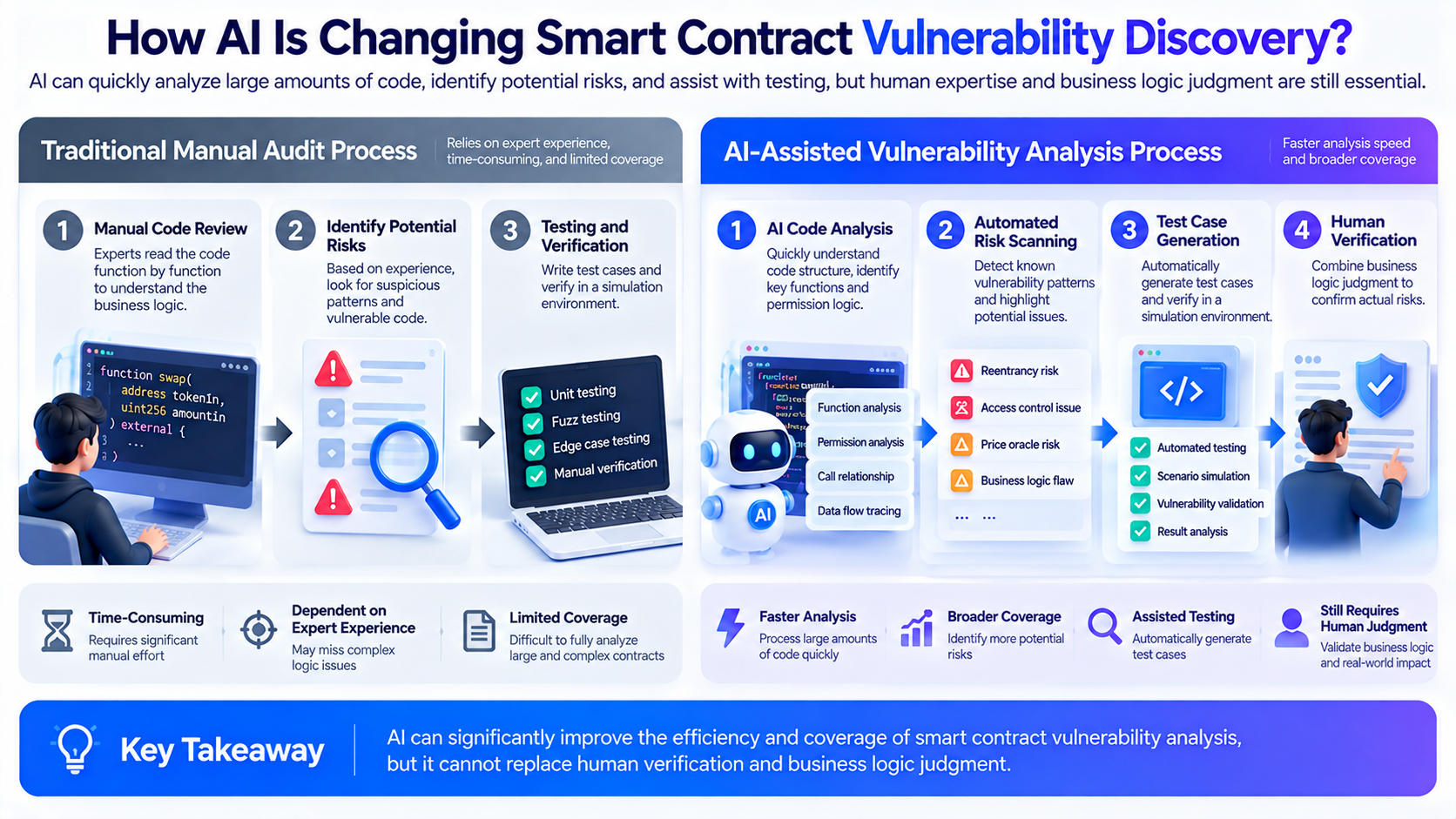
Smart contract vulnerabilities usually result from differences between code implementation and intended business rules. Because smart contracts directly manage on-chain assets, errors in critical logic may affect fund transfers, collateral liquidations, or protocol permissions.
AI can help analyze these logical relationships, particularly when checking large numbers of similar contracts, organizing complex function calls, and identifying recurring security issues.
Common smart contract risks include the following.
| Vulnerability Type |
Primary Risk |
Potential Role of AI |
| Access control flaws |
Unauthorized addresses call sensitive functions |
Assist with reviewing permission checks and role configurations |
| Reentrancy vulnerabilities |
Abnormal ordering of external calls and state updates |
Identify potential repeated-call risks |
| Oracle manipulation |
Incorrect prices affect trading and liquidation |
Analyze price dependencies and abnormal assumptions |
| Business logic flaws |
Errors in fund calculations, rewards, or liquidation rules |
Assist with reviewing complex business processes |
| Cross-contract interaction risks |
Unexpected behavior occurs between different protocols |
Organize call chains and external dependencies |
Business logic vulnerabilities deserve particular attention. Unlike obvious code errors, some vulnerabilities do not violate programming language rules. Instead, they exploit design flaws in a protocol's economic mechanisms. For example, a lending protocol's collateral valuation method may produce abnormal results under special market conditions. Even if each individual function executes normally, the overall fund management process may still have issues.
AI can help identify unusual patterns in code, but economic logic risks still need to be validated against actual business rules, on-chain data, and the transaction environment.
In addition, AI-assisted vulnerability research may develop into a continuous iterative process. A system can analyze code first, use testing feedback to determine whether a hypothesis is valid, and then adjust the direction of its analysis. This automated approach improves research efficiency, but it also means that security teams need to place greater emphasis on continuous testing rather than conducting a single check before contract deployment.
What Are Software Supply Chain Attacks, and Why Can They Bypass Smart Contract Audits?
A software supply chain attack is an attack method in which an attacker introduces malicious code into a target application through third-party packages, development tools, build processes, or external services. Unlike directly searching for smart contract vulnerabilities, this type of attack often uses software components that developers already trust as the entry point.
Modern crypto applications consist of more than on-chain smart contracts. A complete DeFi product typically also includes a front-end website, wallet connection tools, transaction data interfaces, JavaScript dependencies, server services, and automated deployment systems. Even if the on-chain contracts have passed an audit, an external component may still pose an independent risk.
For example, a decentralized exchange application may use a third-party wallet connection component. If malicious code is inserted into that component during a software update, users may receive transaction requests that differ from the expected requests even when they visit the legitimate website. In this case, the issue may not originate from the trading protocol itself. It may occur before the user interacts with the smart contract.
Software supply chain attacks can spread widely. If multiple projects use the same dependency package or front-end component, compromising a single component may affect multiple applications at the same time.
The Ledger Connect Kit incident in 2023 demonstrated this risk. Malicious code entered a wallet connection component through a compromised software release process and affected some decentralized applications that depended on related components. These incidents show that auditing smart contracts does not mean that the entire application environment accessed by users is protected to the same degree.
As open-source components and automated development tools become more widely used throughout the Web3 ecosystem, software supply chain security has become a defense area as important as smart contract security.
How Can AI Further Amplify Software Supply Chain Attack Risks?
AI coding tools can help developers quickly generate code, install dependencies, and configure development environments. However, without the necessary review, automated development may also increase potential risks in the software supply chain.
AI-generated code may reference software packages that have not been sufficiently verified or use outdated dependencies that are unsuitable for the current project. If developers accept generated results without review, they may introduce unnecessary security risks into the project.
AI Agents may have greater operating permissions than ordinary code completion tools. For example, some Agents can read project files, call command-line tools, access external services, and modify the development environment. When these capabilities are combined with untrusted third-party content, the risk is no longer limited to code quality.
One important issue is prompt injection. Attackers may attempt to embed malicious instructions in webpages, documents, code comments, or tool responses to induce an AI Agent to deviate from its original task. If the Agent lacks clearly defined permission boundaries, it may perform actions that the developer did not authorize.
These risks are particularly sensitive for crypto projects. Development environments may contain deployment credentials, RPC service keys, automated signing configurations, and other sensitive information. If an AI tool can directly access this content, external input may become an indirect entry point for influencing internal operations.
Therefore, software supply chain security in the AI era requires more than checking whether dependencies are trustworthy. It also requires confirming which files AI tools can access, which commands they can execute, and whether they can access real funds and critical credentials.
Why Can Asset Loss Still Occur After a Smart Contract Passes an Audit?
Smart contract audits are primarily used to assess security issues in a specific version of the code. The scope of an audit is usually limited by the contract version, business assumptions, and testing conditions. An audit can reduce the risk of known vulnerabilities, but it cannot guarantee that every part of a project will remain secure at all times.
The actual operation of a crypto application involves multiple interconnected systems. Smart contracts execute on-chain logic, front-end websites display transaction information, wallets authorize signatures, and development and operations teams manage upgrade permissions, configuration parameters, and external services.
A problem in any one of these areas may affect the security of user funds.
For example, a protocol's smart contract may have no obvious vulnerabilities, but its front-end website may be compromised. Users may see what appears to be a normal swap operation on the page, while the actual wallet request contains additional authorization content. If users do not verify the signing information, they may voluntarily grant attackers unnecessary permissions to operate their assets.
Another risk comes from administrator permissions. If an attacker obtains protocol upgrade permissions or control over critical configurations, they may use management functions that the contract already allows to change how funds are handled. In this case, the attack may not require exploiting a code vulnerability in the traditional sense.
Therefore, security measures need to cover multiple layers.
| Security Layer |
Primary Risks |
Key Defensive Measures |
| Smart contracts |
Logic errors, permission vulnerabilities |
Code audits, testing, formal verification |
| Front-end applications |
Page tampering, malicious signing requests |
Deployment integrity checks, anomaly monitoring |
| Software dependencies |
Malicious updates, dependency poisoning |
Version pinning, source verification |
| Development environments |
Credential leaks, privilege abuse |
Key isolation, least-privilege principles |
| Wallets and signing |
Phishing authorizations, incorrect transactions |
Signature verification, authorization management |
| Protocol operations |
Stolen administrator permissions, configuration errors |
Multisig, timelocks, continuous monitoring |
This also explains why simply increasing the number of smart contract audits cannot resolve every crypto security issue. Projects must also continuously manage software dependencies, development permissions, and user interaction environments.
What New Risks Can AI Agents Automatically Executing On-Chain Transactions Create?
AI Agents are evolving from information analysis tools into automated systems capable of calling external services, executing transactions, and managing digital assets. In some use cases, an AI Agent can query market information based on preset conditions, analyze asset prices, and execute operations through a wallet or trading interface.
This model can improve the efficiency of fund management, but it also means that AI systems may directly participate in asset transfers.
When a traditional chatbot provides incorrect information, the user usually needs to take further action before funds are affected. In contrast, if an AI Agent with on-chain execution capabilities has wallet authorization, it may directly turn an incorrect judgment into a transaction.
For example, an automated fund management Agent may determine whether to adjust asset allocations based on external data. If the data it reads has been tampered with or it cannot correctly identify risks associated with the target contract, it may execute an operation that does not match the user's expectations.
Another issue is the scope of permissions. If an Agent is granted unlimited token approvals or permission to operate large amounts of funds, a single incorrect execution could cause significant losses. By comparison, setting per-transaction limits, target address allowlists, and manual confirmation mechanisms may help control the potential impact.
Therefore, securing AI Agents requires more than improving decision-making accuracy. It also requires execution limits that operate independently of the model's decisions.
In practical designs, AI can analyze markets and propose transactions, while fund transfers should remain subject to clearly defined authorization rules. For high-risk transactions, unusual amounts, or interactions with unknown contracts, the system can require additional verification rather than relying entirely on the AI to make its own decision.
This will be an important issue to address as AI becomes integrated with on-chain finance.
Can AI Improve Security Defense in the Crypto Industry?
AI can also help security teams improve their defensive efficiency. For crypto projects that need to analyze large numbers of smart contracts, transaction records, and software dependencies, automated tools can reduce repetitive work and help researchers locate abnormal activity more quickly.
For smart contract security, AI can assist with code reviews, vulnerability classification, and test case design. Developers can use AI to understand complex function relationships and then combine static analysis, fuzz testing, and manual audits to validate potential issues.
For on-chain monitoring, AI can help identify unusual fund movements, sudden changes in transaction patterns, and behavior resembling historical attacks. This can be valuable to security teams that need to continuously monitor multiple protocols and asset pools.
For software supply chain management, AI can help organize dependency relationships, identify unusual version changes, and analyze how security advisories affect the current project.
However, AI defense tools also have problems with false positives, missed issues, and insufficient contextual understanding. Some normal transfers of large amounts may be incorrectly identified as attacks, while complex economic logic vulnerabilities may not be detected through conventional pattern recognition.
Therefore, AI is better suited to improving the efficiency of security teams than independently determining whether a protocol is secure. A complete defense system still requires a combination of automated testing, manual verification, continuous monitoring, and clearly defined access controls.
How Can Ordinary Users Protect Themselves Against Crypto Security Risks in the AI Era?
For ordinary users, the security changes brought by AI are mainly reflected in the easier generation of scam content, more convincing identity impersonation, and more deceptive malicious websites and fake transaction information.
Attackers can use AI to quickly generate phishing emails in multiple languages, impersonate customer support messages, and seemingly professional investment explanations. They may also use fake voices or videos to make identity impersonation appear more credible.
However convincing the information may look, asset losses generally still require a critical step, such as a user disclosing a private key, connecting to a malicious website, granting excessive permissions, or signing a transaction that does not match their expectations.
Therefore, users should focus their security checks on actual fund operations.
Access trading platforms and wallet applications through trusted channels. Avoid using login or wallet connection links provided in unfamiliar messages. Before signing a transaction, verify the destination address, transaction amount, and authorization details. Pay particular attention to unlimited approvals and interactions with unfamiliar contracts.
For token approvals that are no longer needed, conduct regular reviews and revoke unnecessary permissions. When holding significant amounts of digital assets, consider separating a wallet used for everyday transactions from a wallet used for long-term reserves to reduce the impact of a single security incident.
In addition, any purported customer service or technical support representative who asks users to provide a seed phrase, private key, or recovery phrase should be treated as a major risk signal. Even if the other party uses convincing voice, video, or professional terminology, this does not replace independent identity verification.
The basic principles of user security have not fundamentally changed in the AI era. What matters is verifying transaction details, controlling fund permissions, and avoiding reliance on unverified information for asset security.
How Will the Crypto Security Framework Develop in the AI Era?
As AI tools gradually become involved in software development, vulnerability research, and on-chain transactions, crypto security is shifting from point-based protection to end-to-end process protection.
In the past, some projects relied primarily on smart contract audits conducted before deployment, hoping to reduce risks through code reviews. However, in complex Web3 applications, security issues may occur in software dependency updates, front-end deployments, administrator operations, user signatures, and other areas.
In the future, security checks will need to more closely reflect the actual process of executing transactions with real funds.
For smart contracts, projects need to conduct comprehensive testing before deployment and continuously monitor abnormal transactions during operation. For software supply chains, development teams need to verify dependency sources, restrict the permissions of automated tools, and protect deployment credentials and critical keys.
For AI Agent-driven on-chain applications, clear security boundaries need to be established between model decisions and actual transaction execution. For example, transaction amount limits, target address checks, anomalous behavior suspension, and manual approval mechanisms can all reduce the impact of incorrect automated execution.
At the same time, security teams need to assess whether AI tools themselves are reliable. Whether a model can correctly process untrusted data, whether tool calls exceed authorized permissions, and whether automated decisions are traceable will all become new areas of security assessment.
Therefore, AI's long-term impact on the crypto industry is not only that it gives attackers more powerful tools. It is also driving security protection away from one-time audits and toward continuous verification.
Conclusion
AI is changing the efficiency and risk structure of crypto attacks. Large language models and automated Agents can assist with code analysis, vulnerability research, and information processing, reducing the cost of some attack preparation activities. However, this does not mean that all complex attacks can be fully automated.
Smart contract vulnerabilities remain an important source of risk, while software supply chains, developer permissions, front-end applications, and wallet signatures can also directly cause asset losses. As AI Agents gain more tool-calling and fund operation permissions, security issues will extend further into automated execution and access control.
For developers, AI can improve the efficiency of audits and monitoring, but it must be combined with traditional security testing, dependency management, and manual review. For ordinary users, verifying transaction details, protecting private keys, and limiting the scope of authorizations remain important measures for preventing asset losses.
Crypto security in the AI era is shifting from simply protecting smart contract code to protecting the entire process, from software development and third-party dependencies to on-chain fund execution. The ability to establish continuous, layered, and verifiable security mechanisms will become an important competitive factor for Web3 applications in the future.
FAQ
Will AI Make Cryptocurrencies More Vulnerable to Hacking?
AI may reduce the cost of some vulnerability analysis, information gathering, and attack preparation activities, but whether an attack succeeds still depends on system vulnerabilities, permission conditions, and defensive measures.
Can AI Automatically Discover Smart Contract Vulnerabilities?
AI can help identify potential vulnerabilities, and some research has demonstrated the ability of AI Agents to discover and exploit vulnerabilities in test environments. However, models may still produce false positives or miss issues and cannot replace a complete security audit.
What Is a Software Supply Chain Attack?
A software supply chain attack is an attack in which an attacker introduces malicious code into a target application through third-party dependencies, development tools, build systems, or other software delivery processes.
Why Can Smart Contracts Still Be Hacked After an Audit?
Audits typically assess specific contract code and assumptions. They cannot automatically eliminate risks such as front-end tampering, private key leaks, malicious dependencies, or incorrect user authorizations.
Is AI-Generated Smart Contract Code Secure?
It cannot be assumed to be secure. AI-generated code may contain business logic errors, permission flaws, or inappropriate dependencies. It needs to undergo testing, review, and, when necessary, a professional audit.
What Are the Security Risks of AI Agents Automatically Trading?
The main risks include incorrectly executing transactions, excessive authorization, using untrusted external data, and transferring more funds than expected without manual confirmation.
Can AI Be Used for Crypto Security Defense?
Yes. AI can assist with code reviews, abnormal transaction analysis, threat intelligence organization, and software dependency checks, but it needs to be combined with other verification methods.
How Can Ordinary Users Protect Themselves Against AI-Generated Phishing Attacks?
Access platforms through trusted channels, verify transaction details, protect seed phrases and private keys, and avoid granting unnecessary token permissions to unfamiliar websites.
Can Software Dependency Vulnerabilities Affect User Wallets?
They can. If a malicious dependency enters a wallet connection component or front-end application, it may affect transaction displays, signing requests, or sensitive data processing.
Will AI Replace Manual Smart Contract Audits in the Future?
There is currently insufficient evidence that AI can completely replace manual audits. A more practical approach is to use AI to improve analysis efficiency while retaining human judgment, automated testing, and continuous monitoring.