In modern corporate finance and capital market theory, companies allocate capital expenditures (Capex) with close attention to the dynamic balance between return on invested capital (ROIC) and free cash flow. Yet amid the historic transformation driven by artificial intelligence, global technology giants are demonstrating an unprecedented approach to capital allocation: to secure a dominant position in AI infrastructure and large-model ecosystems, companies are breaking with traditional financial conservatism and substantially increasing long-term capital expenditures, even under intense pressure on short-term free cash flow.
This shift toward an asset-heavy model, driven by AI capital expenditures, is fundamentally changing the capital structures and financing instruments of traditional technology giants, including the issuance of new nonvoting shares and long-term bonds. It is also triggering significant shifts in financial data and cross-market volatility at the macro level. When traditional equity markets diverge over the tension between high spending and long payback periods, these macro liquidity shocks inevitably spread through risk-appetite transmission channels, with far-reaching effects on global crypto asset markets, including Bitcoin. This article examines the financial foundations of AI capital expenditures through the lenses of corporate finance, financing structures, and cross-market transmission.
Key Takeaways
-
Examine the structural pressure that AI capital expenditures place on traditional technology companies' free cash flow (FCF) and operating margins
-
Analyze how companies shift their financing strategies under substantial spending pressure, including nonvoting share issuance, debt financing, and a broader range of capital instruments
-
Explain how expectations of expanding AI capital expenditures transmit to global traditional financial and crypto markets through risk appetite and liquidity channels
-
Explore the evolving role of crypto assets such as Bitcoin as macro inflation hedges and trustless settlement anchors amid changes in the real economy and technology giants' capital expenditures
-
Analyze complementary approaches to asset allocation and risk hedging during cross-market volatility using Gate's spot trading and asset management ecosystem
Free Cash Flow Pressure and Evolving Financing Instruments: The Financial Leverage Behind AI Capital Expenditures
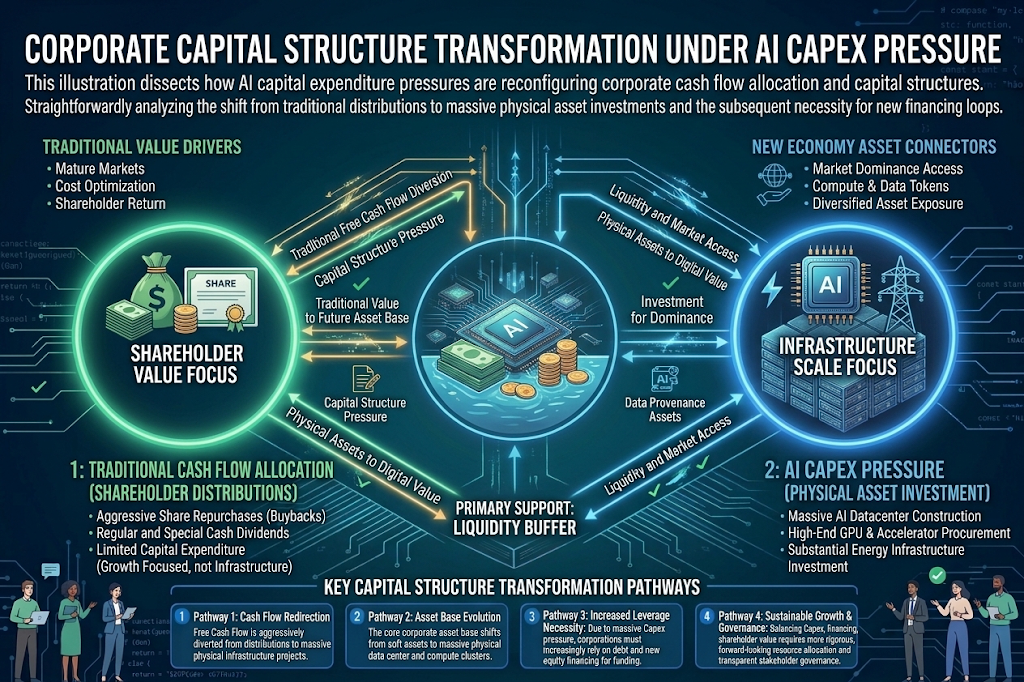
In traditional technology company valuation models, high-tech businesses typically command substantial valuation premiums because of their asset-light operations and strong cash flow. However, the surge in AI capital expenditures is fundamentally disrupting this established model.
As technology giants invest hundreds of billions of dollars in data center construction, outright purchases of computing hardware, and long-term power contracts, their financial statements undergo profound changes. The table below compares the underlying financial logic of the traditional software model with that of the AI capital expenditure model:
| Model Type |
Capital Expenditure Characteristics |
Cash Flow and Financial Performance |
Capital Returns and Valuation Logic |
| Traditional software model |
Low capital expenditure requirements |
High free cash flow (FCF) |
Returns capital to shareholders through share buybacks and dividends, supporting a high valuation premium |
| AI capital expenditure model |
Extremely high capital expenditures |
Short-term pressure on and compression of free cash flow |
Relies on capital structure reorganization and innovative refinancing, with valuations subject to reassessment |
To raise tens or even hundreds of billions of dollars in additional infrastructure funding without eroding founders' control or indiscriminately increasing leverage, corporate finance teams must pursue innovative capital structure reorganizations. These include issuing nonvoting Class C equity instruments, signing exceptionally long-term equipment leases, and issuing green bonds dedicated to AI projects. This growing complexity in capital structures reflects how physical infrastructure development in the AI era has exceeded the funding capacity of any single company's operating cash flow. It is becoming a macro financial undertaking that requires extensive reallocation across capital markets throughout the broader economy.
Debt Leverage and Balance Sheet Restructuring: Testing Financial Limits in the AI Arms Race
As AI capital expenditures continue to expand, technology giants' balance sheets are undergoing an unprecedented stress test. In the past, asset-light models dominated by software and internet businesses gave technology companies strong risk resilience and very low net debt levels. However, internal free cash flow alone is now far from sufficient to cover the funding gap created by expensive GPU purchases and gigawatt-scale data center construction. This forces financial management teams to turn to external debt markets, raising substantial funds through large-scale issuance of corporate bonds and green bonds, or through structured financing instruments. The sharp increase in leverage exposes technology giants to considerable interest expense pressure amid fluctuating macro interest rates. Capital market analysis is also rapidly shifting from a narrow focus on revenue growth to an assessment of the balance between ROIC and interest coverage ratios. This balance sheet restructuring tests companies' financial resilience while fundamentally changing the supply and demand for funds across equity and global bond markets. It has consequently become an important macro indicator affecting both risk assets and safe-haven assets worldwide.
Cross-Market Transmission: Diverging Views in Traditional Finance and Crypto Assets' Macro Hedging Properties
AI capital expenditures do more than restructure individual companies' finances. Through interconnected risk appetite across capital markets, they also create a pricing transmission mechanism spanning the broader financial system and global asset classes.
When public market investors periodically question technology giants' high-spending, slow-payback earnings models, equity market volatility often triggers short-term capital flows into safe-haven assets or more liquid instruments. This cross-market transmission typically follows the sequence below:
-
Valuation reassessment and renewed contraction in risk appetite: Cash flow concerns caused by high capital expenditures lead public markets to reprice highly valued technology sectors, prompting short-term outflows from risk assets.
-
Reassessment of macro liquidity and the interest rate environment: Large-scale corporate bond and equity financing absorbs substantial marginal market liquidity, putting pressure on risk-free interest rates across capital markets.
-
The dual characteristics of crypto assets: As a global market that trades continuously, 24/7, crypto assets—represented by Bitcoin (BTC)—display a distinctive dual character within this transmission mechanism. On the one hand, during short-term liquidation cycles, their risk appetite remains closely linked to that of global technology risk assets. On the other hand, from a longer-term, sector-level perspective, inflation concerns associated with traditional credit systems and equity dilution further reinforce Bitcoin's underlying value as hard money with a fixed supply cap and no intermediary counterparty risk.
This financial transmission mechanism shows that capital competition in the AI era extends beyond technology giants. It is also deeply reflected in the interaction between traditional fiat capital markets and decentralized crypto financial systems.
Asset Allocation Amid a Financial Paradigm Shift and the Complementary Strengths of the Gate Ecosystem
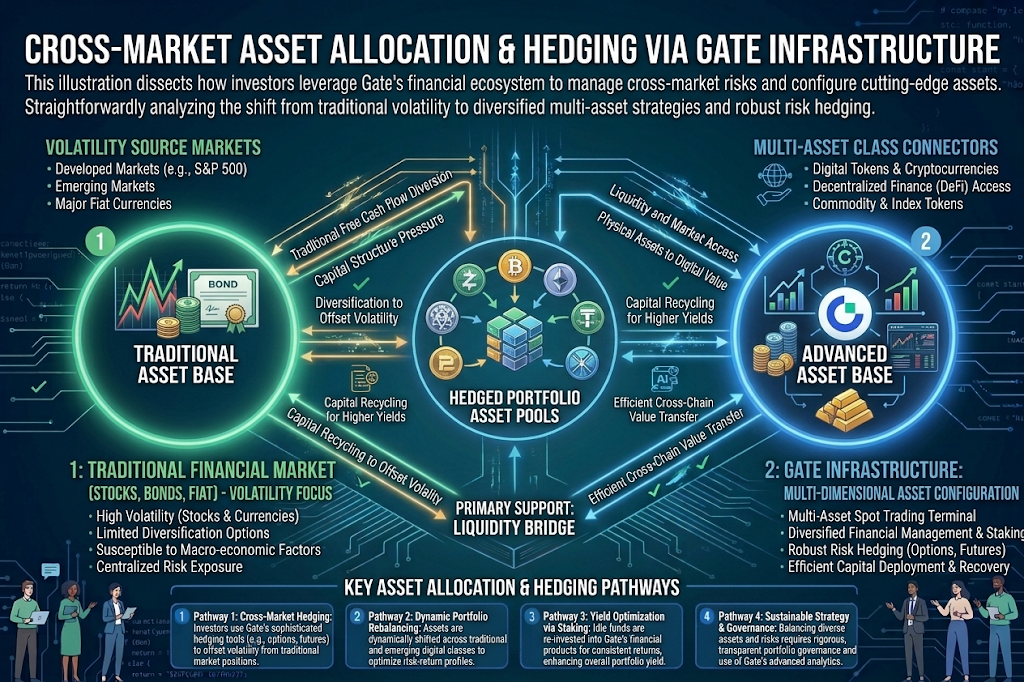
As global macro capital markets undergo extensive rebalancing and technology giants' capital expenditure restructuring drives asset volatility, investors increasingly need asset management solutions with a cross-market perspective. Single-market allocation strategies are no longer sufficient to withstand the shocks caused by sharp contractions and expansions in global macro liquidity.
Against this backdrop, mainstream crypto asset trading platforms demonstrate substantial value as financial hubs. Gate, for example, is a leading global crypto asset trading platform that offers highly liquid spot trading in core large-cap assets such as BTC and ETH. It also provides a diverse range of hedging tools, investment and lending products, and a one-stop asset allocation offering covering emerging DePIN/AI sectors.
Through Gate, users can conveniently participate in the development of underlying crypto infrastructure tokens driven by AI capital expenditures. They can also flexibly use the platform's spot and derivatives ecosystem to manage cross-market liquidity shock risks and pursue steady asset growth. By combining a secure, compliant custody environment, a broad range of assets, and efficient cross-market trading capabilities, Gate provides global users with a solid foundation for risk hedging and value preservation amid major changes in the macro financial environment.
FAQ
Why can rising AI capital expenditures (AI Capex) cause short-term volatility in traditional technology stocks?
Substantial capital expenditures directly compress companies' short-term free cash flow (FCF) and operating margins. If markets do not see a corresponding surge in revenue in the short term, investors may become concerned about declining return on invested capital (ROIC), triggering a valuation correction.
What potential effects could technology giants' AI capital expenditure financing strategies have on crypto markets?
Massive financing needs absorb some of the marginal liquidity in traditional markets and tighten overall risk appetite in the short term. Over the long term, however, this capital expansion advances computing capacity and infrastructure development. It also encourages some capital to seek crypto assets as decentralized tools for macro risk protection and hedging.
How can individual investors use Gate to respond to macro cross-market volatility and gain exposure to the AI sector?
Investors can use Gate's spot market to gradually allocate to foundational hedging assets such as BTC and high-quality AI/DePIN infrastructure assets. They can also combine these allocations with the platform's conservative investment products and risk hedging tools to reduce single-market volatility risk while pursuing steady long-term asset appreciation.