As Generative AI and large language models (LLMs) evolve rapidly, the AI application paradigm is undergoing a profound transformation. AI is no longer limited to simple text generation, image creation, or passive question-and-answer responses. Instead, it is rapidly advancing toward “AI Agents” with autonomous perception, goal decomposition, decision-making, and cross-system execution capabilities. Through this shift, the core requirement for AI systems is moving beyond computational breakthroughs toward autonomous execution boundaries and infrastructure security.
However, traditional centralized internet architectures create inherent bottlenecks for the broader adoption of AI Agents. Although centralized cloud servers provide substantial computing power, tasks involving asset management, identity verification, and cross-application collaboration remain vulnerable to opaque operations, data tampering, and single points of failure. Combining AI Agents with blockchain technology can provide agents with tamper-resistant on-chain identities while creating a transparent, verifiable, and secure decentralized execution environment.
Talus is a representative innovative infrastructure project in this emerging field. For Gate users interested in the intersection of AI and Web3, understanding Talus requires more than applying crypto market trading logic. It also requires examining how its technical architecture, autonomous computing model, and intelligent ecosystem development bridge the gap between AI and on-chain execution. This article provides an in-depth technical analysis and outlook on the ecosystem through the lens of decentralized AI Agent networks.
Key Takeaways
-
Advance AI from centralized cloud-based Q&A toward a trusted, on-chain autonomous execution model for intelligent agents
-
Build a decoupled decentralized automation engine that overcomes the limitations of traditional smart contracts, which rely on external triggers
-
Use Move’s resource-oriented security model to provide secure isolation for AI Agent cross-protocol calls
-
Create a decentralized agent collaboration network that enables efficient, seamless Agent-to-Agent computational workflows
-
Integrate computing consumption, validator staking, and governance mechanisms to establish a sustainable decentralized AI value model
-
Major trading platforms such as Gate provide a window into these technological innovations, but technical implementation and value creation still require rational evaluation
The Evolution of On-Chain AI Agents and Talus’ Technical Architecture
Before exploring Talus’ core design, it is important to understand why AI Agents are inevitably moving from conventional cloud environments to blockchain networks. Under traditional centralized AI architectures, an AI assistant that performs complex tasks for users—such as automatically transferring assets across platforms or signing contracts—must obtain the user’s sensitive private keys or API keys and perform logical computations on centralized servers. This design is highly susceptible to malicious human tampering, cyberattacks, or unexpected platform outages.
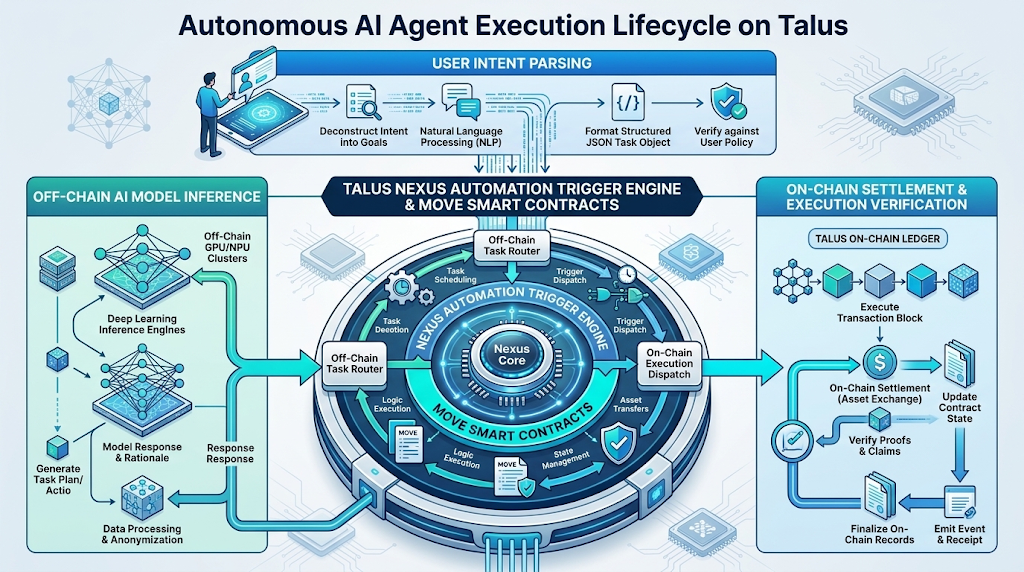
Talus is positioned as a decentralized AI Agent automation layer, known as the Autonomous Execution Layer. Rather than retraining massive neural network models on-chain, it converts model inference outputs into discrete instructions that can be verified, scheduled, and securely executed on blockchain networks. By placing computation-intensive model inference off-chain or on decentralized computing networks while binding autonomous logic, asset permissions, and trigger conditions on-chain, Talus efficiently decouples intelligence at the edge from trust on-chain.
Within this architecture, every AI Agent is designed as an autonomous agent with an independent on-chain identity and defined permission boundaries. For Gate users, Talus can be understood as a neural hub connecting an AI brain to blockchain-powered mechanical arms. It enables AI programs to gain decentralized asset operation permissions and trusted execution guarantees.
Talus’ Core Automation Engine and Move Security Framework
To enable highly reliable on-chain AI Agents, a network must address two major technical challenges: enabling autonomous triggers without human intervention and ensuring that AI Agents do not lose control or become maliciously compromised when granted asset operation permissions.
Autonomous Trigger Mechanism of the Nexus Automation Engine
In traditional blockchain architectures, smart contracts are passive and require an external account (EOA) to submit a transaction before triggering a state change. Talus’ Nexus automation engine overcomes this limitation. By deploying event monitoring and time-based triggers across a decentralized node network, it allows AI Agents to automatically activate transaction instructions based on configured real-time data inputs or logical conditions.
This autonomous trigger mechanism allows AI Agents to execute continuously, 24/7, without manual supervision. For example, an AI Agent responsible for automated market making or risk hedging can automatically call smart contracts to close or add to positions the moment market volatility reaches a predefined threshold, significantly improving system responsiveness and execution efficiency.
Resource Isolation and Reentrancy Protection in the Move Stack
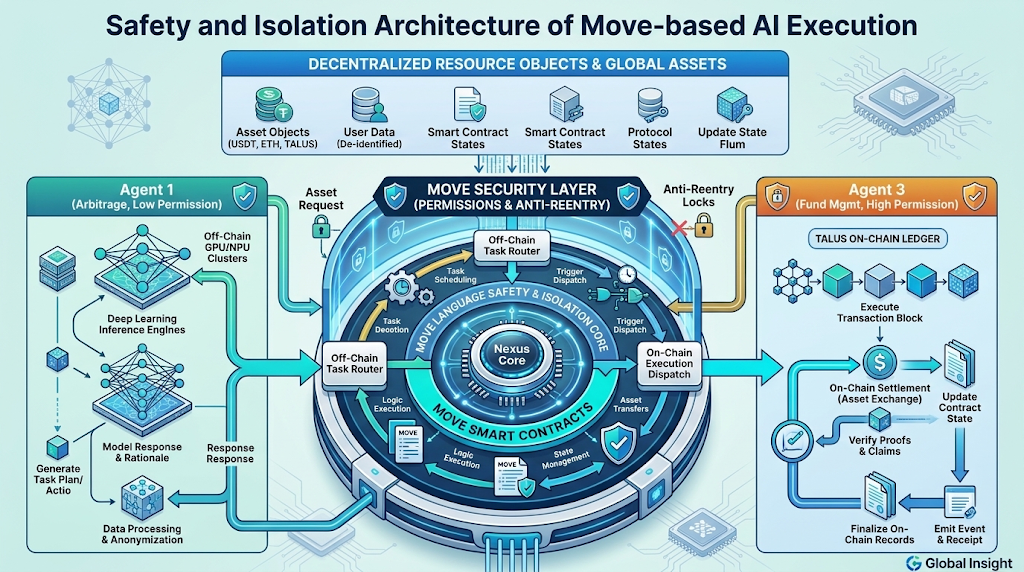
When AI Agents frequently call different protocols on-chain, the primary risks involve unauthorized operations and smart contract vulnerability exploits. Talus has selected Move, a programming language known for its resource-oriented design and high security, as its smart contract development stack.
Unlike traditional EVM smart contract architectures, Move directly defines assets and states as resources that cannot be copied or implicitly discarded. This underlying design prevents common reentrancy attacks and asset double-spending risks at the code level. When an AI Agent executes instructions on the Talus network, its granted permissions are strictly limited to specific resource objects. Even if an AI model produces abnormal instructions, it cannot bypass the established code-level security safeguards.
An In-Depth Comparison Between Traditional Cloud AI Systems and Decentralized AI Agent Networks
From the perspective of technological evolution, decentralized AI Agent networks are not simply replacements for traditional cloud AI. Instead, they complement and enhance conventional systems in security, collaboration, and trustworthiness.
In terms of computation and trust models, traditional centralized cloud AI systems operate as complete black boxes and rely heavily on full trust in a single cloud service provider. In contrast, the Talus decentralized AI Agent network makes logic and state changes fully public on-chain, enabling computational results to be verified.
Regarding identity and asset permissions, traditional cloud AI systems do not have independent on-chain identities. Their private key management and asset operations often depend on centralized custodians. Agents in the Talus network, however, have decentralized digital identities (DIDs) and can achieve autonomous management through smart contracts.
In terms of system resilience, traditional cloud systems face risks such as server outages, single points of failure, and data leaks. Decentralized networks, by comparison, rely on globally distributed node redundancy to eliminate single points of failure and provide blockchain-level global censorship resistance.
For agent collaboration efficiency, cross-platform API integration in traditional AI systems is highly complex, creating significant barriers to data and asset flows. Leveraging blockchain’s inherent composability, Talus can enable seamless on-chain collaboration between Agents.
A closer examination of these differences shows that the greatest advantage of decentralized networks lies in restructuring economic collaboration among agents. Under traditional systems, AI bots developed by two different companies struggle to directly settle value without third-party guarantees. In the environment created by Talus, AI Agents can automate service calls and real-time micropayments through smart contracts, creating a closed-loop commercial model and laying the groundwork for a future autonomous AI economy.
Timing and Risk Management From a Technology Evolution Perspective
For technology enthusiasts and investors following cutting-edge AI and Web3 sectors on platforms such as Gate, decentralized AI Agent technology may present a highly ambitious vision of the future. However, an objective and rigorous approach remains essential throughout project implementation.
During the early stages of project development, attention should focus on infrastructure maturity. Investors should continuously monitor Talus’ actual progress in the completeness of its SDK toolchain, mainnet performance test throughput (TPS), and developer ecosystem development, while remaining alert to projects that emphasize narratives over implementation.
When the industry experiences major AI breakthroughs or market sentiment becomes elevated, it is important to calmly assess whether a project has genuine demand for agent calls and a complete token consumption cycle. When exploring related innovative assets on Gate, consider rational measures such as building positions in stages and setting stop-loss alerts. Carefully manage personal risk exposure and clearly separate the long-term benefits of technological progress from short-term market price fluctuations.
FAQ
What is the fundamental difference between decentralized AI Agents and traditional AI chatbots?
Traditional AI bots primarily remain at the stages of reading and generating information. They do not have the ability to securely hold assets on behalf of users or autonomously trigger execution. Decentralized AI Agents, in contrast, have independent on-chain identities and asset operation permissions, allowing them to autonomously execute complex logic on blockchain networks in response to changes in external conditions.
How does Talus ensure that AI Agents do not lose logical control when executing tasks?
Through Move’s underlying resource-oriented architecture and strict permission constraints in the Nexus automation layer, Talus limits the operational scope of AI Agents to defined code-level security boundaries, preventing unauthorized operations or the execution of malicious logic.
What key metrics are worth tracking over the long term when following AI infrastructure such as Talus?
Key metrics include the number of active AI Agents in its ecosystem, the download and usage frequency of developer tools (SDKs), the number of decentralized nodes, and the actual daily fees generated by automated computation on the network.