Foreword
For years, the primary entry point for enterprise AI has been the chat box: employees ask models questions, generate content, organize information, and then move the results back into existing software and workflows. This approach has improved individual productivity, but it has not fundamentally changed the structure of enterprise software. The next phase worth watching is AI Agents moving into the workflows themselves. They do not simply answer questions—they understand objectives, call tools, read enterprise data, execute multistep tasks, and hand exceptions off to people when needed. Microsoft’s 2026 Work Trend Index found that the number of active Agents in the Microsoft 365 ecosystem grew 15x year over year, with growth among large enterprises reaching 18x. At the same time, only 19% of AI users qualify as “Frontier” users, with both strong individual capabilities and high organizational readiness. Together, these figures show that AI’s bottleneck is shifting from “Can the model do it?” to “Can the enterprise enable it to work reliably?”
Key Takeaways
-
The core value of an AI Agent is not another chat interface, but moving software from “recording work” to “executing work”
-
The competitive moat in enterprise AI is shifting from the capabilities of a single model to data, permissions, workflows, system connections, and evaluation frameworks
-
As Agents become more widespread, traditional seat-based software pricing may increasingly incorporate usage-, task-, or outcome-based fees
-
Enterprises that want to deploy Agents at scale must redesign approvals, accountability, quality control, and human-machine handoffs—not simply add another AI feature
-
The more capable the model, the more important governance and observability become. AI security will evolve from an peripheral requirement into a core part of enterprise software infrastructure
The Real Change in AI Software Is Not Another Chat Box
Most enterprise AI products from the past few years still follow a familiar model: software stores data and provides interfaces and workflows, people make judgments, click, and execute, while AI serves as a new interaction layer that helps them complete certain steps faster. Whether the task is writing emails, generating sales summaries, organizing meeting notes, or helping programmers write code, the basic arrangement is the same: people remain responsible for the main process, while the model improves efficiency in specific areas. This model is easy to adopt because it does not disrupt an enterprise’s existing chain of accountability or software architecture. That same constraint, however, also makes its value ceiling relatively clear.
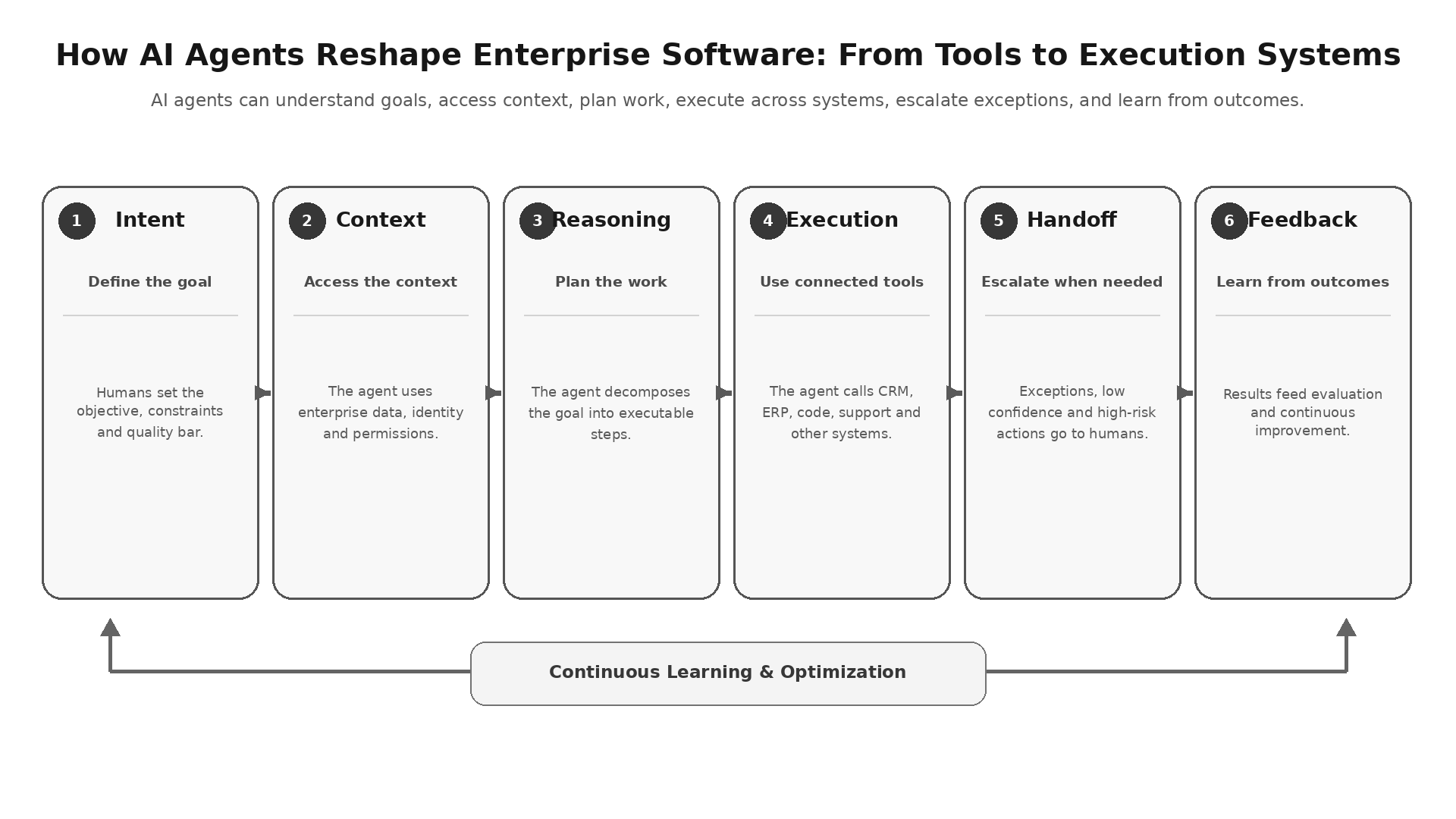
Agents change this by pushing AI from “assistant” toward “executor.” When an Agent can read customer information, check inventory, call a CRM, generate a quote, initiate an approval, and continue to the next step based on the outcome, it is no longer handling an isolated task. It is handling a workflow. Microsoft’s 2026 Work Trend Index describes this shift as a move from collaboration to delegation and orchestration, noting that more mature enterprises are turning Agent workflows, human handoffs, and quality standards into repeatable organizational processes. In other words, software’s value is beginning to shift from “making operations easier for people” to “moving work forward on its own.”
That is why enterprise software competition should not be judged solely by which product has the most polished chat interface or which model gives the smartest answers. The more important questions are whether the Agent understands the business context, can access the right data and systems, can act within its permissions, can detect anomalies, can route tasks to the right people, and can leave a traceable record throughout the process. The model is the engine, but enterprise software is ultimately competing as the whole vehicle—not on engine specifications alone.
Workflows Will Become the Most Important Product Asset in the Agent Era
The core assets of traditional SaaS are often its feature set and user interface. Enterprises buy CRM, ERP, customer service, and project management software because these systems standardize business processes and serve as the organization’s digital record. The arrival of Agents does not diminish the importance of these systems. If anything, it may increase it: the more tasks an Agent can execute, the more it needs a stable, structured business environment with clearly defined permissions. Even access to the most powerful model will not turn an Agent into a productivity engine if the enterprise lacks reliable data, interfaces, and rules.
As a result, software competition in the Agent era will undergo an interesting shift. In the past, software vendors wanted users to spend as much time as possible in their interfaces. In the future, it may matter more whether Agents can call capabilities across systems. An effective enterprise Agent does not necessarily need employees to open its interface every day. It may work in the background, reading email, CRM, knowledge bases, financial systems, and ticketing platforms before completing a sequence of actions. A product’s “front-end traffic” may therefore not equal its “back-end value.” What matters is whether it can serve as a trusted execution node within a workflow.
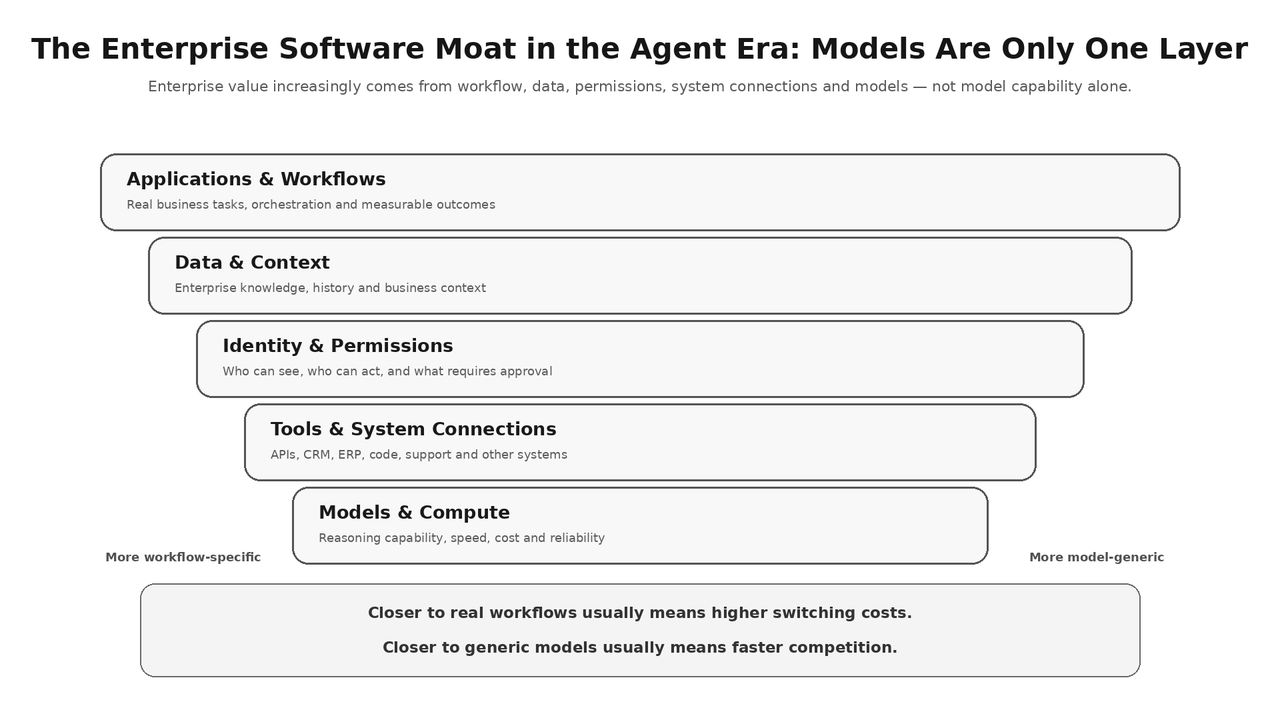
This will redefine the moat of enterprise software. Data integrity determines whether an Agent can make sound decisions. The permission system determines what it can do. APIs and tool connections determine which systems it can reach. Workflow rules determine the order in which it should act. Historical results determine whether the system can keep improving. SaaS competition used to be feature versus feature. Increasingly, it will be workflow versus workflow. Whoever controls critical business processes will have the best chance of becoming Agent infrastructure rather than being bypassed by Agents.
Data, Permissions, and Context Will Become New Software Moats
Once Agents enter enterprise production environments, the biggest challenge is usually not generating text. It is deciding exactly what an Agent should know and what it is allowed to do. A sales Agent needs a customer’s history, contract status, and pricing permissions. A finance Agent needs access to accounting data but must not freely modify payment accounts. An IT Agent may perform system maintenance but must not bypass security approvals. The model itself does not solve these problems automatically. It depends on the enterprise’s data governance and permission systems.
Enterprise AI infrastructure will therefore gradually develop a new “context layer.” This includes not only the information provided to the model, but also the current task, the user’s identity, organizational policies, the tools it may call, the actions that require approval, and the results that require human review. Microsoft’s 2026 research found that organizational factors contributed more than twice as much as individual factors to AI’s impact. This reveals a crucial fact: AI productivity depends not only on whether employees have model accounts, but also on whether the enterprise has built an environment where models can work reliably.
From this perspective, the value of enterprise software will increasingly come from the combination of four layers: data, permissions, context, and execution. Model providers can continue upgrading their models, but internal business data, process rules, and permission structures are not easily migrated. That is why software companies with durable moats may not be those with the strongest model capabilities. They may instead be the companies that understand enterprise workflows best, control high-quality business data, and can connect Agents securely to core systems.
Software Business Models May Shift From “Selling Seats” to “Selling Workloads”
Agents may have a deeper impact on the SaaS business model than on product functionality. Traditional enterprise software typically charges by user seat because its value is tied to the time employees spend using the software and the permissions attached to its features. But if an Agent can continuously execute tasks in the background, “how many people log in” will no longer be the only measure of value. Enterprises may care more about how many customer requests were handled, reviews completed, qualified leads generated, tickets resolved, and coding tasks finished.
Software pricing may therefore increasingly incorporate usage, task volume, call volume, and even outcome value. Similar trends are already emerging: some enterprise software companies are linking AI services to usage rather than treating Agents as an unlimited add-on included in every plan. The discussions around usage-based AI pricing promoted by companies such as Atlassian reflect the same fundamental question: when software starts performing work for an enterprise, the traditional “one account per person” pricing model becomes increasingly inadequate for describing the product’s value.
Of course, outcome-based pricing does not mean SaaS will disappear overnight or that all enterprise software will become purely consumption-based. Enterprises will still need stable software systems, data storage, permission management, and compliance capabilities. A more realistic evolution is likely to be a hybrid model: the foundational platform continues to charge by subscription, Agents charge by usage or task volume, and high-value automation adds outcome-based pricing. For software companies, this could unlock new revenue opportunities, but it could also make revenue volatility, cost control, and customer ROI management more complex.
The More Powerful Agents Become, the More Enterprises Need to Redesign Their Organizations
A common mistake enterprises make when deploying AI is to treat an Agent as a new employee—or as a more capable Copilot—while retaining the existing organizational structure and KPIs. But once an Agent genuinely starts executing work, the old processes themselves may become the biggest bottleneck. An enterprise, for example, may allow AI to automatically organize customer information while still requiring employees to copy data manually across five systems. AI may complete an initial review, yet the organization may continue using layers of approval designed for human workers. The result is a faster model, but not a faster organization.
The “Transformation Paradox” highlighted in Microsoft’s 2026 Work Trend Index is especially telling: 65% of AI users worry that they will fall behind if they do not use AI, but only 13% of respondents said they had been rewarded for redesigning their work. This points to a structural contradiction across enterprises: employees are expected to use AI, but are not truly empowered to change how work is done. The value of Agents will ultimately depend on whether organizations are willing to redefine roles, responsibilities, and handoffs—not simply buy more tools.
Mature enterprises will therefore place greater emphasis on “human-machine collaboration protocols.” Which tasks should be fully automated? Which require human confirmation? Under what circumstances must an Agent stop? Who owns the final result? How should exceptions be escalated? How should errors be reviewed? All of these questions must be clearly defined in the workflow. In high-risk industries, these mechanisms may even become core purchasing criteria. An Agent is not simply replacing a role; it is redrawing the boundaries of the tasks within that role.
AI Security Will Evolve From an Add-On Capability Into Enterprise Software Infrastructure
When an Agent only answers questions, an error usually appears as an inaccurate piece of text. When an Agent can access systems and execute actions, the nature of the error changes completely. It could modify data incorrectly, send information to the wrong recipient, trigger a transaction improperly, or even cause a security incident if permissions are misconfigured. Enterprises therefore need not an “always correct” model, but a system that keeps errors within controllable limits.
That is why stronger AI capabilities will also drive greater governance requirements. In September 2026, OpenAI Chief Scientist Jakub Pachocki publicly warned in An Alien Mind that current frontier models can already operate computers, collaborate with humans and other AI systems, and conduct research. He argued that the industry needs to approach the continued rapid advancement of machine intelligence more cautiously. Earlier OpenAI research likewise emphasized that as Agents take on more complex and autonomous tasks, the need for reliable oversight will continue to grow. The issue enterprises should focus on is not an extreme scenario such as “Will AI suddenly become uncontrollable?” but a practical engineering question: As system capabilities grow stronger, does the enterprise have monitoring, permission, and auditing capabilities of equal strength?
Agent infrastructure will therefore increasingly resemble traditional financial or cloud computing infrastructure. Identity verification, access control, logs, evaluation, anomaly detection, human takeover, and security policies must all become standard components. When procuring Agents, enterprises may ask not only “What can it do?” but also “Why did it do this? Who can stop it if something goes wrong? Who approved this operation? Can the system be fully reviewed afterward?” This will create a new generation of AI governance, evaluation, and security products, while gradually embedding these capabilities into mainstream enterprise software.
The Real Competition Will Shift From Model Capabilities to System Capabilities
Breaking down the full enterprise Agent stack reveals a structure more complex than model competition. Computing power and models form the foundation; data, context, identity, permissions, and tool connections form the middle layer; and specific workflows and applications sit at the top. The market has focused on foundational models because their capabilities determine whether AI can perform tasks. But as those capabilities become broadly available infrastructure, the areas enterprises are truly willing to pay for will increasingly move closer to business execution.
This does not mean model companies will lose their value. On the contrary, models remain the intelligent core of the system, and their reasoning capabilities, speed, cost, and reliability directly affect Agent economics. But a model’s advantage may come to resemble computing resources in the cloud computing era: important, but not necessarily sufficient to determine the full value of the final product. Microsoft’s recent restructuring of its financial reporting into categories such as “Agents and Infra” also suggests that AI is recombining previously separate software, cloud, and Agent capabilities into a more complete commercial system.
From an industry competition standpoint, the key question will not be who builds the Agent that chats best, but who can turn an Agent into a stable production system. It must understand enterprise data, execute across systems, know the boundaries of its permissions, provide clear human-machine handoffs, and continuously improve through real-world work outcomes. Once such a system enters an enterprise’s core processes, switching costs will be high, and its value will be more durable than that of a standalone chat product.
The Long-Term Destination of AI Agents Is to Redefine Software Itself
The central theme of the software industry over the past several decades has been digitizing more and more human work: first putting information into databases, then turning processes into software, and finally connecting that software through the internet and cloud computing. Agents may drive the next stage. Software will no longer merely store information and provide tools; it will begin to understand objectives and proactively complete tasks. In other words, software will gradually evolve from a “tool people use” into a “system that participates in work.”
This shift could change how enterprises measure software value. In the past, enterprises bought software to make employees more productive. In the future, they may buy Agent systems with the direct expectation that a given task will be completed by fewer people and in less time. The distance between software value and business outcomes will therefore shrink. If a CRM merely helps salespeople record customer information, its value primarily comes from management efficiency. If an Agent can automatically identify high-potential customers, schedule outreach, update records, prepare quotes, and track results, it begins participating directly in the revenue process.
The long-term opportunity for AI Agents, then, is not to add a chat window to every SaaS product. It is to reorganize the execution layer of enterprise work. Whoever can combine model capabilities, enterprise data, workflows, permissions, and governance will be more likely to become critical infrastructure for next-generation enterprise software. For investors and business leaders, assessing whether an AI product has long-term value should gradually shift from “How powerful is the model?” to “Has it changed how work gets done?” That may be the industry variable most worth watching in the Agent era.
FAQ
What is the difference between an AI Agent and a Copilot?
A Copilot emphasizes AI assistance with a person’s actions inside software, while an Agent emphasizes AI’s ability to autonomously execute multistep tasks around an objective. The two are not entirely separate product categories. They are better understood as points along a continuous path of evolution—from assistance to delegation to orchestration.
Why can’t enterprises simply buy the most powerful model to solve the Agent problem?
Because a model is only one part of intelligent capability. Enterprises also need data, permissions, system connections, workflow rules, evaluation mechanisms, and human takeover capabilities. Without this infrastructure, the more powerful the model, the greater the potential impact of incorrect execution.
Will Agents completely replace traditional SaaS?
Restructuring is more likely than simple replacement. SaaS products with core data, business processes, and permission systems will remain the infrastructure that enables Agents to perform work, but their interfaces and pricing models may change.
What should matter most when evaluating the value of an AI Agent company in the future?
Key factors include the volume of real tasks completed, customer retention and expansion, cost per task, depth of workflow integration, data and permission moats, and whether the Agent can continuously generate verifiable business outcomes—not merely the quality of its model demonstrations.