A major crypto attack refers to a security incident in which attackers exploit vulnerabilities such as smart contract bugs, private key leaks, social engineering, privilege hijacking, oracle manipulation, or cross-chain verification flaws to steal significant digital assets from trading platforms, DeFi protocols, and associated infrastructure. Unlike traditional software bugs, once a crypto protocol executes a valid but flawed transaction, assets can be transferred cross-chain, swapped, or sent to mixers within minutes, making recovery far more challenging than in conventional financial systems.
The significance of these attacks lies not only in the scale of losses but also in the composability of blockchain systems. Assets issued by one protocol may be accepted as collateral by another lending platform and then deployed across multiple networks via cross-chain bridges. When underlying assets, bridge reserves, or oracles fail, risk propagates through collateral, lending, and liquidity relationships, exposing even protocols not directly attacked to runs, bad debt, and market freezes.
This review draws on major attacks publicly disclosed in 2026, distinguishing attack vectors such as cross-chain message forgery, social engineering, key leakage, smart contract vulnerabilities, and front-end hijacking. The cases of Kelp DAO, Drift Protocol, and Step Finance respectively illustrate cross-protocol contagion, privilege system compromise, and insufficient capital reserves, highlighting why attacks of similar monetary value can have vastly different survival outcomes for different projects.
Key Points
-
In 2026, crypto attacks evolved beyond smart contract vulnerabilities to target cross-chain bridges, administrative privileges, private keys, oracles, and social engineering.
-
Kelp DAO and Drift Protocol together accounted for approximately $577 million in losses, making up the majority of attack-related losses in the first half of the year.
-
A single attack can trigger user runs, collateral depegging, protocol bad debt, and token price collapses, potentially severing a project’s funding chain.
-
Evaluating protocol security requires more than audit reports; factors like multisig privileges, timelocks, security funds, stable asset reserves, and emergency response capabilities are critical.
Scale of Crypto Attack Losses in 2026
Security organizations reported varying figures for crypto attack losses in 2026.
Blockaid estimated that on-chain attack losses in the first half of 2026 reached approximately $1.1 billion, surpassing their full-year 2025 figure. TRM Labs reported slightly less than $1 billion but noted that North Korea-linked attackers were responsible for about 66% of first-half crypto attack losses.
These discrepancies stem from differences in methodology:
-
Inclusion of individual phishing losses as protocol attacks
-
Whether thefts from centralized platform wallets are counted
-
Inclusion of scams and malicious projects
-
Whether losses are calculated at the time of attack or reporting
-
Whether frozen or recovered funds are deducted from total losses
-
Whether depegged cross-chain assets are included in actual losses
As such, annual loss data is best used for trend analysis, and figures from different organizations should not be directly summed. What is clear is that 2026’s attack losses were highly concentrated in a few major incidents. Kelp DAO and Drift Protocol together accounted for around $577 million, the majority of first-half losses.
Major Crypto Attack Incidents of 2026
Based on public reporting and security event summaries, notable 2026 attacks include:
| Date |
Project |
Estimated Loss |
Main Attack Vector |
| April 18 |
Kelp DAO |
~$292 million |
Cross-chain message forgery, bridge reserve release |
| April 1 |
Drift Protocol |
~$285 million |
Social engineering, privilege hijacking, fake collateral |
| January 31 |
Step Finance |
~$27.3–35 million |
Treasury key or high-privilege account compromise |
| January |
Truebit |
~$26.4 million |
Smart contract vulnerability |
| January |
Resolv Labs |
~$23 million |
Private key leak |
| April 15 |
Grinex |
~$13.74 million |
Exchange wallet funds transferred |
| April |
Rhea Finance |
~$7.6 million |
Fraudulent token contract |
| February 21 |
IoTeX ioTube Bridge |
~$4.4 million |
Cross-chain bridge private key leak |
| February |
CrossCurve |
~$3 million |
Missing cross-chain contract verification |
| February |
Hyperbridge |
~$2.5 million |
Cross-chain bridge vulnerability |
| April 14 |
CoW Swap |
~$1.2 million |
Domain or front-end hijacking |
Step Finance’s loss ranged from approximately $27.3 million to $35 million, depending on the market price of the 261,854 SOL stolen at different times. This illustrates that the number of tokens lost in crypto attacks is typically more stable than their USD valuation.
The list also shows that attack targets extend beyond smart contracts. Treasury keys, admin privileges, cross-chain verification, domain name systems, and team members can all be exploited. The traditional “audit before launch” security model no longer covers the full attack surface faced by protocols.
Kelp DAO: How a Cross-Chain Bridge Vulnerability Spread Across Protocols
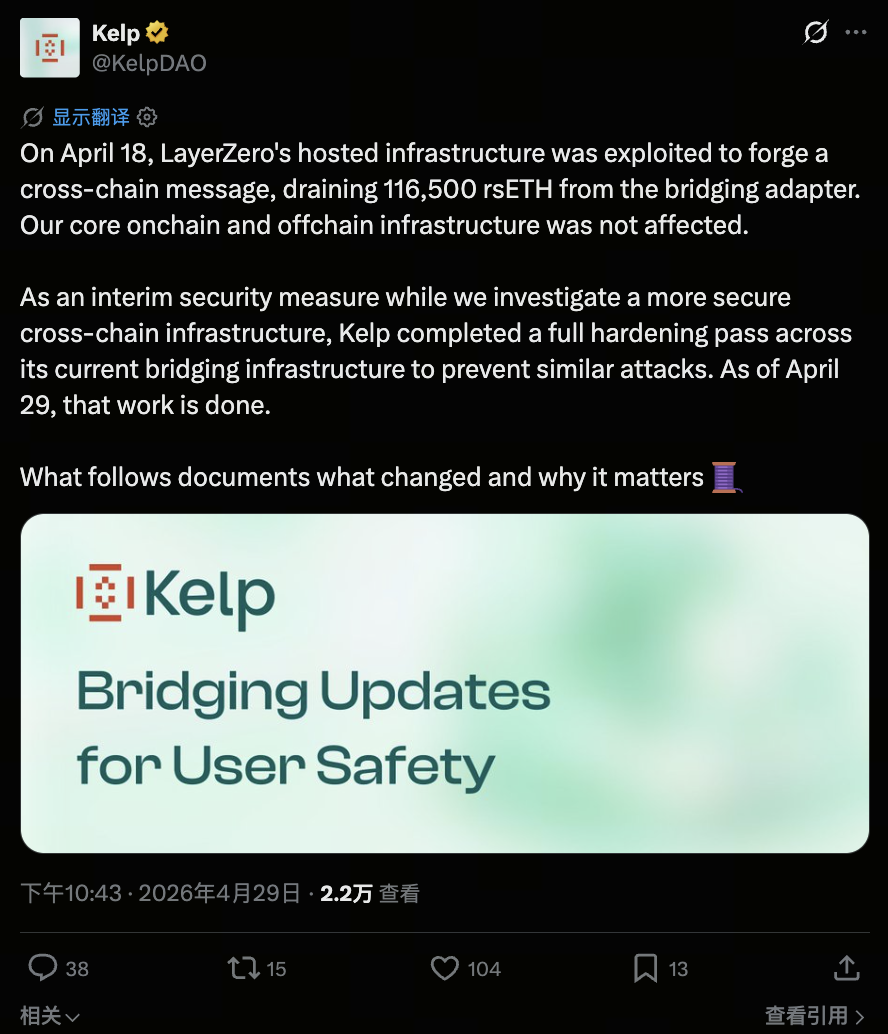
The Kelp DAO attack is a textbook example of cross-protocol risk propagation in 2026.
Attackers drained 116,500 rsETH from Kelp DAO’s LayerZero-based cross-chain bridge, worth about $292 million at the time—roughly 18% of rsETH’s circulating supply.
rsETH is a liquid restaking asset representing users’ staked ETH and yield. Users can hold rsETH or bridge it to other networks as collateral for lending or liquidity protocols.
The problem was that Kelp DAO’s cross-chain bridge held reserves of wrapped rsETH on other networks. When attackers forged cross-chain messages to release assets, over 20 networks’ rsETH derivatives faced questions about reserve sufficiency.
Attack fallout spread rapidly:
-
Kelp DAO lost around $292 million in assets
-
Non-Ethereum network rsETH reserves came under scrutiny
-
Aave froze V3 and V4 rsETH markets
-
Protocols like SparkLend and Fluid took similar actions
-
Lido suspended products with rsETH exposure
-
Users rapidly withdrew from protocols with rsETH risk exposure
-
AAVE token experienced a marked price drop
Kelp DAO’s emergency multisig paused core contracts about 46 minutes after the attack, stopping attackers from moving an additional 40,000 rsETH. However, most of the funds had already been transferred.
This incident demonstrates that cross-chain bridges are more than asset transport tools—they also manage reserves, message verification, and multi-network asset credibility. When bridge reserves are stolen, risk spreads to all lending and liquidity protocols accepting the related wrapped assets.
Even users who never interacted with Kelp DAO could suffer losses by holding rsETH collateral elsewhere. This is how DeFi composability amplifies risk.
Drift Protocol: No Code Flaw, but Privilege System Compromised
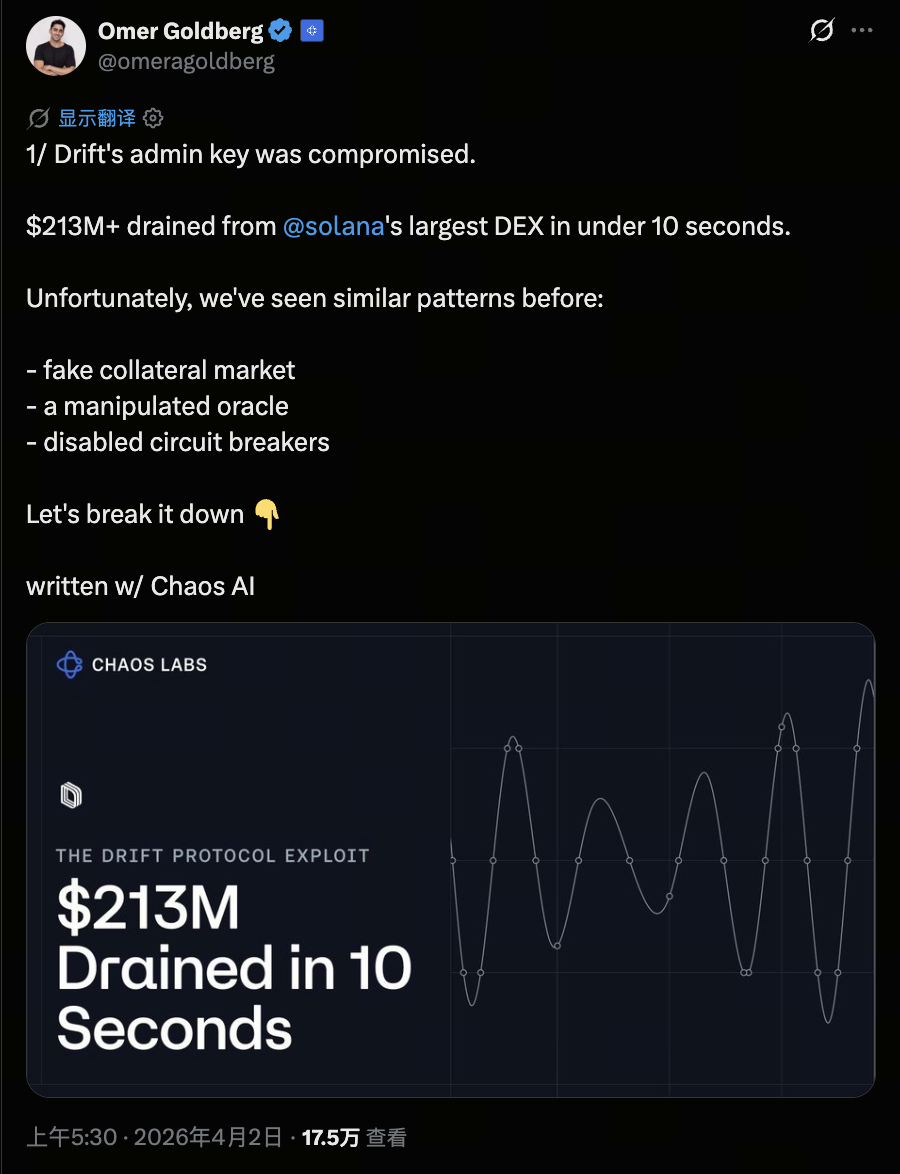
The Drift Protocol attack exposed a risk that traditional audits struggle to catch.
On April 1, 2026, attackers gained management privileges over Drift Protocol, transferring approximately $285 million from the protocol’s treasury—over 50% of its TVL at the time.
Chainalysis found that attackers may have contacted team members as early as fall 2025, posing as a quant trading firm, joining meetings, product discussions, and business collaborations, and even depositing over $1 million into Drift to build trust.
The attack was not a simple key theft, but a long-con:
-
The attacker created a fake token, CVT, and controlled about 80% of its supply
-
Used a tiny liquidity pool to simulate price stability and activity
-
Used a controlled oracle to report a fake price near $1
-
Used social engineering to get security committee members to sign seemingly normal pre-signed transactions
-
Leveraged Solana’s Durable Nonce to delay execution
-
After gaining admin privileges, added CVT as eligible collateral
-
Deposited 500 million essentially worthless CVT tokens
-
Borrowed real assets like USDC, SOL, and ETH using the fake collateral
The attacker did not forge signatures. The transactions had valid signatures from authorized members, so typical security systems would treat them as legitimate.
Drift used a new 2/5 multisig security committee but lacked a timelock. The attacker only needed two valid signatures to transfer privileges instantly.
The key lesson: Multisig raises the bar for privileges, but cannot ensure signers understand what they are authorizing.
Without transaction simulation, privilege change alerts, timelocks, and independent reviews, even fully valid signatures can be socially engineered.
Step Finance: Why Mid-Sized Projects Struggle to Recover from Attacks
Step Finance is a portfolio management and data platform in the Solana ecosystem. In January 2026, a senior executive’s device was compromised via phishing or privilege intrusion, resulting in the transfer of 261,854 SOL from the project’s multisig treasury.
Depending on SOL’s price, the loss was about $27.3 million to $35 million.
While Step Finance’s loss was much less than Kelp DAO and Drift Protocol, the impact on the project’s viability was more severe. The team attempted fundraising, business sales, and rescue solutions, but ultimately failed to secure enough capital and ceased operations in February.
Whether a security incident kills a project depends not just on the loss amount, but on its ratio to:
-
Stablecoin and fiat reserves
-
Annual protocol revenue
-
Tokens that can be sold without crashing the market
-
Insurance or security funds
-
Shareholder and investor funding capacity
-
User willingness to continue deposits and trading
For platforms with hundreds of millions in reserves, a $30 million attack may be absorbable. For mid-sized projects with only a few million in annual income, it can wipe out all operating funds.
Step Finance shows that treasury and product security are inseparable. Even if user assets aren’t in a single smart contract, compromise of high-privilege accounts or the treasury can end the business.
How Crypto Attack Vectors Changed in 2026
Attacks in 2026 did not abandon smart contract bugs, but high-loss incidents increasingly occurred outside contracts.
Cross-Chain Messages and Bridge Reserves
Cross-chain bridges must verify messages from other chains, relying on multisig, oracle networks, light clients, or zero-knowledge proofs. Any error in configuration, privileges, or message verification can lead to the release of real assets.
Bridge contracts typically hold large, centralized reserves, making them high-value targets—successful attacks can yield hundreds of millions.
Private Keys and Management Privileges
Events at Resolv Labs, IoTeX ioTube Bridge, and Step Finance show that keys or high-privilege accounts remain major risks. Code may be audited, but key management involves staff, devices, cloud services, and daily operations, greatly expanding the attack surface.
Social Engineering and Blind Signing
The Drift Protocol case shows attackers may spend months building business relationships, attending meetings, and posing as real clients. The target is not the password, but the signer’s judgment.
Oracles and Fake Collateral
Oracles determine how protocols interpret asset prices. If low-liquidity tokens are mistakenly accepted as collateral, attackers can manipulate prices and borrow assets with real value.
Domain and Front-End Attacks
Front-end incidents like CoW Swap remind users that smart contract security does not guarantee safe access points. Attackers can hijack domains, DNS, front-end code, or third-party scripts to trick users into authorizing malicious transactions.
Fraudulent Tokens and Supply Chain
Rhea Finance involved a fraudulent token contract. As protocols increasingly depend on external tokens, oracles, bridges, and software components, the security boundary now spans the entire technology supply chain.
Why a Single Attack Can Kill a Protocol
While the first impact of an attack is asset loss, a project often enters a death spiral due to subsequent chain reactions.
Direct Asset Shortfall
If stolen assets belong to users, the project must decide on compensation. If they belong to the treasury, the team loses budgets for salaries, security, and servers.
User Liquidity Run
After an attack, rational users exit first. Even if the protocol remains solvent, mass withdrawals may force asset sales, market closures, or redemption limits.
Collateral Depegging and Bad Debt
If stolen assets are stablecoins, liquid staking tokens, or wrapped assets, market prices may drop below theoretical value. Borrowers can abandon undercollateralized positions, leaving losses to the protocol and liquidity providers.
Token Price Decline
Protocols often hold large amounts of their own tokens. Attack news can drive prices down, depriving the project of funding when it’s most needed. Selling tokens to raise funds may further depress prices.
Revenue Interruption
Pausing contracts can halt attacks but also stops trading, lending, and fee income. Projects lose revenue when security, legal, and compensation costs are highest.
Rescue Financing Difficulties
In bear markets, investors are reluctant to fund projects with major asset shortfalls. New funds may demand control, discounted tokens, or senior repayment terms that original teams may not accept.
Irrecoverable Trust
Smart contracts can be fixed, but trust in management is hard to restore with an upgrade. If attacks stem from internal privileges, blind signing, or ignored risks, users may believe similar issues will recur.
Thus, whether an attack is fatal depends on the project’s balance sheet, income, and governance—not just vulnerability severity.
Why Smart Contract Audits Can’t Cover All Risks
Audits review specific code versions at a point in time, identifying some bugs and attack vectors, but cannot guarantee perpetual protocol security.
Traditional audits often miss:
-
Employee devices and communication accounts
-
Admin private key storage
-
Susceptibility of signers to social engineering
-
Parameter changes after launch
-
Addition of new collateral and oracle configurations
-
Third-party bridges and messaging services
-
Domain, front-end, and supply chain components
-
Upgraded code versions
-
Management intent before transaction execution
Drift Protocol’s code was audited multiple times, but the attack vector was privilege and signature flow. Kelp DAO’s risk lay in cross-chain messages and bridge reserves. Both cases show that an audit only proves a code version was reviewed, not that the system is operationally secure.
A mature security framework must cover prevention, monitoring, response, and recovery—not just a pre-launch audit.
Which Security Metrics Matter More Than “Passed Audit”
Assess protocol security by focusing on these metrics:
| Security Dimension |
Key Questions |
High-Risk Signals |
| Management Privileges |
Who can upgrade contracts or change parameters? |
Single private key holds high privileges |
| Multisig Structure |
How many signers are needed for authorization? |
Low threshold, highly overlapping signer identities |
| Timelock |
Are critical operations delayed before execution? |
Privilege changes take effect immediately |
| Transaction Simulation |
Can signers preview actual results before signing? |
Signers rely on hard-to-understand raw data |
| Oracle |
How many markets and data sources supply prices? |
Low-liquidity assets rely on a single price feed |
| Cross-Chain Dependencies |
Do assets depend on bridge reserves? |
One bridge supports large assets across many networks |
| Reserve Structure |
How much of the treasury is in stablecoins and fiat? |
Treasury mainly consists of native tokens |
| Security Fund |
Can it cover major losses? |
No insurance, compensation, or risk reserves |
| Real-Time Monitoring |
Can abnormal withdrawals trigger a pause? |
Solely relies on manual issue detection |
| Emergency Privileges |
Who controls pause mechanisms? |
No quick pause, or privileges overly concentrated |
| Information Disclosure |
Are post-mortems and compensation plans public? |
Prolonged silence or only vague statements |
The essential issue is not whether a protocol has admin privileges, but whether those privileges are segmented and restricted. Parameter changes, asset transfers, contract upgrades, and emergency pauses should not share identical authorization paths.
How Ordinary Users Can Identify Potential Protocol Attack Risks
While ordinary users cannot independently audit complex contracts, they can reduce risk through product structure:
-
Distinguish native from bridged assets. Assets labeled “Wrapped,” “Bridged,” or network-prefixed may depend on cross-chain bridge reserves, exposing holders to risks from the issuing protocol, bridge, and target network.
-
Check if the protocol accepts low-liquidity assets as collateral. The easier it is to manipulate an asset’s price, the higher the oracle and liquidation risk.
-
Confirm if the protocol uses a timelock. Without a timelock, management actions may take effect immediately after a single signature, leaving users no exit window.
-
Don’t judge security solely by TVL. High TVL means more assets at stake—and a bigger target for attackers.
-
Limit exposure to any single protocol. Even if you can’t predict which protocol will be attacked, diversifying funds can prevent a single event from causing irrecoverable losses.
Finally, after a protocol announces an incident, market suspension, or security investigation, avoid unofficial “compensation” or “migration” links. Attackers often exploit real incidents to launch a second wave of phishing.
Conclusion: Protocol Security Is Now a Balance Sheet Issue
Major crypto attacks in 2026 show that security has evolved from “are there smart contract bugs” to “can the organization manage funds, privileges, and dependencies securely.”
The Kelp DAO cross-chain bridge attack highlighted how composability amplifies risk; Drift Protocol proved that valid signatures can execute malicious intent; Step Finance showed that even mid-sized projects with real products can lose operational viability after a single treasury loss.
Direct losses are only the beginning. User withdrawals, collateral depegging, bad debt, token price declines, revenue suspension, and failed fundraising can turn a technical incident into a business crisis.
Protocol security must be viewed not just as an R&D expense, but as part of capital adequacy. Security funds, stablecoin reserves, privilege isolation, timelocks, and emergency response capabilities determine whether a project can recover after an attack.
In the future, the protocols that endure market cycles may not be those that never experience attacks, but those able to limit losses, maintain solvency, disclose facts rapidly, and convince users that the same issues will not recur.