Instead of relying entirely on centralized cloud providers, Cluster Protocol aims to connect individuals and small and medium-sized enterprises (SMEs) with a distributed network of GPU resources. Its model focuses on making unused or available computing power useful for AI while creating a framework for rewarding GPU providers based on their contributions.
Key Takeaways
- Cluster Protocol is a proof of compute protocol designed for decentralized AI computing.
- The project combines **GPU resources, decentralized infrastructure, and Fully Homomorphic Encryption (FHE)**.
- Its open-source approach allows the broader community to participate in the development of decentralized AI infrastructure.
- GPU providers can contribute computing resources and receive rewards based on their participation.
- FHE is intended to help AI workloads process encrypted data without requiring the underlying information to be exposed in plaintext.
- Cluster Protocol aims to make decentralized AI computing more accessible to individuals and SMEs.
- CP is the native token associated with Cluster Protocol and is available for spot trading on Gate.
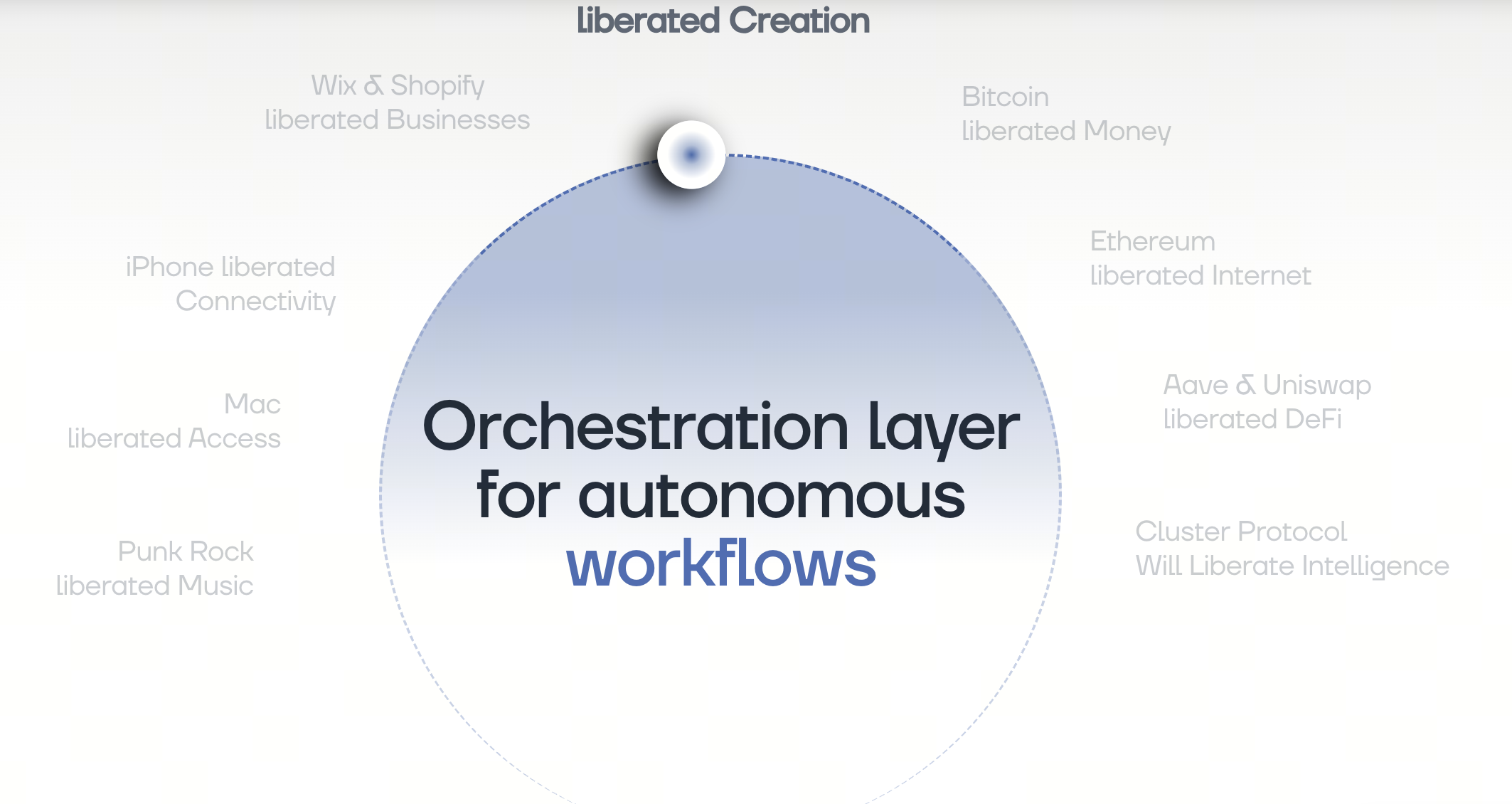
Sources:Cluster Protocol Website
What Is Cluster Protocol?
Cluster Protocol is a decentralized computing protocol focused on supporting AI model development and inference through distributed GPU resources. Its core idea is to create an alternative to highly centralized AI computing infrastructure by allowing computing resources from different participants to contribute to a shared network.
The protocol describes itself as a proof of compute protocol, meaning that computing contributions are an important part of its network model. Rather than treating GPUs simply as hardware, Cluster Protocol seeks to create a mechanism through which computational resources can be measured, verified, and rewarded.
Cluster Protocol also operates as an open-source community. This approach allows developers, GPU providers, researchers, and other participants to contribute to the development of decentralized AI infrastructure. The combination of distributed computing and open-source development is intended to create a broader ecosystem around decentralized AI models.
How Does Cluster Protocol Work?
Cluster Protocol is built around the idea of connecting AI workloads with distributed computing resources. Participants with available GPUs can contribute their computing capacity to the network, while AI-related workloads can use those resources.
A decentralized computing model can potentially make better use of computing resources that would otherwise remain idle. Instead of depending exclusively on large centralized data centers, workloads can be distributed across participating machines.
The proof of compute mechanism is important in this model because the network needs a way to distinguish actual computational contributions from simple claims of available hardware. By linking rewards to computing participation, Cluster Protocol aims to create incentives for GPU providers to contribute reliable resources.
The exact implementation of workload allocation, verification, and rewards can evolve as the protocol develops. Users should therefore refer to Cluster Protocol's latest technical documentation for implementation-level details.
What Is Proof of Compute?
Proof of compute is a mechanism designed to demonstrate that a participant has contributed computational resources to a network. In a decentralized computing system, this type of verification is important because participants may be located across different regions and operate hardware that the network cannot directly control.
For Cluster Protocol, proof of compute provides the foundation for connecting computing contributions with rewards. A participant contributes GPU capacity, the network evaluates the relevant computational work, and the protocol can use this information to determine the participant's contribution.
This model differs from traditional proof-of-work systems used by some blockchains. Proof of work generally uses computation to secure a blockchain network through a competitive process, while proof of compute in a decentralized AI infrastructure can focus on making computation itself useful for workloads such as AI model training or inference.
The distinction is important because the goal is not simply to consume computing power. Cluster Protocol aims to direct computing resources toward useful AI-related workloads.
Why Does Cluster Protocol Use GPUs?
GPUs are particularly important for modern AI because many AI workloads require large amounts of parallel computation. Training and running machine learning models can involve processing large datasets and performing numerous mathematical operations simultaneously.
Centralized AI infrastructure typically relies on large clusters of specialized hardware to handle these workloads. However, GPUs are also distributed across individual users, developers, research organizations, and businesses. Many of these machines may not be used continuously.
Cluster Protocol's decentralized approach seeks to connect these distributed resources with AI workloads. If computing resources can be coordinated effectively, a network of smaller providers could contribute to AI infrastructure without requiring every workload to depend on a single centralized provider.
For GPU owners, this creates another potential use for available computing capacity. Instead of leaving hardware idle, participants can potentially contribute it to decentralized AI workloads and receive rewards according to the protocol's rules.
What Role Does FHE Play in Cluster Protocol?
Fully Homomorphic Encryption, or FHE, is a cryptographic technology that allows computation to be performed on encrypted data. Its significance for decentralized AI comes from the privacy challenge associated with distributed computing.
In a conventional computing environment, an application may need access to data in plaintext to process it. If that workload is moved to third-party or distributed computing providers, sensitive information may be exposed to infrastructure operators.
FHE introduces a different model. Data can remain encrypted while certain computations are performed on the encrypted representation. The result can then be decrypted by an authorized party.
Cluster Protocol integrates FHE into its approach to decentralized AI computing. The goal is to allow distributed computing resources to participate in AI-related workloads while reducing the need to expose sensitive input data to individual GPU providers.
FHE can be computationally demanding, however, and its practical performance depends on the specific cryptographic schemes, workloads, hardware, and implementation. It should therefore be viewed as a privacy technology rather than a guarantee that every aspect of a decentralized AI system is automatically secure.
Why Is Privacy Important for Decentralized AI?
AI applications can process information ranging from public datasets to proprietary business information and other sensitive data. Moving computation across a decentralized network creates an additional challenge: how can users take advantage of distributed computing without giving every infrastructure provider direct access to the data being processed?
This is where privacy-preserving computation becomes relevant. By incorporating technologies such as FHE, decentralized AI infrastructure can potentially separate the ability to perform computation from the ability to view the underlying data.
For individuals, this could make decentralized AI more suitable for workloads involving private information. For SMEs, it could potentially provide access to distributed computing resources without requiring sensitive business data to be exposed directly to third-party GPU providers.
The practical privacy guarantees still depend on the complete system architecture, including encryption implementation, key management, software security, and the applications built on top of the protocol.
How Are GPU Providers Rewarded?
GPU providers contribute computing resources to the Cluster Protocol network. The protocol's reward model is designed to create an economic incentive for participants to make their hardware available for decentralized AI workloads.
This creates a two-sided relationship. Users and AI developers gain access to distributed computing resources, while GPU providers receive compensation for contributing those resources.
A sustainable decentralized computing network needs to balance both sides. If rewards are insufficient, providers may have little reason to maintain hardware and availability. If computing demand is insufficient, providers may also have limited opportunities to contribute resources.
Cluster Protocol's proof of compute model is therefore closely connected to its incentive structure. The ability to verify useful computing contributions can help establish a basis for distributing rewards across participating GPU providers.
Who Can Use Cluster Protocol?
Cluster Protocol is designed to support multiple participants in the decentralized AI ecosystem.
GPU Providers
Individuals or organizations with suitable GPU resources can potentially contribute computing power to the network. This provides a way to make computing hardware available for AI workloads.
AI Developers
Developers can potentially use decentralized computing resources to support AI model workloads without relying entirely on a centralized infrastructure provider.
SMEs
Small and medium-sized enterprises may benefit from access to distributed computing resources and privacy-oriented infrastructure without needing to build large AI data centers themselves.
Open-Source Contributors
Because Cluster Protocol emphasizes an open-source community, developers and researchers can contribute to the ecosystem through software development, research, infrastructure improvements, and other forms of participation.
Cluster Protocol and Decentralized AI
Decentralized AI refers to approaches that distribute parts of AI infrastructure, computation, data, or model development across multiple participants rather than concentrating them within a small number of centralized organizations.
Cluster Protocol focuses particularly on the computing side of this equation. Its model combines distributed GPU resources with mechanisms intended to verify computational contributions and protect data during processing.
This approach addresses two challenges that have become increasingly important as AI workloads grow: access to computing resources and data privacy. Centralized providers can offer significant scale, but decentralized infrastructure can potentially create additional sources of computing capacity and reduce dependence on a single infrastructure provider.
The effectiveness of this model ultimately depends on factors such as network participation, available GPU capacity, workload demand, verification mechanisms, and the performance of privacy-preserving technologies.
What Is the CP Token?
CP is the token associated with Cluster Protocol. It forms part of the project's broader economic ecosystem and is connected to the protocol's decentralized computing model.
The specific utility and token economics of CP may depend on the protocol's implementation and future development. Users should distinguish between the token itself and the computing infrastructure: owning CP does not by itself provide GPU computing capacity, while providing computing resources does not necessarily mean that every participant uses CP in the same way.
As the Cluster Protocol ecosystem develops, the role of CP may become more closely connected to network participation, incentives, and other protocol functions. Current token details should be verified against the project's latest official documentation.
Where Can You Trade CP?
CP is available for spot trading on Gate.
Trade CP/USDT on Gate
Before trading, users should verify the current trading pair, deposit and withdrawal network, and other asset information shown on the exchange.
What Are the Potential Benefits of Cluster Protocol?
Distributed Computing Resources
Cluster Protocol can potentially aggregate GPU resources from different participants, creating a decentralized source of computing capacity for AI workloads.
Privacy-Preserving Computation
The use of FHE is intended to improve data privacy by allowing certain computations to take place on encrypted data.
Incentives for GPU Providers
A proof of compute model can connect useful computational contributions with rewards, creating an incentive for participants to provide GPU capacity.
Accessibility for Smaller Participants
Decentralized infrastructure could make AI computing resources more accessible to individuals and SMEs that cannot operate large-scale centralized data centers.
Open-Source Development
An open-source community can allow developers and researchers to inspect, improve, and extend the infrastructure, potentially supporting broader participation in the ecosystem.
What Are the Risks of Cluster Protocol?
Cluster Protocol also faces several challenges that are common to decentralized AI and distributed computing networks.
Computational performance risk: FHE can introduce additional computational overhead compared with conventional processing. The efficiency of decentralized AI workloads therefore depends heavily on implementation and hardware performance.
Network coordination risk: A decentralized GPU network must coordinate resources across different machines, locations, and hardware configurations. Maintaining consistent performance can be more difficult than operating a controlled centralized data center.
Provider reliability risk: Individual GPU providers may have different uptime, bandwidth, hardware specifications, and maintenance schedules. The protocol needs mechanisms to manage these differences.
Security risk: Encryption can improve privacy but does not eliminate all security risks. Software vulnerabilities, key-management failures, malicious nodes, and application-level weaknesses can still affect a decentralized AI system.
Adoption risk: The long-term usefulness of a decentralized computing network depends on both supply and demand. The network needs enough GPU providers as well as sufficient AI workloads to create a sustainable ecosystem.
Token risk: CP is a crypto asset and can experience significant market volatility. Its market value may not directly reflect the amount of computing activity taking place on the network.
What Is the Future of Decentralized AI Computing?
AI infrastructure is becoming increasingly dependent on computing capacity, particularly as models become larger and AI applications become more widespread. This creates an opportunity for alternative infrastructure models that can supplement traditional centralized providers.
Decentralized AI computing attempts to address this opportunity by turning distributed hardware into a coordinated resource. Projects such as Cluster Protocol focus on making this model more practical by combining computing incentives with privacy technologies.
The long-term development of decentralized AI will likely depend on whether distributed networks can offer competitive performance, reliable infrastructure, sufficient privacy, and attractive economics. For Cluster Protocol, the growth of its GPU network, developer community, AI workloads, and supporting applications will be important factors to watch.
Conclusion
Cluster Protocol is a proof of compute protocol and open-source community focused on decentralized AI computing. Its approach combines distributed GPU resources with Fully Homomorphic Encryption to address two important challenges in AI infrastructure: access to computing power and data privacy.
By creating incentives for GPU providers and connecting their resources with AI workloads, Cluster Protocol aims to build a more distributed computing environment. At the same time, FHE provides a privacy-oriented layer that can help reduce the need to expose sensitive data during computation.
The project's long-term potential will depend on practical adoption rather than the concept alone. Network capacity, workload demand, computational efficiency, security, privacy implementation, and the role of the CP token are all factors that can influence how the ecosystem develops.
FAQs
What is Cluster Protocol?
Cluster Protocol is a proof of compute protocol and open-source community focused on decentralized AI models and distributed GPU computing.
What is proof of compute?
Proof of compute is a mechanism for verifying or measuring computational contributions within a network. In Cluster Protocol, it is used as part of the framework for connecting GPU resources with rewards.
What is FHE in Cluster Protocol?
FHE stands for Fully Homomorphic Encryption. It is a cryptographic technology that enables certain computations to be performed on encrypted data, supporting privacy-preserving computing.
Who can provide computing power to Cluster Protocol?
Individuals and organizations with suitable GPU resources can potentially participate as computing providers, subject to the protocol's technical requirements.
What is CP used for?
CP is the token associated with Cluster Protocol. Its specific utility depends on the protocol's current implementation and development.
Where can I trade CP?
CP is available for spot trading on Gate through the CP/USDT trading pair.
Is Cluster Protocol a DePIN project?
Cluster Protocol shares characteristics with decentralized physical infrastructure networks (DePIN) because it coordinates distributed physical computing resources. However, its specific positioning should be understood through its proof of compute and decentralized AI infrastructure model.