Square
Following
Hot
News
Notifications
Profile
Share your thoughts
placeholder
Article
Hardware Wallet Incidents Show Why Private Key Protection Remains Essential
live-cover
LIVE1,410
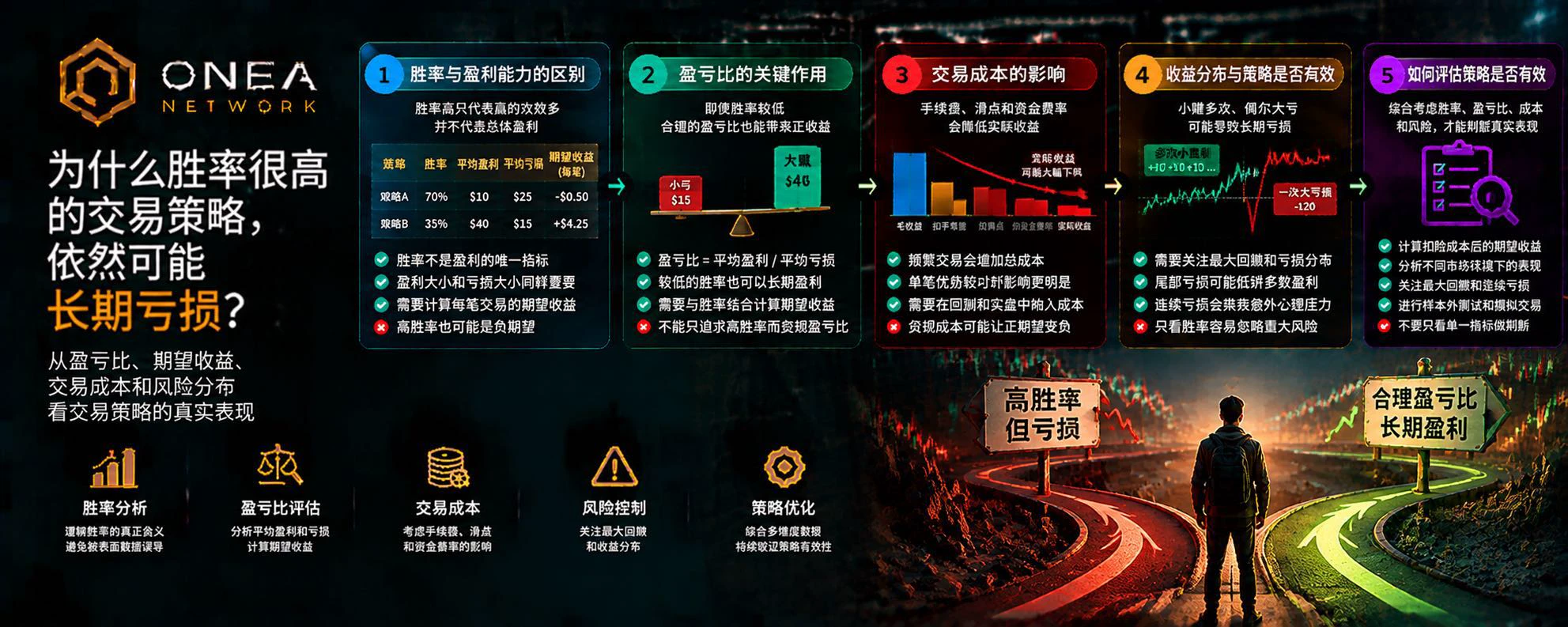
Why Can a High-Win-Rate Trading Strategy Still Lose Money Over the Long Term?

Many traders like to pursue a high win rate.

A 70% win rate sounds pretty good.

An 80% win rate seems even better.

But one easily overlooked issue is that if the amount lost on each losing trade is far greater than the amount gained on each winning trade, you can still lose money in the end, even if you’re often right.

The win rate determines how many times you win, but it cannot determine on its own how much you ultimately make.

I. First, consider a simple mathematical example

Suppose two strategies each make
post-image
Trenches
mihao
m
bade
b
mihao
4Cxj...pump
Market Cap
$.
Change
.
24h Vol
$.
Holders
.
PIEVERSE
P
bade
b
PIEVERSE
0x0e...25a9
Market Cap
$.
Change
.
24h Vol
$.
Holders
.
HOLD
H
bade
b
HOLD
4iJ7...pump
Market Cap
$.
Change
.
24h Vol
$.
Holders
.
X
X
bade
b
X
9VZe...pump
Market Cap
$.
Change
.
24h Vol
$
Holders
.
AGT
A
bade
b
AGT
0x5d...e274
Market Cap
$.
Change
.
24h Vol
$.
Holders
.
This comes in brief / bikini / trongs / tanga / string styles.
post-image
Why can the same trading strategy perform completely differently on different exchanges?

Suppose you test a BTC breakout strategy on one exchange, and the backtest results are good.

So you copy it to another exchange, using the same parameters and entry signals, but find that profits are lower, drawdowns are larger, and the strategy that was originally profitable even starts losing money.

Where is the problem?

In many cases, traders focus only on price signals and overlook one fact:

The same way of generating signals does not mean the same order execution conditions.

I. Different liquidi
post-image
BTC-0.67%
ETH-1.26%
Sunspark, a solo filmmaker's 4K animated short rendered entirely on Render Network, is now in 60 film festivals, 11 of them Oscar-qualifying.
Its lineup now also includes a BAFTA-qualifying festival.
@rendernetwork
RENDER+0.47%
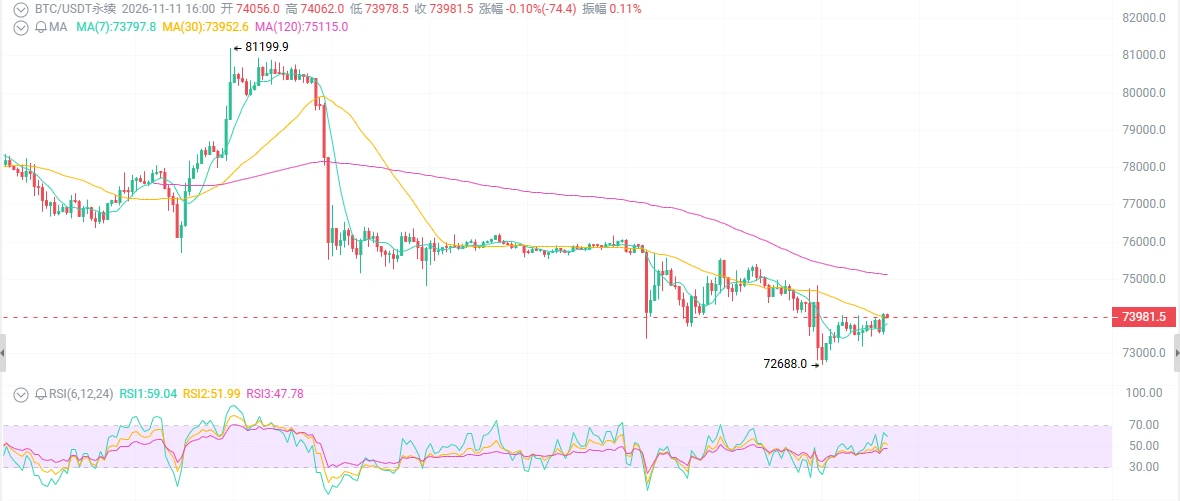
BTC at $74,000—have you capitulated?
CPI came in scorching hot, a rate hike is all but certain, ETFs have bled over $1 billion in consecutive outflows, and $723 million in longs got liquidated—does this 41% drawdown mark the end of the bull market, or is it the last trap the market makers are setting for retail?

First, the surface picture: bad news is piling up, but the price has stopped falling.

The 24-hour low was 72,700, the high was 74,900, and BTC is now hovering around 74,000. Daily RSI is 33, in oversold territory. The Fear and Greed Index is 26, in the fear zone. The candlestick char
post-image
BTC-0.67%
ETH-1.26%
SOL-0.77%
usdc market updates
live-cover
LIVE1,957
Breaking even like this every day—come on, take off!
SNDK-0.18%
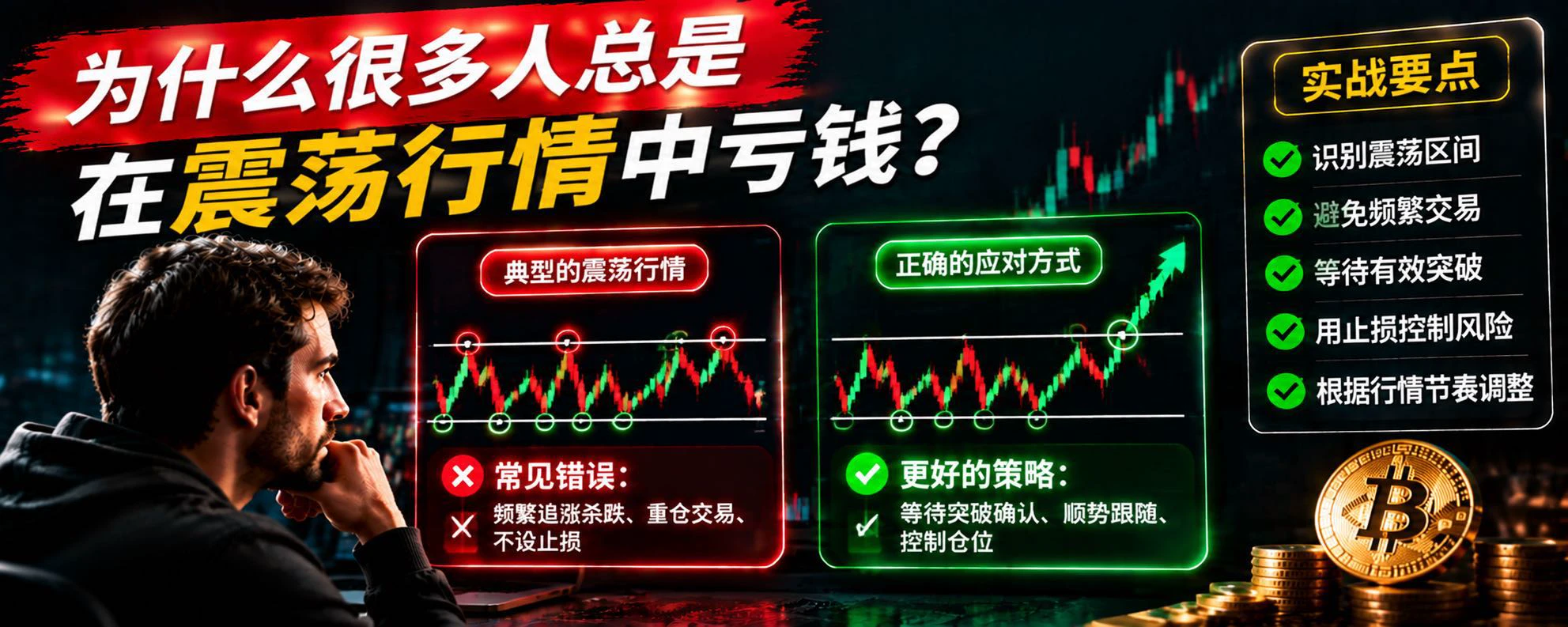
In the cryptocurrency market, many traders know some technical analysis methods, yet continue to lose money repeatedly in choppy markets. The reason may not be that their technical skills are lacking, but that they have failed to identify the current market conditions.

The biggest difference between trending and choppy markets lies in how prices move.

First, in choppy markets, prices usually fluctuate repeatedly within a certain range, with resistance above and support below. If you follow a trend-trading approach, going long when you see prices rise and short when you see them fall, you can
post-image
In crypto futures trading, many people have had this experience: they open a position, the price moves slightly against them, and their stop-loss is triggered. But frustratingly, after they close the position, the market starts moving in the direction they originally expected.

Why do stop-losses keep getting hit?

First, the stop-loss is set too close. BTC naturally has significant short-term volatility. If you place your stop-loss very close to your entry price simply because you’re afraid of losing money, normal price fluctuations can easily trigger it.

Second, key support and resistance l
post-image
BTC-0.65%
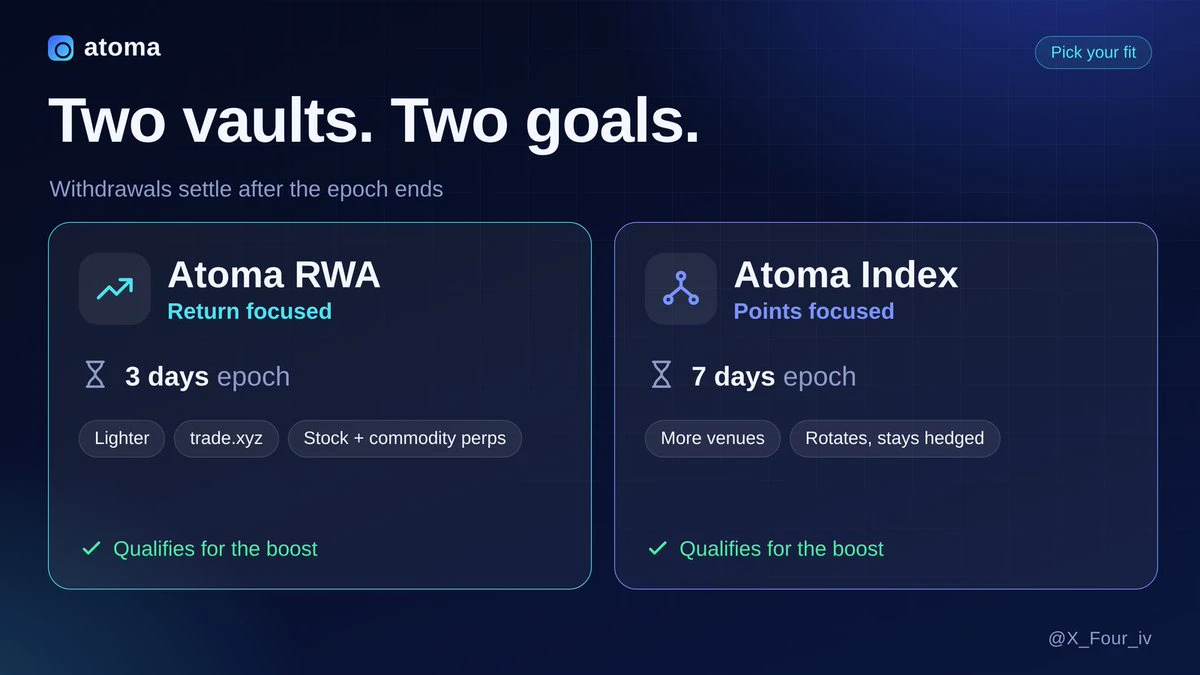
Atoma has two vaults, and both count for the Genesis Points Boost. So the real question is which one fits how you think about your USDC.
@atoma_fi RWA is the return-focused vault. It trades stock and commodity perps, mostly on Lighter and with a 3-day epoch.
Atoma Index is built around points. Capital rotates across more venues to maximise points while staying hedged, with a 7-day epoch.
If shorter waiting time and trading returns matter most to you, RWA tends to suit that. If you care more about points across venues and can live with a longer cycle, read up on Index.
Whichever you choose, wi
post-image
USDC+0.01%
RWA-0.39%
INDEX+0.00%
Which signals indicate that BTC’s upward momentum is weakening as it rises?

In crypto trading, many people see BTC repeatedly hitting new highs and assume the uptrend remains strong. But rising prices do not necessarily mean upward momentum is always robust. What truly matters is whether the market forces behind the price are changing.

There are four signals worth watching closely.

First, trading volume continues to contract. If the price keeps rising while trading volume gradually declines, the capital driving further price gains may be weakening.

Second, the RSI shows a bearish divergenc
post-image
How Can You Determine BTC’s Next Move When It’s Moving Sideways?

In the cryptocurrency market, sideways movement is often more frustrating for traders than a one-way rally or decline. Prices fluctuate repeatedly within a range, making it seem like there are plenty of opportunities, but few people are able to capitalize on them. Some keep going long, while others repeatedly go short, only to find that fees and frequent stop-losses keep eating away at their accounts.

So, how should you determine BTC’s next move during a sideways market?

First, watch for changes in trading volume. If volume gr
post-image
Little piglet, can't go on anymore, huh?$PEPE
post-image
PEPE+1.05%
#Gate股票现货全球前三 After the pullback, my tech stock watchlist

Gate’s stock spot offering made the global top three on RootData (score: 70.1, 24-hour trading volume: $65.88 million, share: 4.77%), so the range of assets is definitely broad enough. But the ranking is just a ticket in; what follows is what I’m really watching.

I. First, my market view

The first valuation reset is over; the earnings reset hasn’t happened yet.

The Nasdaq 100 closed at 27,740, and its forward PE returned to 18x, the same level as before ChatGPT launched in November 2022; its PE-TTM is 26.4x, at the 1.35th percentile
SPX+0.33%
NVDA-5.47%
AMD+1.27%
TSM+2.07%
  • 4
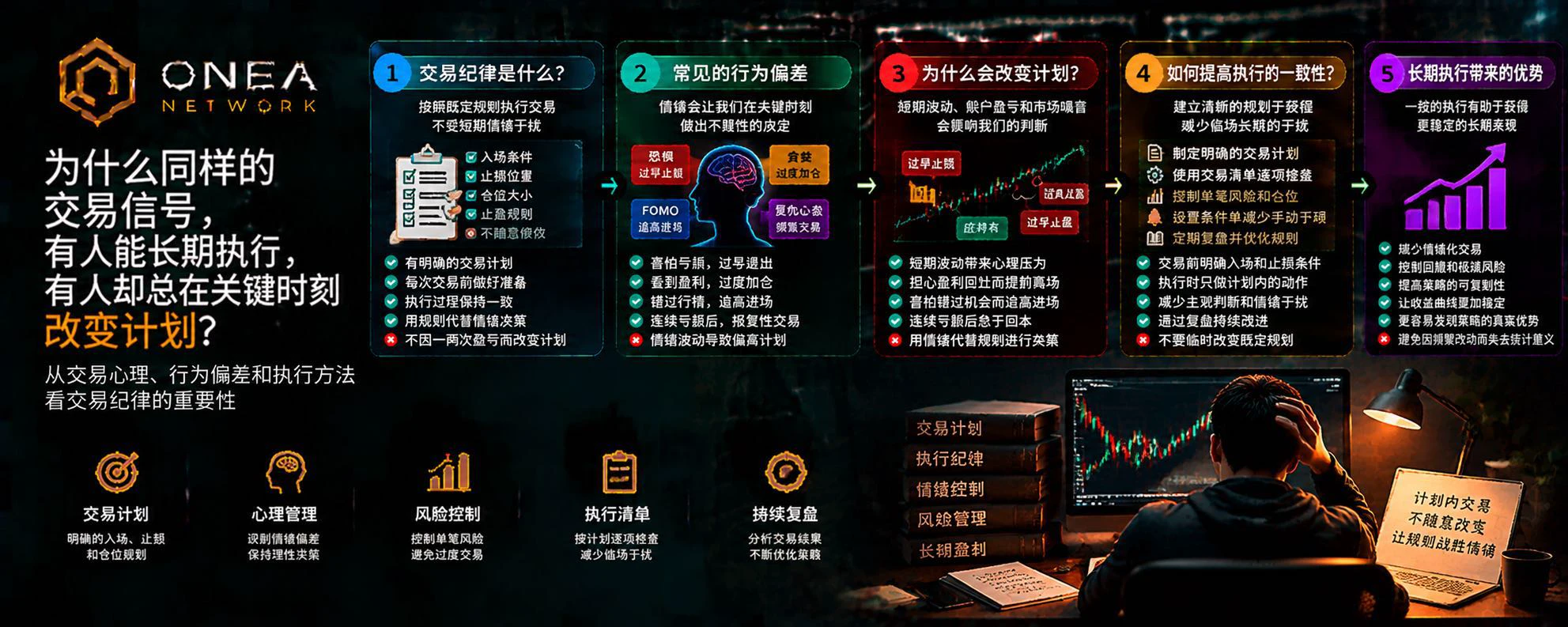
Why can some people consistently follow the same trading signals over the long term, while others keep changing their plans at critical moments?

Many traders are not short on indicators or trading strategies.

They know where to enter, where to set stop-losses, and how to manage position sizes.

But once they enter the market, everything changes.

When in profit, they worry about giving back their gains and close positions early.

When facing a loss, they refuse to admit they were wrong and widen their stop-losses without authorization.

When the market rises, they fear missing out and chase
post-image
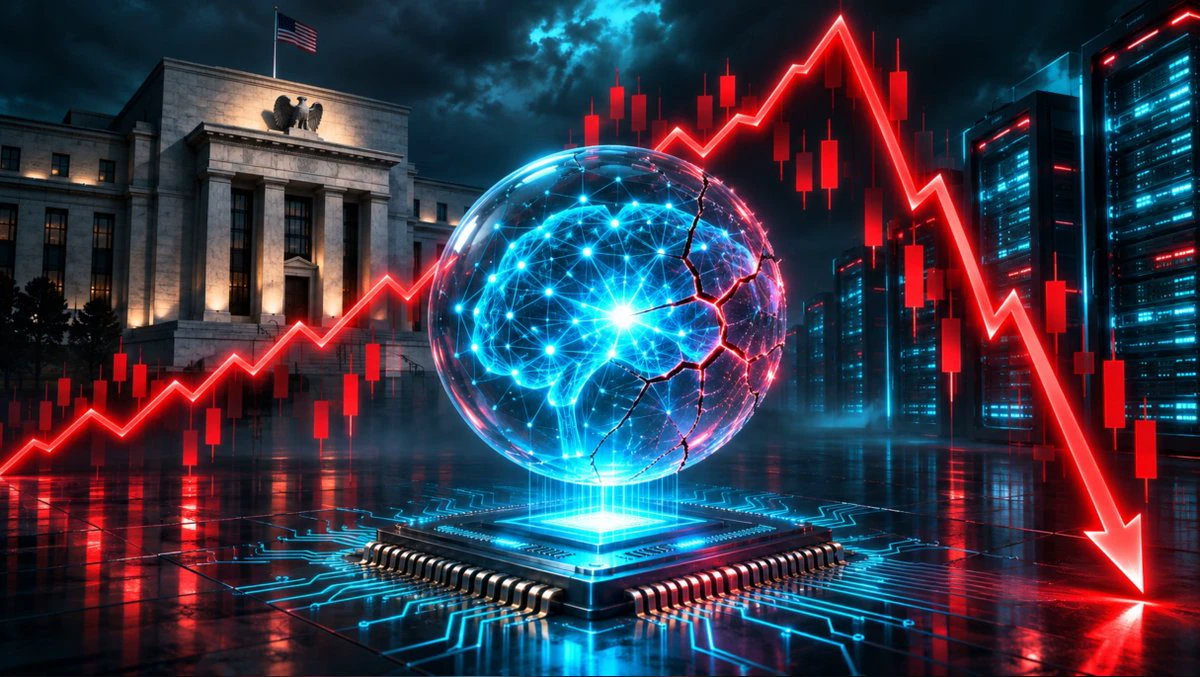
Fed’s Michelle Bowman warns: Stocks could face a sharp correction if AI investments fail to deliver expected returns. Big spending. Bigger expectations. Little room for disappointment.
post-image
How can you tell whether a trading strategy has a genuine statistical edge rather than making money through luck?

One of the easiest things to misjudge in the trading market is treating profits as proof that a strategy works.

A string of profitable trades could mean the strategy has an edge, or it could simply have encountered market conditions that suited it.

So how can you distinguish between the two?

The key is not how much a few trades made, but whether, under sufficiently reasonable testing conditions, the strategy has a repeatable positive expected value that remains positive after c
post-image
A truly seasoned trader is not someone who gets it right every time, but someone who has a set of rules to control losses even when they get it wrong.

After entering the cryptocurrency market, many people keep looking for more accurate indicators, better entry signals, and higher win rates.

But one question is often overlooked:

If your judgments are wrong several times in a row, can your account withstand it?

A complete trading risk management system should include more than just stop-losses. It should cover the entire process, from trade planning to execution and review.

Step 1: Define y
post-image
Load More

Join 40 M users in our growing community

⚡️ Join 40 M users in the crypto craze discussion

💬 Engage with your favorite top creators

👍 See what interests you

Trending Topics

GateGlobalComplianceExpansion

15.89k Views354 Discussing

Gate continues to expand its global compliance footprint, now covering 81 regulated jurisdictions across Europe, North America, Asia, and Oceania. From MiCA and U.S. state-level MTLs to Japan’s FSA, Dubai, and Australia-related regulatory approvals, global exchanges are entering a new stage of compliance competition. Do you think regulatory strength will become as important as products and liquidity for exchanges in the future?

USOctoberCPIBeatsExpectations

87.04k Views2.65k Discussing

AnthropicIPOValuationCouldReach1.4T

12.22k Views1.61k Discussing

View More