The article explores Enzyme (MLN), detailing its origins, significance in the DeFi sector, and decentralized asset management capabilities. It discusses the protocol's blockchain-based operations, security features, and market performance, highlighting its role in on-chain investment strategies. Challenges like scalability and competition in this evolving space are addressed. The piece targets investors and developers interested in DeFi innovations, emphasizing Enzyme's roadmap and community engagement. Key aspects such as governance participation and acquisition through Gate are also covered.
Enzyme's Positioning and Significance
In 2017, the Melon Foundation launched Enzyme (MLN), aiming to solve inefficiencies in traditional asset management and democratize access to financial strategies.
As a pioneering on-chain asset management protocol, Enzyme plays a crucial role in the DeFi (Decentralized Finance) sector.
As of 2025, Enzyme has become a key player in decentralized asset management, with an active developer community and growing adoption among DeFi users. This article will delve into its technical architecture, market performance, and future potential.
Origin and Development History
Birth Background
Enzyme was created by the Melon Foundation in 2017 to address the need for transparent, efficient, and accessible asset management in the blockchain space.
It was born during the early stages of the DeFi revolution, aiming to empower users to create, manage, and invest in on-chain investment strategies without traditional intermediaries.
Enzyme's launch brought new possibilities for both individual investors and fund managers in the crypto space.
Important Milestones
- 2017: Mainnet launch, enabling on-chain fund creation and management.
- 2020: Major upgrade to Enzyme v2, introducing enhanced features and improved user experience.
- 2021: Rebranding from Melon to Enzyme, signaling a new phase of growth and development.
- 2023: Ecosystem expansion, with the number of active vaults surpassing 1,000.
With support from the Enzyme community and development team, Enzyme continues to optimize its technology, security, and real-world applications in decentralized asset management.
How Does Enzyme Work?
No Central Control
Enzyme operates on a decentralized network of computers (nodes) spread across the globe, free from control by banks or governments.
These nodes collaborate to validate transactions, ensuring system transparency and resistance to attacks, granting users greater autonomy and enhancing network resilience.
Blockchain Core
Enzyme's blockchain is a public, immutable digital ledger that records every transaction.
Transactions are grouped into blocks and linked through cryptographic hashes to form a secure chain.
Anyone can view the records, establishing trust without intermediaries.
Enzyme leverages Ethereum's blockchain infrastructure while adding its own layer of asset management functionality.
Ensuring Fairness
Enzyme utilizes Ethereum's Proof-of-Stake (PoS) consensus mechanism to validate transactions and prevent fraudulent activities like double-spending.
Network participants contribute to security by staking ETH and running Ethereum nodes, indirectly supporting Enzyme's operations.
Enzyme's innovation lies in its specialized smart contracts for asset management, built on top of Ethereum's secure foundation.
Secure Transactions
Enzyme uses public-private key cryptography to protect transactions:
- Private keys (similar to secret passwords) are used to sign transactions
- Public keys (similar to account numbers) are used to verify ownership
This mechanism ensures fund security, while transactions remain pseudonymous.
Enzyme also implements additional security features such as access controls and risk management parameters within its vaults.
Enzyme (MLN) Market Performance
Circulation Overview
As of November 20, 2025, Enzyme's circulating supply is 2,988,432.461086299 tokens, which is equal to its total supply. This indicates a fixed supply model.
Price Fluctuations
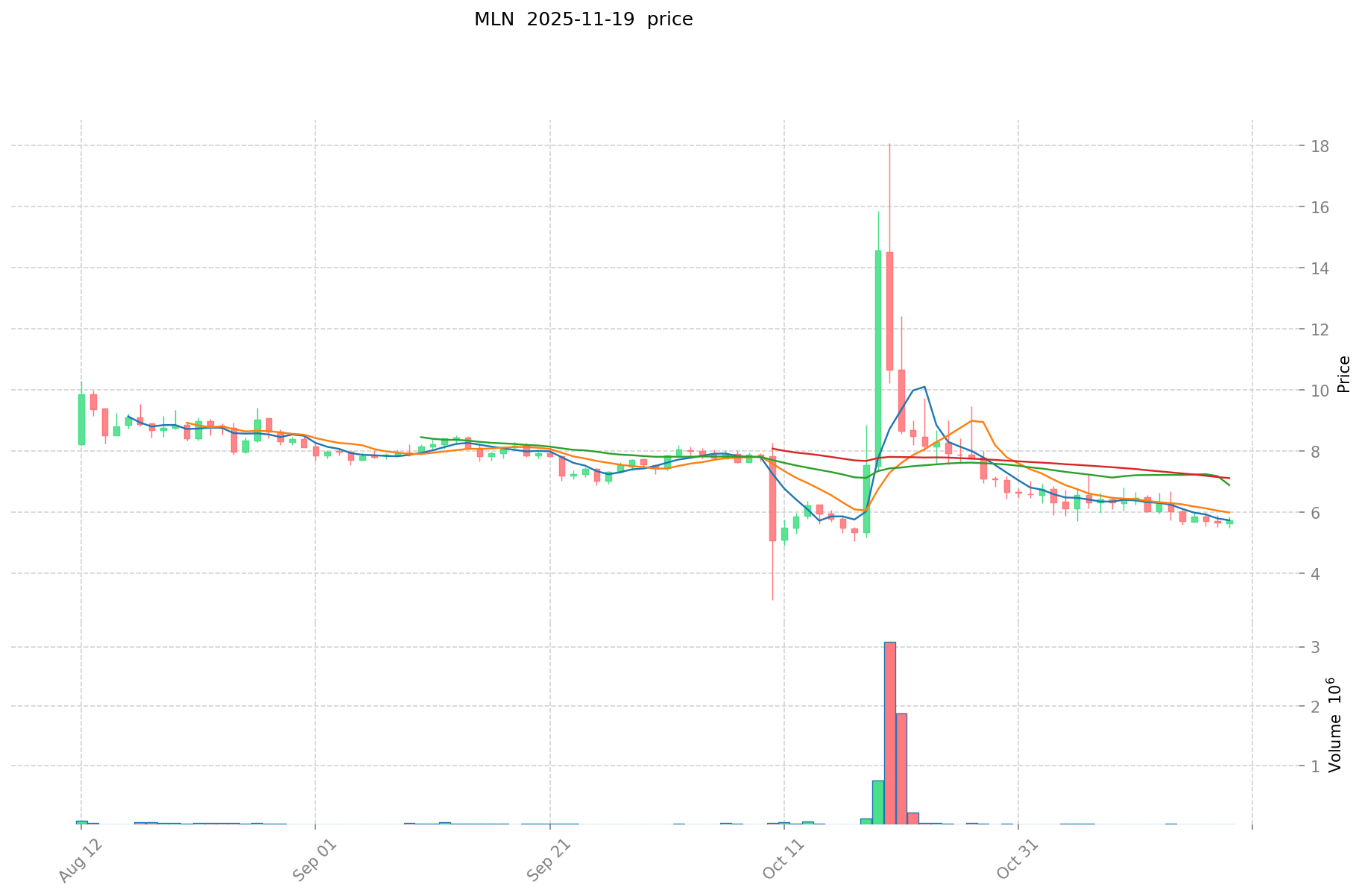
Enzyme reached its all-time high of $258.26 on January 4, 2018, likely driven by the overall cryptocurrency bull market during that period.
Its lowest price was $1.79, recorded on March 13, 2020, possibly due to the global market crash associated with the COVID-19 pandemic.
These fluctuations reflect market sentiment, adoption trends, and external factors affecting the cryptocurrency space.
Click to view the current MLN market price
On-chain Metrics
- Daily Trading Volume: $13,049.69572 (indicating network activity)
- Active Addresses: 8,779 (reflecting user engagement)
Enzyme (MLN) Ecosystem Applications and Partnerships
Core Use Cases
Enzyme's ecosystem supports various applications:
- DeFi: Enzyme protocol allows users to build, share, and explore DeFi investment strategies (called "vaults"), filtered by historical performance and risk profile.
- Asset Management: MLN is used to pay for various functions throughout the vault creation process and investment life cycle.
Strategic Collaborations
Enzyme has established partnerships to enhance its technical capabilities and market influence. These partnerships provide a solid foundation for Enzyme's ecosystem expansion.
Controversies and Challenges
Enzyme faces the following challenges:
- Technical Issues: Potential scalability bottlenecks as the platform grows
- Regulatory Risks: Uncertainty in the evolving DeFi regulatory landscape
- Competitive Pressure: Rising competition from other DeFi protocols and asset management platforms
These issues have sparked discussions within the community and market, driving continuous innovation for Enzyme.
Enzyme Community and Social Media Atmosphere
Fan Enthusiasm
Enzyme's community shows vitality, with metrics such as wallet addresses and daily transaction volumes reflecting its growth.
On X, posts and hashtags related to Enzyme (e.g., #EnzymeFinance) frequently gain traction.
Factors such as new feature releases and market movements ignite community enthusiasm.
Social Media Sentiment
Sentiment on X presents a polarized view:
- Supporters praise Enzyme's on-chain asset management capabilities and its role in the DeFi ecosystem.
- Critics focus on issues such as price volatility and potential risks associated with DeFi investments.
Recent trends show varying sentiment correlated with market conditions and protocol updates.
Hot Topics
X users actively discuss Enzyme's key issues, such as DeFi innovation, asset management strategies, and the future of decentralized finance, highlighting both its transformative potential and the challenges in mainstream adoption.
More Information Sources for Enzyme
- Official Website: Visit Enzyme's official website for features, use cases, and latest updates.
- Whitepaper: Enzyme's whitepaper details its technical architecture, objectives, and vision.
- X Updates: On X, Enzyme uses @enzymefinance, actively posting about technical upgrades, community events, and partnership news.
Enzyme's Future Roadmap
- Ecosystem Goals: Support more DeFi strategies and expand the user base
- Long-term Vision: Become a leading platform for on-chain asset management in the DeFi space
How to Participate in Enzyme?
- Purchase Channels: Buy MLN on Gate.com
- Storage Solutions: Use compatible wallets for secure storage
- Participate in Governance: Engage in community decisions through the Enzyme governance system
- Build the Ecosystem: Visit Enzyme's GitHub to contribute to development
Summary
Enzyme is redefining asset management in the DeFi space through blockchain technology, offering transparency, security, and efficient investment strategies. Its active community, rich resources, and strong market presence make it stand out in the cryptocurrency field. Despite facing challenges such as regulatory uncertainties and technical hurdles, Enzyme's innovative spirit and clear roadmap position it as a significant player in the future of decentralized finance. Whether you're a newcomer or an experienced player, Enzyme is worth watching and participating in.
FAQ
What is the meaning of MLN?
MLN stands for Melon, a blockchain protocol for on-chain asset management. It enables the creation and management of decentralized hedge funds on Ethereum.
What is the mln?
MLN is the token of Enzyme, a decentralized asset management protocol. It's used for governance and fee payments within the Enzyme ecosystem.
What is mln finance?
MLN is the token of Enzyme Finance, a DeFi protocol on Ethereum for creating tokenized investment products on-chain.
What is mln crypto?
MLN is the token of Enzyme, a decentralized asset management platform. It powers protocol operations and governance in the DeFi ecosystem, ensuring security and integrity.
* The information is not intended to be and does not constitute financial advice or any other recommendation of any sort offered or endorsed by Gate.