What is HBAR: A Comprehensive Guide to Hedera's Native Cryptocurrency and Its Role in the Ecosystem

Hedera's Positioning and Significance
In 2018, Dr. Leemon Baird introduced Hedera (HBAR), aiming to address issues such as scalability and security in distributed ledger technology. As the "fastest public ledger in the world," Hedera plays a crucial role in areas like DeFi, NFTs, and enterprise solutions.
As of 2025, Hedera has become a top 30 cryptocurrency by market capitalization, boasting high transaction speeds (>10,000 TPS) and an active developer community. This article will delve into its technical architecture, market performance, and future potential.
Origin and Development History
Birth Background
Hedera was created by Dr. Leemon Baird in 2018 to solve issues of scalability, security, and fairness in distributed ledger technology. It emerged during the blockchain technology boom, aiming to provide a fast, secure, and fair public ledger network through its unique hashgraph consensus mechanism.
Hedera's launch brought new possibilities for enterprise-grade distributed applications and micropayment systems.
Important Milestones
- 2018: Mainnet launch, achieving high throughput and aBFT security.
- 2019: Open access to the mainnet, allowing anyone to create accounts and build decentralized applications.
- 2020: Introduction of Hedera Consensus Service (HCS), enabling new use cases for decentralized applications.
- 2022: Ecosystem expansion with numerous DeFi protocols and NFT platforms leveraging Hedera's network.
With support from the Hedera Governing Council, composed of leading global organizations, Hedera continues to optimize its technology, security, and real-world applications.
How Does Hedera Work?
Decentralized Control
Hedera runs on a decentralized network of nodes distributed globally, free from control by any single bank or government. These nodes collaborate to validate transactions, ensuring system transparency and attack resistance, thus granting users greater autonomy and enhancing network resilience.
Blockchain Core
Hedera's ledger is a public, immutable digital record of all transactions. Transactions are grouped into "events" and securely linked using cryptographic hashes. Anyone can view the records, establishing trust without intermediaries. Hedera's unique hashgraph algorithm further enhances performance and security.
Ensuring Fairness
Hedera employs the Asynchronous Byzantine Fault Tolerance (aBFT) consensus mechanism to validate transactions and prevent fraudulent activities like double-spending. Nodes maintain network security by participating in the consensus process and are rewarded with HBAR tokens. Its innovation includes high throughput (>10,000 TPS) and energy efficiency.
Secure Transactions
Hedera uses public-private key cryptography to secure transactions:
- Private keys (like secret passwords) are used to sign transactions
- Public keys (like account numbers) are used to verify ownership
This mechanism ensures fund security, with transactions maintaining a pseudonymous privacy level. Hedera also offers additional security features through its Hedera Token Service (HTS) and smart contract capabilities.
Hedera (HBAR) Market Performance
Circulation Overview
As of December 15, 2025, Hedera's circulating supply is 42,476,304,285.20149 HBAR, with a total supply of 50,000,000,000 HBAR. The circulating ratio is approximately 84.95% of the total supply.
Price Fluctuations
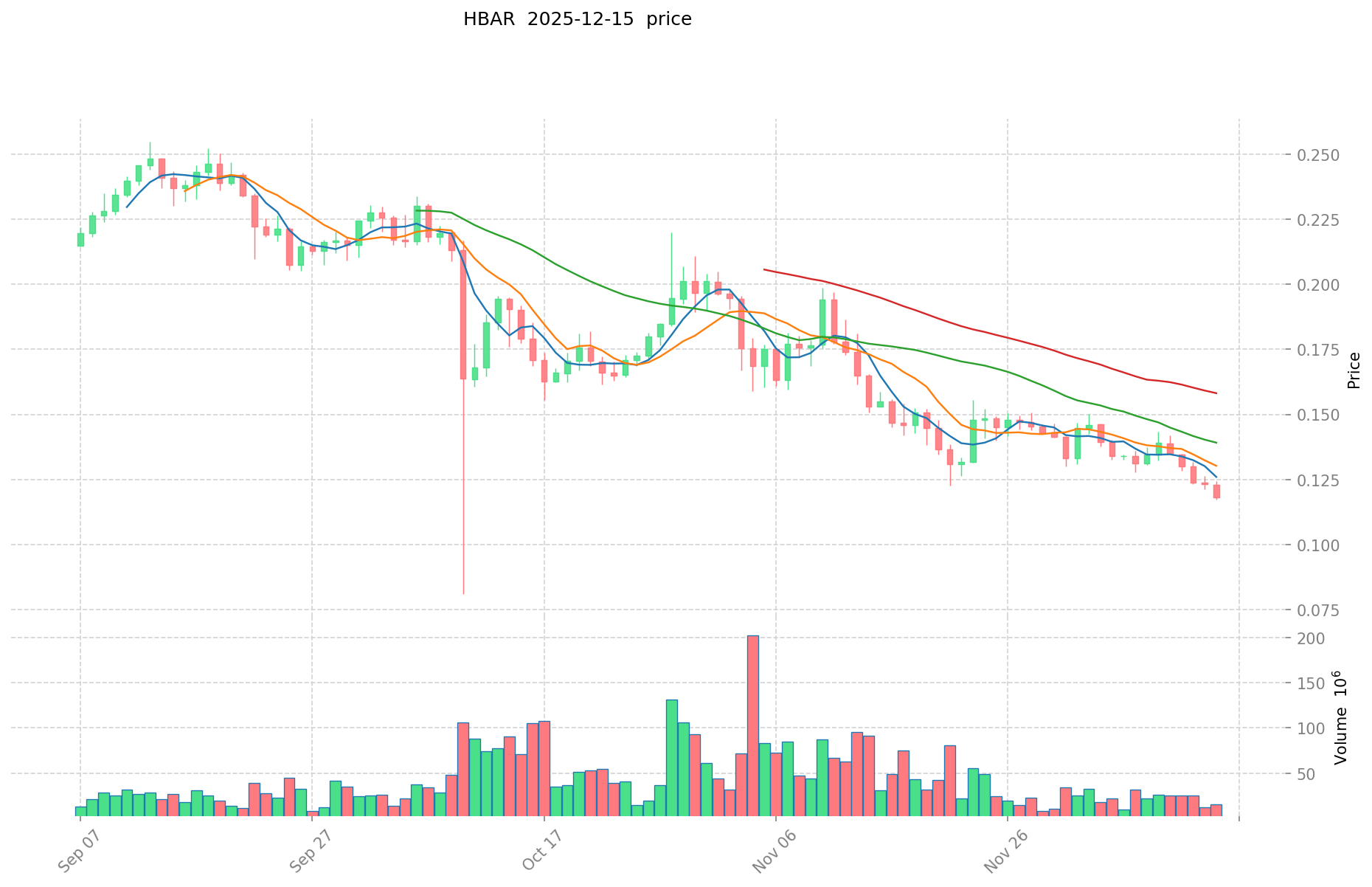
Hedera reached its all-time high of $0.569229 on September 15, 2021, driven by overall market bullishness and increased adoption.
Its lowest price was $0.00986111, recorded on January 3, 2020, likely due to early-stage market uncertainty.
These fluctuations reflect market sentiment, adoption trends, and external factors.
Click to view the current HBAR market price
On-chain Metrics
- Daily Transaction Volume: >10,000 TPS (Transactions Per Second) capability, indicating high network activity potential
- Active Addresses: Data not provided
- Staking Rate: Data not provided
Hedera Ecosystem Applications and Partnerships
Core Use Cases
Hedera's ecosystem supports various applications:
- Decentralized Finance: Projects leveraging Hedera for fast and secure financial transactions.
- Enterprise Solutions: Implementations focusing on supply chain management and data integrity.
Strategic Collaborations
Hedera has established partnerships with prominent organizations to enhance its technological capabilities and market influence. These partnerships provide a solid foundation for Hedera's ecosystem expansion.
Controversies and Challenges
Hedera faces the following challenges:
- Technical Hurdles: Balancing scalability with decentralization.
- Regulatory Concerns: Navigating the evolving regulatory landscape for cryptocurrencies.
- Competitive Pressure: Standing out in a crowded field of blockchain platforms.
These issues have sparked discussions within the community and market, driving continuous innovation for Hedera.
Hedera Community and Social Media Atmosphere
Fan Enthusiasm
Hedera's community is vibrant, with significant growth in daily transaction volumes and wallet addresses. On X, posts and hashtags related to Hedera frequently trend, indicating strong community engagement. Factors such as technological advancements and ecosystem growth have ignited community enthusiasm.
Social Media Sentiment
Sentiment on X shows a range of opinions:
- Supporters praise Hedera's security and efficiency, viewing it as a foundation for future digital economies.
- Critics focus on adoption challenges and competition from other blockchain platforms.
Recent trends show an overall positive sentiment, especially during market upswings.
Hot Topics
X users actively discuss Hedera's role in enterprise adoption, its consensus mechanism, and potential for mainstream use, highlighting both its transformative potential and the challenges it faces in achieving widespread adoption.
More Information Sources on Hedera
- Official Website: Visit Hedera's official website for features, use cases, and latest updates.
- Whitepaper: Hedera's whitepaper details its technical architecture, goals, and vision.
- X Updates: On X, Hedera uses @hedera, with posts covering technical upgrades, community events, and partnership news.
Hedera's Future Roadmap
- Ecosystem Goals: Expand support for enterprise-grade applications and increase network adoption.
- Long-term Vision: Become a leading platform for secure, fast, and fair distributed applications.
How to Participate in Hedera?
- Purchase Channels: Buy HBAR on Gate.com
- Storage Solutions: Use secure wallets compatible with HBAR
- Participate in Governance: Engage in community decisions through official Hedera channels
- Build on the Ecosystem: Visit Hedera's developer documentation to create DApps or contribute code
Summary
Hedera redefines digital currency through its unique hashgraph technology, offering transparency, security, and efficient transactions. Its active community, rich resources, and strong market performance set it apart in the cryptocurrency space. Despite facing challenges such as regulatory concerns and technological hurdles, Hedera's innovative spirit and clear roadmap position it as a significant player in the future of decentralized technology. Whether you're a newcomer or an experienced player, Hedera is worth watching and participating in.
FAQ
Can HBAR ever reach $10?
Yes, HBAR could potentially reach $10 in the future, driven by increased adoption and market growth in the Web3 and cryptocurrency space.
Is HBAR coin a good investment?
HBAR shows promise as a long-term investment. Its innovative technology and growing adoption suggest potential for significant value appreciation by 2025.
Is HBAR better than XRP?
HBAR is more versatile, while XRP excels in payments. XRP has higher liquidity, but HBAR offers broader use cases.
What is HBAR in physics?
In physics, HBAR (ℏ) is the reduced Planck constant, equal to Planck's constant divided by 2π. It's a fundamental constant in quantum mechanics.
Share
Content
Hedera's Positioning and Significance
Origin and Development History
How Does Hedera Work?
Hedera (HBAR) Market Performance
Hedera Ecosystem Applications and Partnerships
Controversies and Challenges
Hedera Community and Social Media Atmosphere
More Information Sources on Hedera
Hedera's Future Roadmap
How to Participate in Hedera?
Summary
FAQ
How to Buy Cryptocurrency


Trending Cryptocurrencies



XZXX: A Comprehensive Guide to the BRC-20 Meme Token in 2025

Bitcoin Fear and Greed Index: Market Sentiment Analysis for 2025

Top Crypto ETFs to Watch in 2025: Navigating the Digital Asset Boom

5 ways to get Bitcoin for free in 2025: Newbie Guide

Bitcoin Market Cap in 2025: Analysis and Trends for Investors
2025 Bitcoin Price Prediction: Trump's Tariffs' Impact on BTC
What is NEAR: A Complete Guide to Understanding the NEAR Protocol and Its Ecosystem

What is OKB: A Comprehensive Guide to OKEx's Native Token and Its Use Cases
What is XAUT: Understanding the Gold-Backed Cryptocurrency Token on the Tezos Blockchain

2025 TAO Price Prediction: Expert Analysis and Market Forecast for Bittensor's Native Token

2025 CC Price Prediction: Expert Analysis and Market Forecast for the Coming Year