Explore the impact of Bancor Network Token (BNT) on decentralized finance, as the article delves into its historical milestones and strategic importance in enhancing liquidity solutions. Analyze Bancor's technical features, market performance, and active community involvement. Discover how Bancor addresses liquidity issues for small-cap tokens and provides protection against impermanent loss. Learn about core applications, strategic partnerships, and governance participation opportunities. Suitable for crypto enthusiasts, the article offers insights on BNT's role as a DeFi cornerstone, ensuring efficient and secure token transactions.
Bancor's Positioning and Significance
In 2017, the Bancor team launched Bancor (BNT), aiming to solve liquidity issues for small market cap tokens.
As the first automated market maker (AMM) protocol, Bancor plays a crucial role in the DeFi ecosystem.
As of 2025, Bancor has become a significant player in the DeFi space, with 38,837 holders and an active developer community. This article will delve into its technical architecture, market performance, and future potential.
Origin and Development History
Birth Background
Bancor was created by the Bancor team in 2017, aiming to solve liquidity problems for small-cap tokens.
It was born during the blockchain technology boom, with the goal of providing liquidity without traditional order books to change the status quo.
Bancor's launch brought new possibilities for small-cap token projects and decentralized trading.
Important Milestones
- 2017: Mainnet launched, achieving automated market-making functionality.
- 2020: Major upgrade introducing impermanent loss protection.
- 2021: Adopted by various DeFi protocols, pushing the price to its all-time high of $10.72.
- 2023: Ecosystem expansion, with the number of integrated DeFi protocols surpassing 100.
With support from its community and foundation, Bancor continues to optimize its technology, security, and real-world applications.
How Does Bancor Work?
Decentralized Control
Bancor operates on a decentralized network of computers (nodes) spread globally, free from control by banks or governments.
These nodes collaborate to validate transactions, ensuring system transparency and attack resistance, granting users greater autonomy and improving network resilience.
Blockchain Core
Bancor's blockchain is a public, immutable digital ledger that records every transaction.
Transactions are grouped into blocks and linked through cryptographic hashes to form a secure chain.
Anyone can view the records, establishing trust without intermediaries.
The unique automated market maker (AMM) technology further enhances performance and liquidity provision.
Ensuring Fairness
Bancor uses a smart contract-based system to validate transactions and prevent fraudulent activities like double-spending.
Liquidity providers maintain network security by contributing tokens to liquidity pools, and receive BNT rewards.
Its innovation includes continuous liquidity and single-sided staking.
Secure Transactions
Bancor uses public-private key encryption to protect transactions:
- Private keys (like secret passwords) are used to sign transactions
- Public keys (like account numbers) are used to verify ownership
This mechanism ensures fund security, while transactions remain pseudonymous.
Additional security features include smart contract audits and upgradeable contracts.
BNT's Market Performance
Circulation Overview
As of September 28, 2025, BNT's circulating supply is 112,260,201.0587688 tokens, which is equal to its total supply.
New tokens enter the market through smart contract interactions with the Bancor protocol, influencing its supply and demand dynamics.
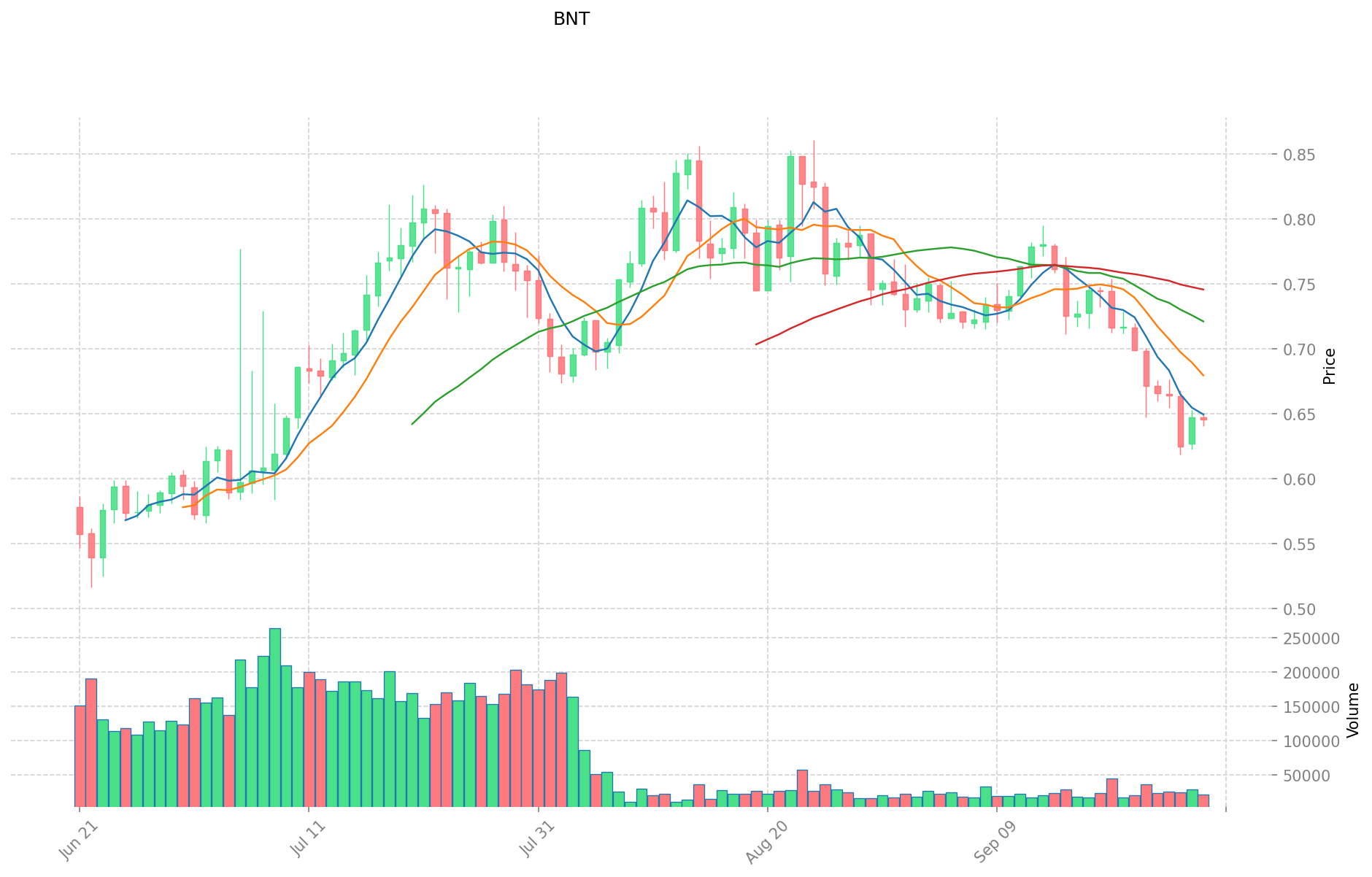
Price Fluctuations
BNT reached its all-time high of $10.72 on January 9, 2018.
Its lowest price was $0.120935, occurring on March 13, 2020, likely due to the global market crash associated with the COVID-19 pandemic.
These fluctuations reflect market sentiment, adoption trends, and external factors.
Click to view the current BNT market price
On-Chain Metrics
- Daily Transaction Volume: $14,390.009011 (indicating network activity)
- Active Addresses: 38,837 (reflecting user engagement)
Bancor Ecosystem Applications and Partnerships
Core Use Cases
Bancor's ecosystem supports various applications:
- DeFi: Bancor Network, providing decentralized token swaps and liquidity provision.
- Liquidity Protocol: Bancor V3, enabling single-sided liquidity provision and impermanent loss protection.
Strategic Collaborations
Bancor has established partnerships with Chainlink and Gnosis, enhancing its technical capabilities and market influence.
These partnerships provide a solid foundation for Bancor's ecosystem expansion.
Controversies and Challenges
Bancor faces the following challenges:
- Technical Issues: Scalability and gas fees on Ethereum
- Regulatory Risks: Uncertain regulatory environment for DeFi protocols
- Competitive Pressure: Rising competition from other AMM protocols
These issues have sparked discussions within the community and market, driving Bancor's continuous innovation.
Bancor Community and Social Media Atmosphere
Fan Enthusiasm
Bancor's community is vibrant, with daily trading volume reaching millions of dollars.
On X platform, related posts and hashtags (such as #Bancor) frequently trend, with monthly post volume reaching tens of thousands.
Protocol upgrades and new features ignite community enthusiasm.
Social Media Sentiment
Sentiment on X shows polarization:
- Supporters praise Bancor's innovative liquidity solutions and impermanent loss protection, viewing it as a "cornerstone of DeFi".
- Critics focus on competition from other AMM protocols and complexity of the system.
Recent trends show generally positive sentiment during bull markets.
Hot Topics
X users hotly debate Bancor's role in DeFi, token economics, and future upgrades,
demonstrating both its transformative potential and the challenges in achieving mainstream adoption.
More Information Sources for Bancor
- Official Website: Visit Bancor's official website for features, use cases, and latest updates.
- White Paper: Bancor White Paper details its technical architecture, goals, and vision.
- X Updates: On X platform, Bancor uses @Bancor handle, with over 100,000 followers as of September 2025,
Posts cover protocol updates, community events, partnership news, generating thousands of likes and retweets.
Bancor Future Roadmap
- 2026: Launch Bancor V4, enhancing capital efficiency and user experience
- Ecosystem Goals: Support integration with multiple blockchain networks and expand cross-chain capabilities
- Long-term Vision: Become the standard for decentralized liquidity provision in DeFi
How to Participate in Bancor?
- Purchase Channels: Buy BNT on Gate.com
- Storage Solutions: Use Web3 wallets for secure storage
- Participate in Governance: Through Bancor DAO voting on Snapshot platform
- Build the Ecosystem: Visit Bancor's developer documentation to contribute or build applications
Summary
Bancor redefines decentralized finance through blockchain technology, offering innovative liquidity solutions, impermanent loss protection, and efficient token swaps.
Its active community, rich resources, and strong market performance make it stand out in the cryptocurrency field.
Despite facing challenges like regulatory uncertainties and technical bottlenecks, Bancor's innovative spirit and clear roadmap secure its important position in the future of decentralized technology.
Whether you're a newcomer or a seasoned player, Bancor is worth watching and participating in.
FAQ
What does BNT mean in medical terms?
BNT stands for Boston Naming Test, a neuropsychological assessment tool used to evaluate a person's ability to name objects and assess cognitive function.
What network is BNT?
BNT operates on the Ethereum network as an ERC-20 token. It's the native token of the Bancor protocol, which uses automated market making (AMM) for decentralized trading.
What does BNT stand for?
BNT stands for Bancor Network Token, the native cryptocurrency of the Bancor protocol, a decentralized liquidity network.
What is BNT used for?
BNT is used as the native token of Bancor Network, enabling decentralized trading and liquidity provision. It facilitates automated market-making and impermanent loss protection for liquidity providers.
* The information is not intended to be and does not constitute financial advice or any other recommendation of any sort offered or endorsed by Gate.