


VARA vs LINK: Comparing the Revolutionary Blockchain Oracle Solutions for Data Integrity
Introduction: VARA vs LINK Investment Comparison
In the cryptocurrency market, the comparison between VARA and LINK has been an unavoidable topic for investors. The two not only show significant differences in market cap ranking, application scenarios, and price performance but also represent different positioning in the crypto asset space.
Vara Network (VARA): Launched in 2023, it has gained market recognition for its innovative approach to building decentralized applications (dApps) in the Web3 space.
ChainLink (LINK): Since its inception in 2017, it has been hailed as a crucial oracle network, becoming one of the most traded and highest market cap cryptocurrencies globally.
This article will provide a comprehensive analysis of the investment value comparison between VARA and LINK, focusing on historical price trends, supply mechanisms, institutional adoption, technological ecosystems, and future predictions, attempting to answer the question investors care about most:
"Which is the better buy right now?" Here is the report based on the provided template and information:
I. Price History Comparison and Current Market Status
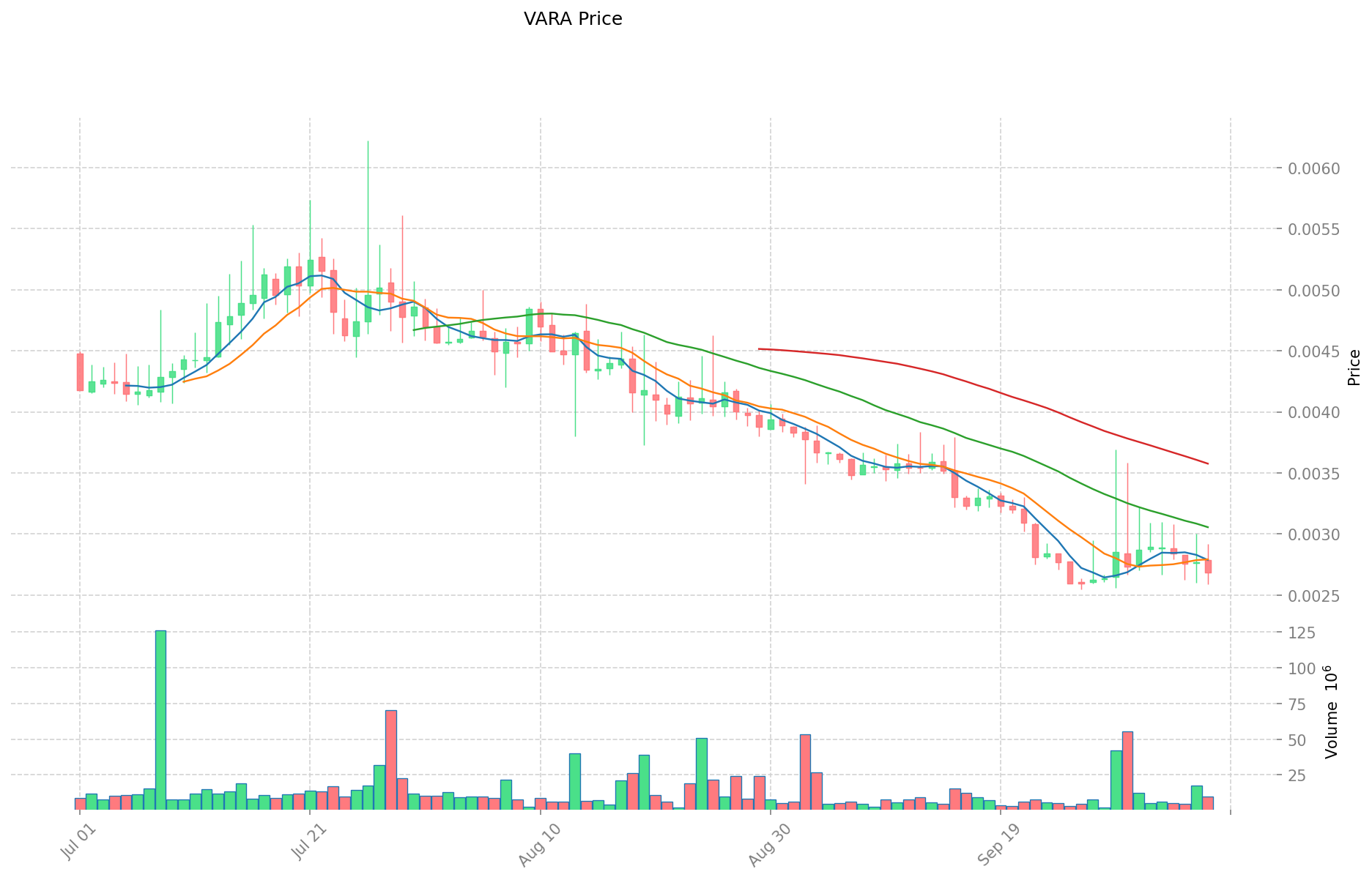
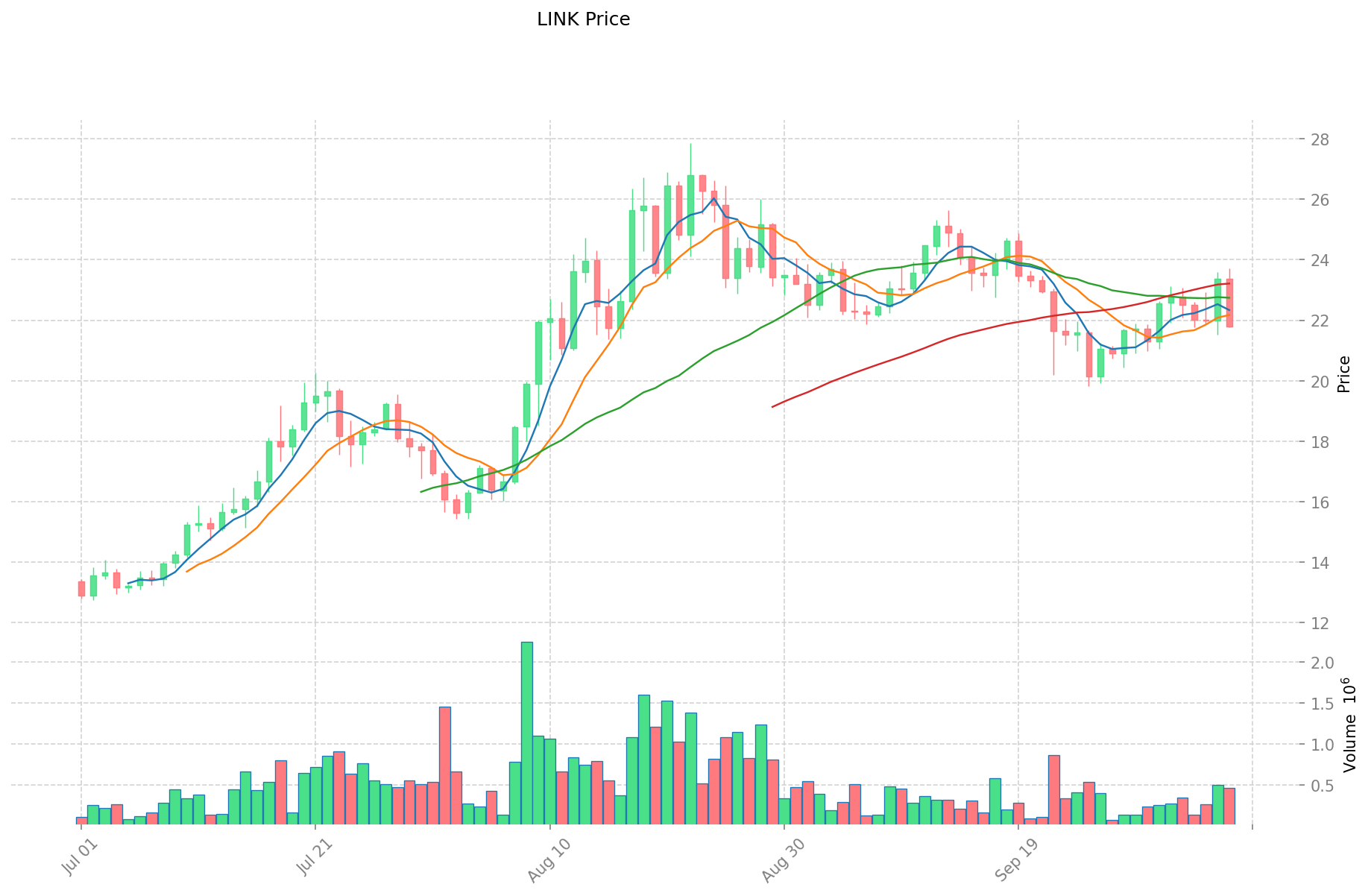
VARA and LINK Historical Price Trends
- 2024: VARA reached its all-time high of $0.2 on January 17, 2024.
- 2021: LINK hit its all-time high of $52.7 on May 10, 2021, driven by increased adoption of decentralized oracles.
- Comparative analysis: In the recent market cycle, VARA dropped from its high of $0.2 to a low of $0.002544, while LINK has shown more resilience, currently trading at $21.853.
Current Market Situation (2025-10-08)
- VARA current price: $0.002687
- LINK current price: $21.853
- 24-hour trading volume: VARA $25,987.44 vs LINK $10,514,406.07
- Market sentiment index (Fear & Greed Index): 70 (Greed)
Click to view real-time prices:
- View VARA current price Market Price
- View LINK current price Market Price
Real-World Assets (RWA) Tokenization: Market Analysis and Future Prospects
Executive Summary
The tokenization of Real-World Assets (RWA) represents one of the most promising developments in the blockchain space. This report analyzes the current state of the RWA market, its growth potential, key projects, and the infrastructure supporting this emerging sector. As of August 2025, the RWA market cap has reached $25.22 billion, with tokenized U.S. Treasury bonds representing the largest category at approximately $6.8 billion (27% of total RWA value).
I. Understanding RWA: Concept and Classification
Real-World Assets (RWA) refer to tangible or intangible assets from the physical world converted into tradable digital tokens through blockchain technology. The scope of RWA is extensive, encompassing:
- Government and corporate bonds and other debt instruments
- Equity assets such as stocks
- Physical assets including real estate and gold
- Non-standardized rights such as private equity, intellectual property, and supply chain receivables
Key RWA categories include:
-
Private Credit: Including SME loans, trade receivables financing, consumer finance, and real estate mortgages. Notable projects: Maple, Centrifuge, Goldfinch, Credix, and Clearpool.
-
Equity and Fund Shares: Covering unlisted equity, public company stocks, and various private fund shares. Representative platforms: Securitize, ADDX, and Swarm.
-
Alternative Collections and Art: Including art pieces, collectible cards, fine wines, and luxury watches.
II. Market Growth and Current Status
The RWA market has experienced exponential growth:
- 2020: Less than $200 million in on-chain RWA
- End of 2023: Over $1 billion
- Mid-2024: Exceeded $12 billion (excluding stablecoins)
- First half of 2025: Surpassed $23.3 billion (380% increase from early 2024)
- August 2025: Approximately $25.22 billion
Tokenized U.S. Treasury bonds constitute the largest single category, followed by private credit assets, including various on-chain loan pools.
III. Major RWA Projects Overview
Government Bond RWA Projects
- Ondo Finance: Offers OUSG tokens with ETF cross-chain packaging structure
- Superstate: Provides USTB tokens as registered funds
- Backed Finance: Offers xStocks framework for tokenizing U.S. and European securities
Common feature: High emphasis on regulatory compliance, typically establishing offshore SPVs or regulated funds to ensure clear legal relationships between tokens and underlying assets.
Credit Loan RWA Projects
- Maple Finance: Positioned as a multi-chain institutional lending platform serving hedge funds, trading companies, and DAOs
- Goldfinch, TrueFi, Centrifuge, Credix, Clearpool: Bringing assets like SME loans into DeFi through off-chain SPV + on-chain fund pool structures
Currently, bond and credit-type RWA projects dominate the market in terms of implementation and scale, while other categories are still in exploratory stages.
IV. Infrastructure Evolution: The BenFen Chain Case Study
Beyond specific projects, underlying blockchain infrastructure development is crucial. BenFen Chain, originally positioned as a stablecoin payment public chain emphasizing high performance and low-cost transactions, announced a major upgrade in August 2025:
- Now supports "one-click RWA issuance and on-chain functionality"
- Upgraded positioning to "stablecoin + RWA infrastructure public chain"
- Optimized underlying Move virtual machine and cross-chain engine
- Maintains 10,000+ TPS throughput and sub-second confirmation speed
- Embedded smart contract templates and standardized business processes
- Automated process combining custody, auditing, and KYC
This infrastructure development significantly reduces the technical difficulty and time cost for issuers, enabling rapid access to on-chain liquidity and global settlement capabilities.
V. Yield and Cost Structure of Different RWA Types
Government Bonds
- Yield: Approximately 5% for one-year U.S. Treasury bonds
- Management fees: 0.15-0.3% (Ondo's OUSG), as low as 0.15% (Superstate's USTB)
- Additional costs: Custody fees to banking custodians
Real Estate and Other Physical Assets
- Yield: 3-5% rental returns in developed markets, potentially 8%+ in developing markets
- Primary costs: Legal structure establishment and ongoing management
- Required payments: Appraisers, custodian banks, notarized legal documents
Different RWA assets exhibit an inverse relationship between yield and liquidity:
- High-yield assets typically have poor liquidity
- Assets with good liquidity (like gold) have low or zero yield, requiring DeFi composite strategies to enhance returns
VI. Regulatory Landscape
Hong Kong has adopted a particularly positive stance toward RWAs, allowing licensed brokers to apply for pilot programs in tokenized securities issuance and trading (limited to professional investors). Their approach emphasizes "compliance first, innovation following," using government endorsement to attract relevant projects.
VII. Future Outlook
RWA represents a promising narrative but faces challenges including legal compliance, asset authenticity verification, and insufficient liquidity. As technological solutions mature and regulatory environments improve, infrastructure providers like BenFen Chain will help RWA evolve from concept to large-scale application, potentially becoming a pillar sector in the crypto space alongside stablecoins.
With continued development of one-click issuance capabilities and standardized frameworks, the barriers to tokenizing various assets will be significantly reduced, creating new opportunities for global financial inclusion and asset liquidity.
Note: This report is based on data available as of August 2025 and focuses on technological and market developments without making specific investment recommendations.
III. 2025-2030 Price Prediction: VARA vs LINK
Short-term Prediction (2025)
- VARA: Conservative $0.00137037 - $0.002687 | Optimistic $0.002687 - $0.00309005
- LINK: Conservative $18.17451 - $21.897 | Optimistic $21.897 - $26.93331
Mid-term Prediction (2027)
- VARA may enter a growth phase, with estimated prices ranging from $0.00171462844 to $0.004439662925
- LINK may enter a bullish market, with estimated prices ranging from $16.197013827 to $37.096386507
- Key drivers: Institutional capital inflow, ETF, ecosystem development
Long-term Prediction (2030)
- VARA: Base scenario $0.003406074567669 - $0.004311486794518 | Optimistic scenario $0.004311486794518 - $0.00590673690849
- LINK: Base scenario $24.73379626012911 - $44.167493321659125 | Optimistic scenario $44.167493321659125 - $45.492518121308898
Disclaimer: This analysis is based on historical data and market projections. Cryptocurrency markets are highly volatile and unpredictable. These predictions should not be considered as financial advice. Always conduct your own research before making investment decisions.
VARA:
| 年份 | 预测最高价 | 预测平均价格 | 预测最低价 | 涨跌幅 |
|---|---|---|---|---|
| 2025 | 0.00309005 | 0.002687 | 0.00137037 | 0 |
| 2026 | 0.003235148 | 0.002888525 | 0.002657443 | 7 |
| 2027 | 0.004439662925 | 0.0030618365 | 0.00171462844 | 13 |
| 2028 | 0.004088317186625 | 0.0037507497125 | 0.00262552479875 | 39 |
| 2029 | 0.004703440139475 | 0.003919533449562 | 0.003292408097632 | 45 |
| 2030 | 0.00590673690849 | 0.004311486794518 | 0.003406074567669 | 60 |
LINK:
| 年份 | 预测最高价 | 预测平均价格 | 预测最低价 | 涨跌幅 |
|---|---|---|---|---|
| 2025 | 26.93331 | 21.897 | 18.17451 | 0 |
| 2026 | 27.8332767 | 24.415155 | 12.6958806 | 11 |
| 2027 | 37.096386507 | 26.12421585 | 16.197013827 | 19 |
| 2028 | 41.09339153205 | 31.6103011785 | 20.23059275424 | 44 |
| 2029 | 51.98314028804325 | 36.351846355275 | 33.443698646853 | 66 |
| 2030 | 45.492518121308898 | 44.167493321659125 | 24.73379626012911 | 101 |
IV. Investment Strategy Comparison: VARA vs LINK
Long-term vs Short-term Investment Strategy
- VARA: Suitable for investors focusing on ecosystem potential and emerging technologies
- LINK: Suitable for investors seeking established projects with proven utility and stability
Risk Management and Asset Allocation
- Conservative investors: VARA: 10% vs LINK: 90%
- Aggressive investors: VARA: 30% vs LINK: 70%
- Hedging tools: Stablecoin allocation, options, cross-currency portfolios
V. Potential Risk Comparison
Market Risk
- VARA: Higher volatility due to lower market cap and trading volume
- LINK: Relatively lower volatility but still subject to overall crypto market trends
Technical Risk
- VARA: Scalability, network stability
- LINK: Oracle network reliability, smart contract vulnerabilities
Regulatory Risk
- Global regulatory policies may have different impacts on both assets
VI. Conclusion: Which Is the Better Buy?
📌 Investment Value Summary:
- VARA advantages: Potential for high growth, innovative ecosystem
- LINK advantages: Established market position, widespread adoption in DeFi
✅ Investment Advice:
- New investors: Consider allocating a smaller portion to VARA and a larger portion to LINK
- Experienced investors: Balanced approach with risk-adjusted allocation between VARA and LINK
- Institutional investors: Conduct thorough due diligence on both projects, focusing on long-term ecosystem development
⚠️ Risk Warning: Cryptocurrency markets are highly volatile. This article does not constitute investment advice. None
VII. FAQ
Q1: What are the main differences between VARA and LINK? A: VARA is a newer project launched in 2023 focused on building decentralized applications in Web3, while LINK has been established since 2017 as a crucial oracle network. LINK has a higher market cap, more widespread adoption, and greater trading volume compared to VARA.
Q2: Which asset has shown better price performance recently? A: LINK has shown more price resilience recently. While VARA dropped from its all-time high of $0.2 to $0.002687, LINK is currently trading at $21.853, closer to its all-time high of $52.7.
Q3: How do the future price predictions compare for VARA and LINK? A: By 2030, VARA's optimistic scenario predicts a range of $0.004311486794518 - $0.00590673690849, while LINK's optimistic scenario predicts $44.167493321659125 - $45.492518121308898. LINK is expected to have higher absolute prices, but VARA may have higher percentage growth potential.
Q4: What are the key risks associated with investing in VARA and LINK? A: VARA has higher volatility risk due to its lower market cap and trading volume. It also faces technical risks related to scalability and network stability. LINK faces risks related to oracle network reliability and smart contract vulnerabilities. Both are subject to regulatory risks.
Q5: How should investors allocate their portfolio between VARA and LINK? A: Conservative investors might consider allocating 10% to VARA and 90% to LINK, while more aggressive investors could allocate 30% to VARA and 70% to LINK. The exact allocation should depend on individual risk tolerance and investment goals.
Q6: Which asset is better suited for long-term vs short-term investment? A: VARA may be more suitable for investors focusing on long-term ecosystem potential and emerging technologies. LINK is better suited for investors seeking established projects with proven utility and stability in both short and long-term timeframes.
Q7: What factors could drive future growth for VARA and LINK? A: Key drivers for both assets include institutional capital inflow, potential ETF approvals, and ongoing ecosystem development. VARA's growth may be more dependent on its ability to deliver on its innovative Web3 applications, while LINK's growth is tied to the continued expansion of DeFi and the need for reliable oracle services.
Share
Content