TUNE vs ATOM: Comparing Two Powerful Mobile App Analytics Platforms

Introduction: Investment Comparison of TUNE vs ATOM
In the cryptocurrency market, the comparison between Bitune (TUNE) and Cosmos (ATOM) remains a topic of interest for investors. The two projects differ significantly in market cap ranking, use cases, and price performance, representing distinct positions in the crypto asset landscape.
Bitune (TUNE): Launched as a product studio challenging the limits of the Bitcoin network, Bitune aims to streamline Bitcoin interaction processes and offer accessible solutions.
Cosmos (ATOM): Introduced in 2019, Cosmos has been hailed as the "Internet of Blockchains," positioning itself as a key player in facilitating interoperability between different blockchain networks.
This article will provide a comprehensive analysis of the investment value comparison between TUNE and ATOM, focusing on historical price trends, supply mechanisms, institutional adoption, technological ecosystems, and future projections. We will attempt to answer the question most crucial to investors:
"Which is the better buy right now?"
I. Price History Comparison and Current Market Status
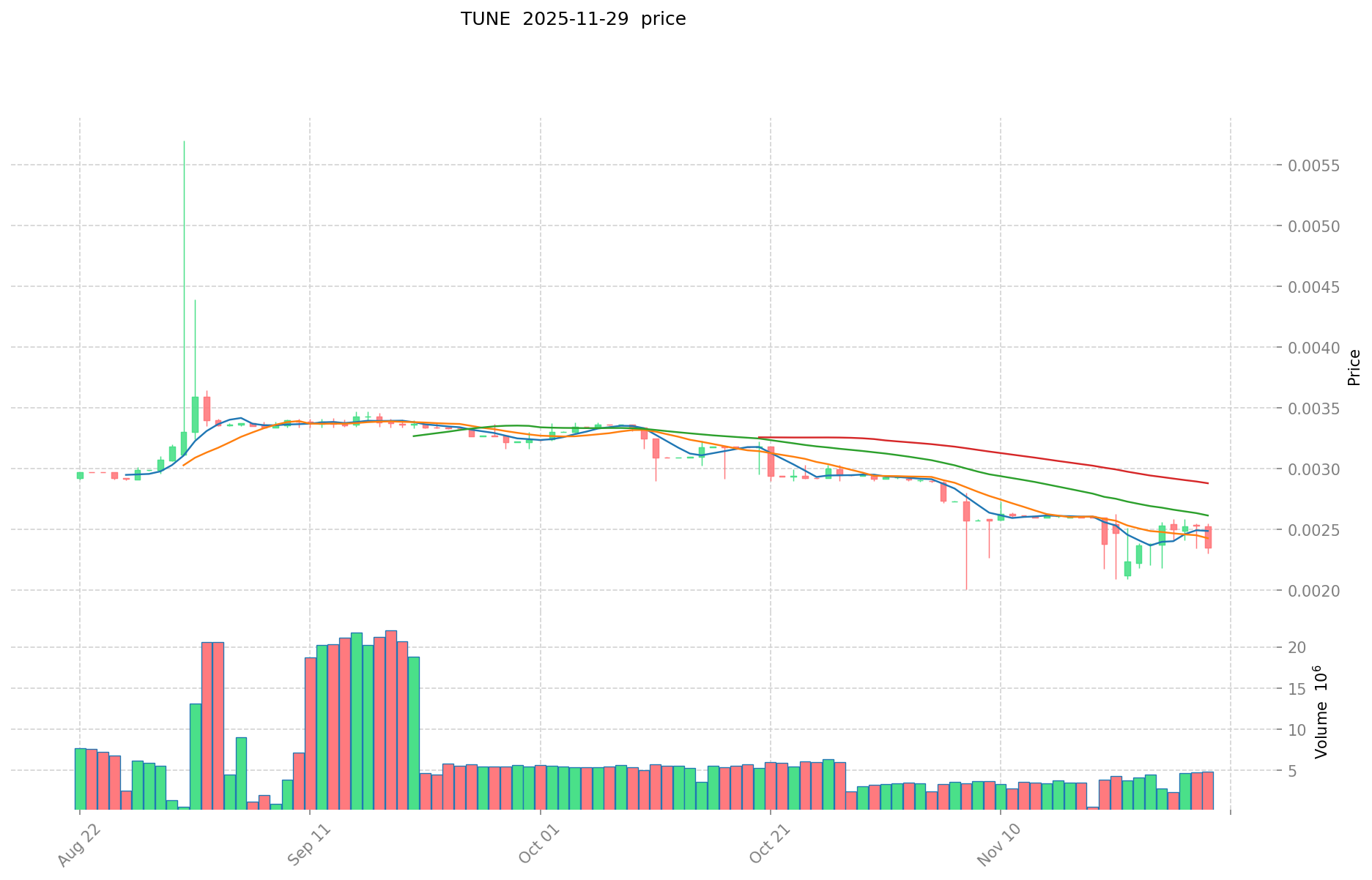
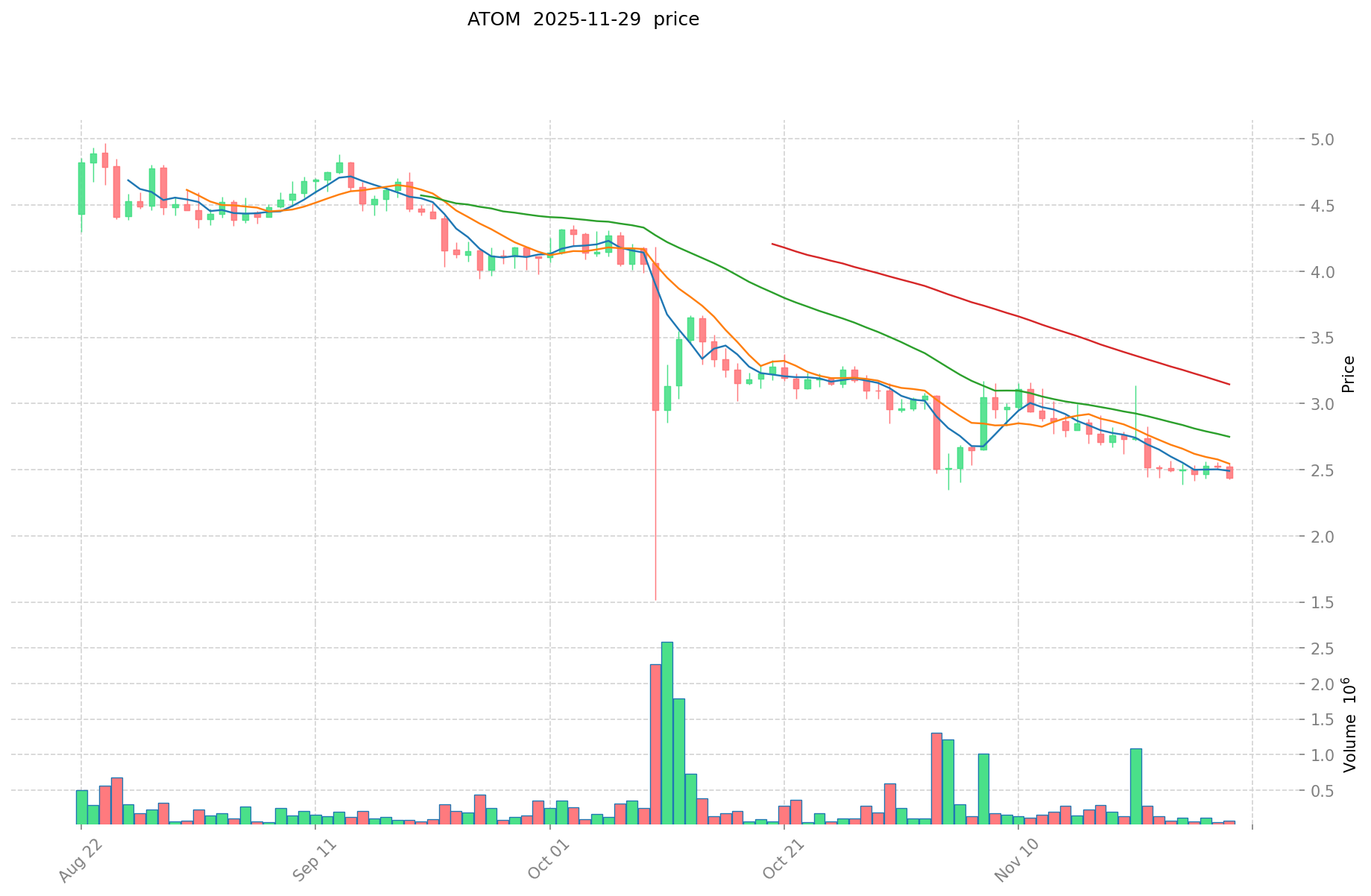
TUNE (Coin A) and ATOM (Coin B) Historical Price Trends
- 2024: TUNE reached its all-time high of $0.1377 on February 29, 2024.
- 2022: ATOM hit its all-time high of $44.45 on January 17, 2022.
- Comparative analysis: TUNE has experienced a significant drop from its all-time high of $0.1377 to its current price of $0.0025344, while ATOM has declined from $44.45 to $2.428.
Current Market Situation (2025-11-30)
- TUNE current price: $0.0025344
- ATOM current price: $2.428
- 24-hour trading volume: TUNE $12,403.04 vs ATOM $117,121.16
- Market Sentiment Index (Fear & Greed Index): 28 (Fear)
Click to view real-time prices:
- Check TUNE current price Market Price
- Check ATOM current price Market Price
II. Core Factors Affecting the Investment Value of TUNE vs ATOM
Supply Mechanism Comparison (Tokenomics)
-
TUNE: Fixed maximum supply with a declining emission rate, implementing a deflationary model through buy-and-burn mechanisms
-
ATOM: Inflationary model with staking rewards, using variable inflation rates (currently around 10-20%) to incentivize network security
-
📌 Historical Pattern: Deflationary models like TUNE's tend to create upward price pressure over time, while ATOM's higher inflation rate requires robust network growth to maintain price stability.
Institutional Adoption and Market Applications
- Institutional Holdings: ATOM currently has broader institutional recognition and integration with major exchanges and custody solutions
- Enterprise Adoption: ATOM has stronger enterprise integration through the Cosmos ecosystem's interoperability focus, while TUNE is establishing initial partnerships in the music and entertainment sectors
- Regulatory Attitudes: Both operate in similar regulatory environments, with neither facing specific regulatory challenges compared to the other
Technical Development and Ecosystem Building
- TUNE Technical Upgrades: Recent implementation of Layer 2 scaling solutions and focus on creator-owned music platforms
- ATOM Technical Development: Continuous improvements to the Inter-Blockchain Communication (IBC) protocol enabling cross-chain interoperability
- Ecosystem Comparison: ATOM has a more mature ecosystem with established DeFi protocols and interchain applications, while TUNE is developing specialized applications in the entertainment and creative industries
Macroeconomic Factors and Market Cycles
- Performance in Inflationary Environments: TUNE's deflationary model potentially offers better protection against inflation compared to ATOM's inflationary tokenomics
- Macroeconomic Monetary Policy: Both tokens show similar sensitivity to interest rate changes and dollar strength
- Geopolitical Factors: ATOM's interoperability focus may provide advantages in fragmented global markets
III. 2025-2030 Price Prediction: TUNE vs ATOM
Short-term Prediction (2025)
- TUNE: Conservative $0.00127 - $0.00236 | Optimistic $0.00236 - $0.00288
- ATOM: Conservative $1.60 - $2.43 | Optimistic $2.43 - $2.87
Mid-term Prediction (2027)
- TUNE may enter a growth phase, with prices expected in the range of $0.00217 - $0.00349
- ATOM may enter a bullish market, with prices expected in the range of $1.79 - $4.17
- Key drivers: Institutional capital inflow, ETF, ecosystem development
Long-term Prediction (2030)
- TUNE: Base scenario $0.00242 - $0.00431 | Optimistic scenario $0.00431 - $0.00574
- ATOM: Base scenario $3.99 - $4.44 | Optimistic scenario $4.44 - $6.17
Disclaimer: The information provided is for informational purposes only and should not be considered as financial advice. Cryptocurrency markets are highly volatile and unpredictable. Always conduct your own research before making any investment decisions.
TUNE:
| 年份 | 预测最高价 | 预测平均价格 | 预测最低价 | 涨跌幅 |
|---|---|---|---|---|
| 2025 | 0.0028792 | 0.00236 | 0.0012744 | -7 |
| 2026 | 0.003850812 | 0.0026196 | 0.002252856 | 3 |
| 2027 | 0.00349402248 | 0.003235206 | 0.00216758802 | 27 |
| 2028 | 0.004373998512 | 0.00336461424 | 0.0028262759616 | 32 |
| 2029 | 0.00475924684248 | 0.003869306376 | 0.00313413816456 | 52 |
| 2030 | 0.005737987890289 | 0.00431427660924 | 0.002415994901174 | 69 |
ATOM:
| 年份 | 预测最高价 | 预测平均价格 | 预测最低价 | 涨跌幅 |
|---|---|---|---|---|
| 2025 | 2.8674 | 2.43 | 1.6038 | 0 |
| 2026 | 3.231414 | 2.6487 | 1.483272 | 9 |
| 2027 | 4.17488094 | 2.940057 | 1.79343477 | 21 |
| 2028 | 4.268962764 | 3.55746897 | 1.8143091747 | 46 |
| 2029 | 4.96978415109 | 3.913215867 | 3.40449780429 | 61 |
| 2030 | 6.17368501257255 | 4.441500009045 | 3.9973500081405 | 82 |
IV. Investment Strategy Comparison: TUNE vs ATOM
Long-term vs Short-term Investment Strategy
- TUNE: Suitable for investors focused on entertainment and creative industry potential
- ATOM: Suitable for investors seeking interoperability and ecosystem growth
Risk Management and Asset Allocation
- Conservative investors: TUNE: 20% vs ATOM: 80%
- Aggressive investors: TUNE: 40% vs ATOM: 60%
- Hedging tools: Stablecoin allocation, options, cross-currency portfolio
V. Potential Risk Comparison
Market Risk
- TUNE: Higher volatility due to lower market cap and trading volume
- ATOM: Susceptible to broader crypto market trends and competition from other interoperability solutions
Technical Risk
- TUNE: Scalability, network stability
- ATOM: Validator concentration, potential security vulnerabilities in IBC protocol
Regulatory Risk
- Global regulatory policies may impact both, with ATOM potentially facing more scrutiny due to its broader ecosystem and DeFi applications
VI. Conclusion: Which Is the Better Buy?
📌 Investment Value Summary:
- TUNE advantages: Deflationary model, focus on entertainment industry, potential for rapid growth
- ATOM advantages: Established ecosystem, strong interoperability features, broader institutional adoption
✅ Investment Advice:
- New investors: Consider a small allocation to ATOM for exposure to the interoperability sector
- Experienced investors: Balanced portfolio with both TUNE and ATOM, adjusting based on risk tolerance
- Institutional investors: Focus on ATOM for its established ecosystem and institutional recognition, while monitoring TUNE for potential future opportunities
⚠️ Risk Warning: The cryptocurrency market is highly volatile, and this article does not constitute investment advice. None
FAQ
Q1: What are the main differences between TUNE and ATOM? Answer: TUNE is a product studio focused on Bitcoin interaction and entertainment industry solutions, with a deflationary token model. ATOM is the native token of Cosmos, an "Internet of Blockchains" project focusing on interoperability between different blockchain networks, with an inflationary token model.
Q2: Which token has performed better historically? Answer: ATOM has shown better historical performance, reaching an all-time high of $44.45 in January 2022, compared to TUNE's all-time high of $0.1377 in February 2024. However, both have experienced significant drops from their peak prices.
Q3: How do the supply mechanisms of TUNE and ATOM differ? Answer: TUNE has a fixed maximum supply with a declining emission rate and implements a deflationary model through buy-and-burn mechanisms. ATOM uses an inflationary model with staking rewards and variable inflation rates to incentivize network security.
Q4: Which token has better institutional adoption? Answer: ATOM currently has broader institutional recognition and integration with major exchanges and custody solutions. It also has stronger enterprise adoption through the Cosmos ecosystem's interoperability focus.
Q5: What are the key factors affecting the future price of TUNE and ATOM? Answer: Key factors include institutional capital inflow, potential ETF approvals, ecosystem development, macroeconomic conditions, and regulatory environments. TUNE's price may be more influenced by developments in the entertainment industry, while ATOM's price could be affected by advancements in blockchain interoperability.
Q6: How should investors allocate their portfolio between TUNE and ATOM? Answer: Conservative investors might consider allocating 20% to TUNE and 80% to ATOM, while more aggressive investors could opt for 40% TUNE and 60% ATOM. The exact allocation should be based on individual risk tolerance and investment goals.
Q7: What are the main risks associated with investing in TUNE and ATOM? Answer: For TUNE, risks include higher volatility due to lower market cap and trading volume, as well as potential scalability and network stability issues. ATOM faces risks from broader crypto market trends, competition from other interoperability solutions, and potential security vulnerabilities in its IBC protocol.
Share
Content
Introduction: Investment Comparison of TUNE vs ATOM
I. Price History Comparison and Current Market Status
II. Core Factors Affecting the Investment Value of TUNE vs ATOM
III. 2025-2030 Price Prediction: TUNE vs ATOM
IV. Investment Strategy Comparison: TUNE vs ATOM
V. Potential Risk Comparison
VI. Conclusion: Which Is the Better Buy?
FAQ
How to Buy Cryptocurrency


Trending Cryptocurrencies



2025 ATOM Price Prediction: Bullish Outlook as Cosmos Ecosystem Expands

DUCK vs ATOM: A Comparative Analysis of Modern Web Development Frameworks

NKN vs ATOM: Comparing Two Blockchain Network Solutions for Decentralized Communication and Interoperability

DADDY vs ATOM: A Battle of Molecular Bonds in Modern Chemistry

NIL vs ATOM: Exploring the Fundamental Concepts in Lisp Programming

GALFAN vs ATOM: A Comparative Analysis of Advanced Corrosion Resistant Coatings for Steel Applications
Xenea Daily Quiz Answer December 13, 2025

Guide to Bridging Assets to the Polygon Network

Guide to Integrating Polygon Network with Your Crypto Wallet

Beginner's Guide to Secure Digital Asset Storage with BEP2

Guide to Bridging Assets to Polygon PoS Network