SQUID vs APT: Comparing Network Monitoring Tools for Enhanced Cybersecurity

Introduction: Investment Comparison of SQUID vs APT
In the cryptocurrency market, SQUID vs APT comparison has been an unavoidable topic for investors. The two not only show significant differences in market cap ranking, application scenarios, and price performance, but also represent different positioning in the crypto asset landscape.
SQUID (SQUID): Launched in 2021, it gained market recognition as a meme token based on the popular Netflix series.
APT (APT): Introduced in 2022, it has been hailed as a high-performance Layer 1 blockchain, focusing on security and scalability.
This article will comprehensively analyze the investment value comparison between SQUID and APT, focusing on historical price trends, supply mechanisms, institutional adoption, technological ecosystems, and future predictions, attempting to answer the question most concerning to investors:
"Which is the better buy right now?"
I. Price History Comparison and Current Market Status
SQUID and APT Historical Price Trends
- 2021: SQUID experienced a dramatic price surge and subsequent collapse due to a rug pull event, with its price plummeting from a peak to near zero.
- 2023: APT reached its all-time high of $19.92 on January 26, 2023, likely influenced by positive market sentiment and project developments.
- Comparative Analysis: During the recent market cycle, SQUID fell from its all-time high of $0.251228 to a low of $0.00000896, while APT declined from its peak of $19.92 to a current price of $2.359, showing significant volatility but maintaining a higher value than SQUID.
Current Market Situation (2025-11-24)
- SQUID current price: $0.003564
- APT current price: $2.359
- 24-hour trading volume: SQUID $4,692.18 vs APT $634,624.95
- Market Sentiment Index (Fear & Greed Index): 13 (Extreme Fear)
Click to view real-time prices:
- Check SQUID current price Market Price
- Check APT current price Market Price
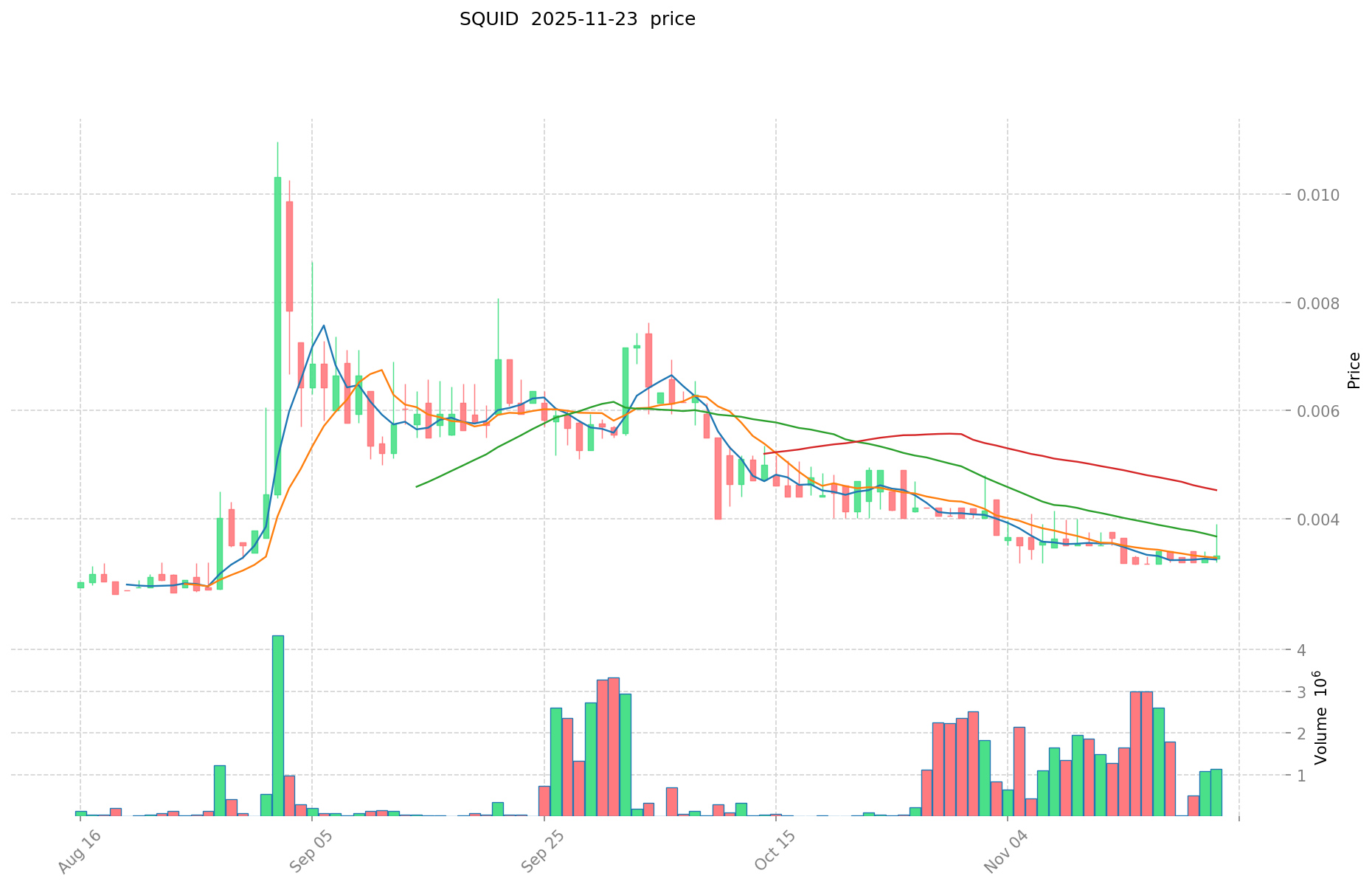
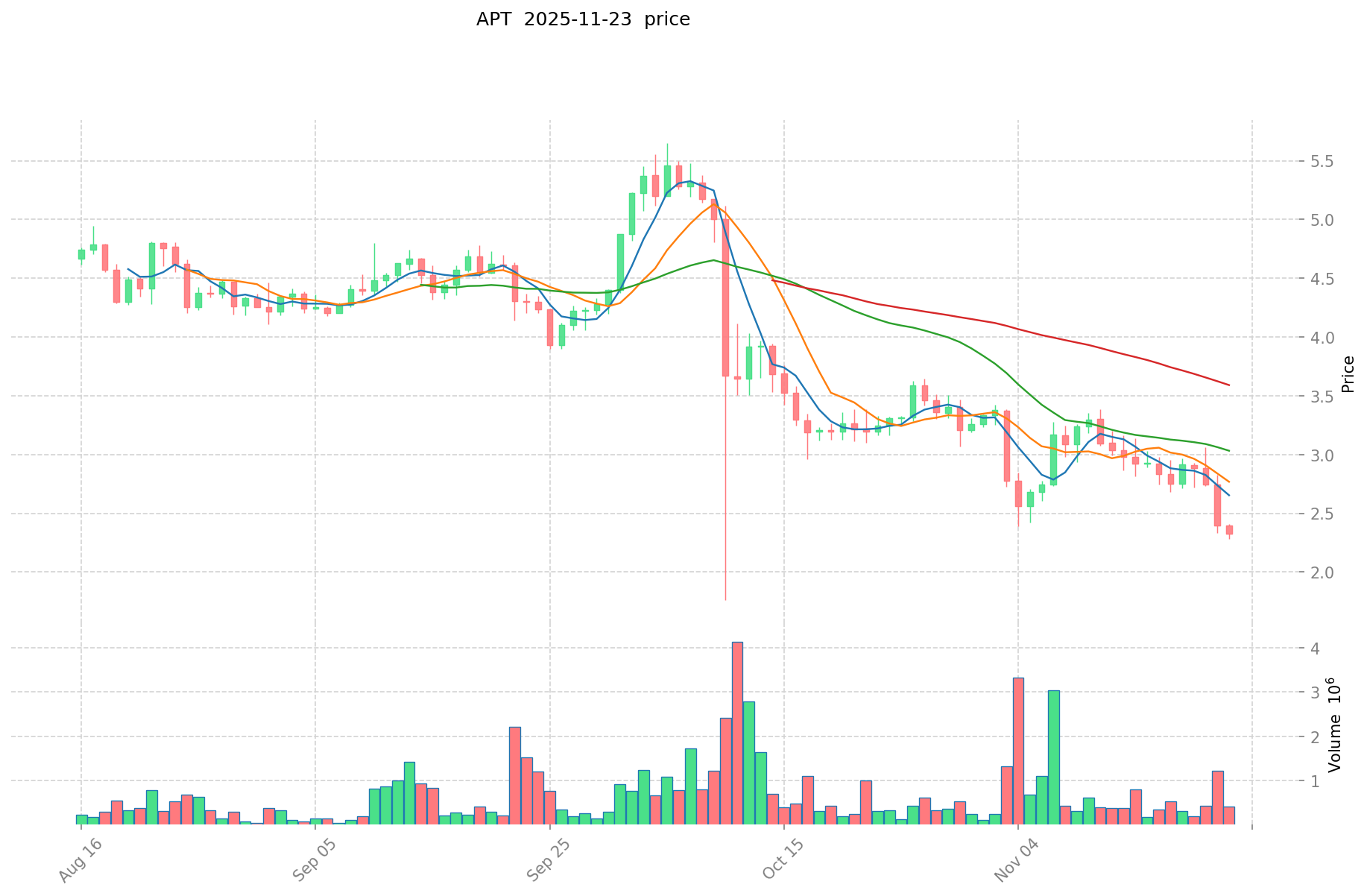
II. Core Factors Affecting Investment Value of SQUID vs APT
Supply Mechanisms Comparison (Tokenomics)
- SQUID: Fixed maximum supply of 1,000,000,000 SQUID tokens with a declining inflation rate over time
- APT: Maximum supply of 1 billion tokens with strategic distribution across ecosystem participants (community, core contributors, foundation, investors)
- 📌 Historical Pattern: Fixed supply models like SQUID's tend to create scarcity-driven value proposition, while APT's strategic distribution aims to balance ecosystem growth with token value stability.
Institutional Adoption and Market Applications
- Institutional Holdings: APT has attracted more institutional interest with backing from major VCs including a16z, while SQUID has focused on community-driven growth
- Enterprise Adoption: APT has gained traction through the Move programming language and its focus on security and scalability in enterprise solutions
- Regulatory Attitudes: Both tokens face varying regulatory approaches across jurisdictions, with neither having achieved clear regulatory advantage globally
Technical Development and Ecosystem Building
- SQUID Technical Upgrades: Focus on DeFi integration and cross-chain functionality
- APT Technical Development: Layer-1 blockchain with high TPS, parallel execution engine, and the Move programming language for enhanced security
- Ecosystem Comparison: APT has developed a more comprehensive ecosystem including DeFi protocols, NFT marketplaces and developer tools, while SQUID is building its presence primarily in the DeFi sector
Macroeconomic Factors and Market Cycles
- Inflation Performance: Both tokens remain subject to broader crypto market trends, with neither demonstrating exceptional inflation-resistant properties
- Monetary Policy Impact: Like most digital assets, both tokens show sensitivity to Fed policy changes and dollar strength
- Geopolitical Factors: Cross-border transaction demands may benefit both tokens, though regulatory clarity will likely determine advantage
III. 2025-2030 Price Prediction: SQUID vs APT
Short-term Prediction (2025)
- SQUID: Conservative $0.00324 - $0.0036 | Optimistic $0.0036 - $0.00522
- APT: Conservative $1.43655 - $2.355 | Optimistic $2.355 - $2.94375
Mid-term Prediction (2027)
- SQUID may enter a growth phase, with expected prices $0.004342527 - $0.005857362
- APT may enter a steady growth phase, with expected prices $2.4949164375 - $3.3072148125
- Key drivers: Institutional capital inflow, ETF, ecosystem development
Long-term Prediction (2030)
- SQUID: Base scenario $0.00437278633407 - $0.007168502187 | Optimistic scenario $0.007168502187 - $0.00939073786497
- APT: Base scenario $3.319029757638351 - $3.998831033299218 | Optimistic scenario $3.998831033299218 - $4.718620619293078
Disclaimer: The above predictions are based on historical data and market analysis. Cryptocurrency markets are highly volatile and subject to change. This information should not be considered as financial advice.
SQUID:
| 年份 | 预测最高价 | 预测平均价格 | 预测最低价 | 涨跌幅 |
|---|---|---|---|---|
| 2025 | 0.00522 | 0.0036 | 0.00324 | 1 |
| 2026 | 0.0056889 | 0.00441 | 0.0026019 | 23 |
| 2027 | 0.005857362 | 0.00504945 | 0.004342527 | 41 |
| 2028 | 0.0065440872 | 0.005453406 | 0.00496259946 | 53 |
| 2029 | 0.008338257774 | 0.0059987466 | 0.005578834338 | 68 |
| 2030 | 0.00939073786497 | 0.007168502187 | 0.00437278633407 | 101 |
APT:
| 年份 | 预测最高价 | 预测平均价格 | 预测最低价 | 涨跌幅 |
|---|---|---|---|---|
| 2025 | 2.94375 | 2.355 | 1.43655 | 0 |
| 2026 | 3.15275625 | 2.649375 | 2.14599375 | 12 |
| 2027 | 3.3072148125 | 2.901065625 | 2.4949164375 | 22 |
| 2028 | 3.9422580778125 | 3.10414021875 | 1.800401326875 | 31 |
| 2029 | 4.474462918317187 | 3.52319914828125 | 2.67763135269375 | 49 |
| 2030 | 4.718620619293078 | 3.998831033299218 | 3.319029757638351 | 69 |
IV. Investment Strategy Comparison: SQUID vs APT
Long-term vs Short-term Investment Strategies
- SQUID: Suitable for investors focused on speculative meme tokens and high-risk, high-reward opportunities
- APT: Suitable for investors interested in Layer 1 blockchain technology and ecosystem development potential
Risk Management and Asset Allocation
- Conservative investors: SQUID: 0% vs APT: 5-10%
- Aggressive investors: SQUID: 1-2% vs APT: 10-15%
- Hedging tools: Stablecoin allocation, options, cross-currency portfolios
V. Potential Risks Comparison
Market Risks
- SQUID: Extreme volatility, potential for pump-and-dump schemes, limited liquidity
- APT: Market sentiment shifts, competition from other Layer 1 blockchains
Technical Risks
- SQUID: Smart contract vulnerabilities, limited development activity
- APT: Scalability challenges, network stability issues during high-load periods
Regulatory Risks
- Global regulatory policies may impact both tokens differently, with meme tokens like SQUID potentially facing stricter scrutiny
VI. Conclusion: Which Is the Better Buy?
📌 Investment Value Summary:
- SQUID advantages: High-risk, high-reward potential; strong community engagement
- APT advantages: Solid technological foundation; institutional backing; growing ecosystem
✅ Investment Advice:
- Novice investors: Consider APT for a more stable entry into the crypto market
- Experienced investors: Diversify with a larger allocation to APT, minimal exposure to SQUID if any
- Institutional investors: Focus on APT for its technological potential and institutional adoption
⚠️ Risk Warning: Cryptocurrency markets are highly volatile. This article does not constitute investment advice. None
VII. FAQ
Q1: What are the key differences between SQUID and APT? A: SQUID is a meme token based on a popular TV series, while APT is a Layer 1 blockchain focused on security and scalability. APT has a more comprehensive ecosystem, stronger institutional backing, and a more robust technological foundation compared to SQUID.
Q2: Which token has shown better price performance historically? A: APT has demonstrated better price stability and overall performance. While SQUID experienced a dramatic price surge and collapse in 2021, APT has maintained a higher value and shown more consistent price trends.
Q3: How do the supply mechanisms of SQUID and APT compare? A: SQUID has a fixed maximum supply of 1 billion tokens with a declining inflation rate. APT also has a maximum supply of 1 billion tokens but employs a strategic distribution across ecosystem participants, aiming to balance growth with token value stability.
Q4: Which token is more suitable for long-term investment? A: Based on its technological potential, institutional backing, and growing ecosystem, APT is generally considered more suitable for long-term investment compared to SQUID, which is seen as a more speculative and high-risk option.
Q5: What are the main risks associated with investing in SQUID and APT? A: SQUID faces risks of extreme volatility, potential pump-and-dump schemes, and limited liquidity. APT's risks include market sentiment shifts, competition from other Layer 1 blockchains, and potential scalability challenges.
Q6: How do institutional investors view SQUID vs APT? A: Institutional investors generally favor APT due to its solid technological foundation, backing from major venture capital firms, and focus on enterprise solutions. SQUID has less institutional interest and is primarily driven by community engagement.
Q7: What allocation strategy is recommended for these tokens? A: Conservative investors might allocate 0% to SQUID and 5-10% to APT, while aggressive investors might consider 1-2% for SQUID and 10-15% for APT. However, individual allocation should be based on personal risk tolerance and investment goals.
Share
Content
Introduction: Investment Comparison of SQUID vs APT
I. Price History Comparison and Current Market Status
II. Core Factors Affecting Investment Value of SQUID vs APT
III. 2025-2030 Price Prediction: SQUID vs APT
IV. Investment Strategy Comparison: SQUID vs APT
V. Potential Risks Comparison
VI. Conclusion: Which Is the Better Buy?
VII. FAQ
How to Buy Cryptocurrency


Trending Cryptocurrencies



2025 SUI价格预测:区块链新贵的未来发展与投资价值分析

INV vs AVAX: A Comparative Analysis of Two Leading Blockchain Platforms
2025 INITPrice Prediction: Market Analysis and Future Outlook for Initial Network Token Growth
ALPINE vs APT: Comparing Package Management Systems for Linux Distributions

SWAP vs NEAR: Understanding the Key Differences Between These Blockchain Protocols

Is Polygon Ecosystem Token (POL) a good investment?: Analyzing the potential and risks of this layer-2 scaling solution
Enterprise Private Blockchain Networks: Enhancing Business Collaboration

Understanding Impermanent Loss in DeFi Liquidity Pools

Understanding Public and Private Keys in Cryptocurrency Wallets

Understanding EIP 4337: Simplified Guide to Implementing Account Abstraction

Comprehensive Steps to Integrate Polygon Network with Your Web3 Wallet