This article provides a comprehensive comparison between KIMA and AAVE, two innovative DeFi lending protocols. It assesses historical price trends, technical infrastructure, ecosystem integration, and potential risks. With insights into long-term and short-term investment strategies, the article helps investors identify the more promising option between the two. Suitable for both new and experienced investors, it addresses key differences in application scenarios, market position, and risk management. Explore the impact of global regulations and market conditions on these protocols, with real-time prices available on Gate.
Introduction: KIMA vs AAVE Investment Comparison
In the cryptocurrency market, the comparison between KIMA and AAVE has been an unavoidable topic for investors. The two not only show significant differences in market cap ranking, application scenarios, and price performance but also represent different positions in the crypto asset landscape.
Kima (KIMA): Launched in 2024, it has gained market recognition for its cross-ecosystem fund transfer protocol that enables seamless TradFi/DeFi interoperability without smart contracts.
AAVE (AAVE): Since its inception in 2020, it has been hailed as a leading decentralized lending protocol, providing deposit and lending services to users.
This article will comprehensively analyze the investment value comparison between KIMA and AAVE, focusing on historical price trends, supply mechanisms, institutional adoption, technological ecosystems, and future predictions, attempting to answer the question investors care about most:
"Which is the better buy right now?"
I. Price History Comparison and Current Market Status
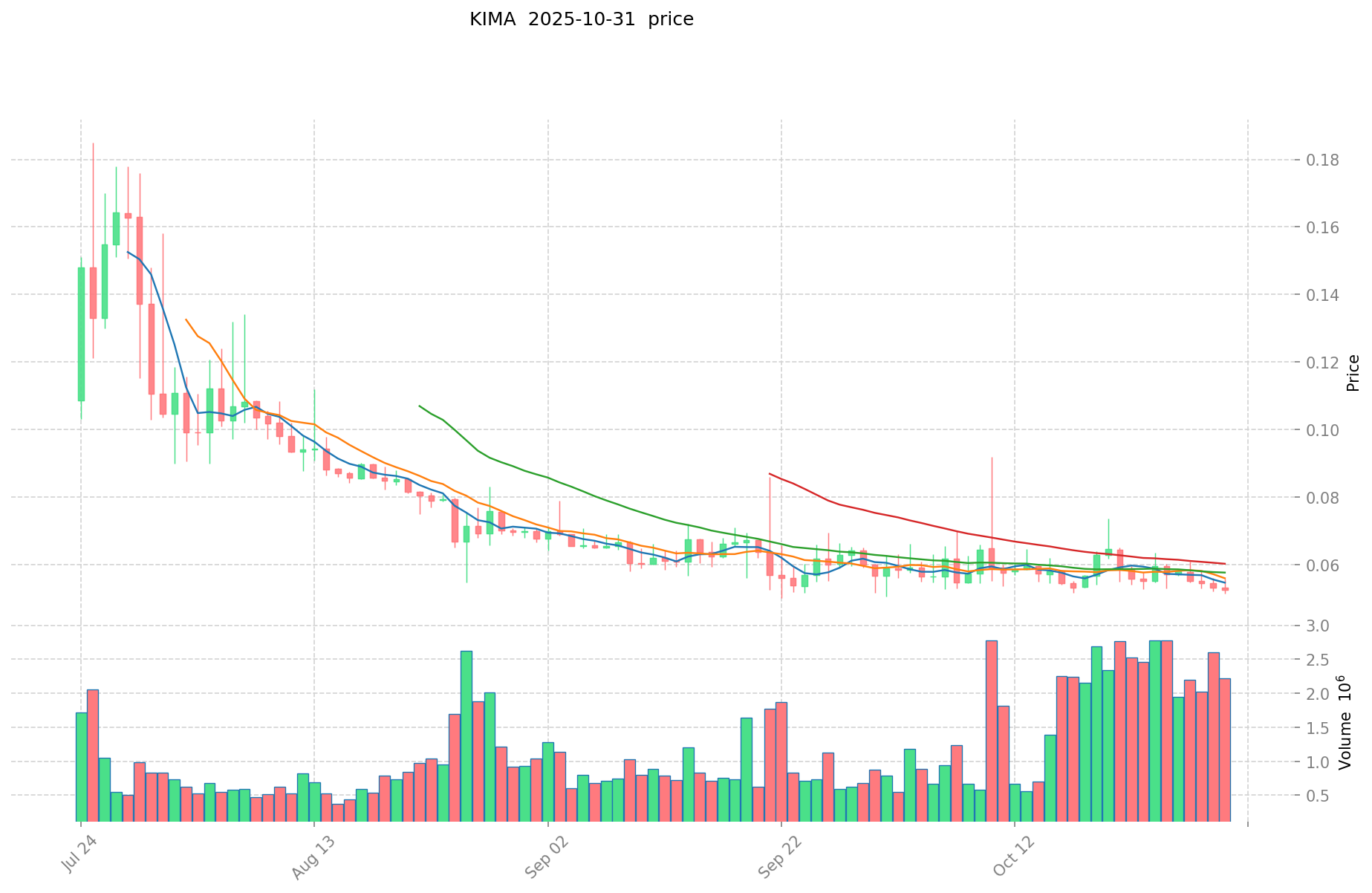
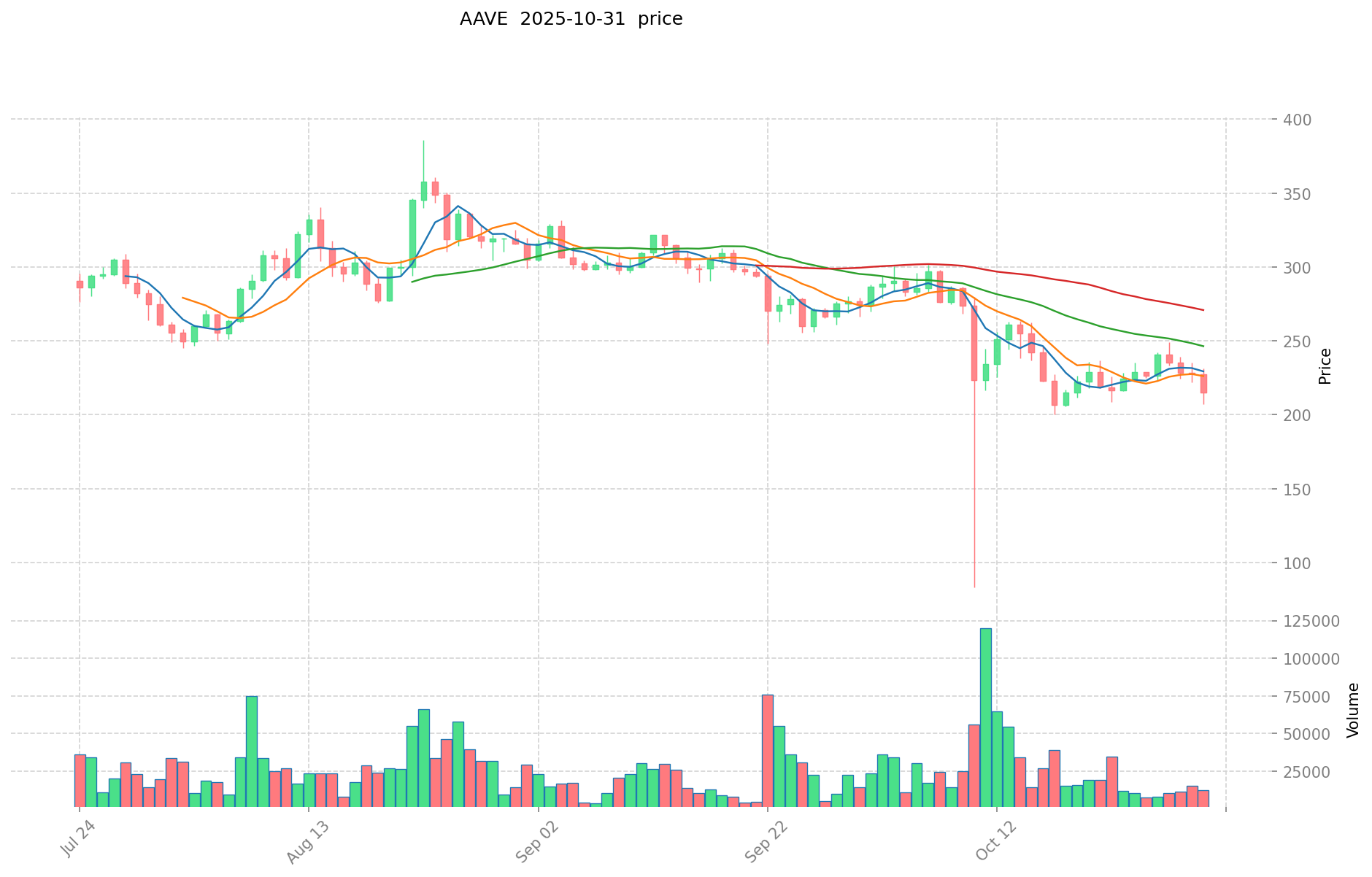
KIMA and AAVE Historical Price Trends
- 2024: KIMA reached its all-time high of $1.1129 on November 27, 2024.
- 2021: AAVE hit its all-time high of $661.69 on May 18, 2021, driven by the DeFi boom.
- Comparative analysis: During the recent market cycle, KIMA dropped from its high of $1.1129 to a low of $0.0465, while AAVE declined from $661.69 to its current price of $217.65.
Current Market Situation (2025-10-31)
- KIMA current price: $0.0528
- AAVE current price: $217.65
- 24-hour trading volume: $123,838 (KIMA) vs $1,979,737 (AAVE)
- Market Sentiment Index (Fear & Greed Index): 29 (Fear)
Click to view real-time prices:
- Check KIMA's current price Market Price
- Check AAVE's current price Market Price
Key Factors Influencing KIMA vs AAVE Investment Value
Technical Infrastructure & Innovation
- KIMA: Focuses on revolutionary blockchain infrastructure aimed at stable coin efficiency, similar to how Chrome transformed web browsing; offers fast transaction finality
- AAVE: Specializes in DeFi lending protocols with multi-chain deployment across Polygon, Arbitrum, Avalanche, Fantom, Harmony, and Optimism
Ecosystem Integration & Development
- KIMA: Partners with top DeFi protocols including AAVE, Pendle, and Ethena; actively recruiting developers through community builder programs
- AAVE: Demonstrates broader ecosystem participation, investing in complementary projects such as Fluid ($4M FUID token investment) and integrating its GHO stablecoin with partner protocols
Use Case Differentiation
- KIMA: Enables fee-free stablecoin transfers and instant settlement; focuses on removing barriers to stablecoin adoption with potential for micropayments, real-time wage payments
- AAVE: Provides lending/borrowing infrastructure across multiple blockchains; emphasizes financial accessibility through decentralized credit markets
Value Proposition & Market Position
- KIMA: Positions as infrastructure layer ("Chrome for stablecoins") with zero-fee USD₮ transfers and EVM compatibility
- AAVE: Established as a leading DeFi protocol with proven market adoption; offers cross-chain financial services with V3 deployment across multiple networks
III. 2025-2030 Price Prediction: KIMA vs AAVE
Short-term Prediction (2025)
- KIMA: Conservative $0.0380016 - $0.05278 | Optimistic $0.05278 - $0.071253
- AAVE: Conservative $134.9802 - $217.71 | Optimistic $217.71 - $315.6795
Mid-term Prediction (2027)
- KIMA may enter a growth phase, with an estimated price range of $0.048667448375 - $0.0826679945
- AAVE may enter a consolidation phase, with an estimated price range of $266.2680384 - $324.5141718
- Key drivers: Institutional capital inflow, ETF, ecosystem development
Long-term Prediction (2030)
- KIMA: Base scenario $0.092296127816074 - $0.10032187806095 | Optimistic scenario $0.10032187806095 - $0.148476379530206
- AAVE: Base scenario $348.53702330681325 - $410.043556831545 | Optimistic scenario $410.043556831545 - $553.55880172258575
View detailed price predictions for KIMA and AAVE
Disclaimer: This analysis is based on historical data and current market trends. Cryptocurrency markets are highly volatile and unpredictable. These predictions should not be considered as financial advice. Always conduct your own research before making any investment decisions.
KIMA:
| 年份 |
预测最高价 |
预测平均价格 |
预测最低价 |
涨跌幅 |
| 2025 |
0.071253 |
0.05278 |
0.0380016 |
0 |
| 2026 |
0.071318975 |
0.0620165 |
0.045272045 |
17 |
| 2027 |
0.0826679945 |
0.0666677375 |
0.048667448375 |
26 |
| 2028 |
0.09184147518 |
0.074667866 |
0.06197432878 |
41 |
| 2029 |
0.1173890855319 |
0.08325467059 |
0.0799244837664 |
57 |
| 2030 |
0.148476379530206 |
0.10032187806095 |
0.092296127816074 |
90 |
AAVE:
| 年份 |
预测最高价 |
预测平均价格 |
预测最低价 |
涨跌幅 |
| 2025 |
315.6795 |
217.71 |
134.9802 |
0 |
| 2026 |
288.03033 |
266.69475 |
149.34906 |
22 |
| 2027 |
324.5141718 |
277.36254 |
266.2680384 |
27 |
| 2028 |
388.210479111 |
300.9383559 |
219.684999807 |
38 |
| 2029 |
475.51269615759 |
344.5744175055 |
261.87655730418 |
58 |
| 2030 |
553.55880172258575 |
410.043556831545 |
348.53702330681325 |
88 |
IV. Investment Strategy Comparison: KIMA vs AAVE
Long-term vs Short-term Investment Strategies
- KIMA: Suitable for investors focused on cross-ecosystem interoperability and stablecoin efficiency
- AAVE: Suitable for investors seeking established DeFi protocols with proven track record
Risk Management and Asset Allocation
- Conservative investors: KIMA: 30% vs AAVE: 70%
- Aggressive investors: KIMA: 60% vs AAVE: 40%
- Hedging tools: Stablecoin allocation, options, cross-currency portfolios
V. Potential Risk Comparison
Market Risks
- KIMA: Relatively new project, potentially higher volatility
- AAVE: Exposure to overall DeFi market fluctuations
Technical Risks
- KIMA: Scalability, network stability
- AAVE: Smart contract vulnerabilities, cross-chain risks
Regulatory Risks
- Global regulatory policies may impact both differently, with AAVE potentially facing more scrutiny due to its established presence in DeFi lending
VI. Conclusion: Which Is the Better Buy?
📌 Investment Value Summary:
- KIMA advantages: Cross-ecosystem interoperability, zero-fee transfers, potential for rapid growth
- AAVE advantages: Established market position, multi-chain deployment, proven adoption
✅ Investment Advice:
- New investors: Consider a balanced approach, leaning towards AAVE for its established presence
- Experienced investors: Explore a mix of both, with a higher allocation to KIMA for potential growth
- Institutional investors: Evaluate KIMA for long-term potential, maintain AAVE for established DeFi exposure
⚠️ Risk Warning: Cryptocurrency markets are highly volatile. This article does not constitute investment advice.
None
VII. FAQ
Q1: What are the main differences between KIMA and AAVE?
A: KIMA focuses on cross-ecosystem fund transfers and stablecoin efficiency, while AAVE specializes in decentralized lending protocols across multiple blockchains.
Q2: Which cryptocurrency has shown better price performance recently?
A: As of October 31, 2025, AAVE is trading at $217.65, while KIMA is at $0.0528. AAVE has maintained a higher price point and market cap, but past performance doesn't guarantee future results.
Q3: What are the key factors influencing the investment value of KIMA and AAVE?
A: Key factors include technical infrastructure, ecosystem integration, use case differentiation, and market position. KIMA offers zero-fee stablecoin transfers, while AAVE provides established DeFi lending services.
Q4: How do the long-term price predictions for KIMA and AAVE compare?
A: By 2030, KIMA's optimistic scenario predicts a range of $0.10032187806095 - $0.148476379530206, while AAVE's optimistic scenario predicts $410.043556831545 - $553.55880172258575.
Q5: What are the potential risks associated with investing in KIMA and AAVE?
A: Both face market risks and regulatory uncertainties. KIMA, being newer, may have higher volatility and technical risks related to scalability. AAVE faces risks associated with smart contract vulnerabilities and cross-chain operations.
Q6: How should different types of investors approach KIMA and AAVE?
A: New investors might consider a balanced approach leaning towards AAVE. Experienced investors could explore a mix of both, while institutional investors may evaluate KIMA for long-term potential and maintain AAVE for established DeFi exposure.
Q7: Are there any hedging strategies recommended for investing in KIMA or AAVE?
A: Investors can consider stablecoin allocation, options, and cross-currency portfolios as potential hedging tools to manage risk in their cryptocurrency investments.
* The information is not intended to be and does not constitute financial advice or any other recommendation of any sort offered or endorsed by Gate.